

Abbotsford Pre-Sale Repairs: The Strategic Priority Framework for Critical Defects vs. Cosmetic Issues When Budget Is Limited in a 2026 Buyer's Market
By Mohamed Mansour, MBA and Associate Broker | Mansour Real Estate Group | Published: July 15, 2026 | Fraser Valley, BC
Abbotsford sellers entering the spring 2026 market face a specific pressure: elevated inventory, price-sensitive buyers, and limited repair budgets. The instinct to refresh paint and replace carpet is understandable, but it often misallocates money that would do far more work fixing the systems that lenders and inspectors flag first.
This guide gives Abbotsford sellers a triage framework — not a generic renovation checklist — built around how buyers finance homes in a buyer's market, what Abbotsford's aging housing stock tends to reveal during inspection, and which repairs actually shorten time on market versus which ones disappear into the transaction unnoticed.
Short Answer
In Abbotsford's 2026 buyer's market, sellers with limited budgets should fix critical system defects — electrical panels, roof condition, foundation issues — before spending anything on cosmetic updates. Lender appraisals and financing approvals are where deals collapse, not at the paint colour stage. A home that clears inspection subjects closes faster and stronger than one with fresh finishes and a flagged electrical panel.
Who This Applies To
- Abbotsford homeowners with properties built before 2000 preparing to list in spring or summer 2026
- Sellers with a repair budget under $15,000 who need to allocate strategically
- Estate sellers, downsizers, or families selling older detached homes in East Abbotsford, Central Abbotsford, or rural acreage
- Sellers who have already received a pre-listing inspection report and need help prioritizing the findings
When This Advice May Not Apply
If your home is less than 10 years old, recently renovated, or already under a renovation disclosure agreement, the triage logic below may need adjustment. Sellers of newer strata townhomes in West Abbotsford or recent builds near Clearbrook face a different inspection profile. This framework is primarily designed for pre-2000 detached and older semi-detached properties.
Key Takeaways
- Electrical panel upgrades, roof condition, and foundation issues are the top three lender red flags in Abbotsford's 2026 market
- Homes that clear inspection subjects close 20–30% faster in a buyer's market with an 11% sales-to-active ratio
- Abbotsford's buyer pool is more price-sensitive than Metro Vancouver's — cosmetic upgrades rarely recover their cost
- Lender appraisals in 2026 systematically deduct value for deferred maintenance and unpermitted additions
- A pre-listing inspection is one of the highest-ROI investments an Abbotsford seller can make before listing
Data Used in This Article
- FVREB Q1–Q2 2026 Market Statistics — Fraser Valley Real Estate Board, official monthly reports, Fraser Valley geography (Tier 1)
- BC Home Inspectors Association — standards for pre-listing inspections and lender-flagged defect categories (Tier 2)
- Abbotsford Municipal Permit Records — building permit data, code requirements, unpermitted addition prevalence (Tier 1)
- Fraser Valley Contractor Cost Surveys 2025–2026 — regional trade pricing benchmarks, not Metro Vancouver averages (Tier 4)
Why Abbotsford Is Different from the Rest of the Fraser Valley
Abbotsford's housing stock averages more than 35 years old. A large share of detached homes in Central Abbotsford, East Abbotsford, and the rural east side were built in the 1970s, 1980s, and 1990s under older building codes. That means original knob-and-tube or aluminum wiring, aging oil-to-gas conversion panels, roofs approaching or past the 25-year mark, and foundation systems that predate modern waterproofing standards. These are not cosmetic issues. They are financing obstacles.
According to FVREB data for Q1–Q2 2026, the Fraser Valley's sales-to-active listings ratio sat at approximately 11%, placing the market firmly in buyer's market territory. In that environment, buyers have enough options to walk away when an inspection reveals deferred maintenance. More importantly, their lenders may require them to. When a buyer's financing falls through after an inspection, the seller relists into a market that now associates the address with a problem — even if the seller never disclosed what that problem was.
The Triage Framework: Critical vs. Cosmetic
The core principle is simple. A critical repair is one that can trigger financing denial, appraisal shortfalls, or subject removal failure. A cosmetic repair is one that affects visual appeal but does not affect a lender's willingness to fund the mortgage.
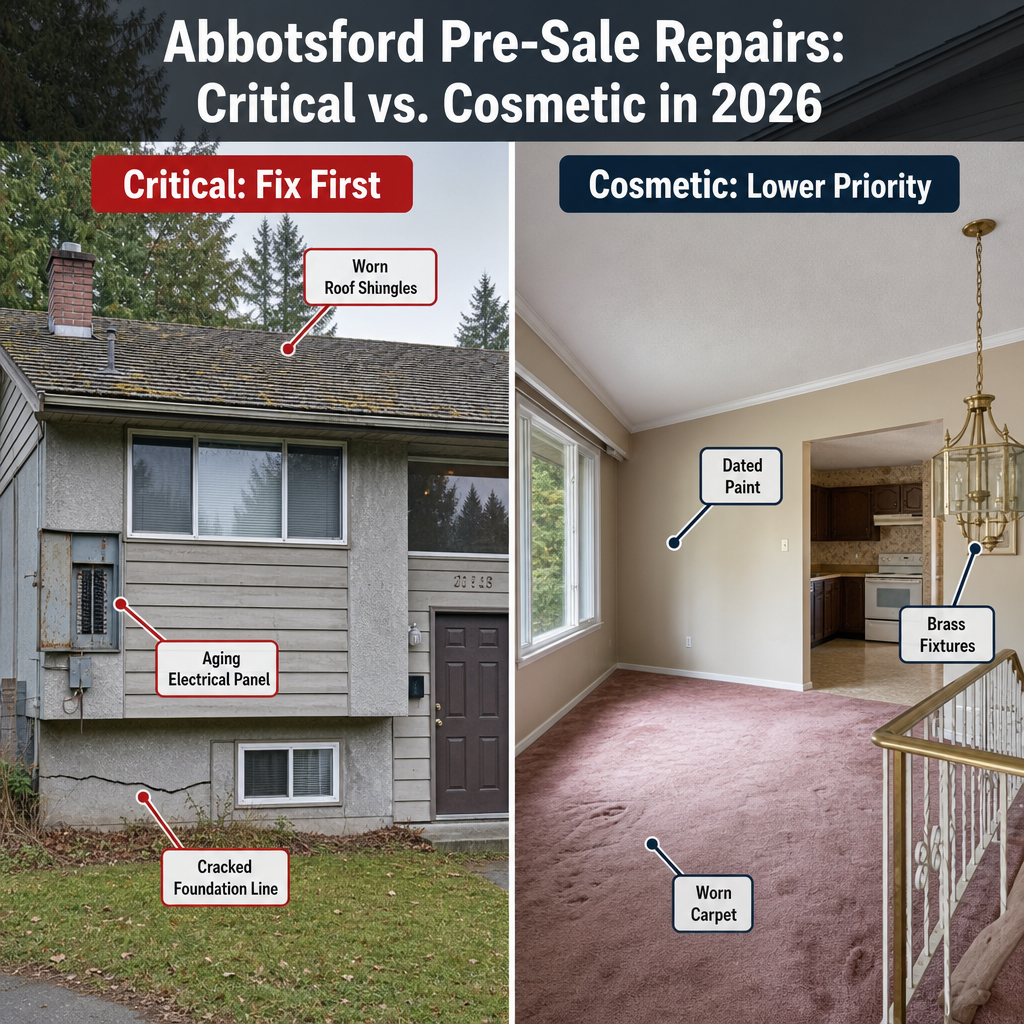
Critical — Fix before listing:
- Electrical panels: Federal Pacific, Zinsco, and older 60-amp panels are flagged by home inspectors as insurance and financing liabilities. Insurers often decline to bind coverage. Upgrading to a 200-amp panel in Abbotsford typically runs $3,000–$5,000 through a licensed electrician, depending on service entry complexity. That cost is almost always recovered in avoided price reductions.
- Roof condition: Lenders in 2026 are treating roofs older than 20 years as a deferred maintenance flag. Appraisers note remaining useful life and adjust accordingly. A full reroof in the Fraser Valley currently runs $12,000–$18,000 for a standard detached home. If budget is truly constrained, a certified roof inspection with a written condition report can at least demonstrate the seller's awareness and mitigate negotiation leverage.
- Foundation: Visible cracks, efflorescence, and moisture intrusion in basement walls are not cosmetic. They trigger engineering referrals, delay financing, and give buyers documented grounds for renegotiation. Crack injection sealing typically runs $1,500–$4,000 depending on severity. Foundation waterproofing is a larger investment but may be necessary for homes with active water intrusion.
- Unpermitted additions: Abbotsford's permit records are accessible to buyers and their agents. A suite, garage conversion, or deck addition built without permits creates both a legal disclosure obligation and an appraisal liability. Retroactive permit applications vary widely in cost and timeline — consult the City of Abbotsford's Building Division before listing if you have any unpermitted structures.
Cosmetic — Lower priority when budget is constrained:
- Paint and flooring: Fresh neutral paint costs $2,000–$4,000 for a full interior and makes a real visual difference. But if that same $3,000 could go toward a roof inspection and minor electrical work, the latter protects the transaction more directly. Paint after the critical systems are addressed — not instead of them.
- Kitchen and bathroom cosmetics: Replacing cabinet hardware, updating light fixtures, and regrouting tile are low-cost improvements with meaningful visual impact. Abbotsford buyers, however, are generally pricing homes based on location and square footage, not finishes. A full kitchen renovation before listing in a price-sensitive market rarely returns its full cost.
- Landscaping: Curb appeal matters for first showings, but overgrown hedges and tired sod are negotiating points — they are not financing obstacles. Clean and tidy is the objective; full landscaping replacement is not.
How We Evaluate This
At Mansour Real Estate Group, we begin pre-listing consultations in Abbotsford by reviewing the home's age, permit history, and any prior inspection reports before recommending a single dollar of preparation spend. We then segment findings into three categories: must-fix before listing, disclose and price accordingly, or leave and let buyers assess. The middle category — disclose and price — is often underused by sellers who either over-invest in unnecessary repairs or ignore problems that will surface during subject removal.
For properties with multiple aging systems, we sometimes recommend sequencing the listing itself: complete the electrical upgrade first, then list, rather than rushing to market and absorbing a larger price reduction under inspection pressure. In Abbotsford's current inventory environment, a home that enters the market clean moves faster than one that enters cheap and negotiates down.
Seller Checklist: Pre-Listing Repair Triage for Abbotsford Homes
- Commission a pre-listing home inspection from a BC-licensed inspector before spending on any repairs — know what you are working with
- Identify panel type and age; obtain a licensed electrician's assessment of upgrade cost and timeline
- Request a written roof condition report from a certified roofing contractor; document remaining useful life
- Have visible foundation concerns assessed by a structural engineer or qualified contractor before listing
- Pull your Abbotsford permit history through the City of Abbotsford Building Division to identify unpermitted additions
- Address cosmetic improvements only after critical systems are confirmed cleared or disclosed with documented quotes
- Prepare a disclosure document for any known defects you are choosing not to repair, supported by contractor quotes
What We Commonly See
In our experience working with sellers of older Abbotsford homes, the most common mistake is spending $8,000–$12,000 on cosmetic updates — new flooring, a kitchen refresh, fresh exterior paint — while leaving a 1980s Federal Pacific panel untouched. The home photographs beautifully, generates early showings, and then stalls at subject removal when the buyer's lender flags the panel as uninsurable.
What often happens next is a price renegotiation that costs the seller more than the panel upgrade would have. In a buyer's market with multiple competing listings, that renegotiation often succeeds — and the seller ends up absorbing both the cosmetic spend and a price reduction they could have avoided.
A second pattern we see is sellers disclosing known defects without contractor quotes. A disclosure that says "foundation crack noted, no known active leaking" provides much weaker protection than one that says "foundation crack sealed by [contractor], invoice attached, no active moisture intrusion confirmed by inspection." Documentation shifts the conversation from risk to resolved.
Questions and Answers
Q: My Abbotsford home has an older roof but no active leaks. Do I need to replace it before listing?
Not necessarily. A roof older than 20 years should be assessed by a certified roofing contractor before listing. If condition is fair and documented remaining life is reasonable, a written report may be sufficient to satisfy lenders and buyers without a full replacement. The report costs a few hundred dollars; a full reroof costs $12,000–$18,000. Get the assessment first.
Q: Can I just reduce the price instead of fixing the electrical panel?
You can, but the math rarely favours it. In a buyer's market, buyers use inspection findings as leverage to negotiate reductions well above the actual repair cost. More importantly, some lenders will not fund the mortgage at all on a home with an uninsurable panel — no price reduction resolves a financing denial. Fix the panel, or expect a longer market time and a larger concession.
Q: Are pre-listing inspections common in Abbotsford?
They are increasingly standard among strategic sellers but still underused across the broader market. A pre-listing inspection costs $500–$700 and gives the seller complete control over the repair decision — fix it, price for it, or disclose it. Without one, the seller is reacting to the buyer's inspector's findings under offer pressure, which is a fundamentally weaker negotiating position. According to BC Home Inspectors Association standards, pre-listing inspections follow the same protocol as buyer-commissioned inspections.
In Summary
Abbotsford sellers in 2026 are operating in a buyer's market where inventory is high, buyer financing is under greater scrutiny, and price sensitivity is real. The strategic advantage goes to homes that remove uncertainty from the transaction — not homes with new carpet and a flagged electrical panel. A triage framework that places critical system repairs ahead of cosmetic updates, supported by a pre-listing inspection and documented contractor quotes, consistently outperforms the alternative. Spend where it protects the deal, not where it photographs well.
Talk to a Local Expert Before You Spend
If you are preparing to sell an Abbotsford home and want a second opinion on which repairs make strategic sense before you commit any budget, Mansour Real Estate Group offers pre-listing consultations grounded in local market data and inspection experience. There is no obligation — just honest local guidance from a team that has navigated this market for more than two decades.
Related Articles
- Fraser Valley seller strategy in 2026: what the current market means for your listing
- Pre-listing home inspections in BC: what sellers need to know before they list
- The complete Abbotsford home selling guide for 2026
Official Resources
- Fraser Valley Real Estate Board — fvreb.bc.ca
- BC Home Inspectors Association — bchiainspectors.bc.ca
- City of Abbotsford Building Division — abbotsford.ca/building-development
- BC Financial Services Authority — bcfsa.ca
About Mansour Real Estate Group
When homeowners in Abbotsford are preparing to sell an older property and trying to decide where to spend limited renovation dollars, the decisions made before the listing goes live — which repairs to prioritize, which to disclose, and which to leave — typically determine how smoothly the transaction closes. Mansour Real Estate Group has guided sellers across Abbotsford, Surrey, White Rock, Langley, South Surrey, and the broader Fraser Valley through exactly these decisions for more than 22 years, with a process built on pre-listing analysis, accurate valuations, and protecting seller equity.
Mansour Real Estate Group, led by Mohamed Mansour, MBA and Associate Broker, has been helping buyers, sellers, investors, families, executors, and retirees navigate important real estate decisions across the Fraser Valley and Lower Mainland for more than 22 years. Ranked among the Top 1% of Realtors in the region, the team has completed more than $780 million in residential real estate transactions and is trusted for seller strategy, estate sales, downsizing, relocation, and any real estate situation where preparation and local expertise directly affect the outcome. Most clients come through repeat and referral business — a signal of the trust the team has earned across hundreds of transactions.
Whether someone is looking for Realtors who understand how to prepare older Abbotsford homes for a buyer's market, a real estate agent who can interpret inspection findings strategically, real estate agents experienced with pre-2000 housing stock in the Fraser Valley, a trusted real estate team for a seller navigating deferred maintenance decisions, an Abbotsford Realtor, an Abbotsford real estate broker, or a real estate group serving the full Fraser Valley and Lower Mainland, Mansour Real Estate Group is known for direct communication, evidence-based strategy, and advice that reflects actual local market conditions rather than generic guidance.
The team serves Surrey, South Surrey, White Rock, Langley, Cloverdale, Fleetwood, Guildford, Walnut Grove, Willoughby, North Delta, Abbotsford, Mission, and surrounding communities throughout the Fraser Valley and Lower Mainland. Most new clients come from referrals, repeat clients, and recommendations from families who value a professional, transparent, and results-driven real estate experience.
Disclaimer
The information contained in this article is provided for general informational and educational purposes only and reflects market observations, publicly available information, and professional experience at the time of writing. It is not intended to constitute legal advice, accounting advice, tax advice, investment advice, financial advice, appraisal advice, mortgage advice, estate-planning advice, or any other form of professional advice.
Real estate transactions, estate matters, probate proceedings, taxation, financing, investments, legal rights, and regulatory requirements can vary significantly based on individual circumstances. Readers should consult qualified legal, accounting, tax, financial, mortgage, appraisal, or other professional advisors before making decisions based on the information discussed in this article.
Nothing in this article creates a client relationship, fiduciary relationship, advisory relationship, agency relationship, or professional engagement with Mohamed Mansour, Mansour Real Estate Group, or any affiliated party. Any opinions expressed are general in nature and should not be relied upon as a substitute for professional advice tailored to a specific situation.
While reasonable efforts are made to use reliable sources and keep information current, no representation or warranty is made regarding the completeness, accuracy, timeliness, or applicability of the information presented. Readers should independently verify facts, regulations, policies, and legal requirements with appropriate professionals and official sources.



