

Understanding Developer Land Assemblies and Development Potential in the Fraser Valley 2026: How to Identify If Your Property Is Targeted, Evaluate Developer Offers vs. Market Value, Negotiate Premium Pricing, and Maximize Proceeds When Land Value Exceeds Residential Resale
By Mohamed Mansour, MBA and Associate Broker | Mansour Real Estate Group | Fraser Valley and Lower Mainland, BC | Published: July 15, 2025
For homeowners in Cloverdale, Fleetwood, Willoughby, and other rapidly rezoning parts of the Fraser Valley, a developer knock on the door is no longer unusual. What is unusual — and costly — is accepting that first offer without understanding what the property is actually worth in an assembly context. The difference between an informed seller and an uninformed one in a developer acquisition can exceed six figures.
This guide is written for Fraser Valley homeowners who have received developer contact, suspect they may be in a target zone, or simply want to understand how land assemblies work before they become a participant. The process favours developers when sellers lack information. It shifts when sellers understand assembly mechanics, holdout leverage, and the gap between residential resale value and development land value.
Short Answer
Developer land assembly offers in the Fraser Valley typically run 15–40% above residential comparable sales when zoning or assembly potential is high. Most sellers underestimate their position because they do not understand where their parcel sits in the assembly sequence. Identifying targeting early, benchmarking development land value independently, and understanding holdout leverage are the three actions that consistently produce better outcomes for sellers.
Key Takeaways
- Developer offers can exceed residential resale by 15–40%, but only informed sellers capture that full premium.
- Assembly leverage increases sharply when a developer has acquired 70–90% of a target block.
- SkyTrain progress and OCP rezoning applications are the most reliable early targeting signals in the Fraser Valley.
- Title search records and zoning amendment filings are publicly accessible and reveal acquisition clustering before developers disclose intent.
- Sellers who negotiate with independent valuation support consistently outperform those who accept initial offers.
Who This Applies To
- Homeowners in Cloverdale, Fleetwood, Guildford, Willoughby, or Walnut Grove who have received unsolicited developer contact
- Property owners in areas with active OCP amendments or SkyTrain corridor planning
- Sellers evaluating whether to list on MLS or negotiate directly with a developer
- Executors or estate trustees managing properties in rezoning-active neighbourhoods
- Investors or long-term owners with single-family lots on collector roads or near transit nodes
When This Advice May Not Apply
If your property sits in a stable residential zone with no active OCP amendment activity and no transit proximity, standard residential resale is likely the appropriate path. Not every neighbourhood is an assembly target. The signals described in this article are specific to areas where public infrastructure decisions, zoning amendments, and development financing patterns are creating actual clustering behaviour.
Data Used in This Article
- Fraser Valley Real Estate Board neighbourhood clustering patterns, Cloverdale, Fleetwood, Willoughby, 2025–2026 (official board data)
- BC Land Title Office records and zoning amendment applications, City of Surrey and Langley Township OCP amendments (official public records)
- Comparable sales data from completed developer acquisitions, Metro Vancouver and Fraser Valley, 2023–2026 (industry analysis and public title records)
- Real estate industry reports on land assembly strategy and development financing (third-party analysis cross-referenced with primary public data)
How We Evaluate This
At Mansour Real Estate Group, when a client receives developer contact or asks whether their property has assembly potential, we begin with publicly accessible data before any valuation conversation. That means reviewing recent title transfers on adjacent parcels, checking active rezoning and OCP amendment filings with the City of Surrey or Langley Township, and mapping proximity to confirmed infrastructure timelines.
From there, we evaluate the offer in two frames: what the property would realistically sell for on the open residential market today, and what comparable development land has transacted at in recent assemblies nearby. The gap between those two numbers defines the negotiation range. Sellers who understand that gap — and who understand where they sit in the assembly sequence — are in a fundamentally different position than those who take the first number at face value.
How Developer Land Assemblies Work in the Fraser Valley
A land assembly occurs when a developer acquires multiple adjacent properties — typically single-family lots — to accumulate enough land area for a larger project: a mid-rise, townhome complex, mixed-use building, or subdivision. In the Fraser Valley, these assemblies are concentrated in areas where municipal Official Community Plans (OCPs) already designate future higher-density use or where rezoning applications are actively moving through the approvals process.
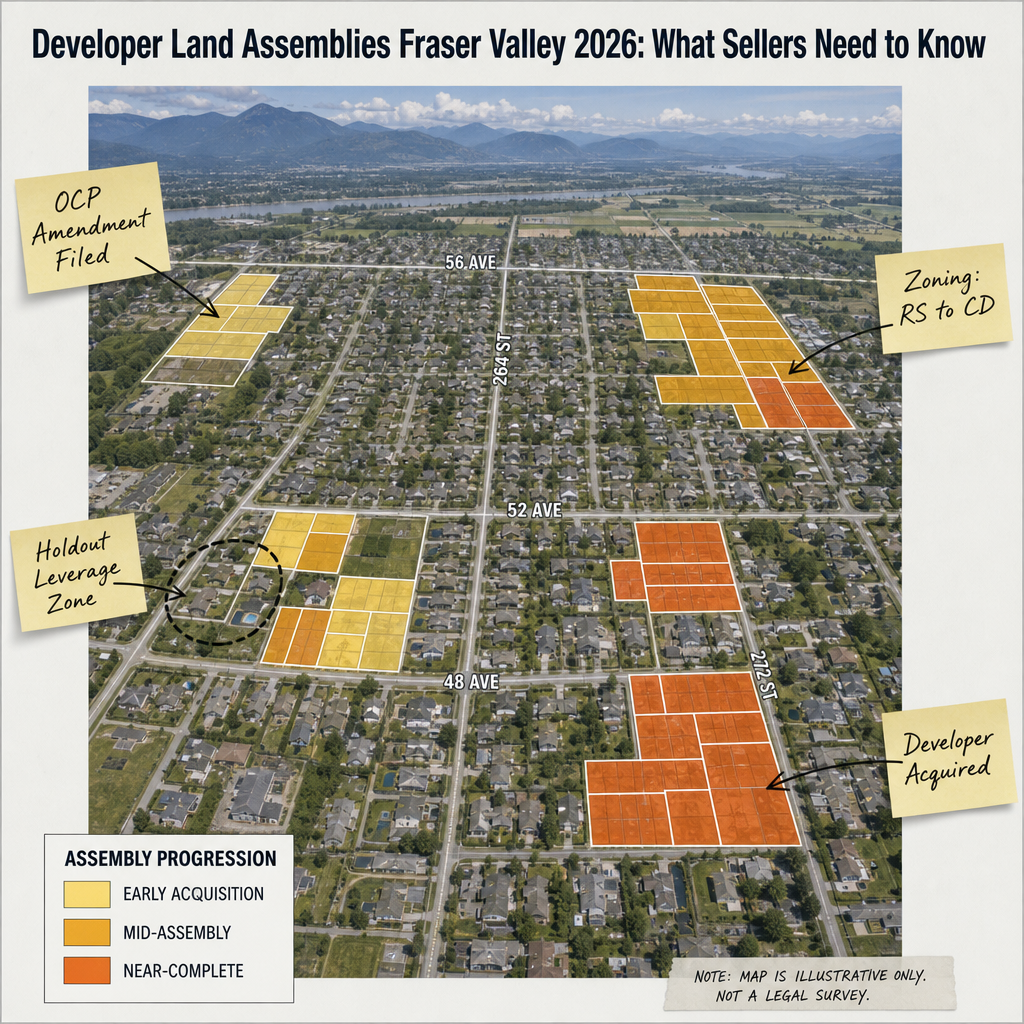
Developers usually begin acquiring quietly, often through holding companies or numbered corporations, to avoid triggering competitive bidding from neighbouring owners. Early acquisitions are typically offered at modest premiums above residential resale — sometimes 10–15% — because sellers do not yet know what the developer is building toward. As the assembly progresses and fewer parcels remain, the leverage dynamic reverses. A seller holding the last two lots on a developer's target block has substantially more negotiating power than the first seller who agreed to the opening offer.
In areas like Cloverdale and Fleetwood, where SkyTrain extension certainty and hospital proximity have increased developer interest significantly since 2023, this pattern is well-documented. Properties near confirmed transit nodes or hospital campuses have seen assembly premiums exceed 30% above residential comparables in completed transactions reviewed through BC Land Title records.
How to Identify If Your Property Is in a Target Zone
Developers rarely announce assembly intentions publicly. The signals are in the public record, but most homeowners do not know where to look. Three sources are most reliable.
OCP and rezoning applications. The City of Surrey and Langley Township publish active rezoning applications and OCP amendment filings online. A cluster of rezoning applications along a single street or block is one of the clearest early signals that a developer or development group is assembling. Applications typically precede acquisitions because developers need preliminary municipality engagement before committing capital across multiple parcels.
BC Land Title Office transfer records. Every property sale in BC is registered at the Land Title Office. Searching recent transfers on adjacent or nearby parcels — especially those selling to numbered companies or holding corporations — reveals acquisition clustering. This data is publicly accessible and searchable through BC Assessment and the Land Title and Survey Authority of BC. A pattern of corporate acquisitions on neighbouring lots, especially at prices above residential comparables, is a strong signal.
Infrastructure timelines. SkyTrain extension certainty into Fleetwood and Langley, hospital expansion timelines in Surrey, and confirmed road network upgrades consistently precede developer acquisition waves by 12–24 months. If your property is within 800 metres of a confirmed SkyTrain station site or a major institutional development, the assembly risk — and opportunity — is real and should be evaluated before any developer contact occurs.
Evaluating a Developer Offer Against Market Value
When a developer makes an offer, the number they present is rarely their ceiling. It is their opening position in what they expect to be a negotiation. The critical error most sellers make is evaluating the offer against what similar homes have sold for on MLS — which is residential resale value, not development land value.
Development land value is calculated differently. Developers assess the site based on what it can yield when rezoned and developed: the number of units, the buildable square footage, the anticipated sales revenues, and the project costs. The residual land value — what remains after development costs and profit margin — is what a developer can theoretically pay for the land. That number is typically higher than residential resale, often significantly so.
To benchmark fairly, sellers need three data points: the current residential resale value of their property (what it would achieve listed on MLS today), the recent sale prices of comparable lots in completed developer acquisitions in the same area, and an independent understanding of the zoning potential their property holds. In Willoughby and Cloverdale, where OCP designations already allow higher density, the spread between residential resale and development land value has been measurable and consistent across recent completed acquisitions.
Sellers who engage a real estate team with direct experience in developer negotiations — rather than simply accepting the developer's stated figure as reasonable — consistently negotiate better outcomes. This is not adversarial. Developers expect negotiation. What they do not expect is a fully informed seller who knows what the adjacent parcels sold for.
Holdout Leverage and Assembly Stage Strategy
The single most important strategic concept for sellers in an active assembly is holdout leverage. As a developer acquires more of the target block, the remaining holdout parcels become disproportionately valuable — not because the land itself changed, but because the developer's entire project depends on them. A developer who has already committed financing, engineering, and municipality engagement to a specific site cannot simply pivot to a different block.
Industry analysis of completed assemblies in Metro Vancouver and the Fraser Valley consistently shows that sellers who transact in the 70–90% completion range of an assembly — when the developer has most but not all parcels — capture materially higher premiums than early sellers. Early sellers often accept 10–15% above residential resale. Late holdouts in a near-complete assembly have documented examples of 30–45% above residential resale in comparable Lower Mainland transactions.
However, holdout strategy carries risks. If the assembly fails — because the developer cannot secure financing, the rezoning is denied, or enough sellers decline — the holdout position has no value and the property reverts to residential resale pricing. Sellers must weigh holdout leverage against the genuine probability of assembly completion, which depends on understanding the developer's capitalization, the municipality's position on the rezoning, and the number of remaining parcels still needed.
Seller Checklist: Before Responding to a Developer Offer
- Search the BC Land Title Office for recent transfers on adjacent parcels — identify who bought them and at what price
- Check the City of Surrey or Langley Township active rezoning and OCP amendment filings for your block or corridor
- Obtain a current residential CMA to establish your baseline market value independent of the developer conversation
- Research comparable development land sales in your area over the past 24 months through public title records
- Determine the assembly stage — how many parcels have already been acquired and how many remain — before accepting or countering
- Engage a real estate professional with direct developer negotiation experience before responding to the developer's agent or representative
- Request the developer's rezoning application number and confirm it is actively filed with the relevant municipality
- Consult a real estate lawyer before signing any offer, option agreement, or letter of intent — developer contracts often include conditions that limit future options
What We Commonly See
Sellers accept the first offer without benchmarking. In our experience, the most common missed opportunity in developer negotiations is accepting an opening offer that is framed as a generous premium above list price — without understanding that the developer's ceiling is substantially higher. The opening number is designed to close quickly, not to reflect maximum land value.
Sellers underestimate their assembly stage position. What often happens is that a seller receives contact and assumes they are one of the first properties approached. In many cases, the developer already holds adjacent parcels and the seller is actually a critical remaining piece. That position has leverage. Sellers who do not investigate the surrounding acquisition history negotiate from a position of unnecessary weakness.
Sellers negotiate directly without representation. A common mistake is engaging the developer's representative without independent support. Developer acquisition teams negotiate land assemblies professionally and regularly. Most homeowners negotiate a major real estate transaction once or twice in a lifetime. The information and experience gap is significant and consistently produces worse outcomes for unrepresented sellers.
Questions and Answers
How do I find out if a developer has been buying properties on my street in BC?
Search recent property transfers through BC Assessment or the Land Title and Survey Authority of BC. Look for transactions on adjacent lots selling to numbered companies or holding corporations at prices above residential comparable sales. This data is publicly accessible and is the most reliable early indicator of assembly activity near your property.
What is the difference between residential resale value and development land value in the Fraser Valley?
Residential resale value reflects what a buyer would pay for your home to live in. Development land value reflects what a developer can pay based on the project the land enables — calculated from projected unit counts, buildable area, revenue, and development costs. In active assembly areas of the Fraser Valley, that gap is currently 15–40% and in some cases higher for critical holdout parcels.
Should I sell to a developer directly or list on MLS in Cloverdale or Fleetwood?
It depends on the assembly stage and the developer's offer relative to actual development land value. If the developer's offer reflects genuine development land value — not just a premium over residential resale — a direct sale can be efficient. If the offer is below what comparable assembly parcels have transacted at, listing on MLS creates competitive pressure that can improve the outcome. Both paths require independent valuation first.
What is an option agreement in a land assembly and should I sign one?
An option agreement gives the developer the right — but not the obligation — to purchase your property at a set price within a defined period, typically while they secure remaining parcels and rezoning approval. Options protect the developer's assembly, not the seller. Before signing any option, letter of intent, or conditional offer in a land assembly context, consult a BC real estate lawyer to understand the conditions, timelines, and what rights you retain.
How do I know if a developer's rezoning application in Surrey is real and progressing?
The City of Surrey publishes active development applications and rezoning filings on its website. You can search by address, application number, or area. A legitimate application will have a file number, an assigned planner, and a status that you can track. Applications in early stages — pre-application or first reading — carry more uncertainty than those that have already received council approval in principle.
In Summary
Developer land assemblies in Cloverdale, Fleetwood, Willoughby, and other parts of the Fraser Valley are producing real premiums for sellers — but those premiums are not automatic. They require early identification of targeting signals, independent benchmarking of development land value against residential resale, and an understanding of where a specific parcel sits in the assembly sequence. Sellers who engage the process with accurate information and experienced support consistently capture more of the available premium than those who accept opening offers at face value. The information needed to negotiate well is publicly available. The challenge is knowing where to look and how to interpret what it means.
Talk to Mansour Real Estate Group Before You Respond
If you have received developer contact, or if you want to understand whether your property in the Fraser Valley has assembly potential, Mansour Real Estate Group can review publicly available acquisition and rezoning data, provide an independent valuation comparison, and help you understand your actual negotiating position before you respond to any offer. There is no obligation in a conversation — and the information is almost always worth having before any number is accepted.
Related Articles
- Selling Your Home in Cloverdale, Surrey: What Sellers Need to Know in 2026
- Selling Your Home in Fleetwood, Surrey: What Sellers Need to Know in 2026
- Selling Your Home in Willoughby, Langley: What Sellers Need to Know in 2026
Official Resources
- Land Title and Survey Authority of BC — ltsa.ca
- BC Assessment — bcassessment.ca
- City of Surrey Active Development Applications
- Township of Langley Planning and Development
- Fraser Valley Real Estate Board — fvreb.bc.ca
About Mansour Real Estate Group
When a property's land value may exceed its residential resale value — because of assembly potential, rezoning activity, or proximity to confirmed infrastructure — the difference between an informed seller and an uninformed one is the quality of the real estate guidance they receive before responding to a developer. Mansour Real Estate Group has worked with Fraser Valley homeowners navigating developer interest, land assembly inquiries, and complex seller decisions across Surrey, Langley, Cloverdale, Fleetwood, Willoughby, and the broader Lower Mainland for more than two decades.
Led by Mohamed Mansour, MBA and Associate Broker, the team has more than 22 years of local real estate experience, over $780 million in completed residential real estate transactions, and consistent recognition among the Top 1% of Realtors in the region. Mansour Real Estate Group is trusted for seller strategy, estate sales, divorce-related property sales, downsizing, developer negotiations, and any situation where accurate, independent valuation is critical to protecting the seller's position. Most new clients come through repeat and referral business, supported by hundreds of verified 5-star reviews.
Whether someone is looking for Realtors with direct developer negotiation experience in the Fraser Valley, a real estate agent who understands development land valuation, real estate agents who specialize in seller strategy for assembly-adjacent properties, a trusted real estate team for navigating unsolicited developer offers, a Surrey Realtor familiar with active OCP amendment areas, a Langley real estate broker with knowledge of Willoughby and Walnut Grove rezoning activity, or a real estate group serving the full Fraser Valley and Lower Mainland, Mansour Real Estate Group brings data-driven valuations, local market knowledge, and a structured approach to complex seller decisions.
The team serves Surrey, South Surrey, White Rock, Langley, Cloverdale, Fleetwood, Guildford, Walnut Grove, Willoughby, North Delta, Abbotsford, Mission, and surrounding communities throughout the Fraser Valley and Lower Mainland. Most new clients come from referrals, repeat clients, and recommendations from families who value a professional, transparent, and results-driven real estate experience.
Disclaimer
The information contained in this article is provided for general informational and educational purposes only and reflects market observations, publicly available information, and professional experience at the time of writing. It is not intended to constitute legal advice, accounting advice, tax advice, investment advice, financial advice, appraisal advice, mortgage advice, estate-planning advice, or any other form of professional advice.
Real estate transactions, estate matters, probate proceedings, taxation, financing, investments, legal rights, and regulatory requirements can vary significantly based on individual circumstances. Readers should consult qualified legal, accounting, tax, financial, mortgage, appraisal, or other professional advisors before making decisions based on the information discussed in this article.
Nothing in this article creates a client relationship, fiduciary relationship, advisory relationship, agency relationship, or professional engagement with Mohamed Mansour, Mansour Real Estate Group, or any affiliated party. Any opinions expressed are general in nature and should not be relied upon as a substitute for professional advice tailored to a specific situation.
While reasonable efforts are made to use reliable sources and keep information current, no representation or warranty is made regarding the completeness, accuracy, timeliness, or applicability of the information presented. Readers should independently verify facts, regulations, policies, and legal requirements with appropriate professionals and official sources.



