
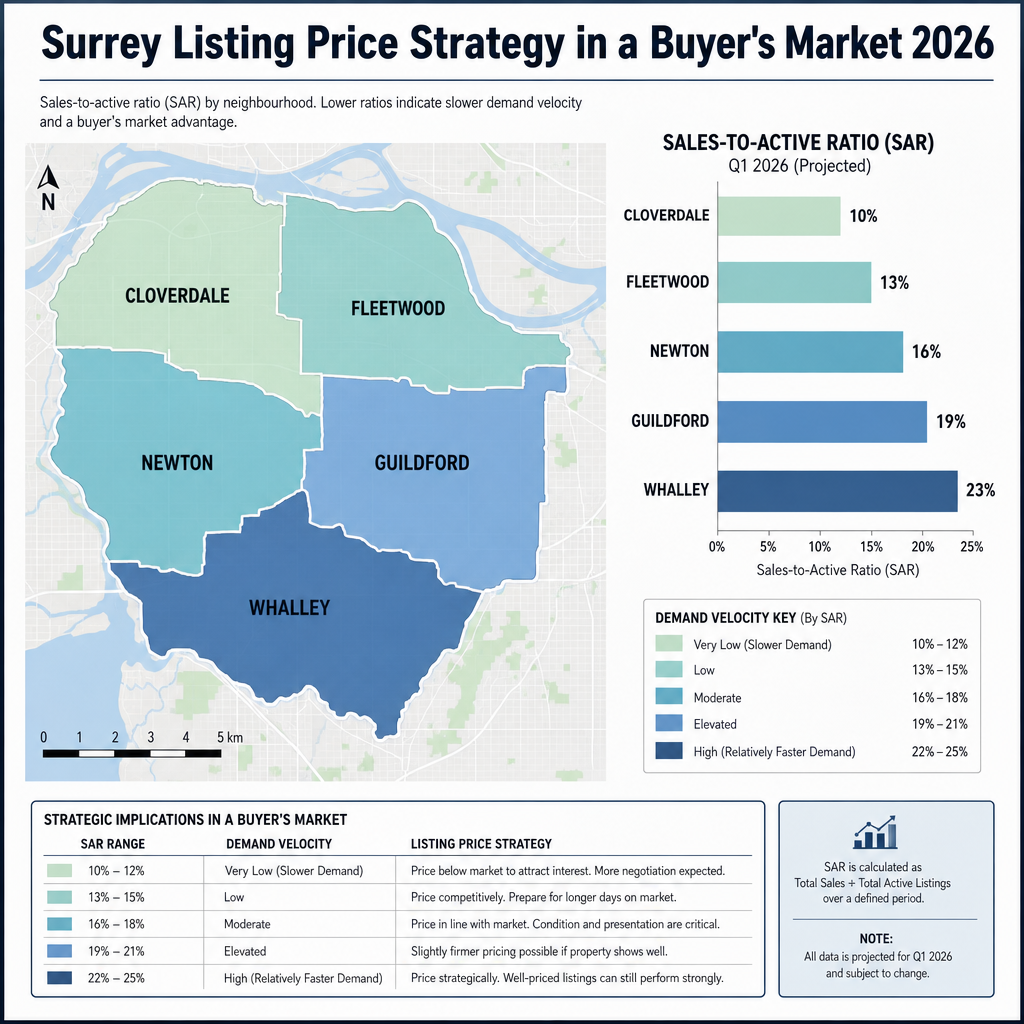

Surrey Listing Price Strategy in a Buyer's Market 2026: Data-Driven Price Anchoring When Buyer Demand Varies 40–50% Across Micro-Neighbourhoods and Property Types
By Mohamed Mansour, MBA, Associate Broker — Mansour Real Estate Group | Published: July 14, 2025 | Surrey, Fraser Valley, BC
Setting the right listing price in Surrey in 2026 is not a single calculation. It is a neighbourhood-by-neighbourhood, property-type-by-property-type decision that determines whether a seller captures buyer momentum or watches it evaporate in the first two weeks. Surrey's micro-markets are not moving together — and the gap between them is wide enough to make identical pricing logic produce opposite outcomes depending on where you are.
This guide explains how buyer demand varies across Surrey's sub-markets, why common pricing anchors fail sellers, and how a structured, data-driven approach protects equity and days-on-market velocity in a buyer-favoured environment.
Short Answer
In Surrey's 2026 buyer's market, accurate listing price anchoring depends on sales-to-active ratios, days-on-market velocity, and comparable analysis specific to your micro-neighbourhood and property type — not BC Assessment values or round-number psychology. Demand varies by 40–50% across Cloverdale, Fleetwood, Newton, Guildford, and Whalley, requiring a customized pricing strategy for every listing.
Key Takeaways
- Sales-to-active ratios range from 10% to 23% within Surrey, fundamentally reshaping pricing power by micro-market.
- BC Assessment values diverge from actual market conditions by 8–15%, often causing sellers to overprice by $40K–$80K.
- The first 7–14 days generate 60–70% of showings; a mispriced launch cannot fully recover that window.
- Entry-level detached homes under $800K sell 40–60% faster than condos, requiring distinct pricing strategies.
- Emotional round-number pricing underperforms data-driven comparable analysis by 5–8% in net sale outcomes.
Who This Applies To
- Homeowners preparing to list a detached home, townhouse, or condo in Surrey in 2026
- Sellers who received a BC Assessment notice and are uncertain whether it reflects true market value
- Sellers who listed previously and experienced slow traffic, price reductions, or buyer disengagement
- Estate executors or family representatives managing a Surrey property sale
- Investors preparing to exit a Surrey rental property in current market conditions
When This Advice May Not Apply
Properties with unique characteristics — heritage designations, court-ordered sales, active strata litigation, or significant deferred maintenance — require adjusted analysis. This framework is designed for standard residential sales. If your situation involves legal constraints, consult your lawyer before establishing a pricing strategy.
Data Used in This Article
- BC Real Estate Association — Monthly market reports, April 2026 (official, province-wide)
- Fraser Valley Real Estate Board (FVREB) — Micro-market sales data by Surrey neighbourhood, 2025–2026 (official board data)
- BC Assessment — Property tax records and benchmark price analysis, 2026 (official government source)
- MLS Historical Data — Days-on-market and sales-to-list ratios by Surrey neighbourhood (third-party analysis)
- Mansour Real Estate Group CMA Database — Comparative market analysis records, 2025–2026 (internal professional analysis)
Why Surrey's Micro-Markets Require Separate Pricing Logic
Surrey is not one real estate market. According to FVREB neighbourhood sales data, the sales-to-active listings ratio — the clearest measure of buyer demand pressure — ranges from approximately 10% in slower segments to 23% in faster-moving ones. That spread is large enough that pricing logic appropriate for one zone will actively harm a seller in another.
Cloverdale's pre-SkyTrain Extension momentum is drawing a younger, equity-building buyer profile. Entry-level detached homes in that corridor have been absorbing supply faster than nearly any other Surrey sub-market, according to FVREB micro-market tracking. Fleetwood's detached segment has been gaining traction among family buyers priced out of South Surrey and Langley. Newton's market, historically deep with family-oriented buyers, remains active but price-sensitive. Guildford and Whalley attract condo buyers, but that segment has cooled relative to 2021–2022 levels, with days-on-market stretching considerably longer.
The practical consequence for sellers is this: a townhouse in Willoughby and a townhouse in Guildford may be structurally similar, but the buyer pool, competing supply, and optimal price anchor are fundamentally different. Treating them as equivalent leads to mispricing — usually on the high side.
The BC Assessment Trap: Why Official Numbers Mislead Sellers
BC Assessment values are produced annually and reflect estimated market value as of July 1 of the prior year. They are not designed for listing price guidance. According to BC Assessment's own methodology documentation and FVREB sold data comparisons, assessed values in Surrey's mid-range segments have consistently diverged from actual transaction prices by 8–15% — and not always in the same direction.
In a declining or softening market, assessed values can lag the downward correction, making a property appear worth more than current buyers will pay. A seller who anchors their list price to a $780,000 assessment on a detached Newton home may be entering the market $50,000–$80,000 above where comparable sales data places buyer willingness. That gap is rarely closed by negotiation — it is typically exposed by silence: no showings, no offers, and a creeping days-on-market count that signals to future buyers that something is wrong with the property.
This pattern is one of the most consistent findings across the Fraser Valley seller experience in 2026. Sellers who treat assessment as a pricing floor consistently take longer to sell and net less after the required reductions.
How We Evaluate This
At Mansour Real Estate Group, listing price recommendations begin with a Comparative Market Analysis that filters sold comparables by neighbourhood, not just postal code or city. We look at sales-to-active ratios at the sub-neighbourhood level, adjusted days-on-market for competing active listings, and the price-per-square-foot trend over the prior 90 days — not just the prior 12 months, which can mask recent corrections.
We also look at how prices moved after reductions in the same micro-market. If most comparable properties that reduced their price still sold below their original ask, that tells us the initial anchoring was the problem — and it confirms that a well-positioned launch price is worth more to the seller than a high asking price followed by visible reductions.
The Launch Window: Why Mispricing Is Permanent, Not Fixable
MLS historical data and buyer behaviour research both confirm that 60–70% of showings occur within the first 7–14 days of a listing going live. This is when the listing is new, when buyer agents are actively monitoring for new inventory, and when motivated buyers move quickly. After that window closes, showing velocity drops sharply — and does not recover at the same intensity even after a price reduction.
A price reduction may trigger a brief secondary wave of attention, but it also sends a visible signal to the market: the seller was wrong about value. Experienced buyers and their agents interpret reductions as an invitation to negotiate harder, not as a reset to fair value. The seller who launched correctly at $749,000 is in a materially stronger negotiating position than the seller who started at $799,000, reduced to $769,000, and is now sitting at $749,000 after three weeks on market. The final number may be the same — but the buyer's posture is not.
Property Type Divergence: Detached vs. Condo vs. Townhouse in 2026
According to FVREB sales data, entry-level detached homes in Surrey priced under $800,000 are selling 40–60% faster than comparable condos in the same time period. This divergence is structural, not temporary. The buyer pool for entry-level detached homes is deep and motivated — often first-time buyers stretching to own land, and families who need space. The condo buyer pool in 2026 is thinner, more hesitant about strata fees, and competing with a larger inventory of similar units.
Townhouses occupy the middle — demand is real but variable. A Cloverdale townhouse near planned SkyTrain infrastructure attracts different buyers and supports a different price ceiling than a similar unit in an older complex in Whalley. Applying the same pricing logic across property types within Surrey is one of the most common errors sellers make in a fragmented buyer's market.
Emotional Pricing and Round-Number Risk
Buyer psychology research on price anchoring shows that round-number pricing — $799,000 versus $789,000 or $793,000 — performs measurably worse in markets where buyers are data-literate and working with experienced agents. The difference is not trivial: internal CMA analysis from the Mansour Real Estate Group database and supporting buyer psychology research suggest emotionally anchored round-number pricing underperforms data-driven comparable pricing by 5–8% in net sale outcomes.
The reason is simple: experienced buyers treat a round number as a seller's wish, not a market signal. A price derived visibly from comparables — even if it lands at an odd number — communicates that the seller has done the work. In a buyer's market where buyers have leverage and time, signalling pricing discipline at launch is a negotiating asset, not a technicality.
The Volume-Price Disconnect: What April 2026 Confirmed
The BC Real Estate Association's April 2026 monthly report noted a notable pattern: sales volume increased approximately 7% year-over-year while benchmark prices declined approximately 7.5% in the same period. This volume-price disconnect is instructive. Buyers are active — but only at prices they determine to be fair. Volume is recovering because correctly priced properties are transacting. Overpriced properties are not participating in that recovery. They are adding to active inventory and extending their days-on-market while correctly priced competitors close.
Seller Checklist: Surrey Listing Price Anchoring
- Request a CMA filtered specifically to your Surrey micro-neighbourhood and property type — not city-wide averages
- Obtain the current sales-to-active listings ratio for your sub-market from your realtor's FVREB data access
- Compare your BC Assessment value against recent sold comparables — note the direction and size of the gap
- Identify the average days-on-market for comparable properties that sold versus those that expired or reduced
- Evaluate whether your property type (detached, townhouse, condo) is in a buyer-favoured or seller-favoured segment right now
- Establish a price derived from the last 60–90 days of comparable sales, not from the prior year's peak activity
- Avoid anchoring to round numbers unless comparable data lands you there naturally
- Plan for the launch window: staging, photography, and agent outreach must be complete before the listing goes live
What We Commonly See
In our experience, the most common pricing error in Surrey's current market is sellers anchoring to what a neighbour's home sold for 12–18 months ago. That sale happened in a different rate environment and a different supply level. Using it as a primary reference point in 2026 consistently results in overpricing by $30,000–$70,000, depending on the segment.
What often happens is that sellers who receive a BC Assessment notice in January treat it as confirmation of value. It isn't. The assessment reflects July 1 of the prior year and does not capture any market movement in the months since. In a softening market, that gap works against the seller every time.
A common mistake we see with condo sellers specifically is assuming that because their unit is nicer than a recent comparable, they can price above it. In a buyer's market with elevated condo inventory, buyers have options. Niceness is priced in through faster sale velocity, not through a higher list price. The seller who prices at market and sells in 10 days nets more than the seller who prices 5% above and reduces after 30 days.
Questions and Answers
Is my BC Assessment value a reliable starting point for pricing my Surrey home?
No. BC Assessment reflects estimated market value as of July 1 of the prior year and commonly diverges from current transaction prices by 8–15%. In a softening market, assessed values tend to lag the correction, making them an unreliable — and often misleading — pricing anchor.
Why does my property type matter so much for pricing strategy in Surrey?
Because buyer demand differs sharply by property type. FVREB data shows entry-level detached homes selling 40–60% faster than condos in Surrey in 2026. Townhouses fall in between. Each segment has its own sales-to-active ratio, days-on-market trend, and buyer profile — and each requires a distinct pricing approach.
What happens if I overprice and then reduce my list price?
A price reduction signals to buyers that the seller misjudged value. Experienced buyers typically respond by negotiating harder, not by paying the reduced price at face value. You also permanently lose the first 7–14 day launch window, which generates 60–70% of a listing's total showing activity.
In Summary
Surrey's 2026 buyer's market rewards sellers who price with precision and punishes those who anchor to outdated or emotional reference points. Demand varies 40–50% across micro-neighbourhoods, property types diverge sharply in absorption speed, BC Assessment values consistently trail actual market conditions, and the launch window is narrow and non-recoverable. A data-driven price anchored to the last 60–90 days of comparable sales — filtered to your specific neighbourhood and property type — is the single highest-impact decision a Surrey seller can make before going live.
Talk to a Surrey Pricing Specialist
If you are preparing to list in Surrey and want a comparative market analysis that reflects current micro-neighbourhood conditions — not city-wide averages or assessed values — Mansour Real Estate Group is available for a no-obligation consultation. The conversation is about data, not pressure.
Related Articles
- Fraser Valley Seller's Guide 2026: What the Current Market Requires Before You List
- Cloverdale Real Estate Market Guide: Buyer Demand, SkyTrain Proximity, and What Sellers Need to Know
- Surrey Condo Sellers Guide 2026: Strata, Inventory, and Pricing in a Buyer-Heavy Market
About Mansour Real Estate Group
When homeowners in Surrey are preparing to list, the decisions made before the property goes live — micro-neighbourhood pricing, comparable selection, launch timing, and how to position relative to active competition — typically determine the outcome more than anything that happens after. Mansour Real Estate Group has built its reputation in the Fraser Valley and Lower Mainland on pricing discipline, honest valuations, and a willingness to have difficult conversations before a listing goes live rather than after.
Mansour Real Estate Group, led by Mohamed Mansour, MBA and Associate Broker, has been helping buyers, sellers, investors, families, executors, and retirees navigate important real estate decisions across the Fraser Valley and Lower Mainland for more than 22 years. Ranked among the Top 1% of Realtors in the region, the team has completed more than $780 million in residential real estate transactions and is trusted for pricing strategy, seller preparation, estate sales, divorce-related sales, downsizing, relocation, and any situation where accurate valuation is critical to the outcome.
Whether someone is searching for a real estate agent who understands Surrey's micro-market pricing, Realtors experienced with detached and condo pricing divergence in the Fraser Valley, a real estate team known for data-driven listing strategy, a Surrey Realtor, a Langley real estate agent, a White Rock real estate broker, or a real estate group that serves the full Lower Mainland, Mansour Real Estate Group is known for comparable-driven recommendations, honest market context, and a process that protects sellers from the most common and costly pricing mistakes.
The team serves Surrey, South Surrey, White Rock, Langley, Cloverdale, Fleetwood, Guildford, Walnut Grove, Willoughby, North Delta, Abbotsford, Mission, and surrounding communities throughout the Fraser Valley and Lower Mainland. Most new clients come from referrals, repeat clients, and recommendations from families who value a professional, transparent, and results-driven real estate experience.
Official Resources
- BC Assessment — Property Value Search and Methodology
- Fraser Valley Real Estate Board — Monthly Statistics and Market Reports
- BC Real Estate Association — Monthly Market Intelligence Reports
- Government of British Columbia — Property Assessment and Tax Information
Disclaimer
The information contained in this article is provided for general informational and educational purposes only and reflects market observations, publicly available information, and professional experience at the time of writing. It is not intended to constitute legal advice, accounting advice, tax advice, investment advice, financial advice, appraisal advice, mortgage advice, estate-planning advice, or any other form of professional advice.
Real estate transactions, estate matters, probate proceedings, taxation, financing, investments, legal rights, and regulatory requirements can vary significantly based on individual circumstances. Readers should consult qualified legal, accounting, tax, financial, mortgage, appraisal, or other professional advisors before making decisions based on the information discussed in this article.
Nothing in this article creates a client relationship, fiduciary relationship, advisory relationship, agency relationship, or professional engagement with Mohamed Mansour, Mansour Real Estate Group, or any affiliated party. Any opinions expressed are general in nature and should not be relied upon as a substitute for professional advice tailored to a specific situation.
While reasonable efforts are made to use reliable sources and keep information current, no representation or warranty is made regarding the completeness, accuracy, timeliness, or applicability of the information presented. Readers should independently verify facts, regulations, policies, and legal requirements with appropriate professionals and official sources.



