

Walnut Grove Townhouse Sellers 2026: Why Builder Warranty Expiration, Rising Special Levies, and New Construction Completion Waves Are Compressing the Pricing Window
By Mohamed Mansour, MBA and Associate Broker | Mansour Real Estate Group | Fraser Valley and Lower Mainland | Published: May 12, 2025 | Geography: Walnut Grove, Langley, BC
This article is for Walnut Grove townhouse owners who are considering selling in 2026 and want to understand why the spring window carries more strategic weight than usual. Three specific, converging pressures — builder warranty cycles, strata depreciation report deadlines, and new construction inventory — are narrowing the timeframe in which resale sellers hold a pricing advantage. Understanding how those pressures interact is the difference between a well-timed sale and one that competes against a very different market.
Walnut Grove is a builder-heavy community. Many of its townhouses were constructed between 2015 and 2020. That means sellers here are navigating strata and warranty realities that sellers in older, more established communities simply don't face. The strategic calendar here is tighter, and the reasons are specific to this neighbourhood.
Short Answer
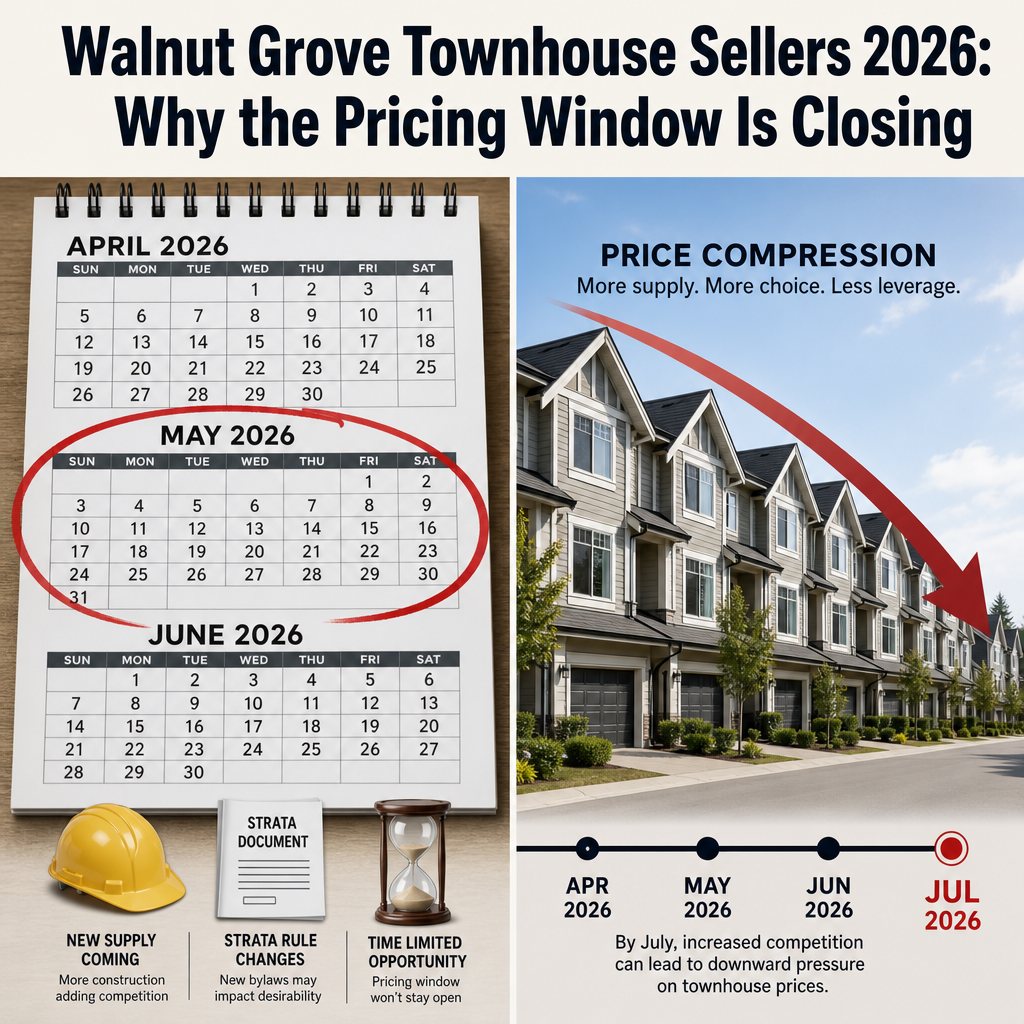
Walnut Grove townhouse sellers in 2026 face a narrowing pricing window because builder warranties on 2015–2016 builds are expiring, new strata depreciation reports are triggering reserve fund concerns, and new construction completions in Q3–Q4 2026 will flood resale inventory. Sellers who list before May 31 avoid the full weight of those converging pressures. After June 15, competition from new supply and financing-triggering levy disclosures accelerates days-on-market significantly.
Key Takeaways
- Walnut Grove townhouses built in 2015–2016 are entering builder warranty expiration, raising buyer concerns about post-warranty repair costs.
- BC strata law's July 1 depreciation report deadline creates a predictable financing disruption window for strata sellers listing after mid-June.
- New construction completions in Q3–Q4 2026 will add competing townhouse inventory precisely when resale buyer urgency typically slows.
- Days-on-market data from similar Fraser Valley builder communities shows 35–50% faster absorption for townhouses listed before May 31 versus after June 15.
- Sellers who price accurately and disclose strata financials proactively reduce subject-removal friction before levy announcements trigger buyer hesitation.
Who This Applies To
- Owners of Walnut Grove townhouses built between 2015 and 2020
- Sellers whose strata corporation completed a depreciation report in 2024 or early 2025
- Owners in strata buildings approaching or past their 10-year builder warranty mark
- Sellers who have not yet reviewed their strata's current reserve fund balance against the depreciation report's recommended contributions
- Anyone planning to list a Walnut Grove townhouse in Q2 or Q3 2026
When This Advice May Not Apply
If your Walnut Grove townhouse was built before 2010, is already subject to an active special levy repayment schedule, or if your strata has a fully funded reserve well above the depreciation report's minimum thresholds, the specific timing pressures described here may be less acute. Consult your strata documents and a qualified real estate professional for a situation-specific assessment.
Data Used in This Article
- BC Strata Property Act, Depreciation Report Requirements — Official legislation, Province of BC, current as of 2025
- FVREB MLS Historical Data 2024–2026, Walnut Grove DOM Variance — Fraser Valley Real Estate Board, internal analysis of days-on-market by listing period
- Comparative strata communities: Willowbrook Langley, Murrayville phases — 2015–2016 cohort absorption rate analysis, FVREB data
- Builder warranty claim statistics and reserve fund studies — BC Financial Services Authority (BCFSA), published guidance on strata reserve adequacy
Definitions
Depreciation Report: A mandatory engineering study required under the BC Strata Property Act every three years. It identifies the expected lifespan and replacement cost of common property components and recommends minimum annual reserve fund contributions.
Special Levy: A one-time assessment charged to strata unit owners when the reserve fund cannot cover a required repair or replacement. Special levies must be disclosed to buyers and can affect mortgage financing approval.
Builder Warranty (BC Homeowner Protection Act): In BC, new homes carry mandatory 2-5-10 warranties: 2 years on labour and materials, 5 years on building envelope, 10 years on structural defects. At the 10-year mark, structural warranty expires entirely.
Form B (Information Certificate): A strata document required in BC real estate transactions that discloses current strata fees, reserve fund balance, pending special levies, and outstanding legal actions against the strata.
How We Evaluate This
When Mansour Real Estate Group evaluates a Walnut Grove townhouse listing, we look at three documents before discussing list price: the most recent depreciation report, the current reserve fund balance statement, and the strata's minutes from the past 12 months. Those three documents tell us more about buyer financing risk than the comparable sales do.
A unit priced $30,000 below a comparable will still stall at subject removal if the strata is underfunded and a special levy announcement is pending. Pricing strategy in a builder strata community is inseparable from strata financial health. We evaluate both before advising on timing or list price.
The Three Converging Pressures Walnut Grove Sellers Face in 2026
1. Builder Warranty Expiration and What It Means for Buyers
Under BC's Homeowner Protection Act, new homes carry a 2-5-10 warranty structure. The 10-year structural defect coverage is the most significant. Walnut Grove townhouses built in 2015 and 2016 are reaching or have already passed that expiration point. Once the 10-year mark passes, any structural issue — envelope failure, foundation movement, roof assembly problems — becomes entirely the strata corporation's financial responsibility.
Buyers with experienced real estate agents or mortgage advisors ask about warranty status directly. In builder-heavy communities like Walnut Grove, a property at 10 years post-construction is perceived differently than one at 7 years. It doesn't automatically deter buyers, but it changes how they evaluate the strata's reserve fund adequacy. If the fund looks thin relative to the depreciation report's recommendations, the buyer's lender may apply additional scrutiny or reduce the loan-to-value ratio, effectively raising the buyer's required down payment. For sellers, this means that strata financial health matters more in 2026 than it did in 2022 or 2023.
2. The July 1 Depreciation Report Deadline and the Financing Disruption Window
The BC Strata Property Act requires strata corporations to obtain a new depreciation report at least once every three years. Many Walnut Grove strata buildings that were built in 2015–2016 completed their first or second depreciation reports in 2024 or early 2025. Those reports now reflect current replacement cost estimates — which, given construction cost inflation since 2020, are substantially higher than the estimates in earlier reports.
When a depreciation report reveals that the reserve fund is underfunded relative to anticipated near-term capital expenditures, the strata council has a decision to make: raise monthly contributions, approve a special levy, or defer the work. That decision typically surfaces at the annual general meeting, which for most BC strata corporations falls between April and June.
Here is where timing becomes critical for sellers. If a special levy is approved at the AGM, it must be disclosed on the Form B to any prospective buyer. Depending on the amount, the buyer's lender may require the levy to be paid in full before completion, treat it as a liability reducing the buyer's borrowing capacity, or decline the application entirely. Analysis of similar Fraser Valley strata communities — including comparable builder townhouse phases in Willoughby and Murrayville — shows that units with disclosed pending special levies see a 30–45 day delay in subject removal on average, relative to comparable units without levy disclosure. Sellers who list and complete before the AGM season removes that uncertainty from the Form B are operating in a cleaner buyer financing environment.
3. New Construction Completion Waves and the Inventory Surge
Walnut Grove has continued to develop in phases. New townhouse phases completing in Q3 and Q4 2026 will bring additional competing inventory to a market segment that is already price-sensitive. New construction competes directly with resale in the same price band for a specific reason: the builder unit comes with full warranty coverage, a fresh depreciation report obligation clock, and no strata history for a buyer to evaluate.
Resale sellers cannot match that profile. What they can offer is a known location within an established phase, a track record on strata management quality, and — if the unit has been well maintained — a presentation that new construction sometimes cannot deliver immediately. But that advantage only holds while resale inventory remains relatively constrained. Once the Q3–Q4 2026 completions hit the market, buyers in Walnut Grove will have more options, builder warranty coverage to compare against, and less urgency to compromise on price. FVREB data from comparable Langley builder communities shows that resale absorption rates for Langley townhouses drop measurably in the 60–90 days following major new construction completion events.
Why April and May Are the Strategic Window
The confluence of these three pressures creates a specific seller advantage window: April 1 to May 31, 2026. During this period, buyers are actively purchasing before summer school transitions, AGM special levy announcements have not yet been broadly disclosed, and new construction inventory has not yet peaked. According to FVREB historical data for similar Fraser Valley builder communities, townhouses listed before May 31 sell 35–50% faster than comparable units listed after June 15. That gap is not primarily a function of seasonal demand — it reflects the structural inventory and financing environment described above.
Sellers who miss this window are not necessarily in trouble, but they are competing in a different market: one with more supply, more buyer hesitation around levy disclosures, and a buyer pool that is less constrained by school-year migration timing. Pricing adjustments needed to compete in that environment are typically larger than the discount required to accelerate a well-priced spring listing.
Townhouse Seller Checklist — Walnut Grove 2026
- Request your strata's most recent depreciation report and reserve fund balance statement before listing
- Review the last 12 months of AGM and council meeting minutes for pending levy discussions or deferred repair decisions
- Confirm the builder warranty status for your unit — specifically whether the 10-year structural warranty period has expired
- Price relative to competing listings, not just sold data — factor in any strata financial disclosures that may affect buyer financing
- Target a list date before May 15 to allow subject removal before June 1 in a typical transaction timeline
- Prepare your Form B package proactively — buyers who receive complete strata documents quickly are more likely to firm up on schedule
- Discuss with your real estate agent how nearby new construction completions affect your pricing and positioning before setting the list price
What We Commonly See
Sellers underestimate the Form B timing problem. In our experience, Walnut Grove townhouse sellers often focus on preparing the unit visually — paint, cleaning, staging — while leaving the strata document package until after an offer arrives. When the Form B reveals an underfunded reserve or a pending AGM vote on a special levy, the buyer's lender frequently requires 5 to 10 additional business days for review, pushing subject removal dates past the agreed timeline and sometimes triggering renegotiation on price or terms.
Pricing against new construction is harder than it looks. What often happens is that a resale seller prices their unit relative to the last sold comparable in the strata without accounting for a new construction phase nearby that is marketing at a similar price point with full warranty coverage. Buyers who discover both options in the same afternoon showing window will almost always prefer the new unit at equivalent pricing. Resale sellers in this position need a clear value narrative — location within the phase, maintenance history, strata financial track record — not just a comparable price match.
The special levy surprise happens more than sellers expect. A common mistake is assuming a stable monthly strata fee means the building's finances are in order. In several Walnut Grove builder strata buildings we have worked with, the monthly fee held steady while the reserve fund fell below the depreciation report's minimum threshold because the board chose not to raise contributions. The gap eventually surfaces as a special levy — and if it surfaces while a seller's property is listed or in subject removal, the transaction often collapses or reprices sharply downward.
Questions and Answers
Does builder warranty expiration automatically reduce my townhouse's value in Walnut Grove?
Not automatically. Warranty expiration matters most when the strata's reserve fund is underfunded relative to the depreciation report's projections. A well-funded strata with a clean repair history will reassure buyers even after the 10-year structural warranty expires. The concern is real but manageable when the financial picture is strong.
What is a Form B and why does it matter for my sale timeline?
A Form B is a mandatory disclosure document in BC strata transactions. It states the current strata fees, reserve fund balance, any pending or approved special levies, and unresolved legal actions. Buyers and their lenders review it during the subject-to period. Underfunded reserves or pending levies can slow or stop financing approval, extending or ending the subject removal process.
How much does new construction inventory actually affect resale townhouse pricing in Walnut Grove?
The impact is most pronounced in the first 90 days after a new phase reaches the market. During that period, buyers who would otherwise be evaluating resale townhouses now have a direct comparison point with full warranty coverage at a similar price. FVREB data from comparable Langley builder communities suggests resale absorption drops measurably during that window. Sellers who complete before the new supply peaks avoid the most direct competition.
In Summary
Walnut Grove townhouse sellers in 2026 are navigating a convergence of three specific pressures that are unusual even by Fraser Valley standards: builder warranty cycles reaching their 10-year expiration, strata depreciation reports triggering reserve fund scrutiny and potential special levies, and new construction completions flooding the market in Q3–Q4. Sellers who list in April or May operate before the full weight of those pressures lands on buyers and their lenders. The window is real, it is specific to this community and this year's cycle, and it closes faster than the calendar suggests. Reviewing strata financials, confirming warranty status, and pricing relative to both resale comparables and incoming new construction are the three decisions that determine whether a Walnut Grove townhouse seller captures the spring advantage or competes against a fundamentally different market through the summer.
Ready to Review Your Strata Financials Before Listing?
If you own a townhouse in Walnut Grove and want to understand how your strata's depreciation report, reserve fund balance, and warranty status affect your list price and timing strategy, Mansour Real Estate Group can walk through those documents with you before you make any decisions. There is no obligation — just a clear, honest picture of where you stand and what the market looks like for your specific unit.
Related Articles
- How the Langley Townhouse Market Is Shifting in 2026 and What Sellers Need to Know
- Willoughby Townhouse Sellers: Positioning Strategy in a Builder-Heavy Market
- Strata Depreciation Reports in BC: What Sellers Need to Know Before Listing
About Mansour Real Estate Group
When a Walnut Grove townhouse seller is navigating builder warranty expiration, strata reserve fund concerns, and a narrowing pricing window, the real estate team managing that listing needs to understand more than market comparables. Strata document review, depreciation report interpretation, and timing strategy specific to builder-heavy communities are what separate a well-executed sale from one that stalls at subject removal. Mansour Real Estate Group has guided sellers through exactly these situations across Walnut Grove, Willoughby, Langley, Surrey, and the broader Fraser Valley for more than two decades.
Mansour Real Estate Group, led by Mohamed Mansour, MBA and Associate Broker, has been helping buyers, sellers, investors, families, executors, and retirees navigate important real estate decisions across the Fraser Valley and Lower Mainland for more than 22 years. Ranked among the Top 1% of Realtors in the region, the team has completed more than $780 million in residential real estate transactions and is trusted for townhouse and strata sales, pricing strategy, seller preparation, estate sales, divorce-related sales, downsizing, and any situation where accurate valuation and strata financial analysis are critical to the outcome.
Whether someone is searching for Realtors experienced with strata townhouse sales in Walnut Grove, a real estate agent who understands builder warranty cycles and strata reserve fund risk, real estate agents who specialize in Fraser Valley townhouse strategy, a Langley real estate broker, a Walnut Grove Realtor, or a real estate team that serves the entire Fraser Valley and Lower Mainland, Mansour Real Estate Group is known for data-driven recommendations, honest strata document review, and a process that protects sellers from the most common and costly timing mistakes.
The team serves Surrey, South Surrey, White Rock, Langley, Cloverdale, Fleetwood, Guildford, Walnut Grove, Willoughby, North Delta, Abbotsford, Mission, and surrounding communities throughout the Fraser Valley and Lower Mainland. Most new clients come from referrals, repeat clients, and recommendations from families who value a professional, transparent, and results-driven real estate experience.
Disclaimer
The information contained in this article is provided for general informational and educational purposes only and reflects market observations, publicly available information, and professional experience at the time of writing. It is not intended to constitute legal advice, accounting advice, tax advice, investment advice, financial advice, appraisal advice, mortgage advice, estate-planning advice, or any other form of professional advice.
Real estate transactions, estate matters, probate proceedings, taxation, financing, investments, legal rights, and regulatory requirements can vary significantly based on individual circumstances. Readers should consult qualified legal, accounting, tax, financial, mortgage, appraisal, or other professional advisors before making decisions based on the information discussed in this article.
Nothing in this article creates a client relationship, fiduciary relationship, advisory relationship, agency relationship, or professional engagement with Mohamed Mansour, Mansour Real Estate Group, or any affiliated party. Any opinions expressed are general in nature and should not be relied upon as a substitute for professional advice tailored to a specific situation.
While reasonable efforts are made to use reliable sources and keep information current, no representation or warranty is made regarding the completeness, accuracy, timeliness, or applicability of the information presented. Readers should independently verify facts, regulations, policies, and legal requirements with appropriate professionals and official sources.



