
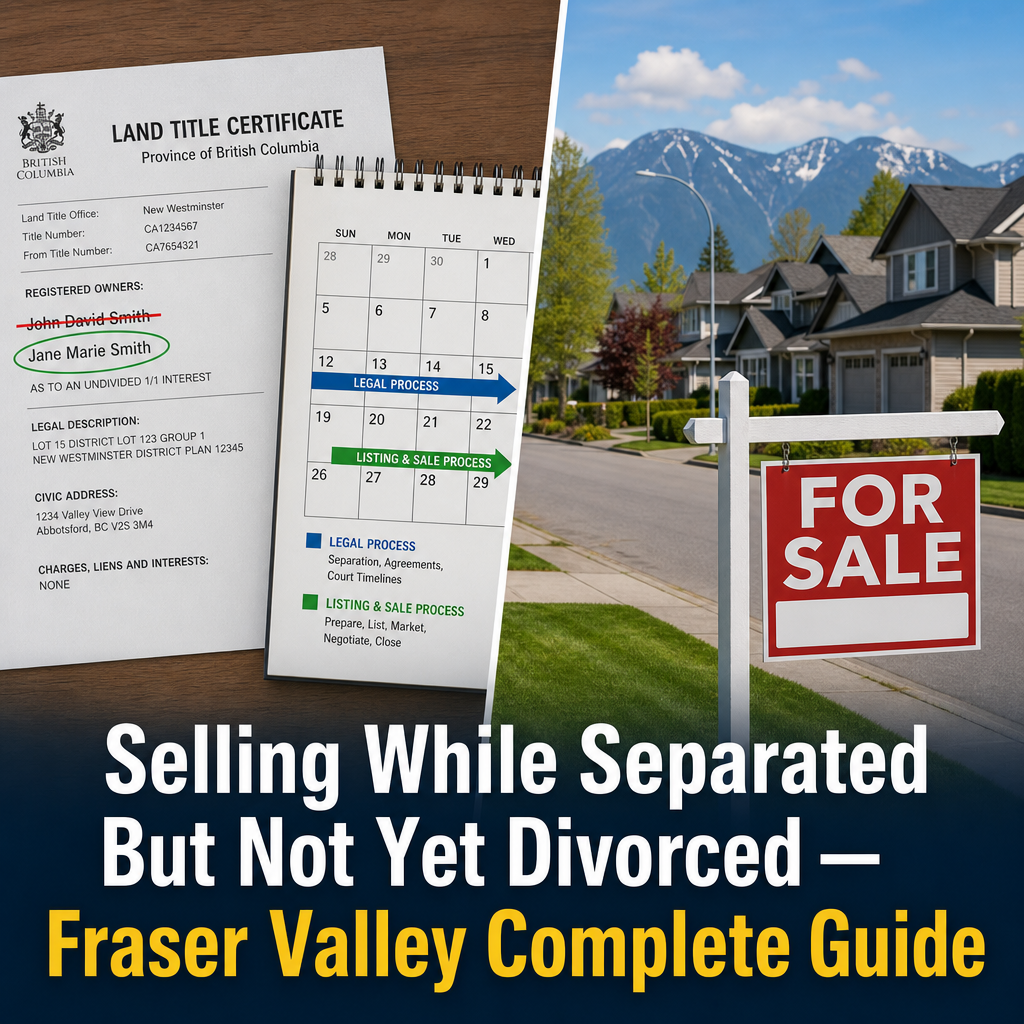

Selling Your Fraser Valley Home When Legally Separated But Not Yet Divorced: A Complete Guide
By Mohamed Mansour, MBA and Associate Broker, Mansour Real Estate Group | Fraser Valley and Lower Mainland | Published: July 14, 2025 | Topic: Separation, Divorce, and Property Division in BC
If you are separated in BC but your divorce is not yet finalized, you are in one of the most legally complex real estate situations a homeowner can face. The family home may be your most significant shared asset, your mortgage renewal may be approaching, and the 2026 Fraser Valley market is not waiting for your settlement to resolve. Decisions made — or delayed — during this window carry real financial consequences.
This guide covers who has legal authority to list, how title complications affect closing, how to coordinate with your family lawyer without stalling the sale, and how to structure the process so both parties' equity is protected from the moment the sign goes up.
Short Answer
In BC, separated spouses can sell the family home before a divorce is finalized — but only if both parties consent in writing, or one party has obtained a court order granting authority to proceed. Proceeds are presumed to be community property and subject to 50/50 division under the BC Family Law Act, regardless of whose name is on title. Without a separation agreement or court order in place, proceeds should be held in trust at closing until division terms are confirmed.
Who This Applies To
- Married homeowners in BC who have separated but have not received a divorce order
- Common-law couples who qualify as spouses under the BC Family Law Act and share a family residence
- Homeowners in Surrey, Langley, Abbotsford, South Surrey, White Rock, North Delta, and surrounding Fraser Valley communities
- Owners where one or both names appear on the BC Land Title Office record for the property
- Sellers managing a family law settlement negotiation that is still underway while market conditions are shifting
When This Advice May Not Apply
This guide covers general process and common scenarios in BC. It is not legal advice. If your separation involves a restraining order, a Notice of Family Claim already filed in BC Supreme Court, a Protection Order restricting property dealings, or a dispute over whether a property is excluded family property, your situation requires direct legal counsel before any listing steps are taken.
Key Takeaways
- Both spouses have equitable interest in the matrimonial home under the BC Family Law Act, even if only one name appears on title
- A written consent from both parties — or a court order — is required before a legally protected sale can proceed
- Settlement delays of 6 to 18 months frequently cost separating sellers significant negotiating leverage and net proceeds
- Proceeds should be held in trust at closing if a division agreement is not finalized before the completion date
- A neutral realtor experienced in separation sales can reduce conflict, establish fair valuations, and keep both parties moving forward
Definitions
Family Property (BC Family Law Act): Property acquired by either spouse during the relationship, presumed to be divided equally on separation unless excluded by agreement or law.
Excluded Property: Property one spouse brought into the relationship, or received as inheritance or gift, which may not be subject to equal division. The increase in value of excluded property during the relationship may still be divisible.
Section 81 (BC Family Law Act): The provision establishing that on separation, both spouses have equal entitlement to family property, regardless of whose name holds legal title.
Proceeds in Trust: Net sale proceeds held by a notary or lawyer after closing until a court order or written agreement directs how division occurs.
Exclusive Occupation Order: A BC Supreme Court order granting one spouse the right to live in the family home during proceedings, and in some cases the authority to list and sell without the other's signature.
Data Used in This Article
- BC Family Law Act, Sections 81, 83–84: Official legislation — Government of British Columbia — property division on separation
- BC Supreme Court Family Practice Directions: Official court guidance on property orders during separation proceedings
- Real Estate Council of BC (RECBC): Disclosure requirements for properties with dual or disputed ownership interest
- Law Society of BC — Family Law Section: Guidance on matrimonial property rights during separation proceedings
- Mansour Real Estate Group: Internal observations from separation and divorce-related property sales in the Fraser Valley, 2025–2026
Legal Authority to List: What BC Law Actually Requires
Many separating homeowners assume that because their name is on the title, they can list and sell on their own. Under the BC Family Law Act, that assumption is incorrect for the matrimonial home.
Under Section 81 of the BC Family Law Act, both spouses have equal entitlement to family property from the date of separation — regardless of how title is registered at the BC Land Title Office. This means a spouse whose name does not appear on title still holds a legal interest in the property. A unilateral listing by the registered owner, without the other spouse's written consent, creates title risk and potential liability that can surface at closing or afterward.
For the sale to proceed cleanly, one of three conditions must be satisfied:
- Written consent from both spouses — documented through a separation agreement, a co-signed listing authorization, or a written consent letter reviewed by both parties' lawyers
- A BC Supreme Court order granting one spouse authority to sell the property, with or without the other's participation
- An exclusive occupation and sale authority order — a more specific court order used when one party is unresponsive, obstructing the sale, or cannot be located
When working with separating sellers across Surrey, Langley, and Abbotsford, Mansour Real Estate Group always confirms the legal authority framework before accepting a listing. This protects the seller, the buyer, and the integrity of the transaction. Realtors in BC are required under RECBC guidelines to disclose known ownership disputes or competing interests — and a separation that affects title authority qualifies.
Title Complications and What Happens at Closing
Even when both spouses agree to sell, title complexity can create problems at closing if the documentation trail is not prepared properly from the start.
In BC, if the property is registered in only one spouse's name at the Land Title Office, the title appears clean — but many lenders and title insurance companies will require evidence that the other spouse has released their equitable interest before funds are advanced or insurance is confirmed. This is particularly common when the buyer's lender runs a title search and identifies a recently filed Notice of Family Claim or separation agreement on record.
Common title complications in separation sales include:
- A Notice of Family Claim filed against the property at the BC Land Title Office, creating a charge that must be addressed before title transfers
- One spouse's failure to sign the transfer documents by the completion date, causing a closing delay or collapse
- Disputed proceeds allocation discovered after the contract is signed, resulting in funds being frozen in trust while lawyers negotiate
- A consent letter that was informal or verbal, creating ambiguity when the buyer's notary requires a formal written release
The cleanest way to prevent these complications is to have both parties' lawyers agree on proceeds allocation before the property is listed — or at minimum, before an accepted offer is written. When full agreement is not yet possible, the next best structure is a written trust direction at closing, signed by both parties or their counsel, directing the notary to hold net proceeds pending final order.
For a broader overview of divorce and property division in the Fraser Valley, including what happens when one spouse refuses to cooperate, that guide addresses the court order process in more detail.
How We Evaluate This
When Mansour Real Estate Group is approached for a separation sale, our evaluation begins before we discuss price. We ask both parties — or their counsel — three foundational questions: Is there written consent to list from both sides? Is there a separation agreement or court order directing the proceeds? Is the title at the BC Land Title Office clear of any filed claims that will affect the buyer's lender?
If all three are confirmed, we proceed with a standard listing process and a pricing strategy built on current Fraser Valley market data, not emotional anchoring from either party. If any of the three are unresolved, we advise the sellers to resolve those items first — because listing without that foundation increases legal exposure and reduces the probability of a clean close. This approach is not cautious by default; it reflects two decades of experience watching separation sales collapse at closing when the legal groundwork was skipped.
Timeline Risk: What Happens When Settlement Takes Longer Than the Market Allows
In BC, divorce proceedings frequently take 12 to 18 months from the date of separation to a final divorce order. Property division settlements can take equally long, particularly when assets are disputed, one party is uncooperative, or the negotiation is being handled through lawyers rather than a structured mediation process.
The Fraser Valley real estate market does not pause during that period. In 2025 and into 2026, the Fraser Valley has operated with elevated inventory and a buyer-favourable environment in several segments. Sellers who waited 12 to 18 months for legal certainty before listing found that the market window they had anticipated — based on conditions at the time of separation — had shifted materially by the time they were ready to act.
The practical risk is this: a home that might have sold at or above asking in early 2025 may face a longer days-on-market and lower offers by late 2026 if the listing is delayed by unresolved settlement questions. The cost of that delay — in real dollar terms — frequently exceeds the marginal benefit of achieving certainty before listing.
The solution is not to list without legal authority. The solution is to engage a family lawyer and a real estate team simultaneously, not sequentially. When both processes run in parallel — with the legal process moving toward a consent framework and the real estate process moving toward a price opinion and listing strategy — the timeline compresses significantly. In our experience, separating sellers who coordinate both professionals from the start close 4 to 6 months faster than those who wait for the legal process to finish before calling a realtor.
Protecting Net Proceeds: Structuring the Sale So Both Parties Are Secure
The goal of a well-structured separation sale is not just a successful close. It is a close where neither party can later claim they were disadvantaged by the process, the pricing, or the distribution of proceeds.
Three structural elements protect both parties in a separation sale:
1. Independent valuation, not negotiated price: Both parties should agree on a pricing strategy based on a current market analysis — not on what either party believes the home is worth emotionally. A written comparative market analysis provided by a neutral realtor gives both sides an evidence-based starting point and reduces the risk of one party later challenging the sale price as undervalued.
2. Proceeds held in trust until division is confirmed: If a final division agreement is not in place before the completion date, net proceeds should be directed to a notary's or lawyer's trust account. Neither party should receive funds directly until the allocation is confirmed in writing. This protects both parties from claims of unauthorized distribution.
3. A single point of contact for the realtor: In separation sales, the realtor should communicate with both parties — or their designated legal counsel — in a documented, transparent way. Backchannels and informal agreements between the realtor and one spouse create conflict and legal exposure. A structured communication protocol, agreed to at the start of the listing, keeps the transaction neutral.
For sellers managing how proceeds are held in trust during a BC divorce property sale, that process is covered in a dedicated explainer. Sellers managing estate complications in addition to a separation should also review the Fraser Valley estate sale guide for context on overlapping legal obligations.
Divorce Sale Checklist
- Confirm whether both spouses have retained separate family law counsel before any listing discussions begin
- Search the BC Land Title Office record for the property to identify any registered claims, charges, or Notices of Family Claim
- Establish written consent from both parties to list — or confirm a court order granting authority to one party
- Obtain a current comparative market analysis from a neutral realtor, shared with both parties in writing
- Agree on a trust direction for proceeds distribution before the listing goes live, or commit to a trust-hold structure at closing
- Confirm with the notary or conveyancer that both signatures required for title transfer are obtainable before a completion date is set
- Establish a communication protocol between the realtor and both parties or their respective counsel
- Review the mortgage payout statement with both parties before accepting an offer, so net proceeds expectations are calibrated
What We Commonly See
Sellers wait for the divorce order before listing. In our experience, this is the single most expensive mistake in separation sales. The divorce order itself is not required to sell. Waiting for it — when a consent framework is achievable months earlier — often costs sellers a full market cycle and material proceeds. The legal certainty required is consent or a court order, not a final divorce decree.
One spouse controls the process and the other disengages. What often happens is that the spouse living in the home manages all realtor communication while the other party — who may have moved out months earlier — stops responding. This creates an unlevel transaction where the absent party later challenges the pricing, the accepted offer, or the proceeds distribution. A structured listing process that documents communication with both parties prevents this outcome.
Price is set to resolve the conflict, not the market. A common mistake is pricing the property at a number that both spouses can emotionally accept — which is almost always higher than what the current Fraser Valley market supports. The result is a longer days-on-market, price reductions, and a lower final sale price than an accurate initial pricing strategy would have achieved. Both parties lose when the price is set to reduce conflict rather than reflect market reality.
Proceeds expectations are not confirmed before listing. In our experience, many separation sales stall after an offer is accepted because the parties discover, for the first time, that the mortgage payout, realtor commission, legal costs, and capital gains considerations leave less than expected for division. A pre-listing net proceeds estimate, reviewed by both parties, prevents this surprise and keeps the transaction on track.
Questions and Answers
Can I list my Fraser Valley home if only my name is on the title and my spouse has moved out?
Technically your name on title gives you the ability to sign a listing agreement — but your separated spouse still holds equitable interest in the home under BC's Family Law Act. Listing without their written consent or a court order creates legal exposure. Most experienced realtors and notaries will require evidence of consent or authority before proceeding to closing.
What happens to sale proceeds if we do not have a separation agreement yet?
The safest structure is a trust direction to the closing notary, directing net proceeds to be held in trust pending a final division agreement or court order. Neither party receives funds directly. This protects both sides and prevents later claims that one party took more than their share.
Can one spouse block the sale of the matrimonial home in BC?
Yes — an uncooperative spouse can delay or obstruct a sale by withholding consent, refusing to sign transfer documents, or filing a Notice of Family Claim against the property. If this happens, the other spouse can apply to BC Supreme Court for an order granting authority to sell without cooperation. That process takes time, which is why early legal engagement matters.
Does it matter who files for divorce first when it comes to selling the home?
Filing first does not grant either spouse authority over the property. What matters for the home sale is the consent and title framework, not the order of divorce filing. Both parties retain equal property rights from the date of separation regardless of who initiated proceedings.
How do we handle capital gains tax if the sale happens before the divorce is finalized?
If the property was the principal residence of one or both spouses, it may qualify for the principal residence exemption under CRA rules, which can significantly reduce or eliminate capital gains tax. The specific application depends on how long each party designated the home as their principal residence, whether either party owns another property, and the timing of the sale relative to the separation date. This requires advice from a tax accountant, not a realtor.
In Summary
Selling a Fraser Valley home during separation — before a divorce is finalized — is legally possible and often financially preferable to waiting. The requirements are clear: written consent from both parties or a court order, a title that is free of unresolved claims at closing, and a proceeds structure that protects both sides from post-closing disputes. The separating sellers who navigate this successfully are the ones who engage a family lawyer and a neutral, experienced realtor at the same time — not sequentially. Delays driven by emotional conflict or legal uncertainty are the most consistent source of lost proceeds in this segment of the Fraser Valley market.
Ready to Talk Through Your Situation?
If you are separated and trying to understand your options before your next conversation with your family lawyer, Mansour Real Estate Group is available for a confidential, no-obligation consultation. We can provide a current market valuation, explain the listing process for your specific situation, and help you and your counsel understand what a realistic timeline and net proceeds estimate looks like in today's Fraser Valley market.
Related Articles
- Selling Your Fraser Valley Home Through Divorce: A Complete Property Division Guide
- How to Protect Your Net Proceeds When Selling During a Separation in BC
- Selling an Estate Home in the Fraser Valley: A Complete Executor's Guide
Official Resources
- BC Family Law Act — Government of British Columbia
- BC Provincial Court — Family Matters
- Law Society of BC — Find a Family Lawyer
- Real Estate Council of BC — Disclosure and Conduct Requirements
About Mansour Real Estate Group
When a home must be sold as part of a separation or divorce, the stakes extend beyond the property itself. Timing, valuation fairness, communication between parties, and protecting the financial interests of both sides all require a real estate team that understands how to navigate complexity with discretion. Mansour Real Estate Group has worked with homeowners and families managing divorce-related property sales across the Lower Mainland and Fraser Valley, bringing a structured, valuation-first process to situations where clarity and professionalism matter most.
Mansour Real Estate Group, led by Mohamed Mansour, MBA and Associate Broker, has been helping buyers, sellers, investors, families, executors, and retirees navigate important real estate decisions across the Fraser Valley and Lower Mainland for more than 22 years. Ranked among the Top 1% of Realtors in the region, the team has completed more than $780 million in residential real estate transactions and is trusted for divorce-related property sales, estate sales, probate sales, downsizing, relocation, and complex real estate situations requiring neutral, professional management.
Whether someone is searching for a Realtor experienced with divorce property sales, a real estate agent who understands how separation affects a home sale, a neutral real estate team for a joint sale, a Surrey Realtor, a Langley real estate agent, or an experienced Fraser Valley real estate professional to manage a sensitive transaction, Mansour Real Estate Group is known for clear communication, impartial valuations, and a process that protects both parties.
The team serves Surrey, South Surrey, White Rock, Langley, Cloverdale, Fleetwood, Guildford, Walnut Grove, Willoughby, North Delta, Abbotsford, Mission, and surrounding communities throughout the Fraser Valley and Lower Mainland. Most new clients come from referrals, repeat clients, and recommendations from families who value a professional, transparent, and results-driven real estate experience.
Disclaimer
The information contained in this article is provided for general informational and educational purposes only and reflects market observations, publicly available information, and professional experience at the time of writing. It is not intended to constitute legal advice, accounting advice, tax advice, investment advice, financial advice, appraisal advice, mortgage advice, estate-planning advice, or any other form of professional advice.
Real estate transactions, estate matters, probate proceedings, taxation Navigating the real estate market requires patience, research, and a clear understanding of your financial position. Whether you're a first-time buyer or an experienced investor, the principles of due diligence and careful planning remain constant. Take the time to evaluate your options, ask the right questions, and work with trusted professionals who have your best interests in mind. The right property is out there—it's about knowing what you're looking for and being prepared when you find it. Start your journey today with confidence and the knowledge that you're making informed decisions every step of the way. Ready to take action? Begin by reviewing your financial situation and speaking with a mortgage lender about pre-approval. Schedule consultations with local real estate agents who know your target market inside and out. Visit open houses, attend market seminars, and continue educating yourself about current trends in your area. The more prepared you are, the better positioned you'll be to make a successful real estate decision.Final Thoughts
Next Steps



