

Probate Real Estate Sales in BC: How Executors Navigate Title Authority, Market Timing Conflicts, and Fair Market Valuation When Legal Delays Clash With Optimal Seller Windows in the Fraser Valley
By Mohamed Mansour, MBA and Associate Broker | Mansour Real Estate Group | Fraser Valley and Lower Mainland, BC | Published: May 27, 2025 | Topic: Estate Sales, Probate, Executor Strategy
This guide is for executors, beneficiaries, and family members responsible for selling a property that forms part of a BC estate. It addresses one of the most financially consequential decisions in probate administration: when to list, how to price, and whether the legal timeline has to determine the market timeline. In the Fraser Valley's current buyer's market, getting this sequence wrong can cost the estate tens of thousands of dollars.
Most executors assume they cannot list or sell an estate property until the probate grant is in hand. That assumption often causes avoidable delays. In a market where inventory is elevated and buyer demand is price-sensitive, every additional month on the shelf carries a measurable cost.
Short Answer
In BC, executors can list an estate property and accept a conditional offer before the grant of probate is issued, using a possession-date strategy that defers closing until legal authority is confirmed. This approach can reduce the effective delay by two to four months and allows executors to capture better market windows without violating their fiduciary duty. The fair market value appraisal required by CRA must still be completed accurately and independently of the list price strategy.
Key Takeaways
- Executors can list before probate is granted but cannot complete title transfer until the grant is received.
- Fraser Valley detached home sales delayed 60 days in a rising-inventory market can cost the estate 8–12% in net proceeds.
- CRA fair market value appraisals and strategic list prices often diverge by 5–15% in a buyer's market — both serve different purposes.
- Strata estate sales face additional complications: Form B requests, special levy disclosure, and depreciation report timing all affect buyer confidence.
- Executor fiduciary duty requires maximizing estate value — meaning early listing in a declining market may be legally defensible and financially necessary.
Who This Applies To
- Executors named in a BC will who are managing a real estate asset as part of estate administration
- Administrators appointed by the BC Supreme Court when there is no valid will
- Beneficiaries working alongside an executor who needs to understand their rights and the sale process
- Families managing an estate property that has sat vacant during probate proceedings
- Legal and financial advisors supporting estate administration in the Fraser Valley
When This Advice May Not Apply
If the estate is subject to a creditor dispute, a contested will, court-ordered restrictions on asset disposition, or if the property involves a co-ownership structure with non-estate parties, the executor's ability to list freely may be constrained. Executors in those circumstances should obtain independent legal guidance before proceeding. This article provides general educational context and does not constitute legal advice.
Data Used in This Article
- Fraser Valley Real Estate Board (FVREB) — April 2026 market statistics, sales-to-active ratios, days-on-market by property type — Official board data
- BC Estate Administration Act (SBC 2009, c. 13) and BC Probate Rules — Provincial legislation governing executor authority — Official government source
- Canada Revenue Agency — Interpretation Bulletin IT-170R and capital gains guidelines for inherited property — Official federal source
- BC Land Title Act (RSBC 1996, c. 250) — Title transfer authority for estate property — Official provincial legislation
- BC Supreme Court Civil Rules (Rule 25-3) — Probate procedure and grant requirements — Official court rules
Key Definitions
Grant of Probate: The court order issued by the BC Supreme Court confirming that a will is valid and authorizing the executor to administer the estate, including transferring title to real property.
Executor: The person named in a will to administer the estate. In BC, when there is no will, the BC Supreme Court may appoint an administrator with equivalent authority under the Estate Administration Act.
Fair Market Value (FMV) Appraisal: An independent appraisal of the property's value at the date of death, required by CRA to calculate capital gains tax on any appreciation since original acquisition. This is distinct from the list price strategy used to sell the property.
Possession-Date Closing: A contractual structure where a sale is accepted conditionally, with the possession and completion date set far enough in the future to allow the probate grant to be received before title can transfer.
Fiduciary Duty: The legal obligation of an executor to act in the best interests of all beneficiaries, including the obligation to protect and maximize the value of estate assets.
What the BC Probate Timeline Actually Looks Like
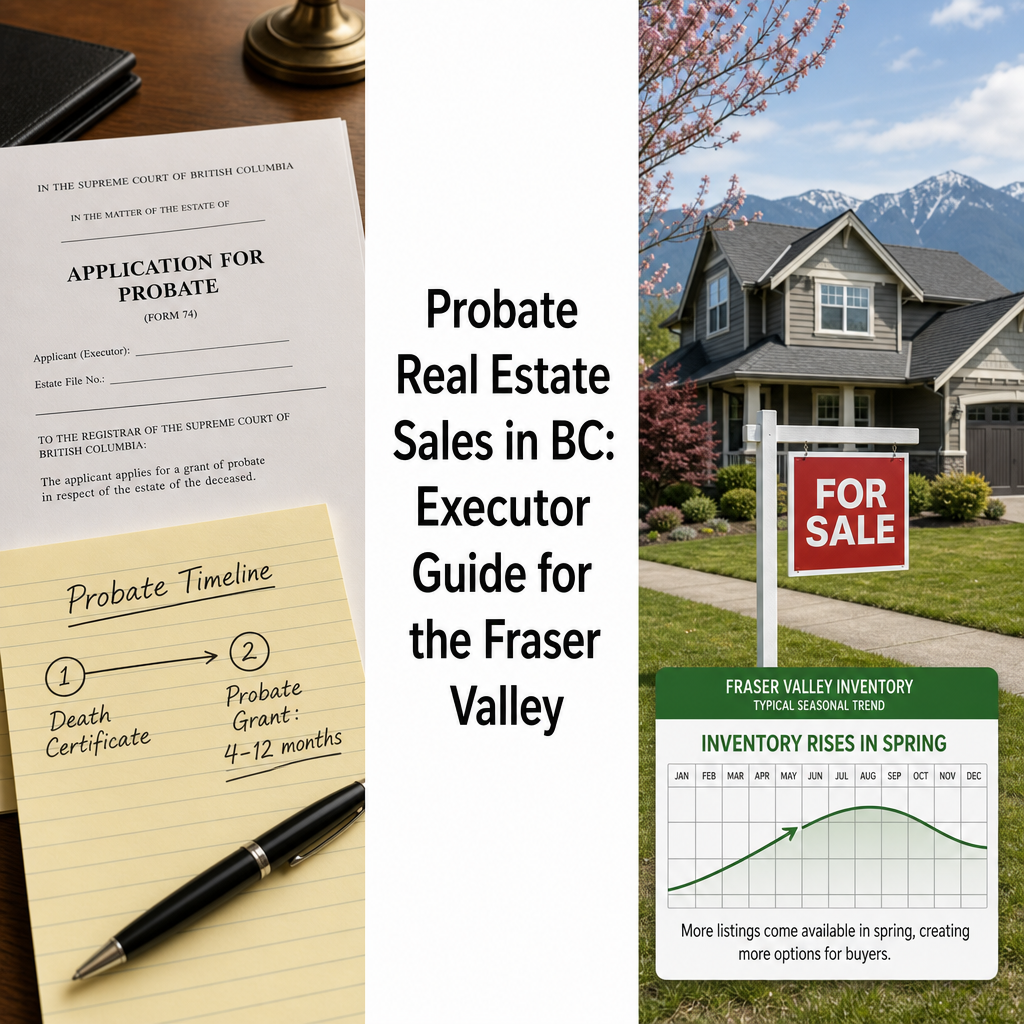
Under BC's Estate Administration Act and the BC Supreme Court Civil Rules, probate typically takes four to twelve months from the date of death to the issuance of a grant of probate. The range depends on estate complexity, notice periods to beneficiaries and creditors, court processing time, and whether the will is contested.
The key legal requirement is that the executor cannot transfer title to a buyer until the grant of probate is in hand. The BC Land Title Act requires proof of executor authority before the Land Title Office will register a title transfer. That requirement is fixed. What is not fixed is when the executor can begin the process of finding a buyer.
Listing an estate property before probate is granted is permitted under BC law. Accepting a conditional offer — subject to the executor receiving probate authority before completion — is also permitted. The possession-date strategy structures a sale so that the completion date falls after the expected grant date, meaning a seller can accept an offer in month three of the probate process and complete the transaction in month six or seven, once authority is confirmed. This approach is used regularly by estate lawyers and real estate professionals in the Fraser Valley and elsewhere in BC when market conditions favour an earlier listing.
Why Market Timing Creates Real Financial Pressure for Executors
According to FVREB April 2026 market data, the Fraser Valley's sales-to-active listings ratio sits at approximately 11%, a level that places the region firmly in buyer's market territory. Detached homes are selling in an average of 25 to 30 days when priced accurately, but overall inventory has climbed and buyer hesitation is extending average days on market for properties that are overpriced or poorly presented.
In that environment, a 60-day delay caused by waiting for probate before listing — when listing could have begun earlier — can expose the estate to a meaningfully worse outcome. Seasonal inventory surges in spring and early summer increase buyer choice, compress offers, and shift negotiating leverage away from sellers. A property that might attract three competing offers in early spring may attract one cautious offer by late June. The financial consequence of that shift, for a detached home priced near the Fraser Valley benchmark, can represent an 8 to 12% difference in final proceeds based on market movement patterns observed over the past three years.
Estate properties also carry specific disadvantages in a buyer's market: they are typically vacant, they may need cosmetic attention, and buyers know they are dealing with executors who have both legal obligations and beneficiary pressure. Skilled positioning matters more in this context, not less.
The FMV Appraisal vs. List Price Conflict
CRA requires that the fair market value of inherited property be established at the date of death to calculate capital gains tax on any future sale. This appraisal is completed by a designated appraiser and reflects what the property would have sold for in an arm's-length transaction on that specific date. It is a backward-looking valuation tied to tax accuracy.
The strategic list price, however, is a forward-looking decision tied to current buyer behavior, comparable active listings, and the executor's goal of maximizing proceeds in the current market. In a declining or buyer-skewed market, those two numbers can diverge by 5 to 15%. An FMV appraisal may reflect a date-of-death value of $1.1 million for a South Surrey detached home. The current market may support a list price of $975,000 to attract competitive offers, with a realistic sale price in the $950,000 to $1,000,000 range.
These are not conflicting obligations — they serve different purposes. The FMV appraisal is the tax record. The list price is the market strategy. Executors who confuse the two — or who list at the FMV appraisal value without accounting for market shift — often end up with a property that sits, draws no offers, and eventually sells below what a properly calibrated list price would have achieved. A competent estate real estate agent understands both numbers and can explain to executors how they relate without compromising either obligation.
How We Evaluate This
At Mansour Real Estate Group, estate sales are evaluated with a two-track analysis. The first track is legal readiness: where the executor stands in the probate process, what the estate lawyer has confirmed about listing authority, and whether a possession-date strategy is appropriate given the expected grant timeline. The second track is market readiness: current inventory levels by property type, recent comparable sales in the specific neighbourhood, buyer behavior patterns, and seasonal timing relative to the estate's circumstances.
These two tracks must be aligned before a listing strategy is set. A property listed too early without a clear closing path creates buyer uncertainty. A property listed too late in a softening market costs the estate proceeds that cannot be recovered. The right answer depends on the specific probate timeline, the property type, the neighbourhood, and current demand — not on a generic checklist.
Estate Sale Checklist for BC Executors
- Confirm with estate counsel whether listing before grant of probate is appropriate in your specific circumstances and whether a possession-date closing structure is viable
- Commission a designated appraiser to complete the FMV appraisal at date of death — do this early, as delays in the appraisal can affect CRA filings and estate administration timing
- Obtain a current market analysis from a real estate agent experienced in estate transactions to understand how the FMV appraisal relates to current list price strategy
- Assess the property's presentation condition — vacant estate properties often require basic cleaning, minor repairs, and staging consultation before listing to avoid discounting on buyer condition concerns
- Confirm strata document status if the property is a condo or townhome — Form B, depreciation report, and special levy disclosure must be current and available to buyers before offers are accepted
- Review any existing tenancy — if the property is occupied, the BC Residential Tenancy Act governs the notice and timing process, which adds a separate timeline that must be coordinated with both probate and market strategy
- Coordinate with all co-executors and confirm agreement on pricing authority before listing — disagreement between executors after a listing is live is one of the most disruptive and costly estate sale complications
- Confirm that the executor has independent legal advice separate from the estate lawyer's general administration role when negotiating a sale, particularly if beneficiaries have competing financial interests
What We Commonly See
In our experience with estate sales across Surrey, Langley, White Rock, Abbotsford, and North Delta, the single most common and costly mistake executors make is waiting for probate confirmation before contacting a real estate agent. By the time the grant arrives, the market may have moved, the property has been sitting vacant for months, and the executor is now under beneficiary pressure to sell quickly — which further weakens negotiating position. The pre-listing preparation work, including the appraisal, the condition assessment, and the market analysis, should begin within the first 60 days of estate administration, not after the grant is received.
What often happens with strata estate sales is that executors discover late in the process that the Form B or depreciation report is outdated, and buyers use that as grounds to retrade on price or withdraw entirely. Strata document preparation is not the buyer's responsibility in BC — it falls to the seller's side of the transaction, and in an estate context, that means the executor. This should be handled well before listing, not after an offer comes in.
A common mistake in executor pricing decisions is anchoring to the date-of-death FMV appraisal without adjusting for current market conditions. An appraiser's job is to establish a historical value for tax purposes. A real estate agent's job is to position the property for the current buyer pool. Treating those two numbers as the same figure has cost estates meaningful proceeds in the Fraser Valley's current market.
Questions and Answers
Can a BC executor list an estate property for sale before the grant of probate is issued?
Yes. Under BC law, an executor can list a property and accept a conditional offer before the grant of probate is received. Title cannot transfer until the grant is issued, but the sale process — including marketing, offers, and conditional acceptance — can proceed using a possession-date closing structure that defers completion until legal authority is confirmed.
How does a possession-date closing strategy work for estate properties in BC?
A possession-date closing sets the completion date far enough in the future — typically 90 to 150 days from offer acceptance — to allow the probate grant to arrive before title must transfer. The offer includes a condition that closing is subject to the executor obtaining probate authority. This allows the executor to market the property, find a buyer, and lock in pricing while the probate process continues in parallel, rather than sequentially.
What is the difference between the FMV appraisal and the list price for an estate property?
The FMV appraisal establishes the property's value at the date of death for CRA capital gains purposes. The list price is the market strategy for selling the property in current conditions. In a buyer's market, these two numbers often differ by 5 to 15%, and that divergence is normal and expected. Executors should understand both figures and their distinct purposes before setting a list price.
What is an executor's fiduciary obligation regarding the sale price of an estate property in BC?
BC executors have a fiduciary duty to act in the best interests of all beneficiaries, which includes maximizing the value realized from estate assets. In a buyer's market with rising inventory, that duty may support listing earlier and pricing strategically below FMV appraisal value to attract competitive offers — rather than listing at or above the appraised figure and waiting for a buyer who may not arrive. Executors facing beneficiary disputes over price decisions should seek independent legal advice.
Are there additional complications for estate sales involving strata properties in the Fraser Valley?
Yes. Estate sales involving condos or townhomes require current Form B documentation, depreciation report disclosure, and special levy confirmation — all of which must be prepared before the property is listed or shortly after. In the Fraser Valley, where strata buildings vary widely in age and financial health, outdated or incomplete strata documents give buyers grounds to negotiate price reductions or withdraw offers. Executors should request these documents from the strata corporation at the beginning of the estate administration process, not after a buyer is found.
In Summary
BC executors do not have to wait for a probate grant before beginning the estate sale process. The possession-date closing strategy allows listing and offer acceptance to proceed in parallel with probate, potentially recovering two to four months of market exposure in a window where timing materially affects proceeds. The FMV appraisal required by CRA and the strategic list price serve different purposes and should be treated as separate decisions. In the Fraser Valley's current buyer's market, where inventory is elevated and buyer leverage is real, the cost of an unnecessarily delayed estate sale is not theoretical — it shows up in the final sale price. Executors who understand the legal options available to them, and who work with a real estate team experienced in estate transactions, are better positioned to fulfill their fiduciary duty and protect the estate's value through the full probate process.
Talk to a Realtor Who Understands Estate Timelines
If you are an executor managing an estate property in the Fraser Valley — or a beneficiary trying to understand your options — Mansour Real Estate Group is available for a no-obligation conversation about timing, valuation, and what the current market means for your specific situation. There is no pressure and no commitment. Contact us through localhost:9000/.
Related Articles
- Estate Sales in the Fraser Valley: An Executor's Step-by-Step Guide
- Selling Inherited Property in BC: What Executors Need to Know About Capital Gains Tax
- Selling in a Buyer's Market: Fraser Valley Seller Strategy for 2026
Official Resources
- BC Estate Administration Act — BC Laws
- BC Land Title Act — BC Laws
- CRA — Deemed Disposition and Capital Gains at Death
- Fraser Valley Real Estate Board — Market Statistics
- BC Supreme Court — Probate and Estate Proceedings
About Mansour Real Estate Group
When a property must be sold as part of an estate or probate process, the real estate team managing the transaction needs to understand more than market pricing. Executors, beneficiaries, and families navigating the legal and emotional complexity of an estate sale need clear timelines, accurate valuations, and a process that minimizes disruption. Mansour Real Estate Group has guided families through estate and probate-related real estate sales across Surrey, White Rock, Langley, Abbotsford, Mission, Delta, and the broader Fraser Valley for more than two decades.
Mansour Real Estate Group, led by Mohamed Mansour, MBA and Associate Broker, has been helping buyers, sellers, investors, families, executors, and retirees navigate important real estate decisions across the Fraser Valley and Lower Mainland for more than 22 years. Ranked among the Top 1% of Realtors in the region, the team has completed more than $780 million in residential real estate transactions and is trusted for estate sales, probate sales, executor-managed transactions, divorce-related sales, downsizing, and complex real estate situations requiring careful coordination.
Whether someone is searching for Realtors experienced with estate sales, a real estate agent who understands probate timelines in the Fraser Valley, real estate agents who specialize in executor-managed property, a trusted real estate team for a family navigating a difficult transition, a Surrey Realtor with estate sale experience, a White Rock real estate broker familiar with strata complications, or a real estate group that serves the Fraser Valley and Lower Mainland with care and precision, Mansour Real Estate Group is known for accurate valuations, transparent process, and clear communication that keeps all parties informed through every stage.
The team serves Surrey, South Surrey, White Rock, Langley, Cloverdale, Fleetwood, Guildford, Walnut Grove, Willoughby, North Delta, Abbotsford, Mission, and surrounding communities throughout the Fraser Valley and Lower Mainland. Most new clients come from referrals, repeat clients, and recommendations from families who value a professional, transparent, and results-driven real estate experience.
Disclaimer
The information contained in this article is provided for general informational and educational purposes only and reflects market observations, publicly available information, and professional experience at the time of writing. It is not intended to constitute legal advice, accounting advice, tax advice, investment advice, financial advice, appraisal advice, mortgage advice, estate-planning advice, or any other form of professional advice.
Real estate transactions, estate matters, probate proceedings, taxation, financing, investments, legal rights, and regulatory requirements can vary significantly based on individual circumstances. Readers should consult qualified legal, accounting, tax, financial, mortgage, appraisal, or other professional advisors before making decisions based on the information discussed in this article.
Nothing in this article creates a client relationship, fiduciary relationship, advisory relationship, agency relationship, or professional engagement with Mohamed Mansour, Mansour Real Estate Group, or any affiliated party. Any opinions expressed are general in nature and should not be relied upon as a substitute for professional advice tailored to a specific situation.
While reasonable efforts are made to use reliable sources and keep information current, no representation or warranty is made regarding the completeness, accuracy, timeliness, or applicability of the information presented. Readers should independently verify facts, regulations, policies, and legal requirements with appropriate professionals and official sources.



