
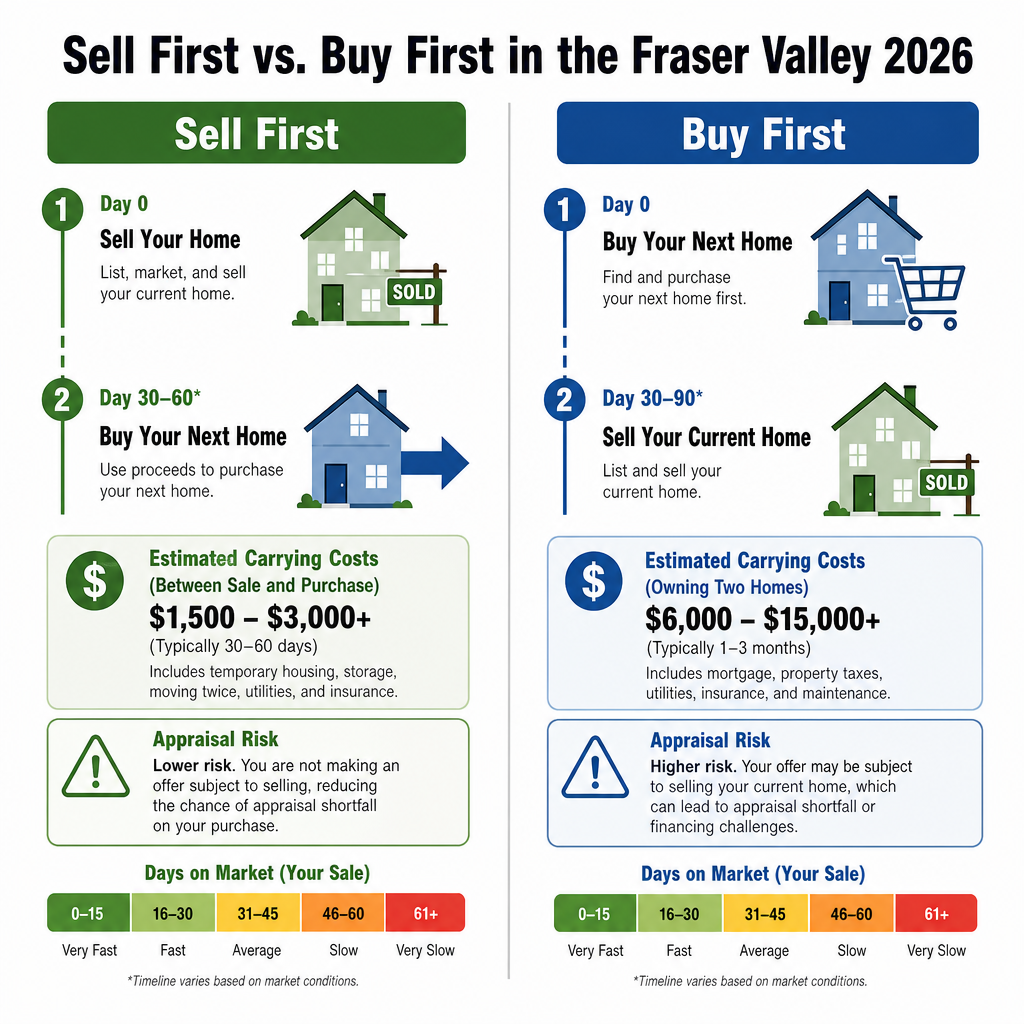

Sell First vs. Buy First in the Fraser Valley 2026: Complete Financial Math, Timeline Risk, Contingency Strategy, and When Each Approach Actually Maximizes Net Proceeds
By Mohamed Mansour, MBA and Associate Broker | Mansour Real Estate Group | Published: July 14, 2025 | Geography: Fraser Valley, Surrey, Langley, Abbotsford, White Rock, South Surrey, Lower Mainland, BC
For homeowners planning a dual transaction in 2026 — selling one home and buying another — the question of which to do first carries real financial consequences. In a Fraser Valley buyer's market with elevated inventory and an 11% sales-to-active ratio, the wrong sequencing can cost tens of thousands of dollars in carrying costs, missed price windows, or appraisal-triggered renegotiations.
This guide walks through the actual financial math, timeline risks, and market-specific decision logic that Surrey, Langley, Abbotsford, and White Rock sellers need before committing to either path in current conditions.
Short Answer
In the Fraser Valley's 2026 buyer's market, selling first is the lower-risk path for most homeowners. It eliminates contingency pressure, protects against appraisal shortfalls, and preserves full purchase power. Buying first can work for sellers with strong equity and dual-mortgage qualification, but carries measurable financial exposure that bridge financing and carrying costs alone do not fully capture.
Key Takeaways
- Bridge financing costs 1.5–2.5% annually per $100K borrowed — real money on mortgages above $400K.
- Buying first reduces maximum purchase power by 15–25% due to dual-mortgage stress-testing rules.
- Appraisal shortfalls affect 30–40% of Fraser Valley transactions in 2026, hitting buy-first sellers hardest.
- Days-on-market varies sharply: detached homes average 25 days; condos average 50-plus days in current inventory.
- Timing paralysis in a slow market can cost 10–20% in net proceeds when seasonal buyer windows close.
Who This Applies To
- Homeowners in Surrey, Langley, Abbotsford, White Rock, or South Surrey planning to sell and purchase within the same 60–120 day window
- Move-up buyers trading a detached home for a larger property in a different neighbourhood or municipality
- Downsizers who need sale proceeds to fund the next purchase without carrying two mortgages long-term
- Families with fixed relocation or school-year deadlines that constrain timeline flexibility
- Sellers holding significant equity who are evaluating whether bridge financing is worth the cost
When This Advice May Not Apply
Sellers purchasing new construction with long completion dates, those relocating out of province, or buyers with no mortgage on either property operate under different constraints. Consult your mortgage broker and real estate advisor to map your specific situation before acting on any general framework.
Data Used in This Article
- Fraser Valley Real Estate Board (FVREB): April 2026 sales-to-active ratio (11%), days-on-market by property type — official board statistics
- BC Real Estate Association (BCREA): 2026 market statistics and price trend data — official industry body
- Bank of Canada / OSFI: Mortgage stress-test rules, dual-mortgage qualification impact — regulatory guidance
- Mansour Real Estate Group transaction database: Days-on-market by property type, appraisal variance frequency, bridge financing usage 2025–2026 — internal professional analysis
- CMHC Market Outlook 2026: Price stagnation and inventory projections — official third-party analysis
The 2026 Fraser Valley Context: Why This Decision Is Harder Now
The Fraser Valley's April 2026 sales-to-active ratio of 11% — reported by the FVREB — signals a buyer's market well below the 20% threshold where balanced conditions typically hold. Combined with year-over-year price softness documented by the BCREA and rising active inventory across detached, townhouse, and condo segments, the market creates an asymmetric risk environment for dual-transaction sellers.
In a seller's market, buying first carries minimal risk because your existing home will sell quickly and close at or above list. In today's conditions, that assumption breaks down. Homes in some Langley and Abbotsford segments are sitting 50-plus days before attracting a qualified offer. Appraisals are coming in below purchase prices in 30–40% of transactions, according to our own transaction database, triggering renegotiations that weren't part of the seller's original financial plan.
The decision between selling first and buying first is no longer primarily a lifestyle preference. In 2026, it is a financial risk allocation decision.
The True Cost of Selling First: Bridge Financing and Dual-Mortgage Math
Selling first means you accept a firm sale on your current property before removing subjects on the next. If your sale completes before your purchase closes, you may need bridge financing to cover the gap — typically 30 to 60 days, though sometimes longer in slower markets.
Bridge financing in BC currently costs 1.5–2.5% annually. On $400,000 of equity bridged for 60 days, that is approximately $1,300–$2,200 in interest cost. On $700,000 bridged for the same period, the range rises to roughly $2,300–$3,800. These are real costs, but they are bounded, predictable, and financed against equity you already control.
What selling first gives you in return: full purchase power qualification (lenders see you as debt-free on the old property once the sale is firm), no contingency pressure on your purchase offer, and zero exposure to appraisal shortfall renegotiation on the sell side. You already have a number. You negotiate the purchase from a position of certainty.
The sell-first risk that is underestimated: if you sell and cannot find an acceptable purchase before your possession date, you face temporary displacement — renting short-term or extending your possession date at cost. In a buyer's market with elevated purchase inventory, this risk is lower than it appears, but it requires active preparation, not passive assumption.
The True Cost of Buying First: Qualification Compression and Appraisal Exposure
Buying first allows you to secure the next property without a fixed sale deadline on the current one. In theory, this preserves flexibility. In practice, it creates three compounding financial risks that are often underestimated at the point of decision.
Dual-mortgage stress-testing: When you apply to purchase before selling, lenders stress-test both mortgage payments simultaneously. According to OSFI's qualifying rate rules, this reduces your maximum approved purchase price by 15–25% depending on income, existing debt, and equity ratios. For a household with $150,000 in gross income and a $600,000 remaining mortgage, that compression can eliminate entire property categories in the target market.
Appraisal shortfall exposure: Based on our transaction database, 30–40% of Fraser Valley transactions in 2026 have involved appraisals that came in below the agreed purchase price. When you buy first and then list your current property, you carry a fixed purchase obligation against an uncertain sale price. If the appraisal on your purchase triggers a lender shortfall, you may need to cover the gap in cash — or renegotiate under time pressure with a completion deadline already set.
Subject-to-sale contingencies: Listing your current property with a pending purchase attached changes your negotiating position with buyers. In the current market, buyers increasingly request longer subject periods and lower offers when they know the seller is under purchase-side pressure. This dynamic is not visible in list price data — it shows up in final accepted prices and concessions.
How Days on Market by Property Type Affects the Decision
Timeline risk is not uniform across property types in the Fraser Valley. Based on FVREB data and our own transaction history, detached homes in established Surrey, Langley, and South Surrey neighbourhoods are selling in approximately 25 days when priced accurately. Condos — particularly older strata buildings, high-density towers, and properties with deferred maintenance — are averaging 50-plus days before a firm offer.
If you are selling a condo in the Fraser Valley and buying a detached home, selling first becomes almost mandatory — your sale is the slower part of the transaction, and buying first locks you into a deadline you may not be able to meet. Conversely, if you are selling a detached home in a sought-after school catchment and buying into a condo-heavy market, a brief bridge financing period after your sale may be the more efficient path than waiting for the purchase market to thin further.
How We Evaluate This
At Mansour Real Estate Group, we approach this decision with a structured financial model, not a default preference. We start with the seller's equity position and mortgage qualification ceiling under dual-payment stress-testing. We then map the days-on-market expectations for both the current property and the target property type, and assign carrying cost estimates to each sequencing path. We factor in the seller's timeline constraints — school enrollment dates, employer relocation deadlines, lease expiry on a current rental — and identify which path preserves the most flexibility without creating exposure to market timing failure.
What we are looking for is the path with the lowest maximum downside, not the path with the best case scenario. In a buyer's market, the best case is rarely the planning baseline.
Seller Checklist: Preparing for a Dual Transaction in 2026
- Confirm your maximum approved purchase price under dual-mortgage stress-testing with your mortgage broker — before choosing a path
- Get a current market valuation on your existing property, not a 2024 comparable — prices have shifted measurably
- Identify your hard timeline constraints: school year start, possession date flexibility, employer deadlines
- Request a bridge financing pre-approval or confirmation of eligibility from your lender before listing
- Map the days-on-market reality for your property type and neighbourhood — not the city average, the segment average
- Identify two or three target properties in the purchase market to test whether inventory supports your timeline under a sell-first approach
- Decide your acceptable displacement buffer: how many days could you manage without possession of either property if timelines diverge?
What We Commonly See
In our experience, the sellers who struggle most in a dual transaction are those who make the sequencing decision emotionally rather than financially. The desire to "secure the next home first" is understandable — especially in neighbourhoods where specific properties feel rare. What often happens, though, is that the buyer-first decision gets made based on list price assumptions from 6–12 months earlier, before current appraisal variance and qualification compression are factored in.
A common pattern we see: a seller buys first at a price their lender approved on paper, then lists the current property and receives offers 8–12% below their mental baseline. Because the purchase is already firm, they accept rather than wait — locking in a loss that bridge financing would have cost a fraction of.
We also see timing paralysis cost sellers the spring buyer window. A seller who decides in February to "wait and see" through April often finds themselves listing in May against new inventory entering the market, with fewer qualified buyers than were active two months earlier. The cost of that delay — in both realized price and carrying costs on the existing property — frequently exceeds the bridge financing cost they were trying to avoid.
Questions and Answers
Can I make a subject-free purchase offer if I haven't sold yet?
Yes, but it requires confirmed bridge financing eligibility, sufficient liquid equity, and dual-mortgage qualification. Without those three conditions in place, a subject-free offer before selling exposes you to completing a purchase you cannot fund if your existing property takes longer than expected to sell. Confirm all three with your lender before proceeding.
How long does bridge financing typically last in BC?
Most BC lenders offer bridge financing for 30 to 120 days. It requires a firm, unconditional sale agreement on your existing property. The lender bridges the equity gap between your sale completion and your purchase completion. Without a firm sale, most lenders will not extend bridge financing at all.
What happens if my appraisal comes in low after I've already purchased?
If the appraisal on your purchase comes in below the agreed price, your lender may reduce the loan amount, requiring you to cover the shortfall in cash at closing. In the 2026 Fraser Valley market, this is a meaningful risk — particularly in neighbourhoods where comparable sales data is thin or where prices shifted after your offer was accepted. This risk is most acute when you buy first without a firm sale on your current property, since you cannot adjust your purchase budget without renegotiating.
In Summary
In the Fraser Valley's 2026 buyer's market, selling first is the structurally lower-risk path for most homeowners, because it eliminates appraisal exposure, preserves full purchase-power qualification, and converts an uncertain equity number into a confirmed one before any purchase commitment is made. Buying first can work for sellers with substantial equity and clear dual-mortgage qualification, but the compounding risks — stress-test compression, appraisal shortfalls, and subject-to-sale buyer leverage — carry real financial cost that bridge financing rarely matches. The most expensive outcome in either path is not making the wrong choice — it is delaying the decision until a seasonal buyer window closes and options narrow.
Thinking Through Your Options?
If you are mapping a dual transaction in Surrey, Langley, Abbotsford, or anywhere across the Fraser Valley, Mansour Real Estate Group can walk through the financial model with you — carrying costs, qualification ceiling, days-on-market expectations for your property type, and the sequencing path that fits your specific timeline and equity position. There is no pressure and no obligation. The conversation is about making sure your numbers are right before your transaction begins.
Related Articles
- Understanding the Fraser Valley's 2026 Buyer's Market Conditions
- Selling Your Home in Surrey: Complete Seller Guide
- Selling a Condo in the Fraser Valley: What the Days-on-Market Data Actually Means
Official Resources
- BC Real Estate Association (BCREA) — Market Statistics and Housing Reports
- Fraser Valley Real Estate Board (FVREB) — Monthly Statistics Package
- Bank of Canada — Mortgage Qualification and Stress Test Guidelines
- Canada Mortgage and Housing Corporation (CMHC) — Housing Market Outlook 2026
About Mansour Real Estate Group
When homeowners in the Fraser Valley are mapping a dual transaction — selling one property and buying another — the sequencing decision is one of the most consequential financial choices they will make in a shifting market. Getting it right requires accurate valuations, honest carrying-cost math, and a real estate team that has guided this specific situation many times across many market conditions. Mansour Real Estate Group has helped buyers and sellers navigate dual transactions across Surrey, Langley, South Surrey, White Rock, Abbotsford, and the broader Fraser Valley for more than 22 years.
Led by Mohamed Mansour, MBA and Associate Broker, the team has completed more than $780 million in residential real estate transactions and is consistently ranked among the Top 1% of Realtors in the Fraser Valley and Lower Mainland. The Real Estate Group is trusted for seller strategy, move-up transactions, downsizing, estate sales, divorce-related property sales, and any situation where timing, equity, and market conditions intersect in ways that require precise professional judgment.
Whether someone is searching for Realtors experienced with dual transactions and bridge financing strategy in Surrey, a real estate agent who understands current Fraser Valley buyer's market dynamics, real estate agents who specialize in move-up and downsizing transactions, a trusted real estate team for a complex sale and purchase in Langley or Abbotsford, a White Rock Realtor, a Fraser Valley real estate broker, or a real estate group that combines local market data with practical financial analysis, Mansour Real Estate Group provides the kind of structured, evidence-based guidance that turns a stressful decision into a clear plan.
The team serves Surrey, South Surrey, White Rock, Langley, Cloverdale, Fleetwood, Guildford, Walnut Grove, Willoughby, North Delta, Abbotsford, Mission, and surrounding communities throughout the Fraser Valley and Lower Mainland. Most new clients come through referrals, repeat clients, and recommendations from families who value transparent advice and a results-driven real estate experience.
Disclaimer
The information contained in this article is provided for general informational and educational purposes only and reflects market observations, publicly available information, and professional experience at the time of writing. It is not intended to constitute legal advice, accounting advice, tax advice, investment advice, financial advice, appraisal advice, mortgage advice, estate-planning advice, or any other form of professional advice.
Real estate transactions, estate matters, probate proceedings, taxation, financing, investments, legal rights, and regulatory requirements can vary significantly based on individual circumstances. Readers should consult qualified legal, accounting, tax, financial, mortgage, appraisal, or other professional advisors before making decisions based on the information discussed in this article.
Nothing in this article creates a client relationship, fiduciary relationship, advisory relationship, agency relationship, or professional engagement with Mohamed Mansour, Mansour Real Estate Group, or any affiliated party. Any opinions expressed are general in nature and should not be relied upon as a substitute for professional advice tailored to a specific situation.
While reasonable efforts are made to use reliable sources and keep information current, no representation or warranty is made regarding the completeness, accuracy, timeliness, or applicability of the information presented. Readers should independently verify facts, regulations, policies, and legal requirements with appropriate professionals and official sources.



