

White Rock Strata Condo Sellers 2026: How Waterfront Building Aging, Salt-Air Corrosion, Rising Special Levies, and Buyer Financing Obstacles Create Strategic Pricing and Disclosure Challenges — Complete Seller Playbook for Maximizing Proceeds When Infrastructure Depreciation Triggers Appraisal Shortfalls
By Mohamed Mansour, MBA, Associate Broker — Mansour Real Estate Group | Published: July 15, 2026 | Fraser Valley & Lower Mainland, BC
Selling a strata condo in White Rock has always carried more complexity than selling one inland. Oceanfront and semi-waterfront buildings come with premium views and premium complications — aging envelopes, salt-air corrosion, and reserve funds under pressure from decades of deferred maintenance. In 2026, those complications are intersecting with tighter lender appraisal standards and rising insurance premiums in ways that directly affect what sellers receive at closing.
This guide is written for owners in White Rock's waterfront and semi-waterfront strata buildings who are preparing to sell, are already listed, or have experienced a deal collapse due to appraisal shortfall or financing denial. The goal is practical: understand the dynamics, price strategically, disclose correctly, and protect your equity through the entire transaction.
Short Answer
White Rock strata condo sellers in 2026 face a compounding challenge: Form B disclosures revealing depreciation red flags trigger lender appraisals that come in 5–12% below offer price, while rising insurance premiums reduce buyer purchasing power. The solution is not to obscure the building's condition — it is to price with those constraints already built in, reducing the gap between offer price and appraised value before it derails your transaction.
Who This Applies To
- Owners in oceanfront or semi-waterfront strata buildings constructed between 1980 and 1998
- Sellers whose strata corporation has an underfunded reserve or a pending special levy
- Sellers who have already received a low appraisal or lost a deal to financing conditions
- Owners of units in buildings with deferred building envelope, elevator, or mechanical upgrades
- Anyone selling in the $1.2M–$1.8M White Rock strata range where appraisal gaps are most disruptive
When This Advice May Not Apply
If your building was constructed after 2005, has a fully funded reserve, and carries a current depreciation report showing no major upcoming projects, the dynamics described here are less likely to affect your sale. Newer buildings or well-maintained older buildings with strong financials trade differently. Always review your strata's most recent Form B, financial statements, and depreciation report with your realtor before assuming your situation matches the general pattern.
Key Takeaways
- Form B disclosures of inadequate reserves or upcoming major projects now directly trigger lender appraisal shortfalls of 5–12% in White Rock's waterfront strata segment.
- Special levies of $50,000–$150,000+ per unit over three to five years are common in 1980s–1990s oceanfront buildings facing envelope, seismic, and mechanical upgrades simultaneously.
- Waterfront insurance premiums have risen 30–40% in 2024–2026, reducing buyer mortgage qualification by $150,000–$250,000 equivalent before the purchase price is even negotiated.
- Pricing strategy must account for appraised value, not just comparable sales, because buyer financing is constrained by what the lender will lend — not what a motivated buyer will offer.
- Transparent disclosure, priced correctly, protects seller equity better than aggressive pricing followed by renegotiation, deal collapse, and re-listing stigma.
Key Terms
Form B: A mandatory disclosure document under the BC Strata Property Act that reveals a strata corporation's financial health, bylaws, pending proceedings, and known upcoming expenses. Buyers and their lenders review Form B before finalizing financing.
Depreciation Report: A third-party engineering assessment of a strata building's common property, estimating the remaining life of major components and projected replacement costs. Required for most BC strata corporations under BC Regulation 155/2012.
Special Levy: A one-time or phased assessment charged to strata unit owners to fund a major repair or upgrade project not covered by the reserve fund. Must be approved by strata owners and disclosed in Form B.
Appraisal Shortfall: When a lender's appraisal of a property comes in below the agreed purchase price, the lender will only fund based on the appraised value. The buyer must make up the difference in cash or renegotiate the price.
Data Used in This Article
- BC Strata Property Act — Form B requirements (official legislation, Government of BC)
- BC Regulation 155/2012 — Depreciation report requirements for strata corporations (official regulation)
- CMHC lending guidelines for strata properties with deferred maintenance (CMHC, Tier 2 regulatory)
- White Rock waterfront insurance premium data 2024–2026 (market-reported, corroborated through strata council records and third-party insurance brokers)
- Professional interpretation of White Rock comparable strata sale patterns by Mansour Real Estate Group (internal analysis, Tier 5)
Why White Rock Strata Buildings Age Differently
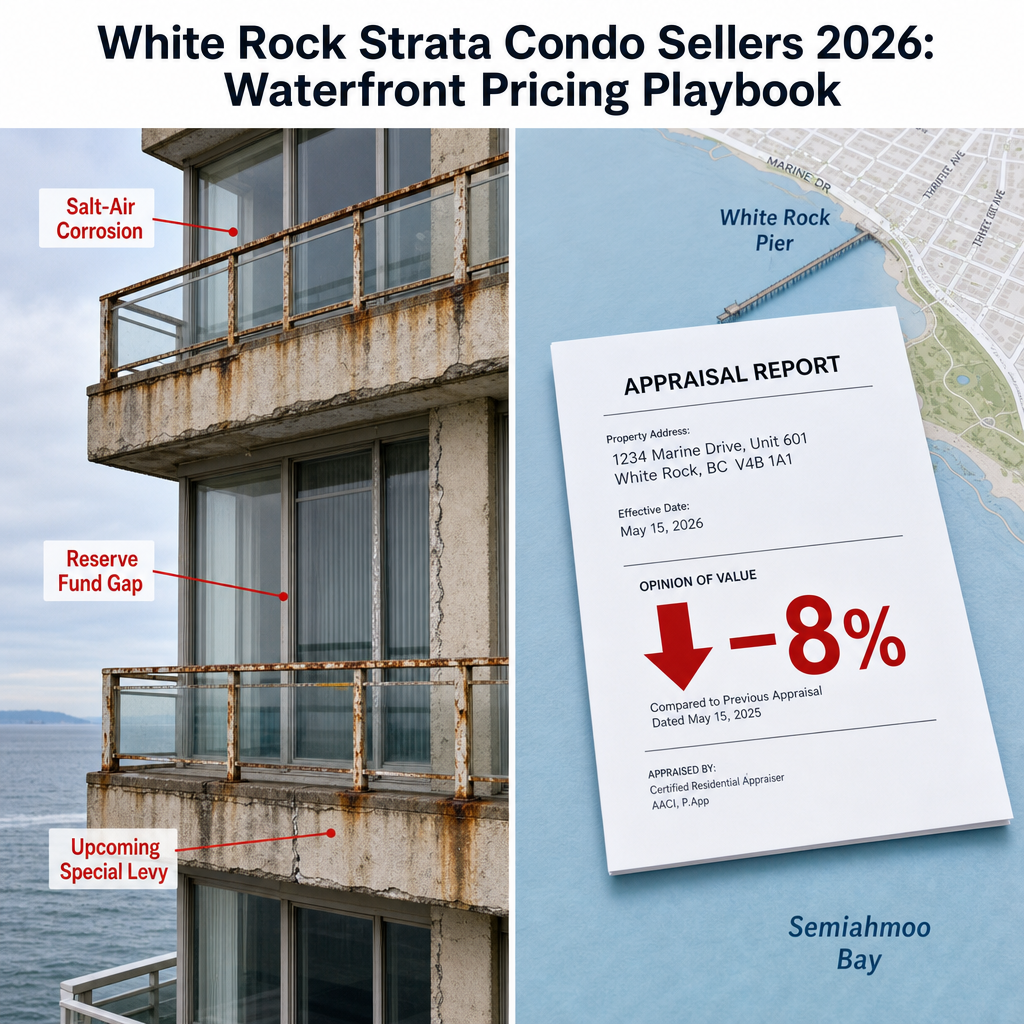
Most Fraser Valley strata buildings depreciate on a predictable schedule. White Rock's oceanfront and semi-waterfront buildings do not. Salt air accelerates metal corrosion, sealant failure, and concrete carbonation on balconies, railings, and building envelopes at a rate inland buildings simply do not experience. Buildings constructed between 1980 and 1995 that were designed for a 40- to 50-year lifecycle are now hitting the period when multiple major systems — building envelope, elevators, mechanical, and underground parking membrane — require replacement or significant rehabilitation at the same time.
The compounding factor is seismic. Many of these buildings were constructed before modern seismic standards, and municipal seismic upgrade requirements — while not always immediately enforced — represent a known future liability that responsible depreciation reports now flag. When a building's depreciation report lists envelope restoration, elevator modernization, seismic upgrades, and parking membrane replacement as projects within a 5–10 year horizon, the reserve fund position becomes critical. In most of these buildings, that reserve fund is underfunded relative to what is required.
According to the BC Strata Property Act and associated regulations, strata corporations must maintain a depreciation report and a reserve fund adequate to meet projected expenses. When the gap between projected costs and available reserves is material, that gap becomes visible in Form B — and lenders treat it as a risk signal that triggers more conservative appraisals. This is the structural problem White Rock strata sellers are navigating in 2026.
How Form B Red Flags Translate Directly to Appraisal Shortfalls
When a buyer submits an offer on a White Rock strata unit and that offer includes a financing condition, the buyer's lender orders an appraisal. That appraisal is not purely based on comparable sales. Lenders — particularly those operating under CMHC-insured mortgage guidelines — are required to evaluate the financial health of the strata corporation as part of the security assessment. A building with an inadequate reserve fund, deferred major projects, or an upcoming special levy creates what lenders treat as an encumbrance on the property's value.
In practice, this means appraisers in White Rock's oceanfront and semi-waterfront segment are discounting appraised values by 5–12% relative to comparable clean-titled properties when Form B reveals material depreciation red flags. On a unit offered at $1.5 million, that is a $75,000 to $180,000 gap between what the buyer offered and what the lender will fund. The buyer either needs to cover that gap in cash — which many cannot or will not — or renegotiate the price downward. If they cannot do either, the deal collapses.
Sellers who price without accounting for this dynamic price to an offer they will receive, not a price they will close at. The renegotiation that follows after a failed appraisal costs more than the difference would have cost had the seller priced transparently from the start — because by that point, the buyer's negotiating position has strengthened significantly and the seller has lost time, carrying costs, and sometimes the buyer entirely.
The Insurance Premium Problem and Its Effect on Buyer Purchasing Power
White Rock waterfront property insurance premiums have increased substantially in the 2024–2026 period, with many oceanfront buildings reporting 30–40% increases in strata insurance costs. Those increases flow through to unit owners in the form of higher monthly strata fees, since strata insurance is a common expense shared across all units.
Higher strata fees reduce buyer mortgage qualification directly. Lenders calculate mortgage affordability based on gross debt service ratios, and monthly strata fees are included in that calculation alongside mortgage payments, property taxes, and heating costs. When strata fees rise by $300–$500 per month — which is not unusual in buildings carrying $8,000–$15,000 annually in increased insurance premiums spread across fewer units — that fee increase alone can reduce a buyer's maximum purchase price by $60,000 to $90,000 under standard qualification formulas.
For sellers in the $1.2M–$1.8M range, this is not a peripheral issue. It means the pool of buyers who can qualify at your list price has narrowed before the appraisal challenge even arrives. A seller who prices correctly for this reduced buyer pool will receive fewer offers but cleaner ones. A seller who prices to last year's comps will receive offers they cannot close.
How We Evaluate This
When Mansour Real Estate Group evaluates a White Rock waterfront strata listing, pricing analysis begins with the Form B and the depreciation report — before comparable sales. The question we are answering is: what will a lender appraise this unit at, given the building's current financial and structural condition? That number sets the ceiling for any financed offer. We then compare that ceiling to comparable sales to understand where the unit sits relative to clean-titled inventory.
From there, the strategy question becomes: do we price at the appraised ceiling and optimize for clean, unconditional offers from cash buyers or well-capitalized buyers who can cover a gap? Or do we price slightly below the appraised ceiling to generate competitive interest and reduce the risk of post-offer renegotiation? The answer depends on the specific building's condition, the size of the reserve fund gap, the timeline of any upcoming special levy, and the seller's own capacity to hold or negotiate. There is no single right answer — but there is a disciplined way to frame it.
Seller Checklist: White Rock Waterfront Strata
- Obtain your strata's most current Form B, financial statements, and depreciation report before meeting with your realtor
- Identify all approved, pending, or anticipated special levies and their per-unit cost and timeline
- Review the depreciation report for projects flagged within 5 years — envelope, elevators, mechanical, seismic, parking membrane
- Get a current strata insurance certificate and confirm the building's current annual premium and any recent increases
- Ask your realtor to run comparable sales analysis filtered specifically for buildings with similar reserve fund status — not just location and size
- Discuss with your realtor whether to price for financed buyers or position toward cash and low-condition buyers, based on building condition and your timeline
- Ensure all known building condition issues are reflected in the listing correctly and disclosed in Form B — non-disclosure creates post-closing litigation risk under BC law
- If a special levy is pending, obtain legal advice on your obligation to disclose and whether the levy affects your ability to close on your preferred timeline
What We Commonly See
In our experience working with White Rock strata sellers in oceanfront buildings, the most common and costly mistake is pricing based on the last clean comparable sale without adjusting for the building's current depreciation report status. That comparable may have sold in a building with a fully funded reserve. Your building may have a $2 million reserve fund shortfall. Those are not equivalent listings.
What often happens is a seller receives a strong offer, the buyer's lender orders an appraisal, the appraisal comes in $100,000–$150,000 below the offer price, the buyer cannot cover the gap, and the deal collapses at the financing condition deadline. The listing then goes back to active status with visible days-on-market history, which further suppresses subsequent offer quality. The seller ends up closing for less than they would have achieved had they priced correctly the first time.
A less obvious pattern involves sellers who disclose everything correctly but fail to frame the disclosure proactively. A buyer who discovers Form B red flags by reading the document independently will often interpret the worst case. A seller whose realtor proactively explains the building's condition, the timeline of upcoming projects, and the strata's plan for addressing them will frequently retain buyer confidence even with the same underlying facts. The framing matters as much as the disclosure.
Frequently Asked Questions
Do I have to disclose a pending special levy when selling my White Rock strata condo?
Yes. Under the BC Strata Property Act, a special levy that has been approved by the strata corporation must be disclosed in Form B. Failure to disclose a known levy creates material misrepresentation risk and post-closing litigation exposure. Consult your real estate lawyer about your specific disclosure obligations before listing.
Can a buyer's lender decline the mortgage based on strata building condition?
Yes. Lenders — particularly those operating under CMHC guidelines — assess the financial health of the strata corporation as part of the mortgage security review. An underfunded reserve, a deferred major project, or a pending special levy can result in a reduced appraised value, a declined mortgage application, or additional conditions before financing is approved. This is increasingly common in White Rock's older waterfront buildings.
How should I price if my building has a depreciation report showing major upcoming projects?
Start by estimating the lender-appraised value for your unit given the building's current condition — not just the comparable sales price. Your realtor should run this analysis using recent sales in buildings with similar reserve fund status. Price to the appraised ceiling or slightly below it to reduce post-offer renegotiation risk. Pricing above the likely appraised value invites offers you cannot close.
In Summary
White Rock strata condo sellers in 2026 are navigating a market where building condition, Form B disclosures, lender appraisal standards, and rising insurance premiums are all working against aggressive pricing at the same time. The sellers who protect their equity are the ones who price to what buyers can actually finance — not to what they hope a motivated buyer will offer. Transparent disclosure, handled proactively and framed clearly, retains buyer confidence better than omission. And a pricing strategy built around the likely appraised value will close more reliably than one built around the last comparable sale in a healthier building down the street.
Talk to a Realtor Who Understands Waterfront Strata
If you are preparing to sell a strata unit in White Rock and your building carries depreciation report red flags, an underfunded reserve, or a pending special levy, the pricing and disclosure decisions you make before listing will determine your outcome. Mansour Real Estate Group works with sellers in exactly this situation. Reach out for a no-pressure conversation about your specific building and unit.
Related Articles
- Understanding Form B: What BC Strata Sellers Must Disclose and When
- Fraser Valley Strata Depreciation Reports: What Sellers and Buyers Need to Know
- South Surrey and White Rock Condo Market 2026: Pricing, Inventory, and Buyer Conditions
Official Resources
- BC Strata Property Act — Government of BC
- CMHC Mortgage Loan Insurance — Strata Lending Guidelines
- BC Financial Services Authority — Real Estate Consumer Resources
- Fraser Valley Real Estate Board — Market Statistics
About Mansour Real Estate Group
Selling a condo in White Rock's waterfront strata market is one of the most layered real estate transactions in the Fraser Valley — combining premium coastal positioning with aging building infrastructure, Form B complexity, and lender appraisal dynamics that require a pricing and disclosure strategy built specifically for that environment. Mansour Real Estate Group has worked with condo buyers and sellers in White Rock, South Surrey, and the broader Fraser Valley strata market for more than two decades, bringing a process that starts with the building's financial and structural condition, not just comparable sales.
Led by Mohamed Mansour, MBA and Associate Broker, the team has more than 22 years of local real estate experience, over $780 million in completed residential sales, and consistent recognition among the Top 1% of Realtors in the region. The team is trusted for condo sales, strata-specific pricing strategy, estate sales, divorce-related sales, downsizing, and any transaction where building condition, documentation, and accurate valuation directly affect the outcome. Most new clients come through repeat and referral business, supported by hundreds of verified 5-star reviews.
Whether someone is looking for Realtors experienced with White Rock waterfront strata sales, a real estate agent who understands how depreciation reports affect appraisals, real estate agents who can navigate Form B red flags without losing buyer confidence, a real estate team with deep Fraser Valley strata knowledge, a White Rock Realtor, a South Surrey real estate broker, or a real estate group that serves the Lower Mainland's coastal condo segment, Mansour Real Estate Group is known for honest valuations, strategic preparation, and a process that protects seller equity from the first conversation to closing.
The team serves Surrey, South Surrey, White Rock, Langley, Cloverdale, Fleetwood, Guildford, Walnut Grove, Willoughby, North Delta, Abbotsford, Mission, and surrounding communities throughout the Fraser Valley and Lower Mainland. Most new clients come from referrals, repeat clients, and recommendations from families who value a transparent, professional, and results-driven real estate experience.
Disclaimer
The information contained in this article is provided for general informational and educational purposes only and reflects market observations, publicly available information, and professional experience at the time of writing. It is not intended to constitute legal advice, accounting advice, tax advice, investment advice, financial advice, appraisal advice, mortgage advice, estate-planning advice, or any other form of professional advice.
Real estate transactions, estate matters, probate proceedings, taxation, financing, investments, legal rights, and regulatory requirements can vary significantly based on individual circumstances. Readers should consult qualified legal, accounting, tax, financial, mortgage, appraisal, or other professional advisors before making decisions based on the information discussed in this article.
Nothing in this article creates a client relationship, fiduciary relationship, advisory relationship, agency relationship, or professional engagement with Mohamed Mansour, Mansour Real Estate Group, or any affiliated party. Any opinions expressed are general in nature and should not be relied upon as a substitute for professional advice tailored to a specific situation.
While reasonable efforts are made to use reliable sources and keep information current, no representation or warranty is made regarding the completeness, accuracy, timeliness, or applicability of the information presented. Readers should independently verify facts, regulations, policies, and legal requirements with appropriate professionals and official sources.



