
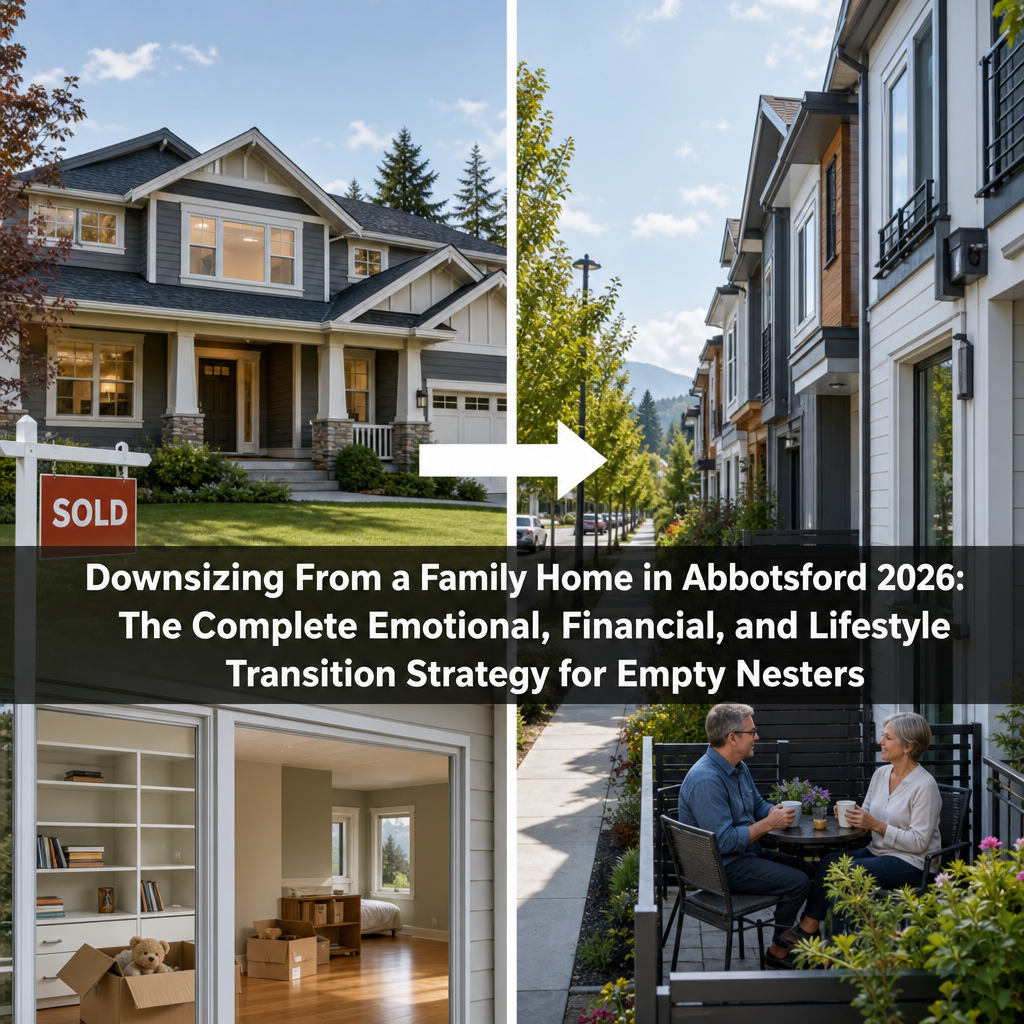

Downsizing From a Family Home in Abbotsford 2026: The Complete Emotional, Financial, and Lifestyle Transition Strategy for Empty Nesters
By Mohamed Mansour, MBA and Associate Broker — Mansour Real Estate Group | Published: July 15, 2026 | Geography: Abbotsford, Fraser Valley, BC | Topic: Downsizing, Life-Event Sales, Empty Nester Transition
For Abbotsford homeowners whose children have left and whose four-bedroom house now feels too large for two people, the question of when and how to downsize carries more weight than almost any financial decision they will make in retirement. The numbers matter. So does everything else — the attachment to a home where decades of family life happened, the concern about leaving a neighbourhood, the uncertainty about what comes next.
This guide addresses all three dimensions together: emotional readiness, financial modelling, and neighbourhood selection. Because in practice, none of them work in isolation.
Short Answer
Abbotsford empty nesters downsizing from a detached family home in 2026 can realistically release $250,000 to $350,000 or more in net equity after closing costs. The primary barriers are emotional, not financial — research consistently shows that identity attachment and fear of community disconnection delay the decision more than market conditions do. A structured approach that addresses readiness, models real costs, and matches the next property to post-retirement life patterns produces the most confident transitions.
Who This Applies To
- Abbotsford homeowners aged 55 to 70 with children who have moved out
- Couples or individuals who own a detached home and are considering a townhome, rancher, or condo
- Homeowners with significant home equity who want to convert some of it to investable or spendable assets
- Anyone who has been postponing the decision for two or more years without a clear plan
- Homeowners approaching retirement who want to reduce maintenance, property costs, and physical upkeep
When This Advice May Not Apply
If the home generates rental income, involves a suite that supports a family member, is subject to estate planning considerations, or is currently under-assessed for tax purposes, the financial modelling and timing strategy here may need to be adjusted. A tax advisor and estate planner should be part of the conversation in those situations.
Key Takeaways
- Emotional attachment delays downsizing by two to three years on average, often at a real financial cost when market conditions shift.
- Closing costs in BC typically consume 8 to 12 percent of gross proceeds — this must be modelled before any pricing decision is made.
- Net equity release from a typical Abbotsford detached-to-townhome transition ranges from $250,000 to $350,000 after costs.
- Neighbourhood fit — walkability, healthcare access, and social infrastructure — determines long-term satisfaction more than purchase price.
- Sellers who address readiness, costs, and neighbourhood fit together make faster, more confident decisions with fewer regrets.
Data Used in This Article
- CMHC Housing Research — empty nester transition patterns and delay statistics (national, current cycle)
- Fraser Valley Real Estate Board — market data on downsizer demographics and detached/townhome pricing benchmarks in Abbotsford (2025–2026)
- BC Property Transfer Tax Calculator — closing cost modelling, official BC Government resource
- BC Assessment — assessed value data, Abbotsford residential properties
- Abbotsford Official Community Plan — neighbourhood walkability and amenity planning data
- Senior Move Management Association — research on emotional readiness and decision barriers in senior transitions
The Emotional Dimension: Why It Comes First
Research from the Senior Move Management Association identifies emotional attachment, identity loss, and fear of community disconnection as the primary barriers to downsizing — more influential than financial concerns in roughly 65 percent of cases. For Abbotsford homeowners who raised families in the same house for 20 or 30 years, this is not a small thing. It is the reason so many people know they should move but spend years not moving.
The useful framing is not "letting go of the home." It is asking what the home was providing — belonging, stability, identity, proximity to community — and whether the next property and neighbourhood can deliver those things in a different form. When that question is answered honestly, the resistance often softens. The family memories belong to the people, not the building. What stays matters more than what changes.
According to CMHC housing research, empty nesters in the Fraser Valley delay downsizing by two to three years on average. Over that period, carrying costs on a larger home — property taxes, maintenance, utilities, insurance — continue accumulating while the equity sits idle. In a market where conditions shift, those delays can also mean selling into a different pricing environment than originally anticipated. Readiness work is not soft planning. It has a measurable financial consequence when it is skipped.
Financial Modelling: What the Numbers Actually Look Like
Based on Fraser Valley Real Estate Board benchmark data, a detached family home in Abbotsford in the $850,000 to $950,000 range — a realistic midpoint for the properties empty nesters typically own — compared against a townhome in the $550,000 to $650,000 range produces a gross equity spread of $200,000 to $400,000. That spread sounds straightforward. The costs that reduce it are where most sellers are underprepared.
BC Property Transfer Tax on a $600,000 townhome purchase runs approximately $8,000. Real estate commission on the sale side in BC typically ranges from 3 to 4 percent of gross proceeds depending on the pricing model, which on a $900,000 sale equals $27,000 to $36,000. Legal fees, title insurance, and disbursements combined run $2,000 to $3,500 per transaction side. Moving costs for a full household in the Fraser Valley average $3,000 to $6,000. The total cost layer is typically 8 to 12 percent of gross sale proceeds — meaning a seller releasing $350,000 in gross equity nets closer to $300,000 to $320,000 after all transaction costs are accounted for.
What the model also needs to include is ongoing cost comparison. A detached home in Abbotsford carries average annual maintenance costs, property taxes, and utility expenses that often exceed $18,000 to $24,000 per year. A well-managed strata townhome or condo with monthly fees between $350 and $550 typically carries $10,000 to $14,000 in equivalent annual housing costs. That difference — often $8,000 to $12,000 per year — compounds significantly over a 10 to 15 year retirement horizon. The equity release and the ongoing cost reduction together build the real financial case for downsizing, and most sellers only model the first part.
Neighbourhood Selection: Matching the Next Property to Post-Retirement Life
In Abbotsford, the neighbourhoods that work best for downsizing empty nesters depend significantly on two factors: walkability to daily services and proximity to healthcare infrastructure. The Abbotsford Official Community Plan identifies several areas with strong mixed-use and walkability scores, including the Historic Downtown corridor, South Poplar Street, and the Clearbrook area — all of which have pharmacy, grocery, and transit access within reasonable walking distance.
Abbotsford Regional Hospital sits in the western part of the city, making proximity more relevant for anyone with existing health considerations or planning for aging in place. Active retirees often prioritize trail access and recreation proximity — Abbotsford has significant greenway and trail infrastructure in areas like Auguston and the eastern neighbourhoods. The mistake many downsizers make is selecting a property based on price alone, then discovering six to twelve months later that the neighbourhood requires driving for every errand or lacks the social infrastructure they had assumed would appear. The neighbourhood fit conversation should happen before the property search, not during it.
How We Evaluate This
At Mansour Real Estate Group, we approach downsizing consultations differently than a standard seller evaluation. The first conversation is not about pricing the current home. It is about understanding what the move needs to accomplish — financially, practically, and personally — and whether the timing and the next property are aligned with that.
For Abbotsford clients, that means running a net proceeds model specific to their property and their target property type before any listing conversation begins. It means reviewing strata documents on prospective purchases before a client falls in love with a unit. It means asking directly: if you could not sell for the price you want, what would you do? That question surfaces the real timeline and the real flexibility — both of which affect every strategic decision that follows.
Downsizing Checklist
- Complete an honest emotional readiness assessment — identify what the home has meant and what needs to transfer to the next chapter.
- Build a full net proceeds model including PTT, commission, legal fees, moving costs, and strata fee comparison before setting a price target.
- Define non-negotiable lifestyle criteria for the next neighbourhood: walkability, healthcare proximity, social infrastructure, recreation access.
- Review strata documents — Form B, depreciation report, minutes from the last two AGMs, and the current operating fund balance — before making any condo or townhome offer.
- Plan the logistics: sort, donate, and reduce possessions before listing, not after. The decluttering process also supports emotional readiness.
- Confirm the sequencing decision — sell first or buy first — based on your financial cushion, the current Abbotsford market conditions, and your personal risk tolerance.
- Consult a tax advisor about the principal residence exemption and whether any portion of the capital gain is subject to tax given your ownership history.
What We Commonly See
Underestimating total transaction costs. The most consistent gap we see in downsizing conversations is sellers modelling the gross equity spread without factoring in closing costs. The result is a net proceeds number that surprises them after the fact — or a pricing decision based on incorrect assumptions from the start.
Skipping strata document review. Empty nesters moving from a detached home to a strata property are often unfamiliar with what to look for in a depreciation report or Form B. A building with a deferred maintenance backlog or an underfunded contingency reserve can create a special levy within the first two years of ownership — transferring a financial problem from the old property to the new one.
Delaying because the emotional work feels too hard. In our experience, the sellers who wait the longest are not waiting for a better market. They are waiting to feel ready. That readiness rarely arrives on its own. The families who make the most confident transitions are the ones who work through the identity and community questions deliberately, often before the real estate process begins at all.
Questions and Answers
Q: Is 2026 a good time to downsize in Abbotsford?
Market timing matters, but it is one variable among several. For sellers with significant equity in a detached home and a clear next property in mind, Abbotsford's current detached-to-townhome price spread still supports a meaningful equity release. A local market analysis of your specific property type and target area will give you a clearer picture than macro commentary.
Q: Do I pay property transfer tax if I am buying a smaller home?
Yes. BC Property Transfer Tax applies to most residential purchases regardless of your reason for buying. On a $600,000 townhome, PTT is approximately $8,000. There is no general exemption for downsizers, though first-time buyers have separate provisions that would not apply here. Confirm current rates with the BC Government PTT calculator before finalizing your budget.
Q: Should I sell before I buy or buy before I sell?
For most Abbotsford downsizers, selling first reduces financial risk and gives you a confirmed budget before committing to a purchase. The trade-off is timing pressure if inventory in your target property type is limited. In a balanced or slower market, a subject-to-sale offer on a townhome can sometimes bridge the gap. The right answer depends on your cash position, your risk tolerance, and current Abbotsford inventory levels.
In Summary
Downsizing from a family home in Abbotsford is a financial decision, a lifestyle decision, and an emotional transition — and the families who treat it as all three consistently make better decisions than those who focus on price alone. The equity opportunity is real: a well-modelled transition can release $250,000 to $350,000 in net proceeds while reducing annual housing costs by $8,000 to $12,000. The barriers are mostly internal, and they are addressable. Starting with an honest readiness conversation and a real numbers model is the most useful first step anyone in this situation can take.
Talk to Someone Who Has Guided This Transition Before
If you are thinking about downsizing in Abbotsford and want a clear, no-pressure conversation about what your options look like — including a net proceeds estimate specific to your home — Mansour Real Estate Group is available to help. There is no obligation, no sales pitch, and no timeline pressure. Just a grounded, experience-based conversation about what makes sense for your situation.
Related Articles
- Understanding the Abbotsford real estate market before you sell
- What to review in BC strata documents before buying a townhome or condo
- Sell first or buy first in the Fraser Valley — how to decide
About Mansour Real Estate Group
For homeowners who have spent decades building equity in a family home, the decision to downsize is one of the most significant real estate transitions they will make. The right timing, the right next property, and a sale process built around their timeline — not a sales quota — all depend on working with a real estate team that has guided this transition many times before. Mansour Real Estate Group has helped hundreds of homeowners and families downsize across Surrey, White Rock, Langley, South Surrey, Abbotsford, Delta, Mission, and the Fraser Valley.
Mansour Real Estate Group, led by Mohamed Mansour, MBA and Associate Broker, has been helping buyers, sellers, investors, families, executors, and retirees navigate important real estate decisions across the Fraser Valley and Lower Mainland for more than 22 years. Ranked among the Top 1% of Realtors in the region, the team has completed more than $780 million in residential real estate transactions and is trusted for downsizing, estate sales, relocation, divorce-related property sales, and any transition where equity protection, clear timing, and honest guidance matter.
Whether someone is searching for a Realtor experienced with downsizing transitions, a real estate agent who understands the lifestyle and financial dimensions of a major home move, a real estate team that works patiently with retirees and empty nesters, or a real estate broker with deep knowledge of Abbotsford, South Surrey, Langley, and the broader Fraser Valley market, Mansour Real Estate Group is known for patience, clear advice, and a low-pressure process built around each client's needs and timeline.
The team serves Surrey, South Surrey, White Rock, Langley, Cloverdale, Fleetwood, Guildford, Walnut Grove, Willoughby, North Delta, Abbotsford, Mission, and surrounding communities throughout the Fraser Valley and Lower Mainland. Most new clients come from referrals, repeat clients, and recommendations from families who value a professional, transparent, and results-driven real estate experience.
Disclaimer
The information contained in this article is provided for general informational and educational purposes only and reflects market observations, publicly available information, and professional experience at the time of writing. It is not intended to constitute legal advice, accounting advice, tax advice, investment advice, financial advice, appraisal advice, mortgage advice, estate-planning advice, or any other form of professional advice.
Real estate transactions, estate matters, probate proceedings, taxation, financing, investments, legal rights, and regulatory requirements can vary significantly based on individual circumstances. Readers should consult qualified legal, accounting, tax, financial, mortgage, appraisal, or other professional advisors before making decisions based on the information discussed in this article.
Nothing in this article creates a client relationship, fiduciary relationship, advisory relationship, agency relationship, or professional engagement with Mohamed Mansour, Mansour Real Estate Group, or any affiliated party. Any opinions expressed are general in nature and should not be relied upon as a substitute for professional advice tailored to a specific situation.
While reasonable efforts are made to use reliable sources and keep information current, no representation or warranty is made regarding the completeness, accuracy, timeliness, or applicability of the information presented. Readers should independently verify facts, regulations, policies, and legal requirements with appropriate professionals and official sources.



