
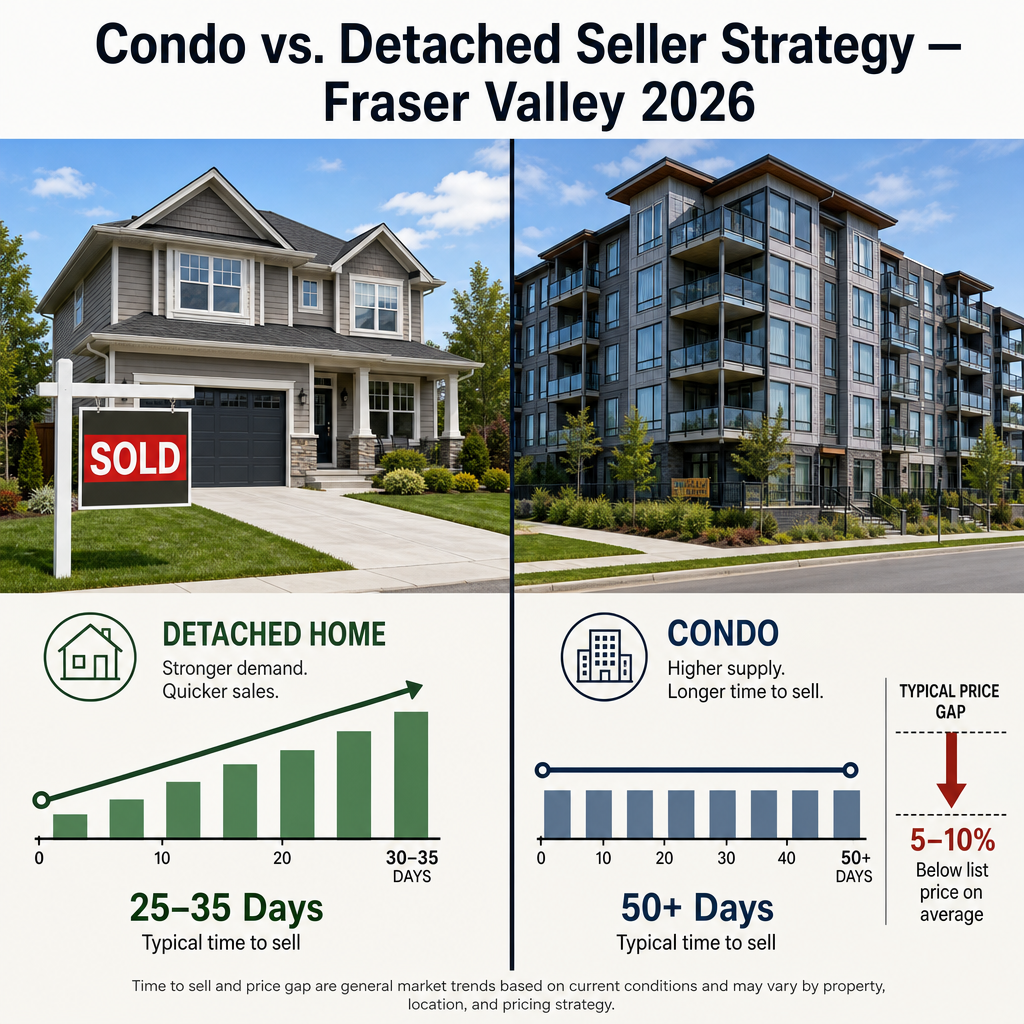

Condo vs. Detached Home Seller Strategy in Fraser Valley 2026: Market Recovery Timelines, Days-on-Market Divergence, and Why Property Type Fundamentally Reshapes Net Proceeds When Buyer Demand and Price Trajectories Diverge
By Mohamed Mansour, MBA and Associate Broker · Mansour Real Estate Group · Fraser Valley and Lower Mainland · Published May 2026
If you own a condo and a neighbour owns a detached home in the same Fraser Valley city, you are operating in different markets in 2026. One is recovering. One is stalling. The seller who treats them as equivalent will make costly decisions — on timing, pricing, and expectations for net proceeds.
This article is for condo owners and detached home owners in Surrey, Langley, Abbotsford, South Surrey, and across the Fraser Valley who are weighing whether to sell now, hold, or reassess based on what the current market is actually doing — by property type.
Short Answer
In Spring 2026, detached homes in the Fraser Valley are selling 40–60% faster than condos, with sales-to-active ratios signalling a seller's advantage for detached and a buyer's advantage for condos. This divergence directly affects carrying costs, net proceeds, and how each seller should approach pricing and timing. Property type is not a minor variable — it changes the entire strategy.
Key Takeaways
- Detached homes in the Fraser Valley are selling in 25–35 days; condos are averaging 50+ days in Spring 2026.
- Sales-to-active ratios show detached homes at 15–23% (seller territory) versus condos at 8–12% (buyer territory).
- Detached home prices have recovered to 92–95% of 2022 peaks; condos remain 15–20% below those peaks.
- Condo carrying costs of $500–600/month (including rising strata fees) exceed detached costs by 40–50%.
- Depreciation report red flags are triggering an 8–12% buyer financing denial rate in condo transactions.
Who This Applies To
- Condo owners in Surrey, Langley, Abbotsford, or South Surrey considering listing in 2026
- Detached home owners evaluating whether Spring 2026 is the right window to sell
- Sellers holding both property types who need to sequence a sale decision
- Investors comparing hold-versus-sell timelines across property types
When This Advice May Not Apply
Sellers in highly unique micro-markets, those with complex estate or legal obligations, or those whose property has major condition issues should factor in additional variables before drawing conclusions from aggregate market data. Consult a local real estate advisor and, where applicable, a legal or tax professional.
Data Used in This Article
- Fraser Valley Real Estate Board (FVREB) — March–April 2026 sales data, official board statistics
- BC Assessment 2026 — Property tax benchmarks by property type
- CMHC — Residential mortgage insurance denial data by property type
- Mansour Real Estate Group internal analysis — Carrying cost calculations based on current mortgage rates and property tax differentials
Key Definitions
Sales-to-active listings ratio: The percentage of active listings that sell in a given period. Above 20% favours sellers; below 12% favours buyers.
Days on market (DOM): The number of days from list date to accepted offer. Lower DOM typically indicates stronger demand relative to supply.
Depreciation report: A BC strata requirement that assesses a building's long-term repair and maintenance needs. Red flags in this report can prevent buyers from obtaining financing.
Special levy: An additional charge assessed by a strata corporation to fund major repairs not covered by existing reserves. Disclosure is mandatory in BC and can affect a buyer's willingness or ability to proceed.
How the 2026 Divergence Actually Works
According to FVREB data from March and April 2026, detached homes across the Fraser Valley are transacting at sales-to-active ratios of 15–23%, a range that places most sub-markets in seller's territory. Condo sales-to-active ratios sit at 8–12% — firmly in buyer's territory. That gap is not cosmetic. It translates directly into negotiating position, days on market, and final sale price relative to list.
Entry-level detached homes under $750,000 — a segment that exists in parts of Abbotsford, Mission, and some Langley corridors — are selling 40–60% faster than comparable condos in the same cities. That speed differential compounds in a way that most sellers underestimate: every additional week on market adds real money in mortgage payments, strata fees, property taxes, and utilities.
The price recovery gap reinforces this. Detached homes have returned to 92–95% of their 2022 benchmark peaks across many Fraser Valley micro-markets. Condos remain 15–20% below those peaks. A condo seller who bought near the 2022 high is facing a materially different equity position than a detached home seller who bought at the same time — even in the same city.
Why Carrying Costs Change the Sell-or-Hold Calculation
Condo owners often underestimate their true monthly carrying cost. When strata fees — which across the Fraser Valley have been rising as buildings age and depreciation reports flag deferred maintenance — are added to property tax and mortgage interest, a typical Fraser Valley condo in 2026 costs $500–600 per month to hold before any principal payment. Detached home owners carrying similar mortgage balances typically see $350–400 in property tax and utilities without the strata component.
The days-on-market divergence multiplies this. A detached home that sells in 25 days versus a condo that takes 55 days represents a 30-day carrying cost difference. At $500–600/month for a condo, that gap equals $500–600 in additional out-of-pocket costs — before accounting for the price negotiating pressure that comes with extended days on market.
For sellers comparing hold-versus-sell timelines, this monthly cost differential is the quiet argument for acting during a window of strength rather than waiting for a recovery that may take considerably longer for condos than for detached homes.
How We Evaluate This
At Mansour Real Estate Group, when a seller comes to us with a condo or a detached home, we run two separate analyses before making a recommendation. The first is a standard comparative market analysis tied to current sold data. The second is a net proceeds projection that layers in carrying costs, estimated days on market by property type, strata risk exposure (for condos), and likely buyer financing conditions.
In 2026, those two analyses produce very different pictures depending on property type. A detached home seller in Willoughby or Cloverdale may see a strong net proceeds case for listing now. A condo seller in the same city may benefit more from a strategic review of strata documents, depreciation reports, and reserve fund status before listing — because a buyer's financing being denied at the eleventh hour costs far more than the weeks spent preparing properly.
Seller Checklist by Property Type
Detached Home Sellers
- Pull recent sold comparables specific to your sub-market within the past 60 days
- Identify your sales-to-active ratio for your price band and neighbourhood
- Prepare a pre-listing home inspection to reduce subject-to-inspection risk
- Price at or just below the competitive ceiling — not above it — to maximize offer activity
- Confirm your next step (purchase or rental) before listing to avoid bridge financing exposure
- Document all permits and renovations to avoid delayed subject removal
Condo Sellers
- Pull your strata depreciation report and review it before listing — not after
- Confirm your reserve fund balance and any known or pending special levies
- Request a current Form B from your strata manager to anticipate buyer questions
- Price to reflect buyer financing risk — lenders are declining condo applications at 8–12% higher rates when depreciation reports flag deferred maintenance
- Build extra time into your expected sale timeline (50+ days is the current baseline)
- Consult your strata council about any upcoming AGM decisions that could affect disclosure obligations
What We Commonly See
Condo sellers pricing at detached-equivalent recovery rates. In our experience, the most common mistake condo sellers make in 2026 is using a neighbour's detached home sale as a reference point for their own valuation. The two markets are not moving in parallel. Applying detached recovery assumptions to a condo leads to overpricing that extends days on market and ultimately produces a lower final price than a correctly positioned listing would have.
Depreciation report surprises discovered mid-transaction. What often happens is that a condo seller lists without reviewing the strata's depreciation report first. A buyer's lender flags deferred maintenance items, financing falls through, and the seller re-lists with a price reduction and longer market history. Reviewing the report before listing does not fix the building — but it allows the seller to price accurately and disclose proactively, which is far better than an unexpected subject removal failure.
Detached sellers waiting for a "better" market. A common mistake among detached home owners in Spring 2026 is delaying a listing while waiting for prices to recover further. With sales-to-active ratios already in seller's territory and prices at 92–95% of 2022 peaks, the current window is demonstrably stronger than the condo side of the market. Waiting introduces rate risk, competition risk if inventory builds, and seasonal disadvantage if the listing carries into slower fall months.
Questions and Answers
Is Spring 2026 a good time to sell a detached home in the Fraser Valley?
Based on FVREB data through April 2026, detached homes are in seller's territory across most Fraser Valley sub-markets, with sales-to-active ratios of 15–23% and average days on market of 25–35. Prices have recovered to 92–95% of 2022 peaks in many areas. The current conditions favour sellers who are well-positioned and priced accurately.
Why are condos taking longer to sell in Fraser Valley than detached homes?
Several factors are converging: rising strata fees, depreciation report disclosures that trigger financing complications, reduced buyer appetite for strata properties, and prices that remain 15–20% below 2022 peaks. Together, these create a buyer's market for condos while detached homes operate under seller-market conditions.
Does a depreciation report actually affect whether my condo will sell?
Yes. According to CMHC data, mortgage insurance denial rates for condo purchases are running 8–12% higher when depreciation reports flag significant deferred maintenance. If a buyer's lender reviews the report and identifies building envelope, mechanical, or structural concerns, financing can be declined even after an accepted offer. Sellers who review the report first can price and disclose accordingly rather than absorb the cost of a collapsed deal.
In Summary
In Spring 2026, detached homes and condos in the Fraser Valley are operating in fundamentally different markets. Detached sellers have negotiating leverage, faster timelines, and pricing momentum that supports strong net proceeds. Condo sellers face longer days on market, higher carrying costs, strata documentation risk, and prices still well below 2022 peaks. For any seller, understanding which side of that divergence they are on — and building strategy from that reality — is the single most important thing they can do before listing.
If you are weighing whether to list a condo or detached home in Surrey, Langley, South Surrey, Abbotsford, or elsewhere in the Fraser Valley, Mansour Real Estate Group can walk you through a net proceeds analysis that accounts for property type, current market conditions, and your specific timeline. There is no pressure and no obligation — just a clear picture of what the numbers actually look like for your property.
Related Articles
- Fraser Valley Real Estate Market 2026: What Sellers and Buyers Need to Know
- How to Price Your Home in the Fraser Valley: A Seller's Guide
- Strata Depreciation Reports and What Condo Sellers in BC Need to Disclose
Official Resources
- Fraser Valley Real Estate Board — fvreb.bc.ca
- BC Assessment — bcassessment.ca
- CMHC — cmhc-schl.gc.ca
- BC Government Strata Housing — gov.bc.ca
About Mansour Real Estate Group
When homeowners are deciding whether to sell a condo or a detached home in the Fraser Valley, the strategy question is rarely the same twice. Strata documents, depreciation reports, days-on-market baselines, and net proceeds projections differ sharply by property type — and in 2026, that gap is wider than it has been in years. Mansour Real Estate Group has built its reputation on giving sellers the full picture before they list, not after a deal falls apart.
Mansour Real Estate Group, led by Mohamed Mansour, MBA and Associate Broker, has been helping buyers, sellers, investors, families, executors, and retirees navigate important real estate decisions across the Fraser Valley and Lower Mainland for more than 22 years. Ranked among the Top 1% of Realtors in the region, the team has completed more than $780 million in residential real estate transactions and is trusted for condo sales, detached home strategy, estate sales, divorce-related property sales, downsizing, and any situation where accurate valuation and market knowledge determine the outcome.
Whether someone is looking for Realtors who understand the condo market in Surrey, a real estate agent with strata transaction experience in Langley, real estate agents who specialize in detached home sales across South Surrey and White Rock, a real estate team that can explain the difference in net proceeds between property types, or a Fraser Valley real estate broker who will give an honest assessment before listing day, Mansour Real Estate Group is known for data-driven recommendations, clear communication, and a process that protects seller equity.
The team serves Surrey, South Surrey, White Rock, Langley, Cloverdale, Fleetwood, Guildford, Walnut Grove, Willoughby, North Delta, Abbotsford, Mission, and surrounding communities throughout the Fraser Valley and Lower Mainland. Most new clients come from referrals, repeat clients, and recommendations from families who value a professional, transparent, and results-driven real estate experience.
Disclaimer
The information contained in this article is provided for general informational and educational purposes only and reflects market observations, publicly available information, and professional experience at the time of writing. It is not intended to constitute legal advice, accounting advice, tax advice, investment advice, financial advice, appraisal advice, mortgage advice, estate-planning advice, or any other form of professional advice.
Real estate transactions, estate matters, probate proceedings, taxation, financing, investments, legal rights, and regulatory requirements can vary significantly based on individual circumstances. Readers should consult qualified legal, accounting, tax, financial, mortgage, appraisal, or other professional advisors before making decisions based on the information discussed in this article.
Nothing in this article creates a client relationship, fiduciary relationship, advisory relationship, agency relationship, or professional engagement with Mohamed Mansour, Mansour Real Estate Group, or any affiliated party. Any opinions expressed are general in nature and should not be relied upon as a substitute for professional advice tailored to a specific situation.
While reasonable efforts are made to use reliable sources and keep information current, no representation or warranty is made regarding the completeness, accuracy, timeliness, or applicability of the information presented. Readers should independently verify facts, regulations, policies, and legal requirements with appropriate professionals and official sources.



