
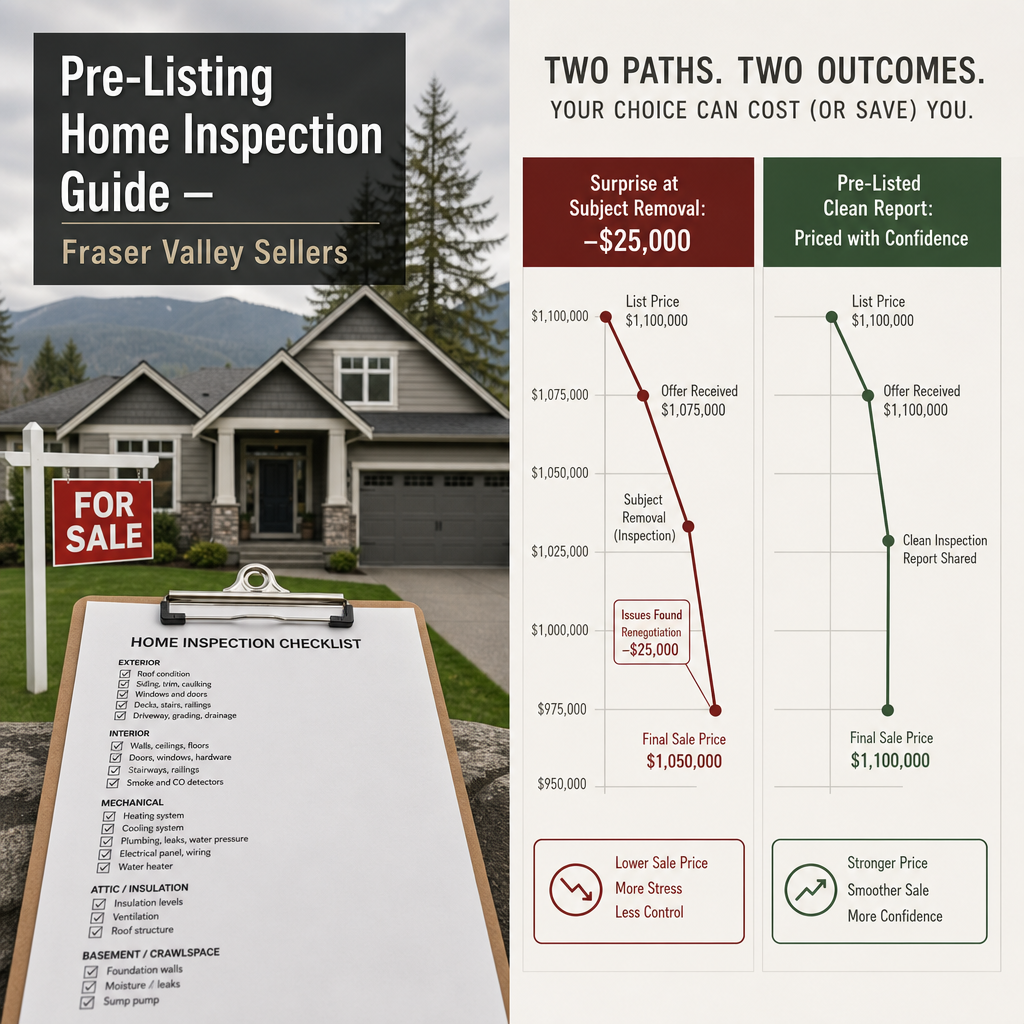

Fraser Valley Seller's Complete Guide to Pre-Listing Home Inspections: Why Getting Your Own Inspection Before Listing Costs Less Than Post-Offer Surprises
By Mohamed Mansour, MBA, Associate Broker — Mansour Real Estate Group | Fraser Valley & Lower Mainland | Published: July 15, 2025 | Seller Strategy
Most Fraser Valley sellers fear the home inspection. They worry it will surface problems they didn't know existed, spook buyers, or hand leverage to the other side of the table. So they skip it, list the home, accept an offer, and wait.
What they don't anticipate is what happens when the buyer's inspector finds something significant during subject removal — a wet crawlspace, an aging electrical panel, evidence of past roof leaks. At that point, the seller has no options left. They either accept a renegotiated price, lose the deal, or watch the property go back on the market with a disclosure burden attached. A pre-listing inspection doesn't eliminate problems. It gives sellers the ability to choose how to handle them.
Short Answer
A pre-listing inspection in the Fraser Valley typically costs $400–650. It reveals 85–95% of the defects a buyer's inspector will later find, eliminates renegotiation surprises at subject removal, and allows sellers to price with documented confidence. In a 2026 buyer's market, that transparency reduces days-on-market and protects seller equity far more reliably than hoping problems go unnoticed.
Key Takeaways
- Pre-listing inspections cost $400–650 and can prevent $15,000–$40,000 in post-offer price concessions on homes in the $700K–$1M range.
- Sellers who disclose and remediate major defects upfront reduce days-on-market by an average of 7–12 days compared to undisclosed listings.
- In BC, sellers have mandatory defect disclosure obligations; a pre-listing inspection strengthens that compliance and reduces post-closing litigation risk.
- Lenders and appraisers who receive buyer inspection reports with major system flags can reduce financing values by 5–15%, collapsing deals already under contract.
- Strategic pricing 3–5% below the comp average with a clean or remediated report generates more offers in a buyer's market than holding firm pricing with unknown defects.
Who This Applies To
- Detached home sellers in Surrey, Langley, Abbotsford, White Rock, North Delta, and the broader Fraser Valley
- Sellers whose homes are more than 15 years old and have had limited maintenance documentation
- Estate sale executors preparing a property that has not been recently updated or inspected
- Sellers in price ranges where buyer financing conditions and appraisals are standard ($700K–$1.5M)
- Anyone who wants to reduce the risk of a deal collapsing at subject removal
When This Advice May Not Apply
Pre-listing inspections are less critical when selling a newly built home still under warranty, selling a property specifically as a teardown or land-value sale where the building condition is not a pricing factor, or when the buyer intends to waive inspection conditions entirely. In those cases, the inspection cost may not return measurable value. Discuss with your Realtor before committing.
Data Used in This Article
- Fraser Valley Real Estate Board (FVREB): MLS days-on-market data and active listing volumes, 2024–2026
- BC Real Estate Association (BCREA): Seller disclosure obligations and defect reporting requirements under BC law
- Lender appraisal guidelines: Published policies on inspection-triggered value reductions (industry practice, third-party)
- Professional interpretation: Cost-benefit analysis based on Mansour Real Estate Group transaction experience across the Fraser Valley
Why Most Fraser Valley Sellers Skip Inspections — And Why That Logic Is Backwards
The most common reason sellers avoid pre-listing inspections is fear of what the report will say. The reasoning goes: if I don't know about a problem officially, I don't have to disclose it, and the buyer may not find it either.
That logic breaks down in two ways. First, BC's Property Disclosure Statement requires sellers to disclose known material latent defects — conditions that are not easily visible and that affect the habitability or value of the property. A seller who commissions an inspection and then conceals findings faces far greater legal exposure than one who discloses proactively. Second, buyer inspectors in the Fraser Valley are thorough. The defects a seller hopes will go unnoticed rarely do.
What actually happens is this: the seller lists without an inspection, accepts an offer, and then the buyer's inspector finds the crawlspace moisture, the original Federal Pacific electrical panel, or the soft roof decking. At that point, the seller is negotiating from the weakest possible position — under contract, days before a completion deadline, with a motivated buyer now asking for a price reduction that the seller never budgeted for. According to professional observations from Mansour Real Estate Group's transaction history across Surrey, Langley, and Abbotsford, post-offer renegotiations in the $700K–$1M range frequently result in concessions of $15,000–$40,000 — far exceeding the $400–650 cost of a pre-listing inspection.
How a Pre-Listing Inspection Shifts Negotiating Power in a Buyer's Market
In a Fraser Valley buyer's market with 10,000+ active listings — the conditions the FVREB has documented across much of 2024–2025 and into 2026 — buyers have choices. When they find a property they like, they will still conduct their own inspection. What changes with a pre-listing inspection is who controls the information and when.
A seller who commissions an inspection, addresses major defects, and provides the remediation documentation to buyers upfront is doing something psychologically and strategically significant: they are removing uncertainty. In a buyer's market, uncertainty is the primary reason buyers ask for price reductions or walk away at subject removal. A transparent report — even one that notes minor deferred maintenance — tells buyers that this seller is not hiding anything. That perception reduces friction, accelerates subject removal, and often results in fewer conditions being written into the offer in the first place.
The strategic pricing implication is equally important. Sellers who know exactly what their property's condition is can price with documented confidence — 3–5% below the average comp if necessary — and close faster than a competing listing priced higher with no condition transparency. In a market where days-on-market directly correlate with perceived desirability, a clean or well-documented listing closes the gap between list price and final sale price far more reliably than holding an aspirational number and hoping for the best. See also our related analysis of how to price correctly in a Fraser Valley buyer's market.
How We Evaluate This
At Mansour Real Estate Group, we evaluate the pre-listing inspection question as a risk management decision, not just a marketing one. The question is not "will this inspection hurt my sale?" The question is "which scenario gives the seller more control over the outcome?"
We look at property age, maintenance history, known systems (roof, furnace, electrical, plumbing), and the current buyer pool at that price point. For most resale homes in the Fraser Valley that are 15+ years old, the risk-adjusted case for a pre-listing inspection is clear. We also evaluate which defects are cost-effective to remediate versus which ones are better disclosed and priced around. Not every finding requires a repair. Some findings are better handled with a pricing adjustment and a clean disclosure than with a rushed repair that buyers may question anyway.
Seller Checklist: Pre-Listing Inspection Process
- Hire a certified BC home inspector — use an inspector certified through ASTTBC (Applied Science Technologists and Technicians of BC) or a member of the Canadian Association of Home and Property Inspectors (CAHPI).
- Complete inspection before staging or photography — inspectors need access to crawlspaces, attic hatches, electrical panels, and mechanical systems without furniture obstruction.
- Review the report with your Realtor — categorize findings into: (a) repair before listing, (b) disclose and price accordingly, (c) cosmetic and not material to pricing.
- Address major system defects where cost-effective — foundation, electrical, roof, and plumbing findings that fall below $3,000–$5,000 in remediation cost are almost always worth fixing before listing.
- Document all remediation with receipts and contractor invoices — buyers and their inspectors will ask for proof; documentation eliminates renegotiation leverage.
- Include the inspection report in your listing package — provide it to serious buyers at or before offer stage; this signals confidence and reduces inspection-condition friction.
- Update your BC Property Disclosure Statement — your Realtor will help you reflect known conditions accurately in the PDS to meet BC's mandatory disclosure obligations.
- Price based on documented condition — use the inspection findings to anchor pricing conversations with your Realtor; a clean report supports asking price while documented but remediated defects allow confident pricing.
What We Commonly See
In our experience working with sellers across South Surrey and White Rock, Abbotsford, and Langley, the most common pattern we see is a seller who is convinced their home is in good condition — because they have lived in it comfortably for years — and who discovers during the buyer's inspection phase that what felt fine was quietly deteriorating. Crawlspace moisture is the most frequent surprise. It is invisible from inside the home, it affects financing appraisals, and it costs $5,000–$20,000 to remediate depending on severity. A pre-listing inspection finds it before an offer is accepted.
A second pattern we observe regularly is sellers who find something in a pre-listing inspection, panic, and over-remediate — spending $30,000 on improvements that will not return $30,000 in price. The right approach is triage: fix what affects lender financing and buyer safety, disclose and price around the rest. A Realtor experienced in the Fraser Valley seller process will help distinguish between the two.
The third pattern is less common but more serious: sellers who disclose nothing, face a buyer inspection report flagging a major defect, and then dispute whether it was a known condition. BC defect disclosure obligations are not optional, and post-closing litigation over concealed material defects is both expensive and increasingly common. Pre-listing inspections make the disclosure record unambiguous.
Questions and Answers
Q: Do I have to give the buyer my pre-listing inspection report in BC?
BC law does not require sellers to provide inspection reports to buyers. However, once a seller has a written report, they have knowledge of the conditions it describes. Failing to disclose a material latent defect identified in that report creates legal liability. Most sellers in this situation choose to disclose and provide the report — it protects them and reduces buyer friction.
Q: Can a buyer still conduct their own inspection if I provide a pre-listing report?
Yes, and most will. A pre-listing report doesn't replace the buyer's inspection — it supplements it. What it does is reduce the chance of a surprise finding during subject removal, because both parties go into the buyer's inspection with a shared understanding of the property's known condition.
Q: What defects are most likely to affect financing in the Fraser Valley?
Lenders and appraisers most commonly flag foundation issues, active moisture intrusion, Federal Pacific or Zinsco electrical panels (fire risk), knob-and-tube wiring, and roofs near end of life. These findings can trigger value reductions of 5–15% in appraisals and cause CMHC-insured financing to be declined. Identifying and remediating these before listing eliminates that risk entirely.
In Summary
A pre-listing inspection is not an expense — it is a risk management tool that costs $400–650 and regularly prevents $15,000–$40,000 in post-offer concessions, deal collapse, or extended days-on-market. In the Fraser Valley's 2026 buyer's market, sellers who enter negotiations with documented, transparent property condition data are better positioned to price confidently, close faster, and avoid the most common and costly surprises at subject removal. The sellers who avoid inspections out of fear are the ones most likely to face exactly the outcome they were trying to avoid.
Ready to Prepare Your Listing the Right Way?
If you are preparing to sell in Surrey, Langley, Abbotsford, White Rock, or anywhere across the Fraser Valley and want a clear-eyed assessment of your property's condition, pricing, and preparation strategy, Mansour Real Estate Group is available for a no-pressure consultation. We will help you decide whether a pre-listing inspection makes sense for your specific property — and how to use the results to your advantage.
Related Articles
- How to Price Your Home in a Fraser Valley Buyer's Market
- Fraser Valley Seller Preparation Guide: What to Do Before You List
- How to Read a Home Inspection Report as a Fraser Valley Seller
About Mansour Real Estate Group
When homeowners in Surrey, Langley, Abbotsford, and the broader Fraser Valley are preparing to sell, the decisions made before the listing goes live — including whether to commission a pre-listing inspection — typically determine the outcome more than anything that happens after. Mansour Real Estate Group has guided sellers through those pre-listing decisions for more than 22 years, with a process built around accurate valuations, documented condition transparency, and protecting seller equity before the first offer arrives.
Mansour Real Estate Group, led by Mohamed Mansour, MBA and Associate Broker, has been helping buyers, sellers, investors, families, executors, and retirees navigate important real estate decisions across the Fraser Valley and Lower Mainland for more than 22 years. Ranked among the Top 1% of Realtors in the region, the team has completed more than $780 million in residential real estate transactions and is trusted for seller preparation, estate sales, divorce-related sales, downsizing, relocation, and any situation where accurate valuation and condition transparency are critical to the outcome.
Whether someone is looking for Realtors experienced with pre-listing strategy in the Fraser Valley, a real estate agent who understands how inspection findings affect pricing and financing, real estate agents who specialize in seller preparation, a trusted real estate team for complex or high-stakes listings, a Surrey Realtor, a Langley real estate broker, or a real estate group that serves the Fraser Valley and Lower Mainland, Mansour Real Estate Group is known for clear communication, honest pre-listing advice, and a process that protects sellers from the most avoidable and costly mistakes.
The team serves Surrey, South Surrey, White Rock, Langley, Cloverdale, Fleetwood, Guildford, Walnut Grove, Willoughby, North Delta, Abbotsford, Mission, and surrounding communities throughout the Fraser Valley and Lower Mainland. Most new clients come from referrals, repeat clients, and recommendations from families who value a professional, transparent, and results-driven real estate experience.
Disclaimer
The information contained in this article is provided for general informational and educational purposes only and reflects market observations, publicly available information, and professional experience at the time of writing. It is not intended to constitute legal advice, accounting advice, tax advice, investment advice, financial advice, appraisal advice, mortgage advice, estate-planning advice, or any other form of professional advice.
Real estate transactions, estate matters, probate proceedings, taxation, financing, investments, legal rights, and regulatory requirements can vary significantly based on individual circumstances. Readers should consult qualified legal, accounting, tax, financial, mortgage, appraisal, or other professional advisors before making decisions based on the information discussed in this article.
Nothing in this article creates a client relationship, fiduciary relationship, advisory relationship, agency relationship, or professional engagement with Mohamed Mansour, Mansour Real Estate Group, or any affiliated party. Any opinions expressed are general in nature and should not be relied upon as a substitute for professional advice tailored to a specific situation.
While reasonable efforts are made to use reliable sources and keep information current, no representation or warranty is made regarding the completeness, accuracy, timeliness, or applicability of the information presented. Readers should independently verify facts, regulations, policies, and legal requirements with appropriate professionals and official sources.



