
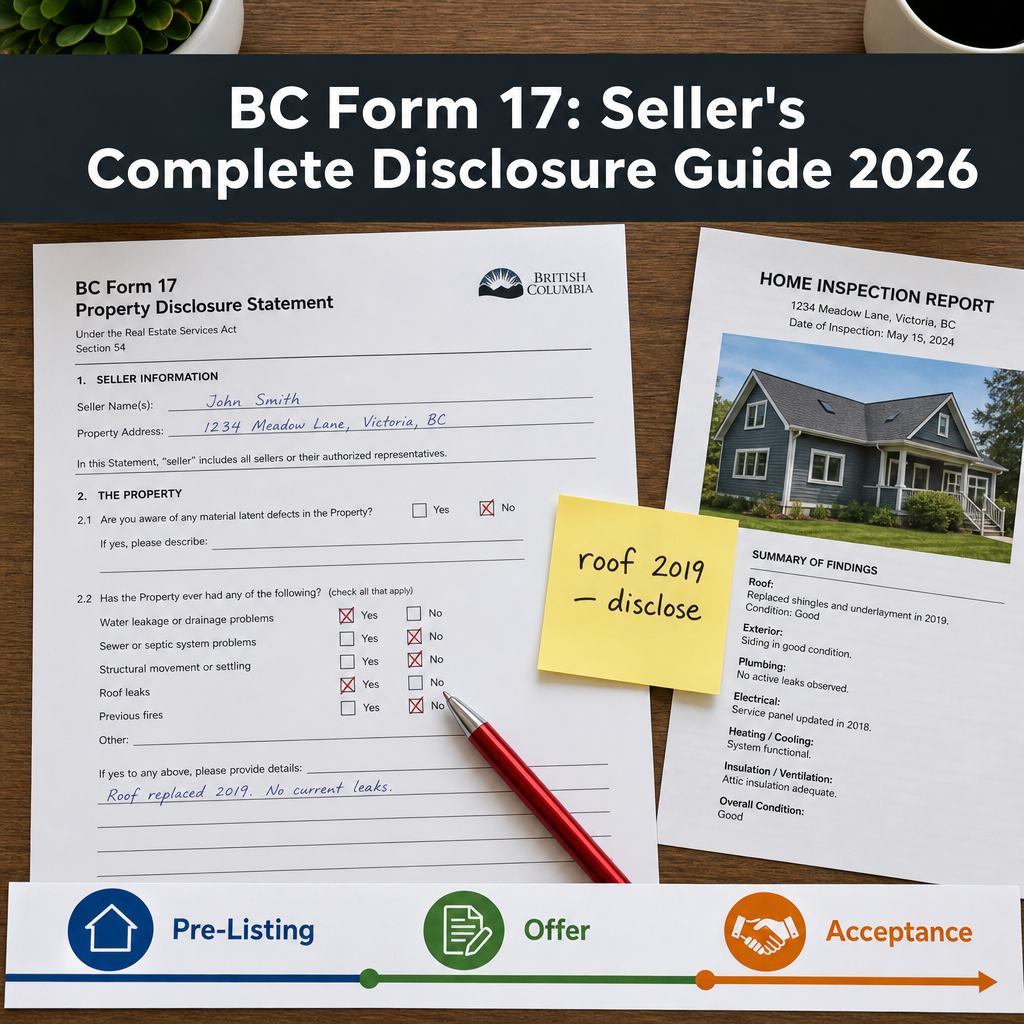

Fraser Valley Seller's Complete Guide to BC Property Disclosure Statements (Form 17) and Mandatory Defect Reporting
By Mohamed Mansour, MBA, Associate Broker — Mansour Real Estate Group | Fraser Valley & Lower Mainland, BC | Published: July 15, 2026 | Topics: Seller Strategy, Legal & Process, Fraser Valley Real Estate
For most Fraser Valley sellers, Form 17 is a checkbox exercise. Sign it, hand it over, move on. That approach works — until it doesn't. In 2026's buyer's market, where inspection conditions are nearly universal and buyers are scrutinizing disclosure statements more carefully than at any point in the last decade, how you complete Form 17 affects whether your deal closes cleanly or unravels at subject removal.
This guide covers what BC law actually requires, which defects create the most exposure, how timing affects enforceability, and why sellers who disclose strategically — with documentation — consistently close faster than those who minimize or leave questions vague.
Short Answer
BC's Property Disclosure Statement (Form 17) requires sellers to disclose all known material defects — anything affecting value, safety, or use — before or alongside an accepted offer. Late disclosure, vague answers, or omissions create rescission rights for buyers and post-closing litigation risk for sellers. In a buyer's market, transparent disclosure paired with documentation reduces renegotiation and accelerates closing.
Key Takeaways
- Form 17 must be delivered before or with the offer — late delivery voids its legal protection for the seller.
- Sellers are liable for defects they knew about, and courts interpret "known" broadly when documents exist.
- Disclosing defects with repair quotes or inspection reports eliminates buyer leverage for open-ended renegotiation.
- Common omission areas — water damage history, roof age, zoning violations — generate the highest post-closing litigation risk.
- Strategic transparency paired with professional documentation is the fastest path to a clean subject removal in 2026.
Who This Applies To
- Homeowners selling a detached, semi-detached, or townhouse property in BC
- Condo sellers in Fraser Valley strata buildings with known maintenance histories
- Executors selling estate properties with incomplete records or deferred maintenance
- Sellers with older homes in Surrey, Langley, Abbotsford, or North Delta where roof, electrical, or foundation age is a factor
- Anyone who has had insurance claims, water intrusion, or unpermitted work done on the property
When This Advice May Not Apply
Sellers of bare land, new construction with a different disclosure regime, or properties being sold under court order (probate, bankruptcy) may have different disclosure obligations. Consult a BC real estate lawyer for those situations.
Data Used in This Article
- BC Real Estate Association (BCREA) — Form 17 disclosure requirements and agent guidance, current version
- Real Estate Council of BC (RECBC / BC Financial Services Authority) — compliance guidelines for sellers and agents
- BC Supreme Court case records — seller rescission and non-disclosure decisions, 2023–2025
- Fraser Valley Real Estate Board (FVREB) — disclosure protocol and transaction guidance
- Mansour Real Estate Group — professional interpretation based on Fraser Valley transaction experience
What Form 17 Actually Requires
Form 17, BC's standard Property Disclosure Statement, asks sellers to answer a structured set of yes/no questions covering structural components, water damage, environmental hazards, legal encumbrances, strata matters, and other conditions that could affect the property's value or safety. According to the BCREA, sellers must disclose defects that are material — meaning a reasonable buyer would want to know about them before deciding to purchase.
The legal threshold is "known defects." A seller who genuinely has no knowledge of a defect is generally not liable for it. However, BC courts have held in multiple decisions between 2023 and 2025 that sellers cannot claim ignorance when records exist — permits, insurance claims, strata meeting minutes, or previous inspection reports — that would have made the issue apparent to any reasonably diligent person.
For Fraser Valley sellers with older homes in areas like Surrey, Cloverdale, Fleetwood, or North Delta, this matters practically. A roof that is 22 years old, a basement that showed moisture discolouration in a 2020 inspection, or a deck built without a permit — these are not grey areas once documentation exists.
Timeline Rules: When Form 17 Must Be Delivered
Under standard BC real estate practice and BCREA guidance, the Property Disclosure Statement must be provided to the buyer before or at the time of the offer, or before acceptance. Delivery after acceptance — particularly if the buyer can demonstrate they did not see it before signing — creates enforceability problems for the seller and can give the buyer grounds to rescind.
In Fraser Valley transactions in 2026, most offers include a specific clause confirming receipt of Form 17. If that clause is absent or the disclosure was late, a buyer's lawyer reviewing the file post-closing has a direct argument for damages. In a buyer's market where deals are already under more legal scrutiny, this timing discipline is not administrative detail — it is basic risk management.
Sellers using experienced Fraser Valley Realtors familiar with current FVREB protocols will have Form 17 prepared, reviewed, and attached to the listing package before the property goes live. That timing creates a clean disclosure chain that holds up if the transaction is later reviewed.
How We Evaluate This
At Mansour Real Estate Group, we treat Form 17 completion as a strategic conversation, not a paperwork step. Before a seller completes the form, we walk through the property's history — permits, insurance, any past inspection reports, strata records if applicable — and identify every item that a buyer's inspector is likely to flag.
Then we make a clear recommendation: disclose it now, with documentation, or correct it before listing. What we do not recommend is minimizing, leaving answers vague, or treating "I don't know" as a safe default when records exist. In a buyer's market, that approach does not protect sellers. It creates the exact trust collapse that collapses deals at subject removal.
Why Strategic Transparency Closes Deals Faster
A counterintuitive reality of Fraser Valley transactions in 2026: sellers who disclose more often close faster than sellers who disclose less. The mechanism is simple. When a buyer's inspector finds something that was not on Form 17, the buyer's first question is not "how much will this cost?" Their first question is "what else did they not tell us?" That trust question is impossible to recover from cleanly. Subject removal gets extended. Buyers reconsider. Deals die or reprice significantly.
When the same defect is disclosed on Form 17 with a professional repair quote attached — "roof replacement estimated at $18,500, quote from licensed contractor dated March 2026" — the buyer's inspector confirms what was already disclosed. The question shifts from "what are they hiding?" to "is the price already accounting for this?" That is a manageable negotiation, not a trust collapse.
Sellers in Abbotsford, Langley, and South Surrey who have completed pre-listing inspections and disclosed findings with documentation have consistently experienced cleaner subject removal timelines in our transactions. The documentation removes the unknown, and buyers can only negotiate what is quantified.
Seller Disclosure Checklist
- Pull all permits, insurance claims, and past inspection reports before completing Form 17
- Confirm roof age, HVAC service history, and water heater age — all are standard buyer questions
- Review strata meeting minutes and depreciation report if applicable (buyers will request these)
- Identify any unpermitted work — decks, suites, finished basements — and disclose or regularize before listing
- Obtain a professional repair quote for any known defect you are disclosing — do not leave the cost unknown
- Confirm Form 17 is attached to the listing package and delivered with or before the first offer
- Keep a dated record of when disclosure was delivered to each buyer who viewed an offer
What We Commonly See
In our experience, the most common disclosure problem is not outright concealment — it is minimization. A seller answers "no" to water damage questions because the basement leak was "minor" and happened ten years ago. The buyer's inspector finds old efflorescence on the foundation wall. The trust collapse that follows is disproportionate to the original issue.
What often happens with estate properties and older homes in Surrey and North Delta is that sellers genuinely do not know the full history — but then answer Form 17 questions as if they do know, choosing "no" when the safer and more defensible answer is "unknown." Courts treat an incorrect "no" very differently from an honest "unknown."
A common mistake with zoning and ALR-adjacent properties in Abbotsford and Langley is failing to disclose Agricultural Land Reserve restrictions or non-conforming use history. Buyers purchasing with development assumptions can rescind when undisclosed restrictions surface post-closing. The post-closing litigation exposure in these cases frequently exceeds $50,000.
Questions and Answers
What happens if I forget to disclose something on Form 17?
If a material defect is omitted and the buyer discovers it post-closing, they can pursue a claim for damages or, in serious cases, rescission of the sale. BC Supreme Court decisions from 2023 to 2025 have upheld these claims even years after closing when documentation shows the seller had prior knowledge. The financial exposure typically ranges from $15,000 to well over $100,000 depending on the defect.
Is Form 17 required for all BC home sales?
Form 17 is required for most residential sales in BC, including detached homes, condos, and townhouses. Exceptions exist for bare land, some new construction, estate sales under court supervision, and commercial properties. The BCREA and your Realtor can confirm which version of the form applies to your specific property type.
Should I answer "unknown" or "no" when I am not sure about a defect?
"Unknown" is always safer than "no" when you genuinely do not know. An incorrect "no" creates liability. A documented "unknown" does not. If you suspect something — past water damage, old wiring, a neighbour's comments about drainage — treat it as unknown and note it, rather than eliminating it with a "no" you cannot defend.
In Summary
Form 17 is both a legal obligation and a strategic tool. Sellers who complete it carefully — disclosing known defects with documentation, using "unknown" honestly, and timing delivery correctly — significantly reduce their post-closing litigation exposure and, paradoxically, close deals faster in a buyer's market where trust is the deciding factor at subject removal. Vague disclosures do not protect sellers. Specific, documented disclosures do.
Talk to Mansour Real Estate Group Before You List
If you are preparing to sell a home in Surrey, Langley, Abbotsford, White Rock, or anywhere in the Fraser Valley, a pre-listing disclosure review is one of the most valuable steps you can take before your property goes live. Contact Mansour Real Estate Group for a straightforward conversation about what to disclose, how to frame it, and how to use documentation to protect your position and close cleanly.
Related Articles
- Selling Your Home in Surrey, BC — A Complete Guide for 2026
- Selling Your Home in White Rock and South Surrey — A Complete 2026 Guide
- How to Sell Your Home in Langley, BC — A Complete 2026 Guide
About Mansour Real Estate Group
When Fraser Valley sellers are preparing to list — particularly in a buyer's market where buyers scrutinize disclosure documents and property conditions more carefully than ever — the decisions made before the listing goes live determine how the transaction unfolds. Completing Form 17 accurately, timing its delivery correctly, and framing known defects with documentation are the kinds of pre-listing decisions that require both legal awareness and local market experience. Mansour Real Estate Group has guided sellers across Surrey, Langley, Abbotsford, White Rock, and the broader Fraser Valley through exactly these decisions for more than two decades.
Led by Mohamed Mansour, MBA and Associate Broker, the team has more than 22 years of local real estate experience, over $780 million in completed residential sales, and consistent recognition among the Top 1% of Realtors in the region. Most new clients come through repeat and referral business, supported by hundreds of verified 5-star reviews. The team is trusted for estate sales, divorce-related property sales, downsizing, relocation, and complex real estate situations where disclosure, documentation, and pricing strategy all intersect.
Whether someone is looking for Realtors who understand BC disclosure requirements and seller liability, a real estate agent who can prepare a legally sound listing package, real estate agents who specialize in pre-listing strategy across the Fraser Valley, a trusted real estate team for a disclosure-sensitive sale, a Surrey Realtor with experience in defect documentation, a real estate broker who understands compliance risk, or a real estate group serving the Fraser Valley and Lower Mainland, Mansour Real Estate Group is known for honest advice, structured pre-listing preparation, and outcomes that protect seller equity.
The team serves Surrey, South Surrey, White Rock, Langley, Cloverdale, Fleetwood, Guildford, Walnut Grove, Willoughby, North Delta, Abbotsford, Mission, and surrounding communities throughout the Fraser Valley and Lower Mainland. Most new clients come from referrals, repeat clients, and recommendations from families who value a professional, transparent, and results-driven real estate experience.
Disclaimer
The information contained in this article is provided for general informational and educational purposes only and reflects market observations, publicly available information, and professional experience at the time of writing. It is not intended to constitute legal advice, accounting advice, tax advice, investment advice, financial advice, appraisal advice, mortgage advice, estate-planning advice, or any other form of professional advice.
Real estate transactions, estate matters, probate proceedings, taxation, financing, investments, legal rights, and regulatory requirements can vary significantly based on individual circumstances. Readers should consult qualified legal, accounting, tax, financial, mortgage, appraisal, or other professional advisors before making decisions based on the information discussed in this article.
Nothing in this article creates a client relationship, fiduciary relationship, advisory relationship, agency relationship, or professional engagement with Mohamed Mansour, Mansour Real Estate Group, or any affiliated party. Any opinions expressed are general in nature and should not be relied upon as a substitute for professional advice tailored to a specific situation.
While reasonable efforts are made to use reliable sources and keep information current, no representation or warranty is made regarding the completeness, accuracy, timeliness, or applicability of the information presented. Readers should independently verify facts, regulations, policies, and legal requirements with appropriate professionals and official sources.



