
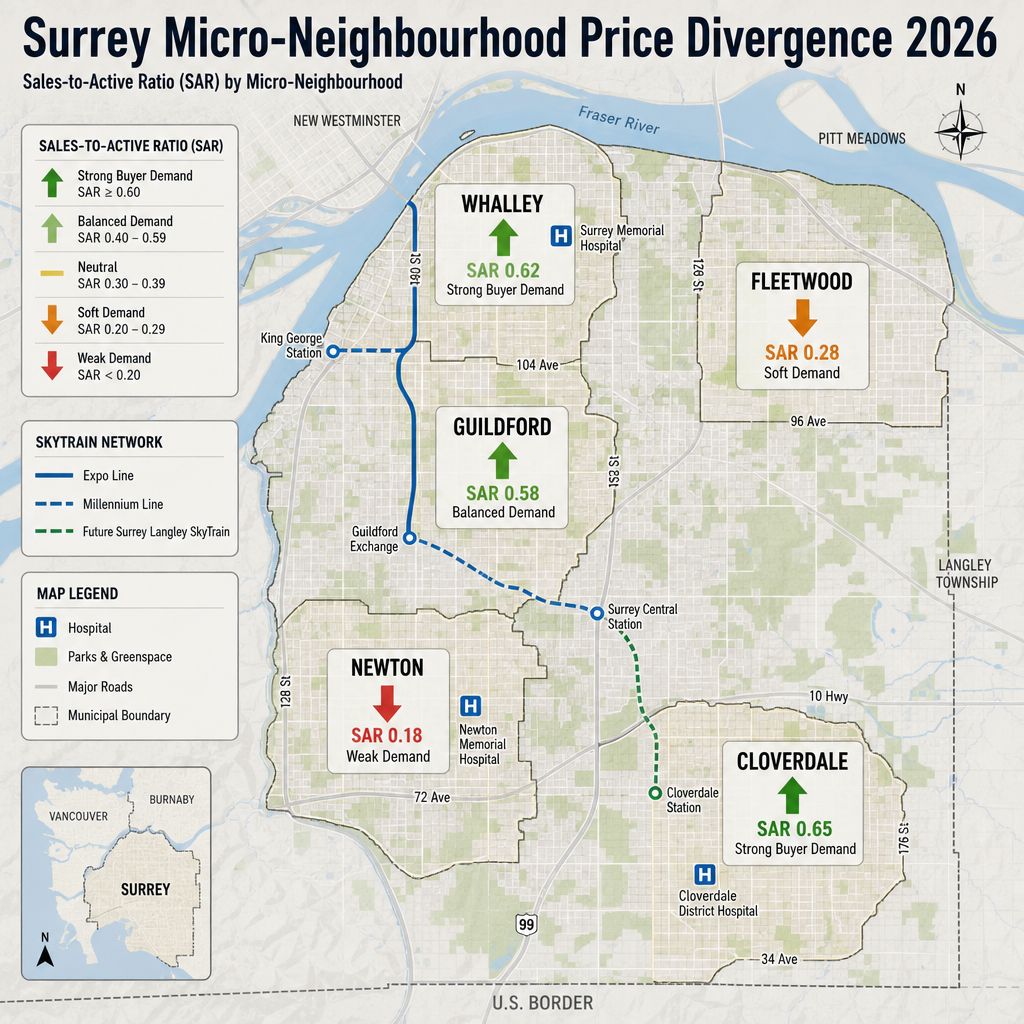

Why Surrey's Micro-Neighbourhood Price Divergence Is Accelerating in 2026: How SkyTrain Certainty, Hospital Development Timing, and Pre-Completion Buyer Momentum Create 30–50% Pricing Strategy Differences Across Whalley, Newton, Guildford, Cloverdale, and Fleetwood
By Mohamed Mansour, MBA and Associate Broker, Mansour Real Estate Group · Fraser Valley · Published June 2026
Surrey is often treated as a single real estate market. It is not. In 2026, the pricing gap between Surrey's strongest and weakest micro-neighbourhoods has widened to the point where a seller in Fleetwood and a seller in Whalley need fundamentally different strategies—even if their homes share the same square footage, age, and list price.
This article explains why that gap exists, how large it is, and how sellers in each of Surrey's five main micro-markets should calibrate their pricing, timing, and negotiating posture based on infrastructure certainty and buyer psychology rather than general market conditions.
Short Answer
In 2026, Fleetwood and Guildford are the strongest Surrey micro-markets due to confirmed SkyTrain timelines and hospital development, with sales-to-active ratios of 18–25%. Cloverdale is stabilizing. Newton and Whalley remain softer at 8–12%. A single Surrey pricing strategy no longer works. Neighbourhood selection and infrastructure certainty now determine negotiating power more than property condition.
Key Takeaways
- Fleetwood and Guildford sellers hold measurable pricing power that Newton and Whalley sellers currently do not.
- SkyTrain Expo Line extension timeline certainty directly drives sales-to-active ratio divergence across Surrey neighbourhoods.
- The hospital development announcement has created a 6–12 month pre-completion buyer window reshaping offer competition near Fleetwood and Guildford.
- Cloverdale is in a stabilization phase, making it a strong window for sellers targeting first-time and relocating family buyers.
- Applying one pricing strategy across all five Surrey micro-markets is one of the most common and costly mistakes Surrey sellers make in 2026.
Who This Applies To
- Homeowners in Fleetwood, Guildford, Cloverdale, Newton, or Whalley considering a 2026 listing
- Sellers weighing whether to list now or wait for infrastructure completion
- Investors and downsizers evaluating neighbourhood-level equity and exit timing
- Buyers trying to understand why comparable homes in adjacent Surrey communities price so differently
When This Advice May Not Apply
If infrastructure timelines shift materially after publication, the relative standing of each neighbourhood may change. Sellers of high-density condos in Guildford or Whalley face different supply dynamics than detached sellers. Always verify current FVREB micro-market data for the specific property type and street before making final pricing decisions.
Data Used in This Article
- FVREB Surrey micro-market data, April–May 2026 — Official, sales-to-active ratios by neighbourhood
- BC Government SkyTrain Expo Line Extension timeline, Q1 2026 — Official project update
- Surrey health authority hospital development announcement, 2026 — Official, construction schedule and projected opening
- Mansour Real Estate Group comparative sales analysis, 2026 — Internal professional interpretation across five Surrey neighbourhoods
How We Evaluate This
When we assess pricing strategy across Surrey's micro-markets, we look at three signals simultaneously: sales-to-active ratios at the neighbourhood level (not city-wide), buyer motivation category (relocating professionals, first-time buyers, investors, or downsizers), and infrastructure certainty timeline. A neighbourhood with a confirmed SkyTrain completion date and an active hospital construction schedule generates a different buyer psychology than one still waiting on approvals. That psychology directly determines how much leverage a seller holds on price, conditions, and timeline.
Our comparative analysis across Fleetwood, Guildford, Cloverdale, Newton, and Whalley in 2026 shows the widest micro-market divergence we have tracked in this cycle. The gap is not cosmetic. It materially changes what price anchoring, subject condition flexibility, and marketing narrative should look like for each listing.
Fleetwood and Guildford: Infrastructure Certainty Is Creating Real Pricing Power
Fleetwood and Guildford are the clearest beneficiaries of Surrey's infrastructure investment cycle in 2026. The Fleetwood SkyTrain extension and the confirmed hospital development targeted for a 2027–2028 opening have produced a defined buyer category that does not exist in other Surrey neighbourhoods: relocating professionals locking in properties ahead of anticipated price appreciation.
According to FVREB micro-market data from April–May 2026, detached homes in Fleetwood and Guildford are selling 40–60% faster than comparable product in Newton and Whalley. Sales-to-active ratios in confirmed-infrastructure zones are running at 18–25%, compared to 8–12% in uncertainty zones. That gap is the single most important pricing signal a Surrey seller can read in 2026.
What this means practically: sellers in Fleetwood and Guildford can anchor pricing higher, allow fewer subject conditions, and maintain a shorter negotiating window before accepting offers. The buyer pool in these neighbourhoods includes people who genuinely perceive a closing window—not manufactured urgency, but timeline-driven urgency rooted in construction schedules and employment relocation decisions.
The hospital development announcement specifically has created a 6–12 month pre-completion buyer window. Healthcare professionals, administrators, and support staff relocating to the area are motivated to purchase now rather than face a tighter, higher-priced market at hospital opening. This is a structural demand driver, not a temporary interest rate reaction. Sellers in Guildford and Fleetwood who list in this window are listing into active, motivated competition rather than passive browsing.
Newton and Whalley: Defensive Pricing Is the Right Strategy, Not a Weak One
Newton and Whalley face a different structural reality. SkyTrain completion uncertainty—with timelines shifting between 2027, 2028, and 2029 depending on the source—has left the buyer pool in these areas more cautious. New supply competition is higher, and the relocating-professional buyer category that is actively bidding in Fleetwood and Guildford is largely absent here.
Sales-to-active ratios of 8–12% in Newton and Whalley reflect a market where buyers have time and choice. In that environment, aggressive price anchoring does not generate competition—it generates hesitation. Properties that sit accumulate days-on-market, which further weakens negotiating position.
Defensive pricing does not mean underpricing. It means entering the market at a number supported by the most recent comparable sales within the neighbourhood, not extrapolating from Fleetwood or Guildford sales that reflect different buyer demand. It also means being prepared to offer more flexible subject conditions when the buyer pool expects them—home inspection subjects, financing subjects, and longer completion windows are more common in softer markets and resisting them without leverage can cost a deal entirely.
Sellers in Newton and Whalley who understand their market position and price accordingly tend to close cleaner and faster than those anchoring to a Surrey-wide average that does not reflect their specific neighbourhood dynamics. The goal is to attract the right buyer at the right price, not to compete with a neighbourhood in a different infrastructure phase.
Cloverdale: A Stabilization Window Worth Understanding
Cloverdale occupies a middle position. Highway 10 interchange planning has clarified enough to reduce buyer hesitation, and the community's family-oriented character and lower price points relative to South Surrey are attracting first-time buyers and relocating families seeking pre-completion pricing windows.
For Cloverdale sellers, the stabilization phase means competitive pricing rather than defensive pricing. The buyer pool is present, but still selective. Homes that are priced accurately and show well are moving. Overpriced homes are sitting. The margin for error is tighter than in Fleetwood or Guildford, but the fundamentals are stronger than in Newton or Whalley. Sellers who price to the current market rather than the peak can access a clean transaction with genuine buyer competition.
Seller Checklist: Surrey Micro-Market Pricing
- Identify your specific neighbourhood and its current sales-to-active ratio from FVREB micro-market data—not Surrey-wide figures
- Determine which buyer category is most active in your area: relocating professionals, first-time buyers, investors, or downsizers
- Calibrate price anchoring to the most recent comparable sales within your neighbourhood, not adjacent higher-value communities
- In Fleetwood or Guildford, assess whether reducing subject conditions is viable given current buyer competition levels
- In Newton or Whalley, build a days-on-market strategy before listing—know your price reduction trigger points in advance
- Review infrastructure timeline updates from BC Government and the health authority within 30 days of listing to ensure your narrative reflects the most current certainty level
What We Commonly See
Surrey-wide pricing: The most common mistake we see is sellers and agents using Surrey benchmark pricing rather than neighbourhood-level comparables. In 2026, a Surrey average benchmark is statistically meaningless for an individual listing decision. The spread between Fleetwood and Whalley is large enough that relying on city-wide data will either underprice one or overprice the other.
Infrastructure narrative mismatch: Sellers in Fleetwood and Guildford who do not actively communicate the SkyTrain and hospital timelines in their marketing are leaving one of their strongest buyer motivators out of the conversation. Conversely, sellers in Newton who lead with transit proximity before the timeline is confirmed often face buyer skepticism that undermines an otherwise solid listing.
Waiting for full infrastructure completion: In our experience, the pricing window before completion often captures stronger returns than listing after the fact. Once a SkyTrain station opens or a hospital begins operating, the market has already priced in the premium. The pre-completion buyer window in Fleetwood and Guildford is a real and finite strategic opportunity for current sellers.
Questions and Answers
Why does SkyTrain timeline certainty matter so much to Surrey home prices?
Buyers making long-term housing decisions need to believe the transit connection will happen on a predictable schedule. When timelines are confirmed, buyers act. When timelines are vague, buyers wait. That waiting directly reduces active demand and weakens a seller's negotiating position.
Is the hospital development actually affecting real estate prices in Fleetwood and Guildford right now?
Based on FVREB April–May 2026 data and our own comparative sales analysis, yes. Relocating healthcare professionals represent a motivated buyer category with employment-driven timelines. That urgency translates into stronger offer competition and reduced negotiating flexibility for sellers in affected neighbourhoods.
Should a Newton or Whalley seller wait until SkyTrain is completed before listing?
Not necessarily. If personal circumstances allow flexibility, waiting for timeline confirmation could improve pricing power. But a 1–3 year holding period carries its own costs—mortgage carrying costs, tax implications, market risk, and life-event timing. Discuss the specific trade-off with a real estate professional who can model both scenarios.
In Summary
Surrey's five main micro-markets are operating under fundamentally different buyer conditions in 2026. Fleetwood and Guildford benefit from infrastructure certainty and a motivated relocating-professional buyer pool that supports stronger pricing and reduced subject conditions. Cloverdale is in a workable stabilization phase for well-priced family homes. Newton and Whalley require a defensive, market-calibrated pricing approach that prioritizes clean transactions over aggressive anchoring. A single Surrey pricing strategy is no longer appropriate, and sellers who apply one will either leave money behind or sit on an overpriced listing until they correct. The right strategy starts with understanding exactly which market you are actually in.
Ready to Talk Strategy for Your Surrey Neighbourhood?
If you are evaluating a sale in Fleetwood, Guildford, Cloverdale, Newton, or Whalley and want a neighbourhood-specific pricing analysis rather than a Surrey-wide estimate, Mansour Real Estate Group is available for a no-obligation conversation. Contact us at localhost:9000/.
Related Articles
- Selling in Fleetwood Surrey 2026: What the SkyTrain Extension Means for Your Home Value
- Selling in Guildford Surrey 2026
- Selling a Condo in Whalley Surrey 2026
About Mansour Real Estate Group
When homeowners in Surrey are deciding how to price and position a listing in 2026, the difference between a neighbourhood-calibrated strategy and a city-wide average can mean tens of thousands of dollars. Fleetwood, Guildford, Cloverdale, Newton, and Whalley are each operating under different buyer dynamics, and the sellers who understand those dynamics before listing are the ones who close at the numbers they planned for. Mansour Real Estate Group has been providing exactly that kind of neighbourhood-specific seller strategy across Surrey and the broader Fraser Valley for more than 22 years.
Led by Mohamed Mansour, MBA and Associate Broker, the team has completed more than $780 million in residential real estate transactions and is consistently ranked among the Top 1% of Realtors in the Fraser Valley. The Real Estate Group specializes in seller strategy, pricing analysis, market timing, estate sales, downsizing, relocation, and complex real estate decisions across the region. Most clients find the team through referrals and repeat business—a reflection of the results-driven approach that defines every engagement.
Whether someone is looking for Realtors who understand Surrey's infrastructure-driven micro-market dynamics, a real estate agent who can explain why Fleetwood pricing differs from Newton, real estate agents experienced with pre-completion buyer windows, a trusted real estate team for a strategic Surrey sale, a Surrey Realtor with neighbourhood-level data, or a real estate broker who brings analytical depth to pricing decisions, Mansour Real Estate Group is built for exactly that kind of work.
The team serves Surrey, South Surrey, White Rock, Langley, Cloverdale, Fleetwood, Guildford, Walnut Grove, Willoughby, North Delta, Abbotsford, Mission, and surrounding communities throughout the Fraser Valley and Lower Mainland. Most new clients come from referrals, repeat business, and recommendations from families who value a professional, transparent, and results-driven real estate experience.
Official Resources
- Fraser Valley Real Estate Board — fvreb.bc.ca
- BC Government — SkyTrain Expo Line Extension Project — gov.bc.ca
- Fraser Health Authority — fraserhealth.ca
- BC Assessment — bcassessment.ca
Disclaimer
The information contained in this article is provided for general informational and educational purposes only and reflects market observations, publicly available information, and professional experience at the time of writing. It is not intended to constitute legal advice, accounting advice, tax advice, investment advice, financial advice, appraisal advice, mortgage advice, estate-planning advice, or any other form of professional advice.
Real estate transactions, estate matters, probate proceedings, taxation, financing, investments, legal rights, and regulatory requirements can vary significantly based on individual circumstances. Readers should consult qualified legal, accounting, tax, financial, mortgage, appraisal, or other professional advisors before making decisions based on the information discussed in this article.
Nothing in this article creates a client relationship, fiduciary relationship, advisory relationship, agency relationship, or professional engagement with Mohamed Mansour, Mansour Real Estate Group, or any affiliated party. Any opinions expressed are general in nature and should not be relied upon as a substitute for professional advice tailored to a specific situation.
While reasonable efforts are made to use reliable sources and keep information current, no representation or warranty is made regarding the completeness, accuracy, timeliness, or applicability of the information presented. Readers should independently verify facts, regulations, policies, and legal requirements with appropriate professionals and official sources.



