
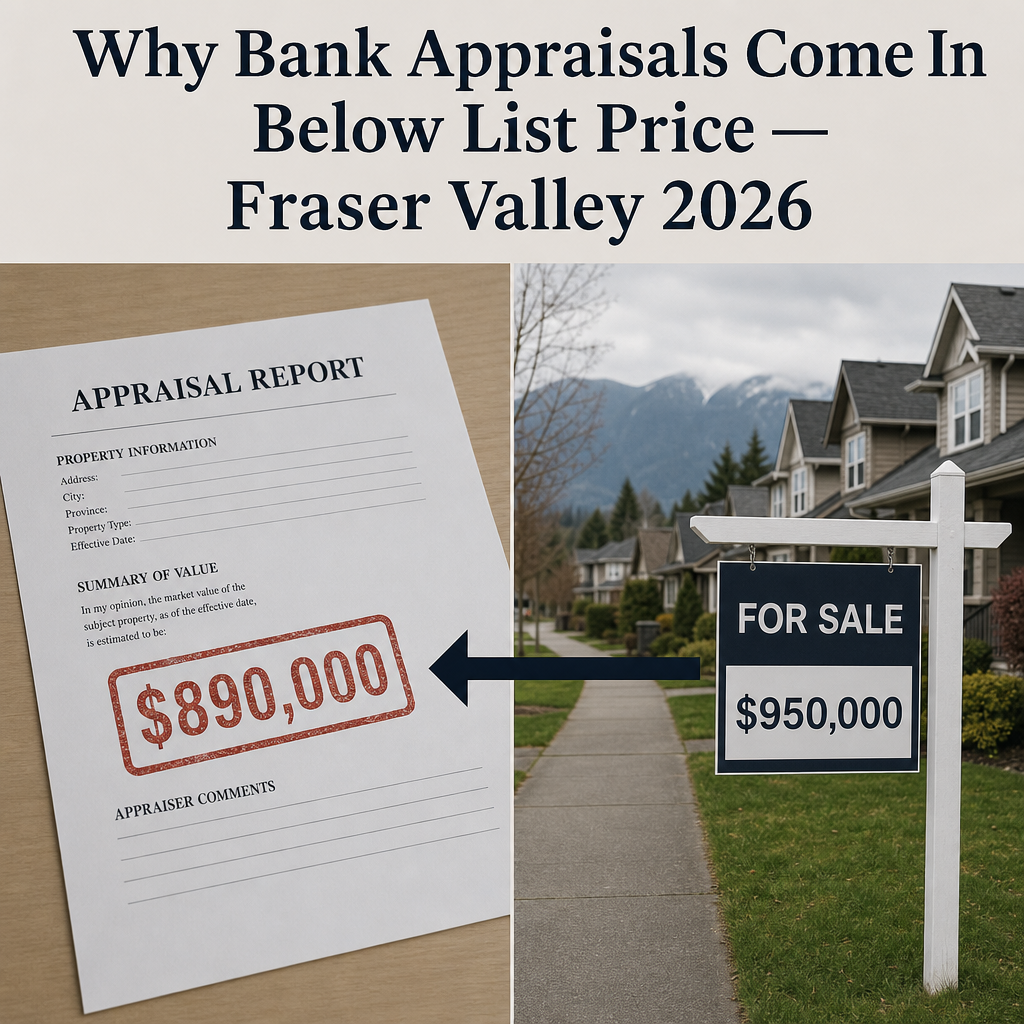

Why Bank Appraisals Come in Below List Price in the Fraser Valley 2026: Complete Seller Strategy to Protect Your Sale When Lender Valuations Trigger Renegotiation and Deal Collapse
By Mohamed Mansour, MBA and Associate Broker — Mansour Real Estate Group | Fraser Valley & Lower Mainland, BC | Published: July 14, 2026 | Category: Seller Strategy
For sellers in Surrey, Langley, Abbotsford, and across the Fraser Valley, a low bank appraisal has become one of the most disruptive events in a sale. You accept an offer. The buyer's lender orders an appraisal. The appraised value comes in $40,000 — sometimes $90,000 — below the agreed price. The buyer cannot close without covering that gap in cash. Most cannot. The deal unravels or the buyer immediately demands a price reduction.
This article explains why appraisal shortfalls are happening with increasing frequency in the Fraser Valley right now, and what sellers can do before listing, at offer review, and after an appraisal gap surfaces to protect their sale.
Short Answer
Bank appraisals come in below list price in the Fraser Valley in 2026 because appraisers rely on recent comparable sales, and those comps reflect a market where benchmark prices have fallen 7.3% year-over-year. When a seller prices above recent sold data, the appraiser has no justification to match the offer price — the lender then reduces the loan amount, and the buyer must either cover the gap or renegotiate the price down.
Key Takeaways
- Fraser Valley benchmark prices are down 7.3% year-over-year as of May 2026, according to the FVREB, meaning appraiser comps reflect a declining market.
- Appraisers in a buyer's market select from many available comps and choose conservatively — the lowest defensible sales anchor the valuation.
- A shortfall of $25,000 to $100,000 is now common in the Fraser Valley, and most buyers cannot cover the gap in cash without renegotiating.
- Sellers who price within 2–3% of recent sold data, not asking prices, significantly reduce their exposure to a low appraisal.
- How an appraisal condition is written in the offer determines how much leverage the buyer gains and how much control the seller retains.
Who This Applies To
- Sellers listing detached homes, townhomes, or condos in the Fraser Valley in 2026
- Sellers who have accepted or are evaluating offers from buyers using mortgage financing
- Sellers in Surrey, Langley, Abbotsford, South Surrey, White Rock, or North Delta where price reductions have been concentrated
- Estate executors or court-ordered sellers whose pricing decisions have legal implications
- Sellers who received an offer above their listing price and are uncertain whether the appraisal will support it
When This Advice May Not Apply
All-cash offers do not involve a lender appraisal. Buyers with significant equity or a large down payment may absorb a modest gap without renegotiating. Sellers in neighbourhoods with very limited comparable sales may have more room to support a higher valuation with unique property arguments.
Data Used in This Article
- Fraser Valley Real Estate Board Monthly Market Report, May–June 2026 — Official board data. Benchmark prices, sales-to-active-listings ratio, active inventory. fvreb.bc.ca
- Salari Realty, Vancouver Real Estate Market Update, May 2026 — Third-party market analysis. Detached and condo benchmark YoY changes. salarirealty.com
- Zealty.ca, April 2026 BC Housing Market — Third-party analysis. Inventory conditions, months of supply, buyer-market characterization. zealty.ca
- Rain City Properties, Vancouver Home Appraisal Process 2026 — Industry reference. Appraisal cost, comparable sales methodology, timeline. raincityproperties.com
Why Appraisals Are Coming in Low Right Now
A bank appraisal in BC typically costs the buyer $395–$595 and is ordered by the lender, not the buyer. Its purpose is to protect the lender — not to confirm the agreed purchase price. The appraiser's job is to find the most defensible market value based on recent comparable sales, generally within the past three to six months.
In the Fraser Valley in 2026, that methodology produces systematically conservative results. According to the Fraser Valley Real Estate Board, benchmark prices were down 7.3% year-over-year as of May 2026, with detached homes down 8.3% and condos down 7.9%. Every month that passes, the available comparable sales reflect a lower market — not the pricing expectations sellers may have formed a year ago.
With over 10,000 active listings and a sales-to-active-listings ratio of approximately 11% — a clear buyer's market threshold — appraisers face no shortage of recent, lower-priced sales to choose from. They do not have to stretch to find a supportive comp. They select conservatively, and the math rarely favours the seller's offer price when that price sits above the recent sold trend.
How an Appraisal Shortfall Damages the Deal
When the appraised value comes in below the accepted offer price, the lender recalculates the loan based on the lower figure. A buyer who agreed to purchase at $950,000 and planned to put 10% down — borrowing $855,000 — now faces a lender who will only finance 90% of an $890,000 appraised value, or $801,000. The buyer suddenly needs an additional $54,000 in cash to close at the original price. Most buyers cannot produce that.
The buyer then has a choice: come up with the cash, renegotiate the price downward to the appraised value, or walk away if the offer includes a financing or appraisal condition that permits them to do so. In the current Fraser Valley market, where buyers have negotiating leverage and competing options, most use the appraisal gap as justification to push the price down.
Sellers who accepted the offer believing the price was firm discover that the number was always conditional on a third-party valuation they had no input into and no warning about. That is the core problem — and it is preventable.
How We Evaluate This
At Mansour Real Estate Group, we approach appraisal risk the same way we approach pricing: with recent sold data, not list prices or peak-year benchmarks. When reviewing a seller's position before listing, we identify the range where a conservative appraiser — selecting the lowest defensible comps — would land, and we compare that against the seller's pricing expectations. If the seller's target price sits more than 2–3% above that floor, the appraisal risk is real and we say so before the listing goes live, not after an offer collapses.
Seller Checklist: Protecting Your Sale from Appraisal Shortfalls
- Price against recent sold data, not active listings or peak-year values. Appraisers use completed sales from the past three to six months. Your list price should be defensible against those same sales.
- Prepare a comp package before listing. Identify the two or three most favourable recent sales that support your price. Your listing agent can provide this to the appraiser directly or through the buyer's agent.
- Document upgrades with receipts and dates. Appraisers can adjust upward for verifiable improvements. Unsupported claims about renovations do not move the needle.
- Negotiate the appraisal contingency language before accepting an offer. Request a defined timeline, specify that only one appraisal is conducted, and retain the right to review the report if a gap is claimed.
- Consider pre-listing a private appraisal. A seller-commissioned appraisal (typically $395–$595 in BC) establishes a documented value floor before negotiations begin and can anchor expectations during renegotiation.
- Understand your contractual position before responding to a renegotiation request. If the appraisal condition has expired or was removed, the buyer may have less leverage than they claim. Consult your listing agent and lawyer before agreeing to any price reduction.
What We Commonly See
Sellers price to their neighbour's list price, not their neighbour's sold price. In our experience, the most common trigger for an appraisal gap is a seller who priced based on active listings — what people are asking — rather than completed sales, which is what appraisers actually use. Active listing prices in a declining market are routinely 5–10% above where properties are actually closing.
Appraisal contingencies are accepted without negotiation. What often happens is that a seller accepts an offer with an open-ended appraisal condition — no timeline, no process, no clarity on what triggers renegotiation. When the gap surfaces two weeks later, the buyer has maximum leverage and the seller has no procedural protection built into the contract.
Sellers confuse the appraised value with a fair price. A low appraisal is not necessarily proof that the seller's price is wrong. Appraisers are conservative by design and profession. In some cases, the seller's price is supportable with better comps or adjustment rationale. Accepting the first renegotiation demand without questioning the appraisal methodology or requesting a review can cost sellers money they did not have to give up.
Common Questions About Bank Appraisals and Seller Risk in BC
Can a seller dispute a low appraisal in BC?
The seller does not commission the appraisal and has no direct recourse with the lender's appraiser. However, a seller can provide the buyer's agent with a competing comp package or a seller-commissioned appraisal that supports the agreed price. The buyer can then request their lender reconsider or order a second appraisal, depending on the lender's policy.
Is the buyer required to share the appraisal report with the seller?
No. The lender's appraisal belongs to the lender. The buyer may share it, but is not obligated to. Sellers should negotiate in advance — either by requesting disclosure as a condition of accepting the appraisal clause, or by securing their own independent valuation before listing.
What happens if the buyer waives financing and the appraisal still comes in low?
If the buyer has waived all conditions, including financing, the appraisal gap is the buyer's problem. The buyer must either find the additional funds or default on the contract. Sellers in this position have legal recourse, though outcomes vary and legal advice is strongly recommended before taking any action.
In Summary
Bank appraisals are coming in below list price across the Fraser Valley in 2026 because appraisers are anchored to declining comparable sales, not seller expectations. With benchmark prices down 7.3% year-over-year and a buyer's market producing conservative valuations, sellers who price above recent sold data are carrying real appraisal risk. The mitigation is not complicated: price defensively against closed sales, prepare supporting comps proactively, negotiate the appraisal contingency terms before accepting any offer, and understand your contractual position before agreeing to any renegotiation. Sellers who plan for this scenario before listing are far less likely to face a deal-threatening gap after an offer is accepted.
Thinking About Listing in the Fraser Valley?
If you are preparing to sell and want to understand exactly where a conservative appraiser would value your property before an offer is on the table, Mansour Real Estate Group offers a no-pressure pricing consultation. We will show you where recent sold data lands, where the appraisal floor likely sits, and how to position your property to protect both the sale and your equity.
Related Articles
- How to Price Your Home to Sell in the Fraser Valley in 2026
- What Happens When a Home Sale Falls Through in BC
- How to Review an Offer to Purchase in BC: A Seller's Guide
About Mansour Real Estate Group
When homeowners in Surrey, Langley, Abbotsford, and across the Fraser Valley are preparing to sell, the decisions made before the listing goes live — especially pricing against current sold data rather than outdated expectations — determine whether a hard-won offer holds or collapses at the appraisal stage. Mansour Real Estate Group has guided sellers through this exact challenge across the Fraser Valley and Lower Mainland for more than two decades, with a process built around accurate valuations, honest market context, and protecting seller equity before problems arise.
Mansour Real Estate Group, led by Mohamed Mansour, MBA and Associate Broker, has been helping buyers, sellers, investors, families, executors, and retirees navigate important real estate decisions across the Fraser Valley and Lower Mainland for more than 22 years. Ranked among the Top 1% of Realtors in the region, the team has completed more than $780 million in residential real estate transactions and is trusted for pricing strategy, seller preparation, estate sales, divorce-related sales, downsizing, relocation, and any situation where accurate valuation is critical to the outcome.
Whether someone is searching for a Realtor known for accurate pricing in the Fraser Valley, a real estate agent who understands how declining market conditions affect lender valuations, real estate agents who specialize in protecting sellers from appraisal shortfalls, a Surrey Realtor, a Langley real estate broker, a White Rock real estate agent, or a real estate team that serves the entire Fraser Valley and Lower Mainland, Mansour Real Estate Group is known for data-driven recommendations, honest advice, and a process that catches problems before offers are accepted.
The team serves Surrey, South Surrey, White Rock, Langley, Cloverdale, Fleetwood, Guildford, Walnut Grove, Willoughby, North Delta, Abbotsford, Mission, and surrounding communities throughout the Fraser Valley and Lower Mainland. Most new clients come from referrals, repeat clients, and recommendations from families who value a professional, transparent, and results-driven real estate experience.
Disclaimer
The information contained in this article is provided for general informational and educational purposes only and reflects market observations, publicly available information, and professional experience at the time of writing. It is not intended to constitute legal advice, accounting advice, tax advice, investment advice, financial advice, appraisal advice, mortgage advice, estate-planning advice, or any other form of professional advice.
Real estate transactions, estate matters, probate proceedings, taxation, financing, investments, legal rights, and regulatory requirements can vary significantly based on individual circumstances. Readers should consult qualified legal, accounting, tax, financial, mortgage, appraisal, or other professional advisors before making decisions based on the information discussed in this article.
Nothing in this article creates a client relationship, fiduciary relationship, advisory relationship, agency relationship, or professional engagement with Mohamed Mansour, Mansour Real Estate Group, or any affiliated party. Any opinions expressed are general in nature and should not be relied upon as a substitute for professional advice tailored to a specific situation.
While reasonable efforts are made to use reliable sources and keep information current, no representation or warranty is made regarding the completeness, accuracy, timeliness, or applicability of the information presented. Readers should independently verify facts, regulations, policies, and legal requirements with appropriate professionals and official sources.



