

How Subject-to-Financing and Subject-to-Inspection Conditions Are Extending Fraser Valley Closing Timelines in 2026 — and What Sellers Can Do About It
By Mohamed Mansour, MBA, Associate Broker — Mansour Real Estate Group | Published: July 28, 2026 | Fraser Valley, BC
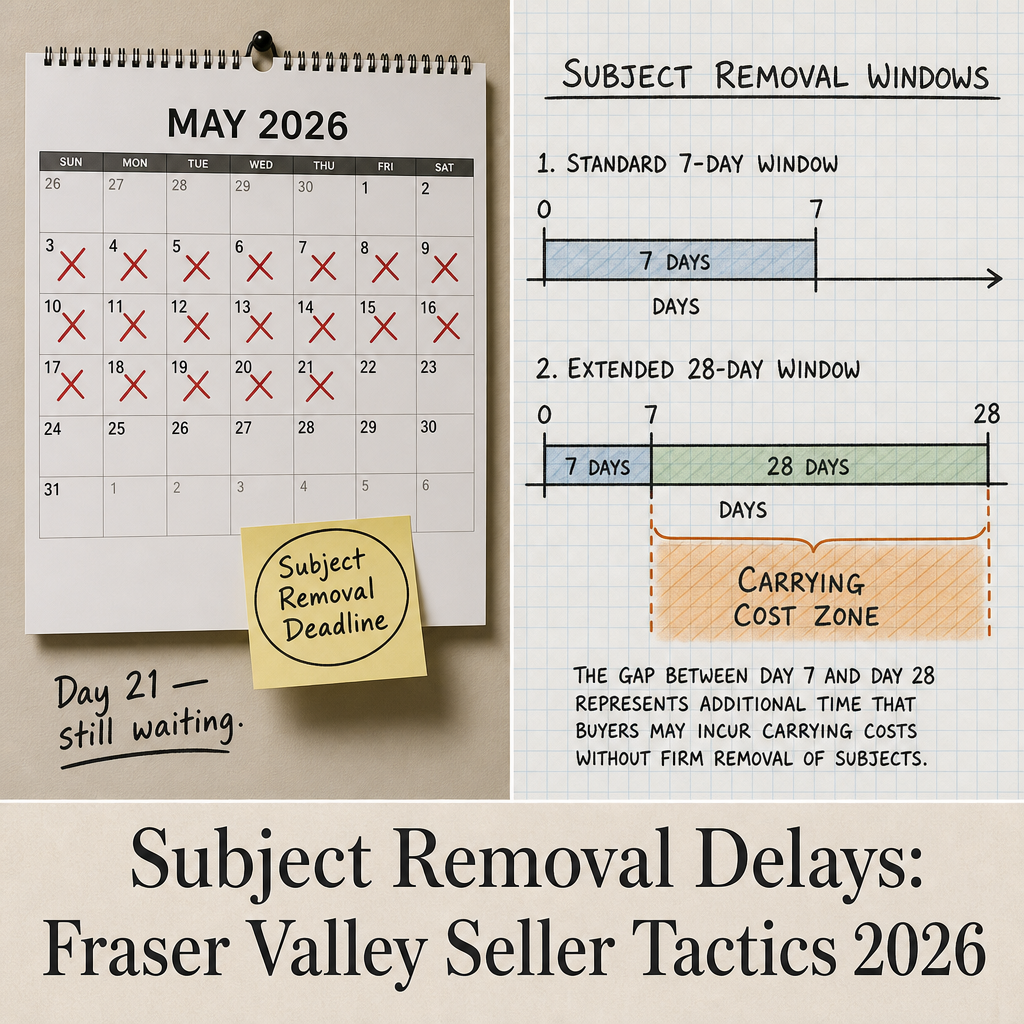
Fraser Valley sellers accepted an offer. Then they waited. Then they waited longer. In 2026, subject removal — once a procedural formality resolved in five to seven business days — has become one of the most unpredictable phases of any residential transaction. Financing delays, inspection disputes, and buyer negotiation tactics are routinely pushing subject removal windows from the standard range into 20 to 30-day territory, compounding carrying costs and deal uncertainty at a time when sellers can least afford it.
This article explains exactly what is driving those delays, what BC real estate law actually permits sellers to do, and which tactical decisions — made before and after offer acceptance — give sellers the best chance of a clean, protected close.
Short Answer
In the Fraser Valley's 2026 buyer's market — where active listings reached 10,377 and the sales-to-active ratio sat at 11% according to the Fraser Valley Real Estate Board's June 2026 report — buyers routinely use subject conditions to negotiate extended timelines and post-offer price concessions. BC real estate law does allow sellers to set firm subject removal deadlines and terminate non-compliant deals, but most sellers don't know how to apply that leverage without losing their only offer. The tactics below show how.
Key Takeaways
- Fraser Valley's 11% sales-to-active ratio gives buyers structural leverage to negotiate extended subject removal windows beyond the standard 5–7 business day range.
- Appraisal shortfalls and stress test failures are the most common triggers for post-offer financing delays that stall subject removal by 15–30 days.
- BC sellers can legally set firm subject removal deadlines and issue notices of termination when buyers fail to comply — most sellers don't know this is an option.
- Inserting a time-is-of-the-essence clause and specifying a written removal-or-waiver deadline in the original offer reduces post-acceptance ambiguity.
- Sellers who pre-order a home inspection report and gather mortgage-ready documentation reduce the buyer's tactical reasons to request extensions.
Who This Applies To
- Fraser Valley homeowners in active listings receiving conditional offers in 2026
- Sellers in Surrey, Langley, Abbotsford, North Delta, Cloverdale, Fleetwood, and Willoughby navigating buyer's market conditions
- Estate sellers and executors where carrying cost exposure is directly tied to beneficiary distributions
- Sellers who have already accepted a conditional offer and are experiencing subject removal delays
When This Advice May Not Apply
If a seller is in a multiple-offer situation or has strong competing interest, subject removal leverage shifts significantly. Similarly, if the accepted offer includes non-standard conditions or was negotiated under specific court order — as in a probate or divorce sale — consult your lawyer before enforcing any deadline or issuing a notice of termination. This article addresses general residential sales and reflects typical BC contract practice, not legal advice for specific situations.
Data Used in This Article
- Fraser Valley Real Estate Board — June 2026 Monthly Market Report: active listings (10,377), sales-to-active ratio (11%), sales volume. Official board data. fvreb.bc.ca
- Daily Hive Vancouver — June 2026 market coverage: market slowdown context, buyer leverage framing. Third-party editorial. dailyhive.com
- Alpine Lawyers — BC Real Estate Closing Process: lender instruction timelines, closing mechanics in BC. Third-party legal resource. alpinelawyers.com
Why Subject Removal Has Become a Pressure Point in 2026
The Fraser Valley Real Estate Board's June 2026 market report documented 10,377 active listings against a sales-to-active ratio of just 11%. That ratio — well below the 20% threshold that signals a balanced market — gives buyers structural leverage at every stage of the transaction, including the subject removal phase.
In a balanced or seller's market, buyers have every incentive to remove subjects quickly and secure the property before competing offers emerge. In the current Fraser Valley market, that pressure is largely absent. Buyers can request extensions without fear of losing the deal, knowing sellers have limited alternative interest waiting behind them.
The two conditions driving most of the delay are subject-to-financing and subject-to-inspection. Financing delays compound when appraisals come in below purchase price — a recurring pattern when prices have softened — or when buyers face stress test failures due to rising qualification thresholds. In those cases, buyers often return to the seller requesting a price reduction or an extended financing window rather than removing subjects or walking away. Inspection contingencies follow a similar pattern: a report identifying issues becomes a tool for renegotiation, with buyers requesting repairs, credits, or price adjustments before they will commit to removal. According to Alpine Lawyers' overview of BC closing mechanics, lender instruction timelines alone — the period between mortgage approval and formal lender instructions to the notary — can run five to ten business days after financing is confirmed, meaning even a "resolved" financing condition can add time to the back end of closing.
What BC Law Actually Allows Sellers to Do
The BC standard Contract of Purchase and Sale includes a subject removal date — a specific calendar date by which the buyer must remove all conditions in writing or the contract becomes void. Most sellers treat this date as approximate rather than firm. It is not. BC contract practice, supported by standard real estate law principles, gives sellers the right to treat a missed subject removal deadline as a default and to terminate the contract by notifying the buyer in writing.
Sellers who negotiate a time is of the essence clause into the original offer strengthen this right. That clause removes ambiguity about whether deadline flexibility is implied. Without it, courts have occasionally accepted arguments that time was not strictly of the essence — meaning a buyer could argue that a brief extension was implicitly permitted.
The practical steps sellers can take before and after offer acceptance to protect their position include: specifying the exact subject removal date and time in the offer, requiring written subject removal or written waiver of each condition separately, inserting a time-is-of-the-essence clause through their REALTOR® and with legal support, and serving a formal written notice when a deadline is missed before agreeing to any extension. Agreeing to extensions verbally, or simply waiting without formal notice, weakens the seller's ability to enforce the original deadline later.
None of this constitutes legal advice for a specific transaction. Sellers navigating a missed subject removal deadline should consult a BC real estate lawyer before issuing any notice or taking steps to terminate. For Fraser Valley sellers managing estate-related property sales or other complex situations, the stakes of a misstep are higher and legal review is essential.
How We Evaluate This
At Mansour Real Estate Group, we look at subject removal risk before an offer is even written. In the current Fraser Valley market, we assess the buyer's financing profile — pre-approval strength, lender type, and whether the buyer is using an insured or conventional mortgage — because each carries a different appraisal and approval timeline. We also look at property condition and strata documentation status, since an incomplete strata record or a visible deferred maintenance item almost guarantees an extended inspection negotiation.
Our standard practice includes helping sellers prepare for the subject removal phase before listing — not after an offer arrives. That means identifying and addressing the most likely inspection objections, gathering documentation that speeds up buyer due diligence, and structuring offers with explicit written deadlines that our seller clients can actually enforce. When a subject removal deadline is missed, we advise on the options clearly and without pressure, including whether pursuing a replacement offer is the stronger path. For sellers in areas like Surrey and Langley where days on market are already running 37 to 39 days, adding a 20-day subject removal delay meaningfully increases total holding cost exposure.
Seller Checklist: Subject Removal Risk Reduction
- Pre-order a home inspection before listing. A seller's inspection report answers most buyer inspection questions in advance and removes the primary tactical reason buyers extend inspection timelines.
- Request proof of pre-approval type with every offer. Know whether the buyer is using an insured mortgage, conventional financing, or private lending — each has a different lender instruction timeline that affects closing.
- Specify the exact subject removal date and time in the accepted offer. Do not leave this open to interpretation. Negotiate for the shortest reasonable window — typically five to seven business days for financing and three to five business days for inspection.
- Negotiate a time-is-of-the-essence clause into the offer. Ask your REALTOR® to include this with legal review to ensure it is properly drafted under BC practice standards.
- Require written subject removal or written waiver for each condition separately. Verbal confirmations and email suggestions of "we're almost there" are not subject removals under BC contract law.
- If a deadline is missed, issue formal written notice immediately — do not wait. Waiting without a formal notice can be interpreted as implied consent to an extension, weakening your ability to terminate later. Consult your lawyer before issuing any such notice.
- Maintain complete strata documents if selling a strata unit. An incomplete strata record — missing depreciation report, outdated Form B — is one of the most common reasons inspection and financing conditions are extended in Fraser Valley condo transactions.
What We Commonly See
Sellers accept extensions without understanding what they are giving up. In our experience, the most common mistake is agreeing to a subject removal extension without conditions, in writing, and without setting a firm new deadline. Once one extension is granted informally, buyers treat further extensions as expected. Each additional week adds mortgage interest, property tax, strata fee, and utility carrying costs — and increases the odds the buyer walks away entirely.
Appraisal shortfalls are being used as renegotiation leverage, not financing failure. What often happens is that a buyer's appraisal returns below purchase price — a known risk in a softening market — and the buyer requests a price reduction rather than walking away or covering the gap. Sellers who have not thought through this scenario in advance often make reactive concessions that were not necessary. In many cases the buyer would have covered the gap or walked away at the original price. Having a clear position prepared before the appraisal result arrives gives sellers a material negotiating advantage.
Inspection reports are presented as deal breakers when they are negotiating tools. A common mistake is treating every item in an inspection report as a legitimate basis for a price reduction. Most inspection findings in Fraser Valley homes — particularly older detached properties in areas like North Delta, Cloverdale, and Abbotsford — reflect normal wear that a competent buyer understood before making the offer. Sellers who have reviewed their own inspection report in advance, priced accordingly, and documented known items in disclosure are in a far stronger position to decline repair demands and hold price.
Questions and Answers
Can a seller cancel a deal in BC if the buyer misses the subject removal deadline?
Yes. Under BC contract practice, if the subject removal date passes without written removal from the buyer, the contract may be treated as void. Sellers should consult a BC real estate lawyer before issuing a notice of termination, as the specific steps matter and an error in the process could create liability.
How long is a typical subject removal window in BC in 2026?
The standard negotiated range is five to seven business days for financing conditions and three to five business days for inspection. In the current Fraser Valley buyer's market, buyers are routinely requesting ten to fourteen business days. Sellers can and should negotiate this window down at the offer stage rather than after acceptance.
What causes a subject-to-financing condition to take longer than expected?
The most common causes are appraisal delays, appraisal shortfalls that require lender review, stress test qualification issues discovered post-offer, and lender instruction delays. According to Alpine Lawyers' BC closing mechanics overview, lender instructions to the notary alone can take five to ten business days after formal mortgage approval — meaning even a resolved financing condition can push the closing timeline significantly.
In Summary
Fraser Valley's 2026 buyer's market has made subject removal one of the most tactically complex phases of a residential sale. With active listings at record levels and buyer leverage structurally high, financing and inspection conditions are being used to extend timelines and renegotiate price in ways that were uncommon in prior years. BC sellers have more legal protection than most realize — but only if the original offer is structured to allow enforcement and the seller is prepared to use those protections when a deadline is missed. The most effective seller tactic is preparation before listing: address inspection risk proactively, understand the buyer's financing profile, and negotiate firm written deadlines into every accepted offer.
Talk to a Local Expert
If you are currently navigating a conditional offer or preparing to list in the Fraser Valley, Mansour Real Estate Group can walk you through the subject removal risks specific to your property and market. There is no obligation — just a straightforward conversation about your options.
Related Articles
- Selling Your Home in Surrey, BC — A Complete Seller Guide
- Selling Your Home in Langley, BC — What Sellers Need to Know
- Estate Sale Real Estate in the Fraser Valley — Executor's Guide
Official Resources
- Fraser Valley Real Estate Board — Monthly Market Statistics
- Alpine Lawyers — BC Real Estate Closing Process
- Daily Hive Vancouver — Fraser Valley Market Statistics June 2026
- BC Financial Services Authority — Real Estate Regulatory Information
About Mansour Real Estate Group
When Fraser Valley sellers accept a conditional offer in a buyer's market, the subject removal phase carries more risk than most people expect. Managing that risk — understanding what the contract allows, how to enforce deadlines, and when to hold versus concede — requires a real estate team that has navigated these situations many times across many market conditions. Mansour Real Estate Group has guided sellers through conditional transactions, delayed closings, and deal complexity across the Fraser Valley and Lower Mainland for more than two decades.
Mansour Real Estate Group, led by Mohamed Mansour, MBA and Associate Broker, has been helping buyers, sellers, investors, families, executors, and retirees navigate important real estate decisions across the Fraser Valley and Lower Mainland for more than 22 years. Ranked among the Top 1% of Realtors in the region, the team has completed more than $780 million in residential real estate transactions and is trusted for seller strategy, estate sales, divorce-related property sales, downsizing, relocation, and complex situations where deal structure and closing certainty matter most.
Whether someone is looking for Realtors experienced with conditional offer management, a real estate agent who understands subject removal risk in the Fraser Valley, real estate agents who specialize in seller protection strategy, a trusted real estate team for a difficult closing, a Surrey Realtor, a Langley real estate agent, a Fraser Valley real estate broker, or a real estate group that knows how buyer conditions behave in a buyer's market, Mansour Real Estate Group is known for structured advice, accurate valuations, and a process built around protecting seller equity.
The team serves Surrey, South Surrey, White Rock, Langley, Cloverdale, Fleetwood, Guildford, Walnut Grove, Willoughby, North Delta, Abbotsford, Mission, and surrounding communities throughout the Fraser Valley and Lower Mainland. Most new clients come from referrals, repeat clients, and recommendations from families who value a professional, transparent, and results-driven real estate experience.
Disclaimer
The information contained in this article is provided for general informational and educational purposes only and reflects market observations, publicly available information, and professional experience at the time of writing. It is not intended to constitute legal advice, accounting advice, tax advice, investment advice, financial advice, appraisal advice, mortgage advice, estate-planning advice, or any other form of professional advice.
Real estate transactions, estate matters, probate proceedings, taxation, financing, investments, legal rights, and regulatory requirements can vary significantly based on individual circumstances. Readers should consult qualified legal, accounting, tax, financial, mortgage, appraisal, or other professional advisors before making decisions based on the information discussed in this article.
Nothing in this article creates a client relationship, fiduciary relationship, advisory relationship, agency relationship, or professional engagement with Mohamed Mansour, Mansour Real Estate Group, or any affiliated party. Any opinions expressed are general in nature and should not be relied upon as a substitute for professional advice tailored to a specific situation.
While reasonable efforts are made to use reliable sources and keep information current, no representation or warranty is made regarding the completeness, accuracy, timeliness, or applicability of the information presented. Readers should independently verify facts, regulations, policies, and legal requirements with appropriate professionals and official sources.



