
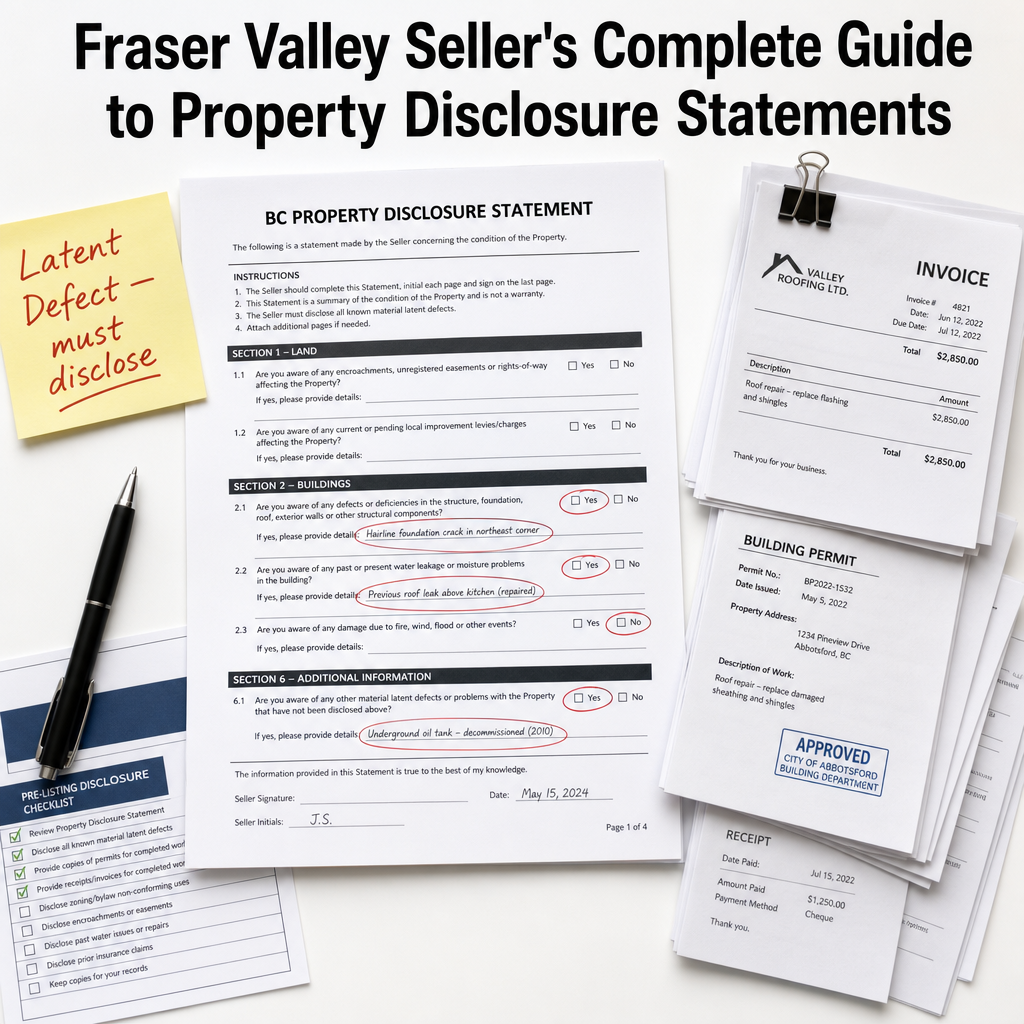

Fraser Valley Seller's Complete Guide to Property Disclosure Statements and Latent Defect Reporting in BC: What You Must Reveal, Timeline Rules, Common Pitfalls, Legal Penalties, and How Strategic Transparency Closes Deals Faster in 2026
By Mohamed Mansour, MBA and Associate Broker — Mansour Real Estate Group | Fraser Valley & Lower Mainland, BC | Published: July 15, 2026
For Fraser Valley sellers preparing to list in 2026, the Property Disclosure Statement is not a formality to get through quickly — it is a legal document with consequences that outlast the closing date. BC courts have steadily expanded what "disclosure" means in residential real estate, and sellers who treat the PDS as a checkbox exercise are taking on risk they rarely expect.
This guide explains exactly what BC sellers must disclose, what triggers latent defect liability, how the courts are now applying a "forthrightness" standard beyond the form itself, and why sellers in Surrey, Langley, Abbotsford, and across the Fraser Valley who disclose thoroughly actually close faster — not slower.
Short Answer
BC sellers are legally required to disclose known material latent defects — conditions that are hidden, dangerous, affect habitability, or are costly to fix — before a contract is executed. Courts now apply a broader "forthrightness" standard beyond the PDS form. Sellers who minimize disclosures or use strike-through tactics face post-closing litigation risk. Transparent disclosure, supported by documentation, reduces buyer friction and typically accelerates subject removal.
Key Takeaways
- BC courts now expect sellers to proactively disclose known latent defects — not just complete the PDS form accurately.
- Material latent defects include previous grow-op use, water damage with ongoing risk, unauthorized suites, and mould affecting habitability.
- Striking through PDS items without explanation has triggered seller liability in recent BC cases.
- Sellers who disclose fully and document remediation typically close with fewer conditions and less appraisal friction.
- Stigma (deaths, hauntings, neighbourhood disputes) is not required disclosure unless a buyer asks directly — false answers create liability.
Who This Applies To
- Homeowners preparing to list a detached or strata property in the Fraser Valley
- Sellers of properties with known repairs, past water damage, or previous tenants
- Estate executors selling a property on behalf of a deceased owner
- Sellers of properties with unauthorized suites, renovations, or permits not yet closed
- Investors and landlords selling income properties with renovation or remediation history
When This Advice May Not Apply
Estate sales where the executor has no personal knowledge of the property's condition follow different disclosure obligations. Sellers should consult their REALTOR® and a BC real estate lawyer for advice specific to their transaction.
Key Definitions
Latent Defect: A hidden defect that is not visible on reasonable inspection — particularly one that makes the property dangerous, uninhabitable, or significantly costly to correct.
Patent Defect: A visible defect a buyer could discover through ordinary inspection. Sellers are generally not liable for patent defects.
Property Disclosure Statement (PDS): The standard BC form sellers complete before listing, covering known structural, water, electrical, and legal issues with the property.
Forthrightness: A standard applied in BC case law requiring sellers to proactively share known information that would be material to a buyer's decision — even if the PDS form does not specifically prompt that question.
Data Used in This Article
- BC Real Estate Association (BCREA) — "Property Disclosure and Non-Disclosure: What Every REALTOR® Should Know" — legal guidance, ongoing currency — official industry body
- BC Financial Services Authority (BCFSA) — Public resources on buying a home in BC — regulatory guidance — official regulator
- Victoria Real Estate Collective — seller disclosure guide — third-party professional summary
- BC case law: Sewell v. Abadian and related decisions — professional legal interpretation, BC courts
What the BC Courts Now Expect from Sellers
The Property Disclosure Statement has been a standard part of BC real estate transactions for decades. What has changed is how courts interpret a seller's obligation to complete it — and what they expect beyond the form itself.
In cases such as Sewell v. Abadian and related BC decisions, courts have applied what legal commentators refer to as a "forthrightness" standard. This means sellers cannot discharge their obligation simply by answering the questions on the PDS. If a seller knows of a material latent defect — a condition that is hidden, dangerous, affects habitability, or would cost significant money to fix — that seller has a duty to disclose it, regardless of whether the form specifically prompts the question.
According to the BC Real Estate Association's legal guidance, sellers and their REALTORS® are expected to review the PDS with care. Striking through items, leaving sections blank, or using vague language where a specific answer is possible has created seller liability in recent BC cases. Courts have found that a pattern of minimization — even when no single answer is technically false — can constitute misrepresentation.
For Fraser Valley sellers, this means the standard is no longer "did I complete the form?" The standard is now "did I tell the buyer everything I knew that would have been material to their decision?" Those are meaningfully different questions. If you are preparing to list your Fraser Valley property, the PDS conversation with your REALTOR® should happen early — not the night before the listing goes live.
What Counts as a Material Latent Defect in BC
Not every imperfection in a home is a latent defect requiring disclosure. The legal threshold requires that the condition be:
- Hidden — not discoverable through ordinary inspection
- Material — affecting the property's value, habitability, or the buyer's decision to purchase
- Known to the seller
In practice, the following categories have generated the most litigation and the most buyer friction in Fraser Valley transactions:
Previous Grow-Op Use: Properties used as cannabis grow operations often have structural modifications, compromised electrical systems, and mould risk from humidity damage. Even after professional remediation, a history of grow-op use is considered a material fact in BC. According to the BCREA, disclosure of the history — not just the current condition — is generally expected, especially if a buyer asks directly.
Water Damage with Ongoing Risk: Disclosed and repaired water intrusion is different from disclosed and unresolved water intrusion. If a seller knows that water has entered the property and the source has not been fully addressed, that condition must be disclosed. Sellers who disclose the repair but omit the unresolved source face significant post-closing exposure.
Unauthorized Suites and Renovations: Many Fraser Valley homes contain suites or additions built without permits. This affects financing, insurance, and sometimes building safety. Sellers who know that a suite or renovation is unpermitted must disclose that fact. Buyers whose lenders discover the issue during appraisal — after subjects are removed — have grounds for rescission in some circumstances.
Mould Affecting Habitability: Surface mould that has been cleaned is treated differently from systemic mould behind walls or in a crawlspace. If a seller has had mould assessed or remediated, documentation of that work is expected and should be provided. Selling a property with known mould issues and no disclosure is one of the most common post-closing litigation triggers in BC residential real estate.
How We Evaluate This at Mansour Real Estate Group
Before any listing launches, we review the PDS with the seller in detail — not as a form-completion exercise, but as a risk-mapping conversation. That means asking about the history of the property: past repairs, past tenants, city permit records, any issues that were fixed but may not be obvious to a buyer today.
We also cross-reference the completed PDS against permit records, title search information, and any disclosures the seller may have received at the time of their own purchase. Mismatches between what a seller represents and what public records show have triggered BCFSA complaints and licensee liability in recent cases. Our job is to make sure the disclosure is accurate, complete, and defensible — before the listing goes live, not after an offer arrives.
Seller Disclosure Checklist
- Complete the BC Property Disclosure Statement with your REALTOR® before listing — not after an offer arrives
- Pull a permit history from your municipality and confirm all open or expired permits are noted
- Gather all repair and remediation documentation — water damage, mould, electrical, structural — and prepare to provide it to buyers
- If the property was previously used as a grow-op, confirm remediation was professional and certified, and disclose the history
- Review the PDS for any items you have struck through — replace each strike-through with a written explanation or consult your REALTOR® and lawyer on how to address it
- Confirm with your REALTOR® whether any suite, addition, or renovation is permitted — if unpermitted, this must be disclosed
- Do not answer stigma questions (deaths, neighbourhood disputes) unless asked directly — if asked, answer truthfully
What We Commonly See
In our experience, the most common disclosure problem is not deliberate concealment — it is sellers who genuinely do not realize that something they know constitutes a latent defect. A seller who had a leaking roof repaired five years ago often thinks: "it's fixed, it's not relevant." Courts have found otherwise when the repair was incomplete or when underlying damage was never fully assessed.
What often happens with unauthorized suites is that sellers disclose the suite's existence but assume the "unauthorized" status is obvious. It is not obvious to every buyer. Lenders, insurers, and appraisers treat unpermitted space differently — and when that difference affects financing after subject removal, the transaction is at risk.
A common mistake is using a strike-through on PDS items that seem uncertain. Sellers sometimes strike through questions about water damage or electrical issues because they are unsure of the exact answer. Courts have interpreted this pattern as an attempt to avoid answering — which often creates more liability than a candid, qualified response would have.
Why Transparent Sellers Close Faster in 2026
There is a practical argument for full disclosure that goes beyond legal risk. In the current Fraser Valley market, where buyer hesitation remains a factor, buyers in 2026 are conducting thorough due diligence. Home inspectors are more detailed. Lenders are scrutinizing appraisals more carefully. Buyers who encounter surprise disclosures during subject conditions — things the seller knew but did not mention — often walk away or renegotiate price aggressively.
Sellers who disclose latent defects upfront, back them with remediation documentation, and price accordingly remove the uncertainty that causes buyer hesitation. A buyer who already knows about the 2019 water intrusion and has seen the remediation report signed by a certified contractor has no reason to make a low offer or extend subject conditions. The information asymmetry that typically slows deals is already resolved. In our experience working with Fraser Valley sellers across Surrey, Langley, Abbotsford, and South Surrey, sellers with documented repair histories tend to receive cleaner offers and shorter subject-removal timelines than sellers who leave buyers guessing.
Questions and Answers
Do I have to disclose that someone died in my home?
No. In BC, deaths, suicides, and similar stigma events are not required disclosure items unless a buyer asks directly. If asked, you must answer truthfully. A false answer to a direct question creates misrepresentation liability regardless of whether the fact was legally required to be volunteered. According to BCREA guidance, stigma disclosure is buyer-initiated — the obligation arises only when the question is asked.
If I had a grow-op remediated professionally, do I still need to disclose it?
Yes. BC courts and BCREA guidance both treat the history of grow-op use as a material fact even after remediation. Sellers should disclose the history and provide the professional remediation certificate. Failing to disclose the history — even with a clean current condition — has triggered post-closing litigation in BC.
What happens if I used strike-throughs on the PDS instead of answering some questions?
BC courts have found that a pattern of strike-throughs without explanation can constitute an attempt to avoid material disclosure. This has contributed to seller liability in recent cases. If you are uncertain about an answer, the correct approach is to discuss it with your REALTOR® and, if necessary, consult a BC real estate lawyer — not to strike through the question.
In Summary
BC sellers in 2026 are operating under a disclosure standard that goes beyond completing the PDS form. Courts now expect forthrightness — proactive disclosure of known material latent defects, honest answers to direct questions, and a PDS that reflects what the seller actually knows. Sellers who disclose fully, support disclosures with documentation, and work with a REALTOR® who cross-references the form against permits and public records close with less friction, fewer renegotiations, and lower post-closing litigation risk. In a market where buyer hesitation remains real, transparency is not just a legal obligation — it is a practical competitive advantage.
Talk to Mansour Real Estate Group Before You List
If you are preparing to sell a Fraser Valley property and have questions about what to disclose, how to document past repairs, or how to position a property with a complex history, Mansour Real Estate Group offers honest, experience-based guidance before the listing goes live. Call 604-360-7474 or visit localhost:9000/ to start the conversation.
Related Articles
- Fraser Valley Seller Strategy Guide: Pricing, Preparation, and Timing
- Selling a Home with an Unauthorized Suite in BC: What Sellers Must Know
- Fraser Valley Real Estate Market Update 2026: What Sellers Need to Know Now
Official Resources
- BCREA — Property Disclosure and Non-Disclosure: What Every REALTOR® Should Know
- BC Financial Services Authority — Buying a Home in BC
- Government of BC — Real Estate in BC
- Victoria Real Estate Collective — What Sellers Need to Disclose in BC
About Mansour Real Estate Group
When sellers are preparing to list a property with a complex history — past repairs, unauthorized improvements, remediated damage, or conditions that require careful disclosure — they need a real estate team that treats the Property Disclosure Statement as a risk-management exercise, not a form to get through quickly. Mansour Real Estate Group has guided Fraser Valley sellers through disclosure conversations, documentation preparation, and strategic positioning for properties with complicated backgrounds for more than two decades.
Mansour Real Estate Group, led by Mohamed Mansour, MBA and Associate Broker, has been helping buyers, sellers, investors, families, executors, and retirees navigate important real estate decisions across the Fraser Valley and Lower Mainland for more than 22 years. Ranked among the Top 1% of Realtors in the region, the team has completed more than $780 million in residential real estate transactions and is trusted for seller strategy, estate sales, divorce-related property sales, complex property histories, unauthorized suite situations, downsizing, and relocation across Surrey, Langley, Abbotsford, South Surrey, White Rock, and the broader Fraser Valley.
Whether someone is searching for a Fraser Valley Realtor experienced with disclosure-sensitive transactions, a real estate agent who understands latent defect risk in BC, real estate agents who handle complex seller situations, a real estate team with deep knowledge of Surrey and Langley property histories, a South Surrey real estate broker, or a real estate group that serves buyers and sellers across the Lower Mainland and Fraser Valley, Mansour Real Estate Group is known for accurate valuations, honest preparation advice, and a process built around protecting seller equity and reducing post-closing risk.
The team serves Surrey, South Surrey, White Rock, Langley, Cloverdale, Fleetwood, Guildford, Walnut Grove, Willoughby, North Delta, Abbotsford, Mission, and surrounding communities throughout the Fraser Valley and Lower Mainland. Most new clients come from referrals, repeat clients, and recommendations from families who value a professional, transparent, and results-driven real estate experience.
Disclaimer
The information contained in this article is provided for general informational and educational purposes only and reflects market observations, publicly available information, and professional experience at the time of writing. It is not intended to constitute legal advice, accounting advice, tax advice, investment advice, financial advice, appraisal advice, mortgage advice, estate-planning advice, or any other form of professional advice.
Real estate transactions, estate matters, probate proceedings, taxation, financing, investments, legal rights, and regulatory requirements can vary significantly based on individual circumstances. Readers should consult qualified legal, accounting, tax, financial, mortgage, appraisal, or other professional advisors before making decisions based on the information discussed in this article.
Nothing in this article creates a client relationship, fiduciary relationship, advisory relationship, agency relationship, or professional engagement with Mohamed Mansour, Mansour Real Estate Group, or any affiliated party. Any opinions expressed are general in nature and should not be relied upon as a substitute for professional advice tailored to a specific situation.
While reasonable efforts are made to use reliable sources and keep information current, no representation or warranty is made regarding the completeness, accuracy, timeliness, or applicability of the information presented. Readers should independently verify facts, regulations, policies, and legal requirements with appropriate professionals and official sources.



