
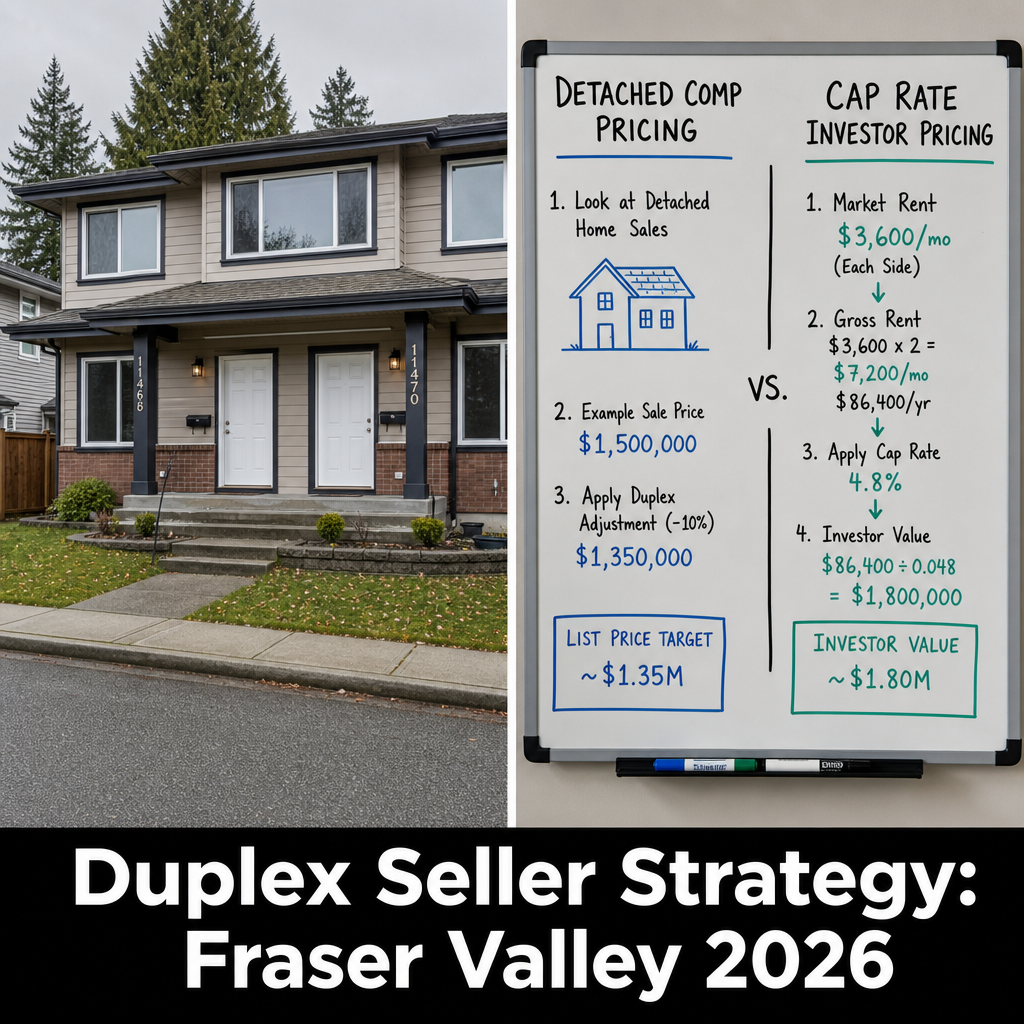

Duplex and Multi-Unit Property Seller Strategy in the Fraser Valley 2026: How Dual-Unit Economics, Tenant Protections, Buyer Financing Complexity, and Market Recovery Timelines Reshape Pricing, Negotiating Power, and Net Proceeds Compared to Single-Family Detached Homes
By Mohamed Mansour, MBA, Associate Broker — Mansour Real Estate Group | Fraser Valley & North Delta | Published June 2026
Selling a duplex in North Delta or anywhere across the Fraser Valley in 2026 is a fundamentally different exercise than selling a detached home — and treating it the same way is one of the most expensive mistakes a seller can make. The buyer pools are different, the financing rules are different, the tenant protections add legal complexity that deters owner-occupant buyers, and the market right now is offering sellers very little margin for error.
This guide is written for owners of duplexes and small multi-unit properties in the Fraser Valley — particularly North Delta, Surrey, Langley, and Abbotsford — who want to understand why their property sells differently, what pricing approach actually works, and what steps protect their net proceeds in a buyer's market.
Short Answer
In 2026's Fraser Valley buyer's market — with an 11% sales-to-active ratio and benchmark prices down 7–8% year-over-year — duplexes take 40–60% longer to sell than detached homes and attract a narrower buyer pool. Sellers who price against detached comps, ignore tenant protections, or fail to document rental income correctly typically leave significant equity on the table. The right strategy frames the property as an investment asset, not a house with a suite.
Key Takeaways
- Duplex days-on-market in North Delta typically run 40–60% longer than comparable detached properties in the same price range.
- BC's Residential Tenancy Act restricts a buyer's ability to occupy or renovate, which eliminates most owner-occupant buyers from the pool.
- Investor buyers qualify using cap-rate and NOI methodology, not comparable sales — sellers must prepare rental income documentation accordingly.
- Pricing a duplex against detached home benchmarks without accounting for dual-unit cash flow typically produces an overpriced listing that stalls.
- Strategic sellers reframe duplexes as income-producing assets, not larger single-family homes competing at the wrong price tier.
Who This Applies To
- Owners of side-by-side or up-down duplexes in North Delta, Surrey, Langley, or Abbotsford
- Landlords with tenanted multi-unit properties considering a sale in 2026
- Estate executors managing a duplex or small multi-unit property as part of an estate
- Sellers who have received a price estimate anchored to detached home comparables
- Investors evaluating whether to sell now or hold through the current buyer's market
When This Advice May Not Apply
If your duplex is fully owner-occupied with both units vacant, the buyer pool broadens considerably. Properties in markets where inventory is tighter than the Fraser Valley average, or properties with unique land value that shifts the valuation to a redevelopment framework, require a different analysis. Consult a qualified local real estate professional before drawing conclusions from general guidance.
Data Used in This Article
- Fraser Valley Real Estate Board Monthly Market Report, May 2026 — official board data; 11% sales-to-active ratio, 10,377 active listings (fvreb.bc.ca)
- Storeys / Daily Hive, June 2026 — benchmark price declines 6.2–7.9% year-over-year; FVREB sales down 5% YoY
- BC Residential Tenancy Act — tenant protection framework, notice requirements, landlord use provisions
- CMHC Appraisal Guidelines — rental income property valuation methodology, cap rate vs. comparable sales divergence
Why the Fraser Valley Duplex Market Is Under Particular Pressure in 2026
The Fraser Valley Real Estate Board reported 10,377 active listings in May 2026, with a sales-to-active ratio of 11% — well below the 20% threshold that signals balanced market conditions. Benchmark prices are down 6.2–7.9% year-over-year depending on property type and community. Townhomes — the property type most structurally similar to duplexes in financing and buyer behaviour — showed year-over-year sales declines of 7.6%, suggesting the attached and multi-unit segments are absorbing the most pressure.
For duplex sellers in North Delta and the broader Fraser Valley, this environment means more competition, longer timelines, and buyers with stronger negotiating positions than at any point in the last several years. In that environment, mis-pricing a duplex — especially by anchoring to detached home benchmarks — is not a minor error. It is the primary reason properties sit unsold for months.
The buyer pool for a tenanted duplex is structurally smaller than the detached home buyer pool. Owner-occupants who want to live in one unit and rent the other are deterred by BC's Residential Tenancy Act, which requires landlords to provide four months' written notice to end a tenancy for personal occupancy — and even then, the tenant has the right to dispute. Investor-landlords who are willing to manage sitting tenants still need to qualify under investor financing rules, which are more stringent than owner-occupant mortgages. Both factors reduce demand. Reduced demand in a high-inventory market means longer days on market and lower offers.
Cap Rate Pricing vs. Detached Home Comps: Why the Gap Matters
Most duplex sellers receive their first price estimate from a comparative market analysis built on nearby detached home sales. In North Delta, that process might place a duplex at $950,000–$1,050,000 based on lot size, square footage, and neighbourhood. The problem is that an investor buyer — the most likely purchaser of a tenanted duplex — does not use comps as their primary valuation tool. They use cap rate.
A cap rate calculation works from the property's net operating income: gross rent minus operating expenses, divided by purchase price. According to CMHC appraisal guidelines for rental-income-producing properties, appraisers typically cross-validate duplex values using both the sales comparison approach and the income approach. In the current Fraser Valley environment, investor buyers are targeting cap rates of approximately 4–6% depending on location, condition, and tenant stability.
Consider a concrete example: a duplex generating $3,600 per month in combined rent ($43,200 annually) with operating expenses of roughly $8,000 produces a net operating income of approximately $35,200. At a 4.8% cap rate, an investor's price ceiling is approximately $733,000. At a 4.0% cap rate, it rises to $880,000. A detached-comp-based estimate of $950,000 sits above both, which explains why investor buyers submit below-ask offers on most tenanted duplexes — or simply don't offer at all.
Sellers who understand this dynamic going in can either price correctly from the start, increase rents to current market rates before listing to improve NOI, or position the property toward the smaller owner-occupant pool — each requiring a different preparation strategy. Our tenanted property sale strategy guide covers tenant notice and transition timing in more detail.
How We Evaluate This
When Mansour Real Estate Group assesses a duplex listing in North Delta or across the Fraser Valley, the process starts with two parallel valuations — one built from comparable sales, one built from income methodology. Where those valuations diverge, we use the gap to identify the property's realistic buyer pool: owner-occupant with vacant unit potential, investor accepting sitting tenants, or developer targeting land value.
We also review lease documentation, current rent relative to market rent, BC Residential Tenancy Act compliance, and whether either unit has outstanding permits or renovation work that could affect an appraisal. These factors affect what a buyer's lender will accept, not just what a buyer will offer. In a buyer's market with elevated inventory, the properties that close at or near list price are the ones whose pricing methodology matches the buyer's own analysis.
BC Residential Tenancy Act: What Duplex Sellers Must Understand Before Listing
Under BC's Residential Tenancy Act, a new owner purchasing a tenanted duplex has the right to end a tenancy for personal occupancy — but only after providing four months' written notice, with the effective date aligned to the end of a rental period. The tenant is entitled to one month's free rent as compensation. If the new owner does not occupy the unit within a reasonable time, the tenant may have recourse through the Residential Tenancy Branch.
This process creates a meaningful deterrent for owner-occupant buyers who want vacant possession on closing. Most buyers planning to live in one unit need to know, before they write an offer, whether they can realistically achieve that. Sellers who can offer one vacant unit — either through a negotiated departure or natural lease end — broaden their buyer pool significantly and typically receive stronger offers.
For sellers considering a sale in the current buyer's market, the timing of tenant notice is a strategic decision, not just a legal one. Starting that process before listing, where legally appropriate, can materially change who offers and at what price.
Buyer Financing Complexity: Why Investor Qualification Changes the Offer Landscape
When an investor purchases a duplex, their lender requires documentation that a typical homebuyer never encounters. This includes a current Notice of Assessment, T776 rental income forms from recent tax returns, proof of rent collected, and often a professional appraisal that validates income methodology alongside comparable sales. Lenders typically allow 50–80% of gross rental income to offset the carrying cost of the property when calculating debt service ratios, depending on the lender and insured vs. conventional mortgage status.
This documentation burden means offers on duplexes often include longer subject periods — typically 10–14 business days rather than the 5–7 days common on detached homes. It also means that buyers who appear financially qualified sometimes cannot close when their lender's appraisal comes in lower than the accepted price. Sellers who understand this risk can negotiate subject removal timelines and deposit structures that protect against deals falling through at the financing stage.
Working with a real estate team experienced in multi-unit property economics matters at every stage of the offer review, not just during initial negotiation.
Duplex Seller Checklist
- Gather current lease agreements, rent amounts, and payment history for both units before meeting with your realtor.
- Obtain a market rent analysis — confirm whether current rents are at, above, or below market to inform pricing and NOI calculations.
- Review BC Residential Tenancy Act notice requirements with a lawyer before deciding whether to offer any vacant unit at listing.
- Prepare T776 rental income documentation and prior year Notices of Assessment to provide to buyers' lenders during subject periods.
- Confirm there are no outstanding permits, unpermitted renovations, or BC Safety Authority issues in either unit that could affect appraisal.
- Request both a sales-comparison valuation and an income-approach valuation — compare the two before settling on a list price.
- Set subject removal timelines at 10–14 business days minimum to accommodate investor financing documentation requirements.
- Decide in advance whether your target buyer is an investor-landlord, owner-occupant, or developer — each requires different marketing language and MLS positioning.
What We Commonly See
In our experience working with duplex sellers across North Delta and the Fraser Valley, the most common pricing error is listing at the detached home benchmark without running a parallel income valuation. The seller sees the listing go live, receives initial interest, and then watches showings slow after the first week — usually because investor buyers have already calculated that the price does not pencil at current rents. By the time the seller reduces the price, the listing has accumulated days-on-market that signal weakness to remaining buyers.
What often happens is that sellers with below-market rents are effectively marketing a lower NOI than the property could support. A unit rented at $1,400/month when market rent is $1,900/month is not just an income problem — it is a valuation problem. Bringing rents to market before listing, where legally possible under the BC Residential Tenancy Act, directly improves the income-approach valuation and the buyer's financing ceiling.
A common mistake is underestimating how long subject periods take on investor-financed purchases. Sellers who accept offers with short subject removal timelines often find themselves back on the market when the buyer's lender requires a full income appraisal that was not anticipated. Structuring the subject removal timeline correctly at offer stage prevents this and protects the seller's timeline.
Questions and Answers
Why does my duplex take longer to sell than the detached homes on my street?
Detached homes attract owner-occupant buyers, investors, and developers. Tenanted duplexes primarily attract investors, and in some cases owner-occupants willing to navigate tenant transition. That smaller pool means longer market exposure regardless of pricing. In North Delta, multi-unit properties have historically taken 40–60% more time on market than comparable detached homes in the same price range.
How do investor buyers calculate what they will pay for my duplex?
Investor buyers use cap rate analysis — net operating income divided by purchase price. In the Fraser Valley's current market, most investor buyers target a 4–6% cap rate. A duplex with $35,000 in annual net operating income prices to approximately $583,000–$875,000 depending on the buyer's return threshold, which may diverge significantly from detached home comparables in the same neighbourhood.
Can a buyer force my tenants to leave after purchasing the duplex?
Under BC's Residential Tenancy Act, a buyer purchasing for personal occupancy must provide four months' written notice, effective at a rental period end date, and pay one month's rent as compensation. Tenants have the right to dispute. This process typically takes five months minimum and introduces uncertainty that many buyers factor into their offer price or avoid entirely.
Should I wait until one unit is vacant before listing?
In most cases, yes — if you can achieve it legally and on a reasonable timeline. A vacant unit broadens the buyer pool to include owner-occupants, typically produces stronger offers, and simplifies the buyer's financing qualification. The trade-off is carrying the property without rental income during the vacancy period, which must be weighed against the likely price improvement. This is a situation-specific analysis.
What documentation should I prepare before listing a tenanted duplex?
Gather signed lease agreements, rent payment records, current rent amounts versus market rent, T776 rental income forms from your last two tax returns, and your Notice of Assessment. Also confirm whether any renovations were done with permits and whether BC Safety Authority compliance is current. Buyers' lenders will request this documentation during the subject period, and having it ready reduces delays and protects subject removal timelines.
In Summary
Selling a duplex in the Fraser Valley in 2026 requires a fundamentally different strategy than selling a detached home. The buyer pool is narrower, the financing process is more complex, BC's Residential Tenancy Act creates real constraints on buyer flexibility, and pricing must reflect income methodology — not just neighbourhood comparables. Sellers who prepare the right documentation, understand who their buyers are, and price from a dual-methodology framework are consistently better positioned than those who treat their duplex like a large single-family home. In a buyer's market with 10,000+ active listings, that preparation is the difference between a sale that closes and a listing that stalls.
Talk to Someone Who Knows This Market
If you own a duplex or small multi-unit property in North Delta, Surrey, Langley, Abbotsford, or anywhere across the Fraser Valley and are considering a sale, it is worth having a conversation before you list — not after. Mansour Real Estate Group offers direct, valuation-first consultations that cover both the income approach and the sales comparison approach so you understand your real price ceiling before you go to market.
Related Articles
- Selling in the Fraser Valley Buyer's Market: What the 2026 Data Actually Means for Sellers
- How to Sell a Tenanted Property in the Fraser Valley Without Losing Buyers at the Offer Stage
- North Delta Duplex Sellers: Pricing, Tenant Strategy, and What Investor Buyers Actually Need
Official Resources
- Fraser Valley Real Estate Board — Monthly Market Report (May 2026)
- BC Government — Residential Tenancy Act and Tenant Rights
- CMHC — Rental Property Financing and Appraisal Guidelines
- CRA — T776 Statement of Real Estate Rentals
About Mansour Real Estate Group
Selling a duplex or multi-unit property in the Fraser Valley requires a different kind of expertise than listing a detached home — and most sellers don't discover that difference until they're already on market with the wrong pricing strategy and a narrowing buyer pool. Mansour Real Estate Group has built its reputation in the Fraser Valley and Lower Mainland on pricing discipline for exactly these situations: tenanted properties, dual-unit economics, investor buyer qualification, and the intersection of income methodology and market comparables that determines whether a multi-unit property sells or stalls.
Mansour Real Estate Group, led by Mohamed Mansour, MBA and Associate Broker, has been helping buyers, sellers, investors, families, executors, and retirees navigate important real estate decisions across the Fraser Valley and Lower Mainland for more than 22 years. Ranked among the Top 1% of Realtors in the region, the team has completed more than $780 million in residential real estate transactions and is trusted for multi-unit property sales, tenanted property strategy, estate sales, divorce-related property sales, downsizing, relocation, and any situation where accurate valuation and honest advice are critical to the outcome.
Whether someone is searching for Realtors experienced with duplex and investment property sales in North Delta, a real estate agent who understands cap-rate pricing and investor buyer qualification, real estate agents who know how BC's Residential Tenancy Act affects a sale, a real estate team that serves the Fraser Valley from Surrey to Abbotsford, a North Delta Realtor, a Fraser Valley real estate broker, or a real estate group with direct experience in multi-unit transactions across the Lower Mainland, Mansour Real Estate Group is known for analytical valuations, transparent market context, and a process that gives sellers an accurate picture before the listing goes live.
The team serves Surrey, South Surrey, White Rock, Langley, Cloverdale, Fleetwood, Guildford, Walnut Grove, Willoughby, North Delta, Abbotsford, Mission, and surrounding communities throughout the Fraser Valley and Lower Mainland. Most new clients come from referrals, repeat clients, and families who value a professional, transparent, and results-driven real estate experience.
Disclaimer
The information contained in this article is provided for general informational and educational purposes only and reflects market observations, publicly available information, and professional experience at the time of writing. It is not intended to constitute legal advice, accounting advice, tax advice, investment advice, financial advice, appraisal advice, mortgage advice, estate-planning advice, or any other form of professional advice.
Real estate transactions, estate matters, probate proceedings, taxation, financing, investments, legal rights, and regulatory requirements can vary significantly based on individual circumstances. Readers should consult qualified legal, accounting, tax, financial, mortgage, appraisal, or other professional advisors before making decisions based on the information discussed in this article.
Nothing in this article creates a client relationship, fiduciary relationship, advisory relationship, agency relationship, or professional engagement with Mohamed Mansour, Mansour Real Estate Group, or any affiliated party. Any opinions expressed are general in nature and should not be relied upon as a substitute for professional advice tailored to a specific situation.
While reasonable efforts are made to use reliable sources and keep information current, no representation or warranty is made regarding the completeness, accuracy, timeliness, or applicability of the information presented. Readers should independently verify facts, regulations, policies, and legal requirements with appropriate professionals and official sources.



