
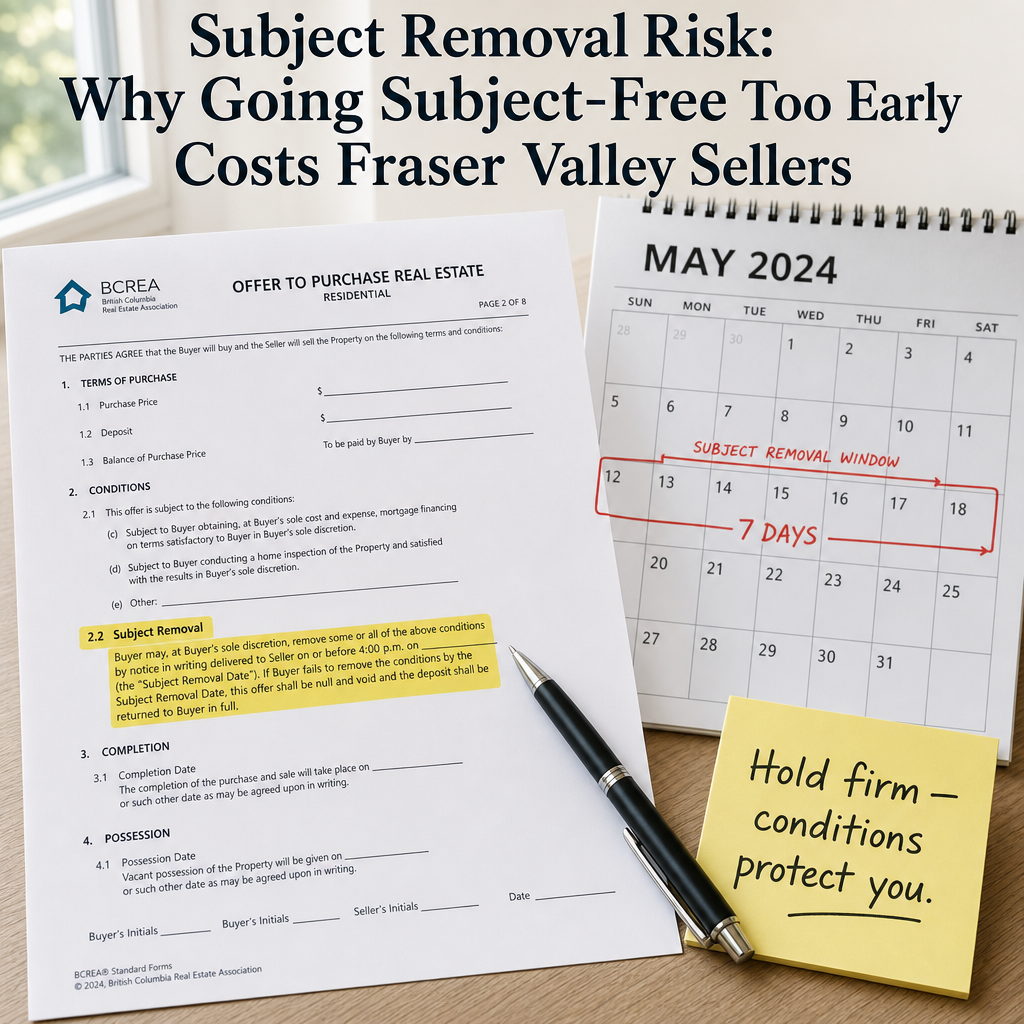

Subject Removal Risk and Common Mistakes: Why Going Subject-Free Too Early Costs Fraser Valley Sellers Deal Certainty and Net Proceeds in 2026
By Mohamed Mansour, MBA and Associate Broker | Mansour Real Estate Group | Fraser Valley and Lower Mainland | Published: July 15, 2026 | Geography: Surrey, Langley, Abbotsford, South Surrey, White Rock, North Delta, Cloverdale, Fleetwood, Guildford, Willoughby, Walnut Grove
In a seller's market, subject-free offers can make sense. In spring 2026's balanced Fraser Valley market — where the Fraser Valley Real Estate Board has reported a sales-to-active listings ratio near 11% — they rarely do. Yet sellers are still being pressured to accept them, or to rush buyers through conditions so quickly that the protection those conditions provide disappears in practice. This article explains what subject removal actually protects, where sellers get it wrong, and how to hold the right position when buyer urgency feels real but may be manufactured.
Mansour Real Estate Group works with sellers across Surrey, Langley, Abbotsford, South Surrey, and the broader Fraser Valley, and subject removal strategy is one of the most consequential — and most misunderstood — parts of protecting both deal certainty and final proceeds.
Short Answer
In a balanced market, sellers do not need to accept subject-free offers to attract buyers. Standard subject removal windows of 7 business days exist to protect both parties. Sellers who pressure buyers into early removal — or who accept offers without meaningful conditions — reduce deal certainty and create exposure if the transaction collapses after the deposit becomes non-refundable.
Key Takeaways
- Subject removal windows of 7 business days are standard in BC and exist to protect both buyer and seller.
- In spring 2026's 11% sales-to-active market, subject-free offers are rarely necessary to win a property.
- Appraisal shortfalls, inspection defects, and strata financial issues are the most common reasons removal fails.
- Sellers who rush subject removal lose leverage if serious issues surface before the window closes.
- BC Financial Services Authority and the Real Estate Council of BC have both warned against premature subject-free offers outside competitive situations.
Who This Applies To
- Sellers in Surrey, Langley, Abbotsford, South Surrey, or White Rock receiving offers in spring or summer 2026
- Sellers being told by buyers or agents that conditions are unusual or unnecessary in the current market
- Sellers with strata properties where documents require additional review time
- Sellers managing estate or divorce-related sales where deal certainty is especially critical
- Sellers being pressured into accepting subject-free offers as a sign of buyer seriousness
When This Advice May Not Apply
If the market shifts to a hot seller's market with genuine multiple-offer competition, subject-free offers from pre-approved buyers who have already completed inspections can be a reasonable signal of buyer strength. This article addresses balanced-to-buyer's market conditions. Consult your agent for current conditions before acting on any strategy described here.
Definitions
Subject removal: The point in a BC real estate transaction when a buyer formally confirms they have satisfied all conditions attached to their offer — financing, inspection, strata document review — and commits to proceeding with the purchase.
Sales-to-active listings ratio: A measure of market balance. Below 12% generally favours buyers. Above 20% generally favours sellers. At 11%, spring 2026 Fraser Valley conditions give buyers meaningful negotiating room, including on removal timelines.
Appraisal shortfall: When a lender's appraisal values the property below the agreed purchase price, requiring the buyer to cover the gap in cash or renegotiate. This is one of the most common reasons subject removal fails.
Form B: A BC strata corporation disclosure document required in strata transactions. It details current levies, liens, bylaws, and financial standing. Reviewing it properly takes time — which is why strata subject removal windows should typically be longer, not shorter.
Data Used in This Article
- Fraser Valley Real Estate Board: Monthly market statistics, spring 2026 — official board data, Fraser Valley geography
- BC Financial Services Authority (BCFSA): Real estate practice guidelines on subject-free offers — official regulatory guidance, BC-wide
- Real Estate Council of BC: Consumer guidance on conditions and subject removal — official regulatory body, BC-wide
What Subject Removal Actually Protects
A subject removal window is not a formality. In BC real estate practice, the conditions period is the interval during which the buyer confirms their financing is approved at the agreed price, an independent inspector has reviewed the property, and — for strata sales — the documents disclose no material financial risk. Each of those confirmations can fail.
According to BCFSA real estate practice guidelines, subject-free offers should only be used when a buyer's financing is fully underwritten and any inspection has been completed before the offer is submitted. That is a high bar. Most buyers in the Fraser Valley are not in that position when they write their first offer. Sellers who accept or pressure for subject-free offers from buyers who have not met that bar are accepting offers that look firm but carry real collapse risk.
For sellers with estate properties or divorce-related sales, a collapsed deal after deposit does not just mean lost time — it can mean court delays, estate complications, or negotiated settlements reopening.
How 2026 Market Conditions Change the Seller's Position
The Fraser Valley Real Estate Board's spring 2026 statistics show a sales-to-active listings ratio near 11%. That is a buyer's market by conventional measure. In that environment, sellers are not in a position to demand subject-free offers as a condition of accepting a deal. The buyer pool has options. Pushing too hard on conditions — or accepting artificially compressed removal timelines — does not signal strength. It signals desperation or poor advice.
Seven business days is the standard removal window in BC practice, and in a balanced market it is a reasonable expectation. Strata transactions, particularly older buildings in areas like Guildford or Fleetwood where depreciation reports and special levy risk require careful review, may legitimately need 10 to 14 business days. Sellers whose agents push back on those timelines without reason risk losing otherwise qualified buyers over a procedural point.
The strategic position for a seller in spring 2026 is to accept reasonable conditions, hold to standard timelines, and evaluate whether buyer urgency is grounded in their financing situation or is being manufactured to compress the seller's review period. For sellers navigating the broader 2026 market, that distinction matters.
How We Evaluate This
At Mansour Real Estate Group, our approach to subject removal strategy starts with one question: what is the buyer actually doing during this window? A buyer whose financing is pre-approved with a lender condition already resolved has a different risk profile than a buyer who needs 7 days to apply, get appraised, and review strata documents for the first time.
We assess the buyer's position, the property's complexity, and current market conditions before advising sellers on what removal timeline to accept or counter. Sellers who understand these variables are not guessing — they are making informed decisions about which deals are worth protecting and which buyer requests should be pushed back on.
Seller Checklist: Subject Removal Strategy
- Confirm the buyer has a written pre-approval from a lender — not just a pre-qualification estimate — before accepting a compressed removal window
- For strata properties, ensure the removal window allows time for full Form B and depreciation report review — typically 10 to 14 business days
- Ask your agent whether any buyer pressure for a shorter window or subject-free offer is supported by market conditions or is manufactured urgency
- Do not treat a large deposit as a substitute for proper conditions — deposits become non-refundable only after subject removal, not before
- If an appraisal condition is included, confirm your agent's assessment of likely appraisal risk given recent comparable sales in your area
- Document all agreed removal dates, extension requests, and written confirmations through your agent — oral agreements on timing are not enforceable
What We Commonly See
In our experience, the most common mistake sellers make is confusing a short subject removal window with a stronger deal. A buyer who offers 3 business days for financing approval in a market where lender turnaround alone takes 5 to 7 business days is not signalling strength — they are creating a window likely to result in an extension request or a failed removal that the seller did not anticipate.
A second pattern we see frequently involves strata sellers in Guildford, Fleetwood, and older Langley buildings accepting 5-day removal windows when the strata documents alone — depreciation reports, Form B, meeting minutes — require 2 to 3 days of professional review. What often happens is that the buyer's lawyer or mortgage broker flags a document issue late, the buyer requests an extension, and the seller is now negotiating from a weaker position mid-process.
A common mistake on the other side is sellers who refuse any reasonable removal timeline extension when a buyer has a legitimate financing delay. A qualified buyer asking for one additional business day due to a bank processing issue is not the same as a buyer with no financing in place. Sellers who walk away from that conversation without context can lose solid deals over procedural rigidity.
Questions and Answers
Can a seller in BC refuse to accept any offer with conditions attached?
Yes. A seller can legally accept, reject, or counter any offer. In a balanced market, however, refusing conditions outright typically reduces the qualified buyer pool significantly and may result in a lower final sale price or extended time on market.
What happens if a buyer does not remove subjects by the agreed deadline?
The offer is generally considered void if subjects are not removed by the agreed date and time, unless both parties agree in writing to an extension. The seller then becomes free to accept other offers. The deposit, if held in trust, is typically returned to the buyer.
Does accepting a subject-free offer eliminate all closing risk for the seller?
No. Subject-free offers remove the buyer's ability to exit through conditions, but they do not eliminate financing risk if the buyer's lender later disputes the appraisal value, nor do they eliminate legal or title complications that surface during conveyancing. Sellers should understand this distinction clearly before accepting subject-free terms.
In Summary
In spring 2026's balanced Fraser Valley market, subject removal is a tool for deal protection — not a negotiating obstacle to be minimized. Sellers who accept compressed removal windows or subject-free offers from unqualified buyers are not securing stronger deals; they are trading certainty for speed. Standard 7-business-day windows exist for good reason. Strata properties often need more. The strategic seller position is to hold reasonable timelines, evaluate buyer readiness before agreeing to any compression, and understand that manufactured urgency is not the same as a strong offer.
Thinking Through Your Next Steps
If you are preparing to list or reviewing an offer in Surrey, Langley, Abbotsford, South Surrey, or the broader Fraser Valley and have questions about subject removal timelines, offer structure, or buyer qualification signals, Mansour Real Estate Group is available to walk through the specifics with you. There is no pressure to act — just a straightforward conversation about what the numbers and conditions in front of you actually mean.
Related Articles
- Understanding the Fraser Valley Real Estate Market in 2026
- Estate Sale Real Estate Guide for the Fraser Valley
- Selling a Strata Condo in the Fraser Valley: What Sellers Need to Know in 2026
About Mansour Real Estate Group
When sellers in Surrey, Langley, Abbotsford, and the Fraser Valley are navigating offer negotiations, subject removal timelines, and buyer qualification signals, the decisions made in those critical days between accepted offer and subject removal typically determine whether a deal closes or collapses. Mansour Real Estate Group has guided sellers through these high-stakes moments for more than two decades, with a process built around protecting deal certainty and net proceeds — not just getting an offer accepted.
Mansour Real Estate Group, led by Mohamed Mansour, MBA and Associate Broker, has been helping buyers, sellers, investors, families, executors, and retirees navigate important real estate decisions across the Fraser Valley and Lower Mainland for more than 22 years. Ranked among the Top 1% of Realtors in the region, the team has completed more than $780 million in residential real estate transactions and is trusted for seller strategy, estate sales, divorce-related property sales, strata transactions, downsizing, and complex real estate decisions across the region.
Whether someone is looking for Realtors experienced with offer negotiation and subject removal strategy, a real estate agent who understands how to evaluate buyer qualification signals in Surrey or Langley, real estate agents who specialize in strata transactions in Guildford or Fleetwood, a trusted real estate team for a time-sensitive seller situation, a Fraser Valley real estate broker with deep experience in balanced-market conditions, or a real estate group that serves the full Lower Mainland and Fraser Valley, Mansour Real Estate Group is known for clear communication, strategic advice, and a calm, evidence-based approach to protecting seller outcomes.
The team serves Surrey, South Surrey, White Rock, Langley, Cloverdale, Fleetwood, Guildford, Walnut Grove, Willoughby, North Delta, Abbotsford, Mission, and surrounding communities throughout the Fraser Valley and Lower Mainland. Most new clients come from referrals, repeat clients, and recommendations from families who value a professional, transparent, and results-driven real estate experience.
Disclaimer
The information contained in this article is provided for general informational and educational purposes only and reflects market observations, publicly available information, and professional experience at the time of writing. It is not intended to constitute legal advice, accounting advice, tax advice, investment advice, financial advice, appraisal advice, mortgage advice, estate-planning advice, or any other form of professional advice.
Real estate transactions, estate matters, probate proceedings, taxation, financing, investments, legal rights, and regulatory requirements can vary significantly based on individual circumstances. Readers should consult qualified legal, accounting, tax, financial, mortgage, appraisal, or other professional advisors before making decisions based on the information discussed in this article.
Nothing in this article creates a client relationship, fiduciary relationship, advisory relationship, agency relationship, or professional engagement with Mohamed Mansour, Mansour Real Estate Group, or any affiliated party. Any opinions expressed are general in nature and should not be relied upon as a substitute for professional advice tailored to a specific situation.
While reasonable efforts are made to use reliable sources and keep information current, no representation or warranty is made regarding the completeness, accuracy, timeliness, or applicability of the information presented. Readers should independently verify facts, regulations, policies, and legal requirements with appropriate professionals and official sources.



