
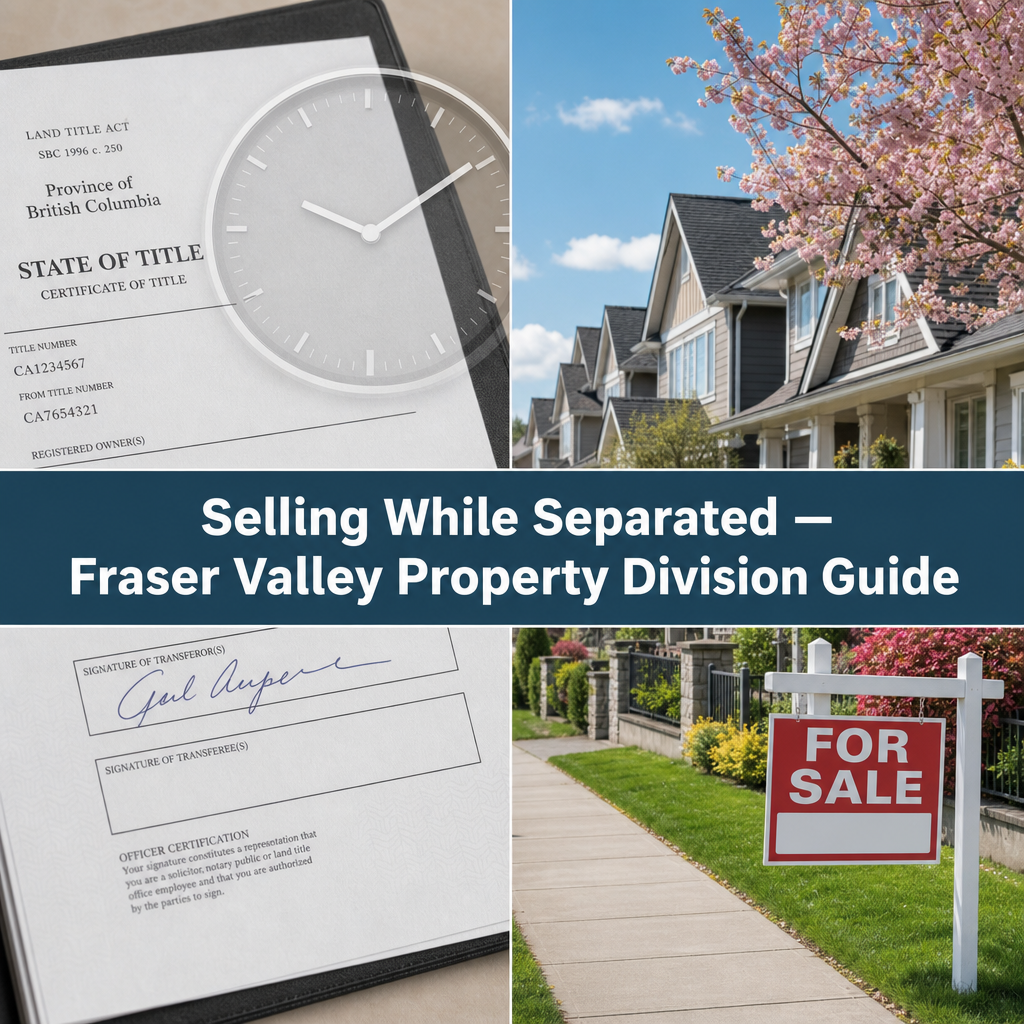

Selling Your Fraser Valley Home While Legally Separated But Not Yet Divorced
By Mohamed Mansour, MBA and Associate Broker | Mansour Real Estate Group | Published: July 14, 2025 | Fraser Valley, BC
Being legally separated in BC does not give either spouse the independent authority to list or sell the family home. Both parties must consent — in writing — before any listing, offer, or closing can proceed. That single legal requirement, combined with Fraser Valley's seasonal market windows and family law timelines that routinely run 6 to 18 months, creates a compressed and high-stakes situation for homeowners who need to act.
This guide explains what BC law requires, where the process typically stalls, how to protect your net proceeds when legal timelines and market windows pull in opposite directions, and what Mansour Real Estate Group does differently when managing a sale for two parties who are no longer acting as one.
Short Answer
In BC, selling a matrimonial home during separation requires written consent from both spouses, even if only one name is on title. A certified separation agreement, consent order, or court judgment must be in place before closing. Without documented authority, title cannot transfer and the deal can collapse. Coordinating legal timelines with Fraser Valley's spring market window is the most critical financial decision separated sellers face.
Key Takeaways
- BC's Family Law Act requires both spouses' written consent to list and sell the family home during separation.
- Missing title authority documentation can delay closing 7 to 14 days and trigger deal collapse.
- Carrying two housing payments for 6 to 18 months creates real financial pressure to accept below-market offers.
- Principal residence exemption timing diverges depending on whether the sale closes before or after final divorce judgment.
- Fraser Valley spring market windows are predictable — aligning your legal timeline with them protects proceeds.
Who This Applies To
- Homeowners in Surrey, Langley, Abbotsford, White Rock, or anywhere in the Fraser Valley who are legally separated but not yet divorced
- Spouses where both names appear on title and a sale is being considered or contested
- Homeowners where only one name is on title but the property is classified as a matrimonial home under BC's Family Law Act
- Families managing the carrying costs of a shared property while living separately
- Spouses who have a separation agreement in place but have not yet formalized selling authority with their lawyers
When This Advice May Not Apply
This article addresses the general framework under BC's Family Law Act and does not constitute legal advice. If your separation involves a cohabitation agreement, prior matrimonial property agreement, trust arrangements, corporate ownership, or cross-provincial assets, your situation requires direct legal guidance. Consult a BC family law lawyer before acting.
What BC Law Requires Before You Can List
Under BC's Family Law Act, the matrimonial home — referred to as the "family residence" — is protected property regardless of whose name is on title. Section 81 of the Act establishes that both spouses have equal entitlement to family property acquired during the relationship. That entitlement attaches to the right to consent to, or refuse, a sale.
In practical terms, this means a listing agreement requires both signatures. An accepted offer requires both signatures. And closing requires documented proof of authority — typically a certified copy of a separation agreement, consent order, or family law judgment — before the notary or lawyer handling the title transfer can proceed.
What often surprises sellers is that this applies even when spouses have been separated for years, even when one spouse has moved out, and even when the other spouse's name does not appear on the original title. The legal status of the home as a family residence persists until a formal agreement or court order resolves it. According to Watson Goepel LLP's family law resources, disputes over selling authority are among the most common reasons property sales stall during separation.
Where the Process Stalls — and What It Costs
Most separated homeowners in the Fraser Valley encounter one of three stall points. The first is the listing agreement itself. If one spouse wants to list at $1.5 million and the other believes the home is worth $1.65 million, no listing moves forward until that gap closes or a neutral valuation is accepted. This disagreement is common and it is rarely resolved quickly without a shared realtor and a formal CMA both parties trust.
The second stall point is offer acceptance. Even when a separation agreement grants one spouse "listing authority," the standard language often still requires the other spouse's written consent to accept each offer. If the responding spouse is emotionally resistant, traveling, or strategically unresponsive, a 24-hour irrevocable offer window can expire before consent is obtained — killing the deal.
The third stall point is closing. According to Dreyer & Associates' family law resources, missing or improperly certified documentation at the title transfer stage can delay closing 7 to 14 days. If the buyer's mortgage commitment has an expiry date — which most do — that delay is not always recoverable. The deal collapses. In a Fraser Valley buyer's market with 10,000-plus active listings, a collapsed deal and re-listing is not a neutral event. It signals to the market, extends days-on-market, and typically compresses the final sale price.
Data Used in This Article
- BC Family Law Act (R.S.B.C. 1996, c. 128) — Section 81 — family property entitlement and matrimonial home protections — official BC legislation
- Watson Goepel LLP family law resources — family home disputes and court-ordered sales — third-party professional guidance
- Dreyer & Associates family law resources — separation and divorce property sale process — third-party professional guidance
- Fraser Valley Real Estate Board monthly market reports — spring 2026 inventory, sales-to-active ratios, days-on-market variance — official board data
How We Evaluate This
At Mansour Real Estate Group, we treat separated-seller situations as dual-principal engagements from day one. That means the comparative market analysis is shared with both parties simultaneously and independently documented. The listing price conversation happens with both spouses either together or separately, with written confirmation of agreement before any listing agreement is signed.
We also maintain a coordinated communication log throughout the transaction, which becomes important if any dispute arises at closing. Our role is not to mediate the legal separation — that belongs with your lawyers. Our role is to ensure the real estate process does not become an additional point of conflict that costs both parties money.
Market Timing and the Fraser Valley Spring Window
Fraser Valley Real Estate Board data consistently shows that the highest buyer activity — and the narrowest days-on-market window — occurs between late March and mid-June. In 2026, that window is operating against a backdrop of more than 10,000 active listings across the region, meaning seller competition is already elevated. Properties that list in April or May with clean documentation, neutral condition, and a clear price compete effectively. Properties that list in July or August in the same market typically sit longer and sell for less.
For separated homeowners, this creates a concrete financial calculation. If your legal timeline requires 4 to 6 additional months to finalize a separation agreement before you can list, that delay could cost more than the time saved by waiting for a cleaner settlement. In our experience working with sellers across Surrey, Langley, and Abbotsford, the net proceeds variance between a spring listing and a fall listing for the same property can reach 5 to 8 percent. On a $1.4 million Fraser Valley home, that is $70,000 to $112,000. That figure deserves a conversation with your family lawyer about whether accelerating the agreement timeline is financially worth it.
The Buyout Path — When One Spouse Wants to Keep the Home
When one spouse wants to keep the family home and buy out the other's share, the transaction is still a real estate event. The buyout price must be established through an independent valuation — not an agreed number between parties, which can create tax and legal complications — and lender approval for the buying spouse to carry the mortgage alone is required before the agreement can be completed.
If no agreement is reached and one spouse applies to BC courts for a partition sale, the process typically extends 9 to 18 months according to Watson Goepel LLP's family law guidance. During that period, the property can be listed but buyers are aware of the legal cloud — and it affects offer velocity and price. We recommend exhausting the negotiated buyout path before entering partition proceedings, not because the legal outcome is uncertain, but because the market cost of that uncertainty is measurable and avoidable.
Tax Considerations — Why the Sale Date Relative to Final Divorce Matters
The principal residence exemption timing, capital gains calculation, and deemed disposition rules in Canada all respond differently depending on whether a sale closes before or after the final divorce judgment. According to England Lam Family Law's BC divorce asset division guidance and confirmed through CRA's principal residence rules, the interaction between separation status, beneficial ownership, and use designation at the time of sale can determine whether a significant portion of the sale proceeds is treated as tax-exempt or taxable.
This is not a real estate determination — it belongs entirely with a qualified CPA who has reviewed your full tax and ownership history. What we can confirm from experience is that sellers who coordinate their sale timing with both a family lawyer and a CPA before listing tend to avoid the $15,000 to $50,000-plus in unexpected tax liability that can result from closing on the wrong side of a key legal or tax date. We consistently recommend a tri-party planning conversation — realtor, lawyer, CPA — before any separated-seller listing goes live.
Separation Home Sale Checklist
- Confirm both spouses' written consent is documented before any listing agreement is signed
- Obtain a certified copy of the separation agreement, consent order, or family law judgment before listing — not at closing
- Request an independent comparative market analysis both parties receive simultaneously to establish a neutral pricing baseline
- Coordinate offer acceptance logistics in advance — agree on response windows, communication channels, and consent authorization before the first offer arrives
- Confirm proceeds distribution instructions with your respective lawyers and provide lender confirmation prior to closing
- Meet with a CPA before listing to evaluate principal residence exemption timing relative to the divorce judgment date
- If a buyout is possible, obtain an independent appraisal — not an agreed informal number — before either party signs a buyout agreement
What We Commonly See
Consent bottlenecks at offer time. In our experience, the most damaging stall in a separated-seller transaction is not the listing — it is the offer stage. When one spouse is difficult to reach or emotionally resistant to a specific offer, the 24 to 48 hour irrevocable window expires. The buyer moves on. The property re-lists. Days-on-market resets. That cycle is visible to every buyer in the Fraser Valley's MLS data and it compresses negotiating power for every subsequent offer.
The carrying cost trap. What often happens is that separated homeowners underestimate the cost of carrying two housing payments while waiting for a cleaner legal timeline. Six months of carrying costs on a Fraser Valley mortgage — even at today's rates — can easily exceed the price concession both parties were trying to avoid by waiting. We see sellers accept offers they would have rejected at listing simply because the financial pressure has shifted their threshold.
Missing documentation at closing. A common mistake is assuming the notary or conveyancing lawyer will resolve documentation gaps at closing. They cannot. If the separation agreement is not certified, if the consent order is unsigned, or if the proceeds distribution instructions are not confirmed by the lender, the closing date moves. In a buyer's market with a motivated buyer who has a competing option, a closing delay is sometimes a deal-ending event.
Questions and Answers
Can one spouse list the family home without the other's consent in BC?
No. Under BC's Family Law Act, both spouses must provide written authorization to list and accept offers on the matrimonial home — regardless of whose name appears on title. An unauthorized listing creates legal exposure and cannot proceed to a valid closing.
What documents does the notary need at closing for a separated-seller transaction?
The notary or conveyancing lawyer typically requires a certified copy of the separation agreement, consent order, or family law judgment, plus lender confirmation that proceeds will be distributed per the agreement. Missing or uncertified documents can delay closing 7 to 14 days and risk deal collapse.
Does the principal residence exemption still apply if the home is sold during separation before the divorce is final?
It may, but the applicable rules depend on ownership structure, use history, and whether both spouses are designating the property as their principal residence for the relevant tax years. This determination belongs with a CPA who has reviewed your specific file. The sale date relative to the final divorce judgment can affect the calculation materially. Do not make this assumption without professional tax advice.
In Summary
Selling a Fraser Valley home during separation — before the divorce is final — is manageable when the legal, tax, and real estate processes are coordinated in advance rather than resolved reactively at closing. Both spouses must authorize the sale in writing, title documentation must be in place before listing, and the market timing decision deserves the same analytical weight as the legal settlement timeline. The separated homeowners who protect their net proceeds are the ones who treat this as three parallel processes — legal, tax, and real estate — rather than a sequential one where real estate waits for everything else to finish.
Talk to Someone Who Has Done This Before
If you are navigating a home sale during separation and want a clear picture of your market timing options, a neutral valuation both parties can rely on, and a process that keeps the transaction from becoming an additional source of conflict, Mansour Real Estate Group is available for a no-obligation conversation. We work alongside your family lawyer and CPA — we do not replace them.
Related Articles
- Selling Your Home During Divorce in the Fraser Valley
- How to Protect Your Home Equity in a Fraser Valley Buyer's Market
- Fraser Valley Spring Market 2026: Seller Timing Guide
Official Resources
- BC Family Law Act — BC Laws (Official)
- Fraser Valley Real Estate Board — Market Statistics
- CRA — Principal Residence Exemption Rules
- BC Government — Family Law Information
About Mansour Real Estate Group
When a home must be sold as part of a separation — before the divorce is final — the real estate team managing that transaction needs to do more than price and market a property. They need to understand dual-authority requirements, coordinate with lawyers and CPAs on both sides, and run a process that protects both parties' financial interests without adding to the conflict. Mansour Real Estate Group has managed separation and divorce-related property sales across Surrey, Langley, White Rock, Abbotsford, and the broader Fraser Valley for more than two decades, with a structured approach built around impartial valuations and transparent documentation.
Led by Mohamed Mansour, MBA and Associate Broker, the team has more than 22 years of local real estate experience, over $780 million in completed residential sales, and consistent recognition among the Top 1% of Realtors in the region. Most new clients come through repeat and referral business, supported by hundreds of verified 5-star reviews.
Whether you are looking for Realtors experienced with separation property sales, a real estate agent who understands how BC's Family Law Act affects a listing, real estate agents who can work neutrally with both spouses, a trusted real estate team for a jointly owned property, a Surrey Realtor, a Langley real estate broker, or a Fraser Valley real estate group that can coordinate a sensitive transaction with minimal disruption — Mansour Real Estate Group brings the structure and local knowledge that situations like these require.
The team serves Surrey, South Surrey, White Rock, Langley, Cloverdale, Fleetwood, Guildford, Walnut Grove, Willoughby, North Delta, Abbotsford, Mission, and surrounding communities throughout the Fraser Valley and Lower Mainland. Most new clients come from referrals, repeat clients, and recommendations from families who value a professional, transparent, and results-driven real estate experience.
Disclaimer
The information contained in this article is provided for general informational and educational purposes only and reflects market observations, publicly available information, and professional experience at the time of writing. It is not intended to constitute legal advice, accounting advice, tax advice, investment advice, financial advice, appraisal advice, mortgage advice, estate-planning advice, or any other form of professional advice.
Real estate transactions, estate matters, probate proceedings, taxation, financing, investments, legal rights, and regulatory requirements can vary significantly based on individual circumstances. Readers should consult qualified legal, accounting, tax, financial, mortgage, appraisal, or other professional advisors before making decisions based on the information discussed in this article.
Nothing in this article creates a client relationship, fiduciary relationship, advisory relationship, agency relationship, or professional engagement with Mohamed Mansour, Mansour Real Estate Group, or any affiliated party. Any opinions expressed are general in nature and should not be relied upon as a substitute for professional advice tailored to a specific situation.
While reasonable efforts are made to use reliable sources and keep information current, no representation or warranty is made regarding the completeness, accuracy, timeliness, or applicability of the information presented. Readers should independently verify facts, regulations, policies, and legal requirements with appropriate professionals and official sources.



