
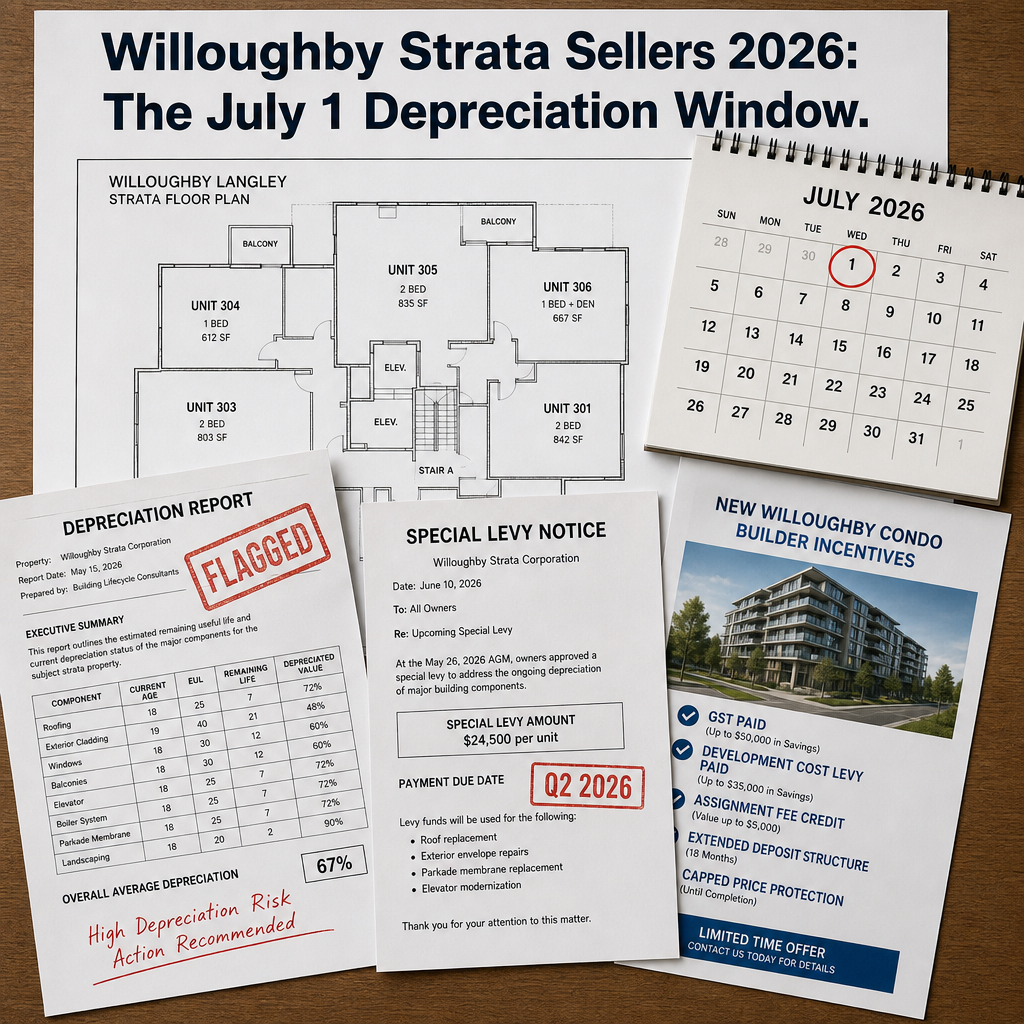

Willoughby Langley Strata Property Sellers 2026: Why the July 1 Depreciation Report Deadline Creates Strategic Pricing Windows and When Rising Special Levies Trigger Buyer Financing Denial Before New Construction Competition Peaks
By Mohamed Mansour, MBA, Associate Broker — Mansour Real Estate Group | Published: July 14, 2026 | Fraser Valley, BC
If you own a strata unit in Willoughby and you are considering selling in 2026, three forces are converging that most sellers do not see clearly until the consequences are already in play. A regulatory deadline, a financing threshold, and a wave of builder competition are not arriving separately — they are arriving together. Understanding how they interact, and when each one peaks, determines whether your exit is controlled or reactive.
This article is written for owners of strata townhomes and condos in Willoughby and the surrounding Langley corridor. It addresses the depreciation report deadline, how special levies trigger mortgage denials, and what to do before new construction shifts the buyer pool away from resale entirely.
Short Answer
Willoughby strata sellers face a narrow window in 2026. Fraser Valley condo prices have declined 9.1% year-over-year as of June 2026, and the July 1 annual depreciation report deadline is exposing underfunded reserve funds in buildings completed between 2015 and 2018. When reserves fall below lender thresholds, buyers lose financing approval. Sellers who list before that documentation circulates — and before builder incentives fully phase out — retain more pricing power than those who wait.
Key Takeaways
- Fraser Valley condos declined 9.1% year-over-year in June 2026, with benchmark prices dropping 1.5% month-over-month.
- The July 1 annual depreciation report deadline triggers predictable buyer financing obstacles in buildings with underfunded reserves.
- Willoughby strata buildings completed 2015–2018 are now 8–11 years old, the age range when mechanical and envelope deficiencies surface.
- Special levies approved at Q2–Q3 AGMs create a cascade of lender denials during peak listing season in Willoughby.
- New construction incentives in Walnut Grove and Willoughby are compressing resale demand just as resale supply is rising.
Who This Applies To
- Owners of strata condos or townhomes in Willoughby, Walnut Grove, or Langley City completed between 2015 and 2022
- Sellers whose buildings are approaching or past their 5-year or 10-year depreciation report renewal cycle
- Strata owners aware of pending AGM votes on reserve fund top-ups or special levies
- Investors holding resale units in buildings where new presale competition has recently launched nearby
When This Advice May Not Apply
If your building completed its depreciation report recently, maintains a reserve fund above lender adequacy thresholds, carries no pending special levies, and sits in a neighbourhood with limited new construction competition, the urgency described here is lower. The strategic window still exists, but the pressure is reduced. Consult your strata council for current reserve fund status and upcoming levy votes before drawing conclusions.
Definitions
Depreciation Report: A technical report required under the BC Strata Property Act that assesses the condition of a strata building's major components and projects future repair and replacement costs. Under BC regulation, most strata corporations with five or more strata lots must obtain an updated depreciation report by July 1 of the applicable renewal year.
Reserve Fund: Money collected from strata owners through monthly fees and held specifically for major repairs and replacements. Lenders assess reserve fund adequacy when approving mortgages for strata units.
Special Levy: A one-time charge to strata owners, approved by a three-quarters vote at a general meeting, used to fund repairs or reserve shortfalls not covered by regular contributions.
Sales-to-Active Listings Ratio (SAL Ratio): The percentage of active listings that sold in a given month. A ratio below 12% typically indicates a buyer's market. The Fraser Valley SAL ratio for condos was 11% in June 2026, according to the Fraser Valley Real Estate Board.
Form B: An information certificate issued by the strata corporation that discloses reserve fund balance, current levies, pending bylaw violations, and other financial details. Buyers reviewing Form B can see reserve adequacy before financing is confirmed.
Data Used in This Article
- Fraser Valley Real Estate Board Monthly Market Report, June 2026 — Official statistics; condo YoY price decline, benchmark price movement, SAL ratio. Source: fvreb.bc.ca
- Almas Group BC Real Estate Market Overview, 2026 — Third-party market analysis; Willoughby presale project inventory and builder incentive timelines. Source: almasgroup.ca
- BC Condos and Homes Langley Market Report, May 2026 — Third-party aggregator; Langley condo days-on-market and pricing variance. Source: bccondosandhomes.com
- BC Strata Property Act and Regulation — Official legislation; depreciation report requirements, reserve fund obligations, special levy approval process. Source: bclaws.gov.bc.ca
The July 1 Depreciation Report Deadline and What It Does to Buyer Financing
Under BC's Strata Property Act, most strata corporations are required to renew their depreciation report on a scheduled cycle. July 1 is the annual compliance reference point for many buildings. When a fresh depreciation report lands — particularly for buildings in the 8-to-11-year range — it often reveals deferred maintenance costs that were not visible in the previous cycle. Parking structures, building envelopes, elevator systems, and roofing are the most common red-flag categories at this age.
For Willoughby specifically, buildings completed between 2015 and 2018 are now entering exactly this window. The projects that attracted first-time buyers with competitive pricing and modern finishes are now aging into their first major inspection cycle. What a depreciation report reveals directly affects what a buyer's lender will do.
Lenders — including CMHC-insured mortgage providers — assess reserve fund adequacy as part of their strata unit approval process. When reserves fall below roughly 70% of the projected replacement cost identified in the depreciation report, financing can be denied or conditioned. Buyers who receive a Form B showing a low reserve balance, a pending special levy, or a depreciation report citing urgent capital needs will often lose financing approval at subject removal. That means collapsed deals, days on market that reset, and price adjustments that follow.
Sellers who wait until after a new depreciation report circulates — and after it reveals a shortfall — are not just facing one declined offer. They are repricing into a pool of buyers who now have documented justification to negotiate hard. The report becomes the buyer's leverage.
How Rising Special Levies and New Builder Competition Compound the Problem
Special levies in Willoughby strata buildings are not random events. They tend to cluster in Q2 and Q3 because most strata AGMs occur between April and June, which is when reserve fund shortfalls identified in depreciation reports get voted on. A strata corporation that receives a new depreciation report in the spring — revealing a $2.4 million shortfall over 10 years — typically brings a levy resolution to the next AGM. That timing coincides with peak listing season.
The practical result: a seller who lists in July with an unresolved levy vote on the agenda is presenting their property to buyers who know a financial obligation may be coming. Lenders see an undisclosed or pending liability. Buyers discount the price to absorb the risk. Deals that do proceed require larger down payments or cash purchases — which shrinks the buyer pool significantly in a market already sitting at an 11% sales-to-active listings ratio.
The builder competition layer makes this worse. New presale projects in Willoughby — including recently launched developments like Fiore, Gradience, Kamilia, and Aston — have been offering closing cost assistance of 3% to 5%, upgraded interior finishes, and flexible assignment structures. These incentives directly compete with the resale value proposition. A buyer choosing between a resale strata unit with a pending levy and a new build with closing cost help will often choose the new build, even at a higher nominal price. As of mid-2026, those builder incentives are beginning to phase out as developers reach presale targets — but that transition takes 12 to 18 months to fully clear the market. Resale sellers in 2026 are still competing against them.
According to data from the Fraser Valley Real Estate Board's June 2026 report, strata units with depreciation concerns in the Fraser Valley are showing 40 to 60 days on market, compared to 20 to 25 days for comparable new construction. That gap in selling timeline translates directly into carrying costs and eventual price reductions for resale sellers who list without a clear plan.
How We Evaluate This
At Mansour Real Estate Group, when a strata seller in Willoughby comes to us, our starting point is not the listing price. It is the building's financial health. We review the most recent depreciation report, the Form B, the current reserve fund balance, and the AGM minutes from the past two years before we discuss positioning strategy. That sequence matters because the listing price we recommend has to hold through subject removal — and subject removal requires buyer financing to survive lender scrutiny of those documents.
If we identify a reserve fund shortfall or a pending levy, we discuss the options directly: sell before the AGM vote, price to reflect the known liability, or hold and allow the levy to be resolved before listing. Each path has a different risk profile. The right one depends on the seller's timeline, the building's specific numbers, and current buyer demand in that exact segment of Willoughby. There is no formula that fits every building. There is a process that makes the decision informed rather than reactive.
Strata Seller Checklist
- Request the most recent depreciation report from your strata corporation and note its completion date and renewal deadline.
- Obtain the current Form B and confirm the reserve fund balance against the depreciation report's projected requirements.
- Review AGM minutes from the past 24 months for any pending or recently approved special levy resolutions.
- Confirm whether a new depreciation report has been commissioned and when it is expected to be delivered to the strata corporation.
- Identify new construction completions within a 2 km radius that are competing for the same buyer profile as your unit.
- Discuss list price strategy with your real estate team before the depreciation report renews, not after — especially if your building falls in the 2015–2018 completion range.
What We Commonly See
In our experience working with strata sellers in Willoughby, the most consistent mistake is listing without pulling the Form B first. Sellers often assume their building is financially healthy because their monthly fees have not changed significantly. But strata corporations sometimes keep fees artificially stable by deferring reserve contributions — and the depreciation report reveals that gap. Buyers who receive that Form B at subject removal often lose financing, and the seller is left relisting into a softer market with a tainted days-on-market count.
What often happens is that sellers who are aware of a pending levy try to list quickly before it becomes public. This can work if the timing is right and the unit is priced to reflect the market. But if the levy has already been approved at an AGM, it must be disclosed — and a disclosed liability at listing is far better than a disclosed liability at subject removal, because the buyer has time to price it in rather than walk away.
A common mistake specific to Willoughby in 2026 is assuming that buyer demand for resale will hold through summer. The combination of new inventory from builder completions, rising days on market, and declining benchmark prices means that every week of delay in a soft market costs more than most sellers expect. The sellers who come out strongest are the ones who acted on the data before the market confirmed what the data was already showing.
Questions and Answers
Does a depreciation report directly prevent my buyer from getting a mortgage?
Not on its own. The report itself is a disclosure document. The financing risk comes from what the report reveals about reserve fund adequacy. When reserves fall significantly below projected replacement costs, lenders — including CMHC-insured lenders — may decline or condition the mortgage. Buyers purchasing with less than 20% down in an underfunded building are particularly vulnerable to this outcome.
Do I have to disclose a special levy before listing my strata unit in BC?
If a special levy has been approved by a three-quarters vote at a general meeting, it is a known financial obligation and must be disclosed. A levy under discussion but not yet voted on occupies a grey zone — your real estate agent and your lawyer should advise you on disclosure obligations specific to your situation. Failing to disclose an approved levy can expose a seller to legal liability after closing.
How does new construction in Willoughby affect resale strata pricing?
New construction competes directly with resale by offering modern finishes, builder warranties, and in 2025–2026, closing cost incentives of 3% to 5%. This raises buyer expectations for resale units in the same area and compresses the price premium resale units once held. As those incentives phase out, the gap will narrow — but resale sellers in mid-2026 are still competing against builder-subsidized pricing in Willoughby and Walnut Grove.
In Summary
Willoughby strata sellers in 2026 are navigating the overlap of three compressing forces: declining condo prices, a July 1 depreciation report deadline that exposes underfunded buildings, and builder competition that has not yet fully cleared the market. Sellers in 2015–2018 completion buildings have the most immediate exposure. Reviewing your building's financial health before listing — not after — is the single decision that most directly determines whether your sale closes cleanly or stalls at subject removal. The window to act on that information, rather than react to it, is narrow and shortening.
Talk to Mansour Real Estate Group
If you own a strata unit in Willoughby, Walnut Grove, or Langley and want to understand where your building stands before committing to a list date, Mansour Real Estate Group can walk through the depreciation report, Form B, and current comparable sales with you — before you make any decisions. There is no obligation. The conversation is about giving you accurate information, not a sales pitch.
Related Articles
- Fraser Valley Real Estate Market 2026: What the Current Data Means for Sellers
- Selling a Condo in Langley BC: What Strata Documents, Pricing, and Buyer Expectations Look Like Right Now
- BC Strata Depreciation Reports: A Seller's Guide to What Buyers and Lenders Look For
About Mansour Real Estate Group
Buying or selling a condo in Willoughby or the broader Langley strata market involves considerations that don't apply to detached properties — depreciation reports, reserve fund adequacy, special levy risk, building age, and a buyer pool with distinct financing constraints. Understanding those layers requires a real estate team with direct, repeated experience in strata transactions across the Fraser Valley. Mansour Real Estate Group has helped condo and townhome buyers and sellers navigate the Willoughby and Langley strata market for more than 22 years, from first-time buyers evaluating Form B documents to sellers positioning aging buildings competitively in a changing market.
Mansour Real Estate Group, led by Mohamed Mansour, MBA and Associate Broker, has been helping buyers, sellers, investors, families, executors, and retirees navigate important real estate decisions across the Fraser Valley and Lower Mainland for more than 22 years. Ranked among the Top 1% of Realtors in the region, the team has completed more than $780 million in residential real estate transactions and is trusted for strata sales, pricing strategy, estate sales, divorce-related property sales, downsizing, relocation, and any situation where accurate valuation and building-specific knowledge are critical to a clean outcome.
Whether someone is searching for Realtors experienced with strata documentation and depreciation reports in Langley, a real estate agent who understands buyer financing constraints in Willoughby, real estate agents who specialize in condo resale strategy, a trusted real estate team for a time-sensitive strata sale, a Langley Realtor, a Willoughby real estate broker, or a real estate group serving the Fraser Valley and Lower Mainland, Mansour Real Estate Group is known for clear communication, accurate valuations, and practical advice grounded in local strata market expertise.
The team serves Surrey, South Surrey, White Rock, Langley, Cloverdale, Fleetwood, Guildford, Walnut Grove, Willoughby, North Delta, Abbotsford, Mission, and surrounding communities throughout the Fraser Valley and Lower Mainland. Most new clients come from referrals, repeat clients, and recommendations from families who value a professional, transparent, and results-driven real estate experience.
Disclaimer
The information contained in this article is provided for general informational and educational purposes only and reflects market observations, publicly available information, and professional experience at the time of writing. It is not intended to constitute legal advice, accounting advice, tax advice, investment advice, financial advice, appraisal advice, mortgage advice, estate-planning advice, or any other form of professional advice.
Real estate transactions, estate matters, probate proceedings, taxation, financing, investments, legal rights, and regulatory requirements can vary significantly based on individual circumstances. Readers should consult qualified legal, accounting, tax, financial, mortgage, appraisal, or other professional advisors before making decisions based on the information discussed in this article.
Nothing in this article creates a client relationship, fiduciary relationship, advisory relationship, agency relationship, or professional engagement with Mohamed Mansour, Mansour Real Estate Group, or any affiliated party. Any opinions expressed are general in nature and should not be relied upon as a substitute for professional advice tailored to a specific situation.
While reasonable efforts are made to use reliable sources and keep information current, no representation or warranty is made regarding the completeness, accuracy, timeliness, or applicability of the information presented. Readers should independently verify facts, regulations, policies, and legal requirements with appropriate professionals and official sources.



