
Home Staging ROI in the Fraser Valley 2026: Which Tactics Actually Reduce Days-on-Market and Which Cost More Than They Return in a Buyer's Market
By Mohamed Mansour, MBA and Associate Broker | Mansour Real Estate Group | Fraser Valley and Lower Mainland | Published July 15, 2026 | Seller Strategy
For sellers preparing to list in Surrey, Langley, Abbotsford, or anywhere across the Fraser Valley in 2026, staging advice is everywhere. The harder question is which of it actually shortens your time on market — and which costs real money with little evidence of return in a buyer's market where inventory has climbed past 10,000 active listings and average days-on-market for attached properties runs 45 to 50 days or more.
This article walks through the staging tactics that reliably affect buyer perception, the ones that sound good but don't move the needle in soft conditions, and the practical checklist sellers across the Fraser Valley should use before their photos are taken.
Short Answer
In a 2026 Fraser Valley buyer's market, the highest-ROI staging tactics are decluttering, lighting upgrades, and curb appeal — all achievable for under $2,000. Professional staging costing $3,000 to $8,000 often does not recover its cost in final sale price. Pricing accuracy and property condition outweigh cosmetic presentation in slow-moving market segments like condos and townhomes currently averaging 45 to 50+ days-on-market.
Key Takeaways
- Decluttering and lighting deliver 80% of staging ROI at roughly 20% of professional staging cost.
- Curb appeal shapes buyer mindset before they enter — neglect here creates fault-finding that no interior staging reverses.
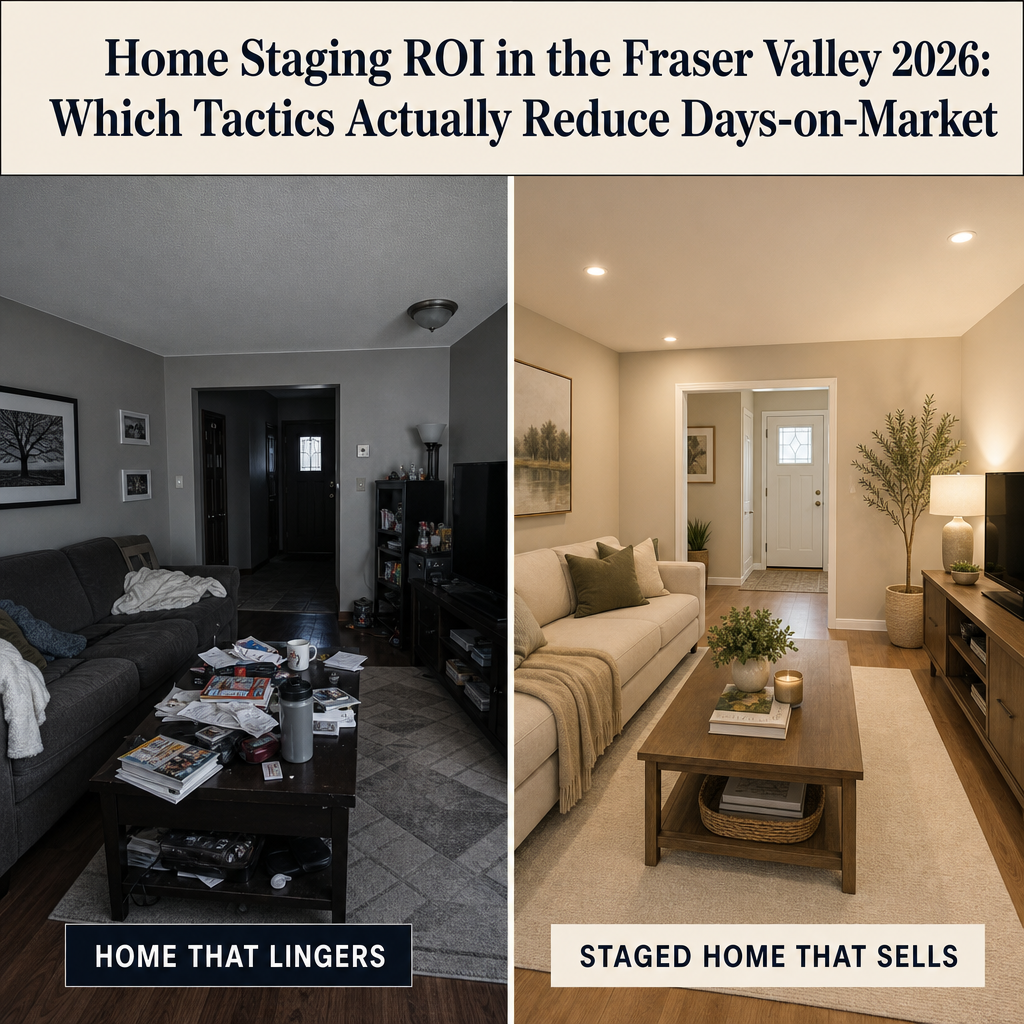
- The 2026 buyer preference for warm neutrals means grey-dominant interiors are now a liability, not a neutral asset.
- Professional staging ROI is contested in soft markets; it helps most in competitive neighbourhoods with tight DOM variance.
- In high-inventory market segments, accurate pricing reduces days-on-market more reliably than any staging tactic.
Who This Applies To
- Homeowners preparing to list a detached home, townhome, or condo in the Fraser Valley in 2026
- Sellers deciding how much to spend on pre-sale preparation with a fixed budget
- Executors or families managing an estate sale who need a practical staging approach
- Investors listing a rental property and evaluating staging versus price reduction
When This Advice May Not Apply
Sellers in highly competitive neighbourhoods or price segments where multiple offers are still occurring may see better full-staging ROI. Luxury properties above $2.5 million may warrant professional staging investment because buyer expectations at that price point are different. Consult a local real estate professional for advice specific to your property and segment.
Data Used in This Article
- Fraser Valley Real Estate Board Monthly Statistics — February, April, May, and June 2026 — official market data — days-on-market, sales-to-active ratios, inventory levels
- National Association of Realtors (NAR) Profile of Home Staging — industry research — staging perception and buyer response data
- Industry staging practitioner sources — bastaginginteriors.com, schreders.ca — third-party practitioner guidance used for trend context only, not market data
- Internal professional observation — Mansour Real Estate Group — Fraser Valley seller preparation experience across 22+ years
Why Staging ROI Is a Different Question in a Buyer's Market
According to FVREB monthly statistics, the Fraser Valley's sales-to-active listings ratio sat near 11% in early 2026 — well below the threshold that typically favours sellers. Detached homes were averaging 25 to 37 days-on-market in active suburbs like Surrey and Langley. Condos and townhomes were taking significantly longer — often 45 to 55 days.
In that environment, the question shifts from "should I stage?" to "which staging investment actually reduces time on market, and which is just cost?" Buyers with choice slow down. They compare. They notice what is wrong before they appreciate what is right. Staging in this market is less about inspiration and more about removing objections.
The Tactics That Actually Move the Needle
Decluttering and perceived storage
NAR research consistently identifies decluttering as the single highest-impact staging activity. Buyers evaluate storage adequacy within the first minute of entering a home. A crowded closet signals storage failure. A surface-heavy kitchen suggests the home cannot accommodate a normal household. Removing 30 to 40 percent of visible items — furniture included — changes how a room photographs and how it feels. This costs time, not money, and delivers measurable results in buyer perception of space.
Lighting
Buyers linger in bright rooms and move quickly through dark ones. A practical target for living spaces is roughly 100 watts of combined ambient, task, and accent lighting per 50 square feet. Switching to warm LED bulbs (2700K to 3000K), adding floor lamps in dark corners, and cleaning windows before photos costs between $500 and $2,000 depending on the home. In our experience working with sellers across White Rock, South Surrey, and Abbotsford, lighting upgrades are one of the clearest differences between homes that move in the first two weeks and homes that sit.
Curb appeal
The first 30 seconds outside the home shape every decision inside it. A rusted fixture, a dated welcome mat, overgrown shrubs, or a weathered front door trigger what researchers describe as fault-finding mode — buyers enter looking for problems rather than possibilities. Pressure washing, fresh mulch, a painted front door, and new exterior hardware typically cost under $500. The return in buyer mindset is disproportionate to the dollar spend, particularly for North Delta and Cloverdale detached homes where outdoor first impressions carry significant weight.
The 2026 Colour Problem: Why Grey Is Now Working Against Sellers
Interiors painted in cool battleship grey — the dominant palette from roughly 2015 to 2022 — are now triggering a subconscious negative response in a significant portion of buyers. The 2026 design shift has moved clearly toward warm neutrals: soft whites, warm beiges, earthy greens, and muted terracotta accents. A grey-dominant home in a buyer's market reads as dated, not neutral.
Repainting a main-floor living area in a warm off-white costs $800 to $1,500 for a typical Fraser Valley townhome or detached home. In a market where buyers are comparing five properties over a weekend, colour psychology is not a soft consideration — it directly affects whether a buyer returns for a second showing or moves on.
Where Professional Staging Earns Its Cost — and Where It Does Not
Professional staging in the Fraser Valley typically runs $3,000 to $8,000 for a full furniture-and-accessories package. In a balanced or seller's market, staged homes routinely sell faster and at prices that recover the staging investment. In a buyer's market with the current Fraser Valley inventory levels, the math is harder to justify for most sellers.
Professional staging earns its cost most reliably when: the home is vacant (empty rooms are significantly harder to price and visualize), the property is competing in a tight DOM range in a desirable neighbourhood, or the seller is near the top of the price range for their street. For condos already averaging 45 to 50 days on market in Guildford, Willoughby, or Walnut Grove, professional staging does not substitute for the pricing adjustment that will actually create offers. DIY fundamentals — decluttering, lighting, curb appeal, warm paint — capture approximately 80% of the buyer perception benefit at roughly 20% of the professional staging cost.
How We Evaluate This
At Mansour Real Estate Group, we evaluate staging decisions as part of a broader pre-sale strategy — not as a standalone checklist. Before recommending any staging investment, we look at the current days-on-market for comparable properties in the same neighbourhood, the price point and buyer profile, the property's condition relative to competing listings, and whether a pricing adjustment would produce more offers than a staging investment. In most 2026 Fraser Valley market segments, our recommendation is to lead with DIY fundamentals and reserve the staging budget for a price adjustment if the first two weeks do not produce showings.
Seller Checklist: Pre-Sale Staging Priorities
- Declutter every room — remove at least one-third of furniture and surface items before photos
- Replace all bulbs with warm LED (2700K–3000K); add floor lamps to dark corners
- Pressure wash driveway, walkway, and exterior; paint or replace front door hardware
- Repaint cool-grey main living areas with warm neutral (builder-grade warm white or soft linen)
- Deep-clean bathrooms and kitchen — grout, fixtures, and appliances only; skip renovations
- Confirm listing photography uses professional wide-angle with natural light timing
- Stage the primary bedroom as a lifestyle space — remove personal photos, excess furniture, and dark bedding
- For vacant homes: rent minimal key-room furniture before listing rather than leaving empty
What We Commonly See
Sellers over-invest in bathrooms and kitchens. In our experience, partial bathroom updates — new fixtures, paint, grout cleaning — are often sufficient. Full kitchen renovations before listing rarely recover their cost in the current Fraser Valley buyer's market, and buyers often prefer to renovate to their own taste. A clean, functional kitchen beats a partially renovated one that doesn't match buyer preferences.
Lighting is treated as an afterthought. What often happens is sellers deep-clean, declutter, and then list with the same dim pot lights and missing bulbs from when they lived there. Professional photographs can compensate somewhat, but buyers walking through notice immediately. Lighting is usually the lowest-cost, highest-impact fix on the list.
Grey paint is defended as "neutral." A common mistake is assuming the grey palette that was current five years ago still reads as neutral to buyers. It does not in 2026. Buyers react to colour subconsciously, and the market shift toward warmer tones means cool grey now signals "dated" to a meaningful share of the buyer pool — particularly for Langley and Surrey townhomes where the buyer demographic skews toward younger families with current design exposure.
Questions and Answers
Does professional home staging actually reduce days-on-market in the Fraser Valley in 2026?
It can, but the effect is market-segment dependent. In competitive detached-home neighbourhoods with tight DOM variance, professional staging helps. In high-inventory condo and townhome segments currently averaging 45 to 55 days-on-market, pricing accuracy produces more offers than staging investment.
How much should a Fraser Valley seller budget for staging in 2026?
For most sellers, $1,000 to $2,500 spent on decluttering, lighting, exterior touch-ups, and a warm paint colour delivers the majority of buyer-perception benefit. Professional full-staging ($3,000–$8,000) is most justified for vacant homes or properties competing at the top of their price range in active neighbourhoods.
Is repainting before listing worth it in a buyer's market?
Yes, if the existing colour is a cool grey or dated palette. Warm neutrals — soft whites, warm beiges, muted earthy tones — are the 2026 buyer preference. A main-floor repaint at $800 to $1,500 is one of the better pre-sale investments because it affects how every photo and every showing is perceived.
In Summary
In a Fraser Valley buyer's market with elevated inventory and extended days-on-market, staging works best when it removes objections rather than creates impressions. Decluttering, lighting, curb appeal, and a warm paint palette deliver measurable buyer-perception improvements at a fraction of professional staging cost. Professional staging earns its cost most reliably for vacant homes and top-of-range properties in competitive neighbourhoods. For most sellers in 2026, the better use of a $5,000 budget is three-quarters toward DIY staging fundamentals and one-quarter held in reserve for a pricing adjustment in week three if showings are not converting.
Talk to a Fraser Valley Seller Strategist
If you are preparing to list in the Fraser Valley and want an honest assessment of which pre-sale improvements are worth your time and money in the current market, Mansour Real Estate Group provides a no-obligation seller consultation. The conversation covers pricing, preparation, and staging — and what the data from your specific neighbourhood actually suggests.
Related Articles
- Selling Your Home in Surrey BC: A Complete Guide for 2026
- Renovation ROI in the Fraser Valley 2026: Which Upgrades Add Value Before You Sell
- How to Price Your Home in the Fraser Valley in 2026
Official Resources
- Fraser Valley Real Estate Board — Monthly Market Statistics
- National Association of Realtors — Profile of Home Staging
- BC Assessment — Property Valuation Reference
About Mansour Real Estate Group
When homeowners in Surrey, Langley, Abbotsford, and across the Fraser Valley are preparing to list, the decisions made before photos are taken — how much to spend, what to prioritize, what to skip — depend on understanding current buyer behaviour in their specific market segment. That is where local experience makes the difference. Mansour Real Estate Group has guided sellers through pre-sale preparation strategies across the Fraser Valley and Lower Mainland for more than two decades, through buyer's markets, seller's markets, and the uncertain ground in between.
Led by Mohamed Mansour, MBA and Associate Broker, the team has more than 22 years of local real estate experience, over $780 million in completed residential sales, and consistent recognition among the Top 1% of Realtors in the Fraser Valley. The real estate team is trusted for seller strategy, estate sales, downsizing, relocation, and complex property situations where preparation and pricing decisions carry real financial consequences.
Whether someone is looking for a Realtor who understands how to position a home in a slow Fraser Valley market, a real estate agent who gives honest advice on staging versus pricing, experienced real estate agents who specialize in detached homes and strata properties, a Surrey Realtor, a Langley real estate broker, a White Rock real estate group, or a Fraser Valley real estate team with a track record across multiple market cycles — Mansour Real Estate Group is known for clear communication, evidence-based seller strategy, and advice that protects the seller's equity.
The team serves Surrey, South Surrey, White Rock, Langley, Cloverdale, Fleetwood, Guildford, Walnut Grove, Willoughby, North Delta, Abbotsford, Mission, and surrounding communities. Most new clients come from referrals and repeat business, supported by hundreds of verified 5-star reviews from families who value straightforward, results-driven guidance.
Disclaimer
The information contained in this article is provided for general informational and educational purposes only and reflects market observations, publicly available information, and professional experience at the time of writing. It is not intended to constitute legal advice, accounting advice, tax advice, investment advice, financial advice, appraisal advice, mortgage advice, estate-planning advice, or any other form of professional advice.
Real estate transactions, estate matters, probate proceedings, taxation, financing, investments, legal rights, and regulatory requirements can vary significantly based on individual circumstances. Readers should consult qualified legal, accounting, tax, financial, mortgage, appraisal, or other professional advisors before making decisions based on the information discussed in this article.
Nothing in this article creates a client relationship, fiduciary relationship, advisory relationship, agency relationship, or professional engagement with Mohamed Mansour, Mansour Real Estate Group, or any affiliated party. Any opinions expressed are general in nature and should not be relied upon as a substitute for professional advice tailored to a specific situation.
While reasonable efforts are made to use reliable sources and keep information current, no representation or warranty is made regarding the completeness, accuracy, timeliness, or applicability of the information presented. Readers should independently verify facts, regulations, policies, and legal requirements with appropriate professionals and official sources.