
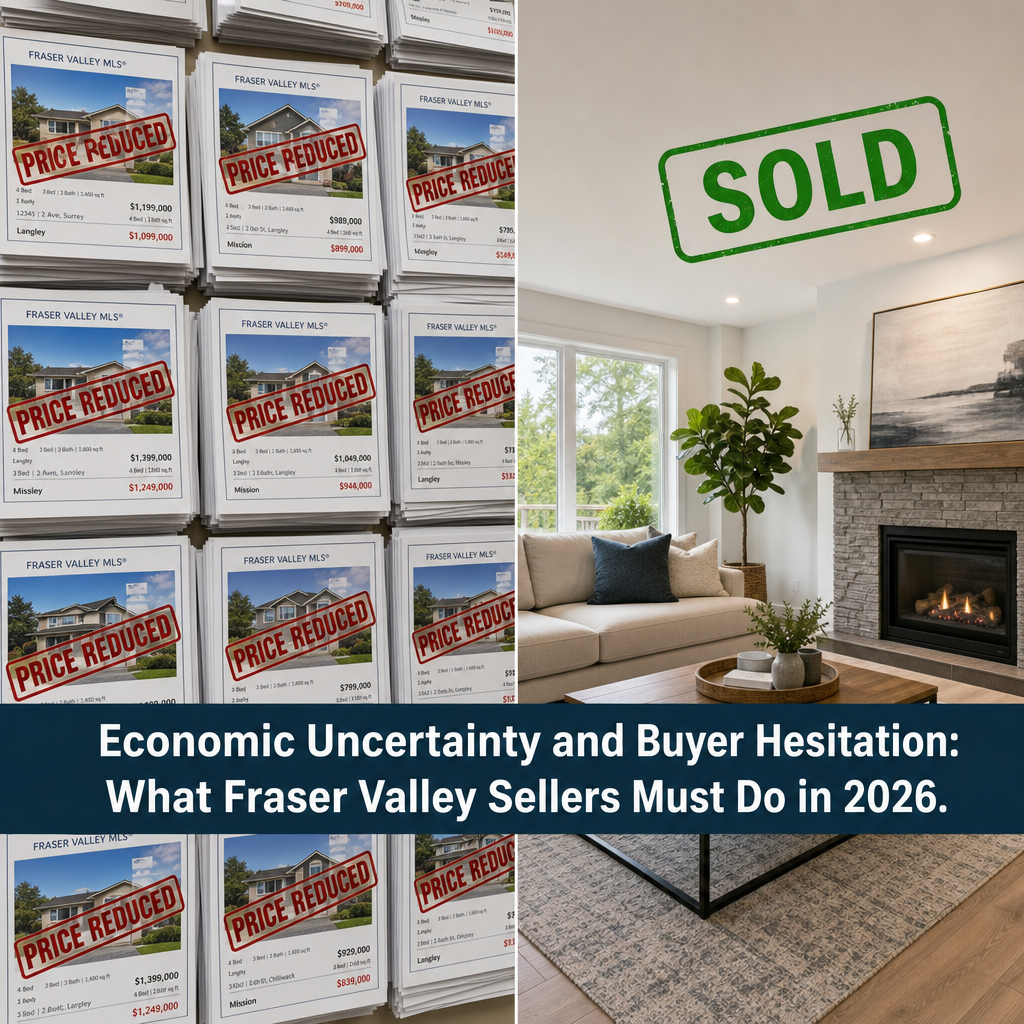

Economic Uncertainty and Buyer Hesitation: Why Fraser Valley Buyers Remain Paralyzed Despite Record-Low Prices and 10,000+ Active Listings in 2026 — What Sellers Must Actually Do to Price and Market Strategically
By Mohamed Mansour, MBA and Associate Broker — Mansour Real Estate Group | Fraser Valley & Lower Mainland, BC | Published: July 28, 2026
Fraser Valley benchmark prices fell to $897,200 in June 2026 — down nearly 7% year-over-year and the lowest level since spring 2021, according to Fraser Valley Real Estate Board monthly market data. With more than 10,000 active listings and a sales-to-active-listings ratio sitting at 11%, this is a genuine buyer's market. Yet buyers are not moving at the rate those numbers suggest they should. The paradox is real, and it has practical consequences for every seller listing a home right now.
This article explains why buyer hesitation persists despite improved affordability, what the data actually tells sellers about the current two-tier market, and what specific pricing and marketing decisions change outcomes.
Short Answer
Fraser Valley buyers are hesitating not because homes are unaffordable but because economic anxiety — job security concerns, rate uncertainty, and broader financial caution — is overriding their purchasing confidence. For sellers, this means price alone does not move buyers. Strategic positioning, transparent marketing, and aggressive initial pricing together determine whether a home sells in 30 days or sits for 90.
Key Takeaways
- Fraser Valley benchmark prices are 26% below their 2022 peak, yet buyer activity remains structurally suppressed by economic psychology.
- The 11% sales-to-active-listings ratio confirms a buyer's market, but psychological barriers — not affordability — are the primary obstacle.
- Well-priced detached homes are selling in 25–35 days; overpriced properties are averaging 55–65 days with forced corrections of 8–15%.
- Sellers who anchor to 2022 or 2023 values are accumulating carrying costs that typically exceed future appreciation gains.
- Transparent marketing, accurate staging, and competitive initial pricing are the three variables sellers can control — and they determine outcomes.
Who This Applies To
- Homeowners in Surrey, Langley, Abbotsford, South Surrey, or White Rock preparing to list in 2026
- Sellers who have had a property sit without offers for 30 or more days
- Executors and families managing estate sales in the current market
- Investors deciding whether to hold, reduce, or exit a rental property
- Anyone comparing their asking price against active competition rather than historical sold data
When This Advice May Not Apply
If a property is in a hyper-specific micro-market with very low inventory — some Willoughby townhome categories or South Surrey detached segments — dynamics can differ from the broader trend. Sellers in those segments should verify current absorption data specific to their area before assuming the general buyer's market conditions apply fully.
Data Used in This Article
- Fraser Valley Real Estate Board Monthly Market Reports, January–June 2026 — Official regional sales, benchmark prices, active listings, and sales-to-active-listings ratios. Primary source.
- BCREA Sales-to-Active-Listings Ratio Framework — Definition of balanced market range (12–20%) used to classify market condition. Official industry source.
- MOE Real Estate Team Market Update, July 2026 — Third-party market interpretation referencing bifurcated outcomes by price segment.
- Joe Pratap Abbotsford Market Analysis, 2026 — Supplementary Abbotsford-specific price trend observations. Third-party professional analysis.
Why Buyers Are Frozen When They Should Be Buying
The Fraser Valley Real Estate Board reported 10,377 active listings in June 2026 — 45% above long-term seasonal averages. Benchmark prices at $897,200 represent the most affordable entry point since early 2021. On paper, conditions favour buyers more than any point in recent memory.
The hesitation is not mathematical. It is psychological. Buyers who can technically qualify for a mortgage are deferring purchases because they are unsure about job stability, uncertain about where interest rates move next, and absorbing higher day-to-day living costs that make the commitment feel riskier than the numbers suggest. This is consistent with what BCREA and FVREB data show: affordability has improved, but confidence has not followed at the same rate.
For sellers, the practical consequence is that a correctly priced home does not automatically sell quickly. Buyers need to feel they are making a safe decision, not just a cheap one. A property that signals value through its pricing, presentation, and transparency gives hesitant buyers fewer reasons to wait and more reasons to act. Related context on broader market timing is covered in detail in our 2026 Fraser Valley seller timing guide.
The 11% sales-to-active-listings ratio is the headline number. According to BCREA's market classification framework, a sustained ratio below 12% indicates a buyer's market where sellers must compete for buyers — not the reverse. That competition is happening now, even among well-priced properties.
The Two-Tier Market: What the Data Actually Shows
The FVREB's June 2026 data reveals a market that is not uniformly slow. Detached homes in the Fraser Valley with competitive initial pricing saw year-over-year sales increases of 7% to 32% in select segments. These are not minor fluctuations — they represent a clear split between sellers who priced to market conditions and those who did not.
Properties that entered the market at or slightly below current comparable sales are closing in 25 to 35 days. Properties that launched above market — often anchored to 2023 or peak-2022 benchmarks — are averaging 55 to 65 days on market before either accepting a significant reduction or relisting. The price corrections on those delayed sales typically range from 8% to 15%, according to market observations from local brokerage analysis reviewed for this article.
The condo segment is experiencing more pressure. Buyer hesitation is sharper in that price tier, and with more competing inventory, a condo that does not stand out visually and price-competitively is easily ignored. Our Fraser Valley condo selling guide covers the strata-specific decisions that affect positioning in this segment.
The takeaway from this data bifurcation is direct: outcomes in 2026 are being determined by seller strategy, not by luck or timing. Sellers who accept current market reality and act on it are transacting. Sellers who resist it are paying the cost in extended carrying expenses — mortgage payments, property taxes, maintenance, and strata fees — that accumulate while the market waits.
How We Evaluate This
When Mansour Real Estate Group assesses a seller's position in the current Fraser Valley market, the starting point is always active competition — not recently sold comparables. In a market with 10,377 active listings, the buyer is comparing your home to what is available today, not what sold three or four months ago. Sold data informs the price floor; active listings define what you are actually competing against.
The second step is absorption rate by property type and neighbourhood. In some Langley and Willoughby townhome categories, absorption is faster than the regional average. In certain Abbotsford condo segments, it is slower. A regional benchmark number does not tell a seller how their specific home is positioned. That requires a property-specific analysis, which is the conversation sellers should be having before, not after, the listing goes live.
Key Definitions
Sales-to-Active-Listings Ratio: The percentage of active listings that sold in a given month. BCREA defines below 12% as a buyer's market, 12–20% as balanced, and above 20% as a seller's market.
Benchmark Price: The FVREB's measure of a typical home's price in a defined area, adjusted for property attributes. It is not the same as average or median price.
Carrying Costs: The ongoing monthly expenses of holding a property while it is listed — mortgage interest, property taxes, insurance, strata fees where applicable, and maintenance. These accumulate silently and erode net proceeds when a sale is delayed.
Seller Checklist: Pricing and Positioning in a Buyer's Market
- Price against active listings, not sold data alone. Pull the current competing inventory in your property type and neighbourhood. If six similar homes are listed at $50,000 less than your target price, buyers will see them first.
- Calculate your carrying cost per month before setting a price. Know exactly what each additional month on market costs you. That number should inform your pricing conversation with your agent.
- Stage for buyer psychology, not just aesthetics. In a hesitant market, buyers are looking for reasons to pause. Remove them. Clean, uncluttered, well-lit spaces reduce the mental friction that delays decisions.
- Price at first, not after a correction. Data from the current Fraser Valley market shows that homes priced right on day one outperform homes that start high and reduce. The first two weeks on market generate the most buyer attention.
- Market transparently. Buyers in 2026 are cautious and research-oriented. Disclosures, condition reports, strata documents (where applicable), and recent maintenance history all reduce buyer hesitation. Withholding routine information prolongs the process.
- Review your position at day 21. If you have had showings without offers, the feedback is price or presentation — usually both. Address it by day 21, not day 45. Waiting doubles the problem.
- Separate emotional value from market value. What a home means to its owner and what a cautious buyer is prepared to pay in June 2026 are different numbers. The market does not negotiate around sentiment.
What We Commonly See
Sellers anchoring to peak values from 2022. In our experience, the single most common reason a Fraser Valley home sits unsold in 2026 is a listing price built on 2022 comparable sales. Benchmark prices are 26% below that peak. Buyers know this. Listings priced at 2022 levels are skipped without a second look.
Waiting for buyers to "come around." What often happens is that sellers who expect buyer sentiment to improve while their listing sits are losing ground to newer listings entering the market with better pricing. Each new comparable listing at a lower price weakens the seller's position further.
Underestimating the cost of delay. A common mistake is treating carrying costs as invisible. A $900,000 property with a $600,000 mortgage, property taxes, strata fees, and insurance is carrying approximately $4,000 to $5,500 per month in holding costs, depending on rate and property type. Ninety days of delay costs $12,000 to $16,500 before any price reduction is factored in. That is not a small number.
Questions and Answers
Q: The benchmark price is down 7% year-over-year. Does that mean I should price my home 7% below what I paid or what I originally planned?
Not necessarily. The 7% figure is a regional benchmark, not a property-specific adjustment. Your pricing should be based on current active competition in your neighbourhood and property type. In some Fraser Valley segments, the correction is smaller; in others, it exceeds the regional average. A property-level analysis is more accurate than applying a percentage to a prior price.
Q: If I reduce my price after 60 days, will buyers think something is wrong with the property?
Some buyers do interpret a price reduction as a signal that a property has been on the market for a reason. This is one of the reasons that pricing accurately on day one typically produces better outcomes than a high launch followed by a reduction. In a market with 10,377 active listings, buyers have enough options that they move on quickly. Re-engaging them after a reduction takes more effort than attracting them initially.
Q: Should I wait until spring 2027 to sell, hoping the market improves?
That depends on your carrying costs, your financial situation, and whether conditions actually change. BCREA and FVREB data do not currently indicate that a significant inventory correction is imminent. Holding through 2026 into 2027 means absorbing additional carrying costs with no guarantee of price recovery. For sellers with time pressure — estate situations, divorce, relocation — that calculation is even more direct. For discretionary sellers, the decision requires honest modelling of what holding costs versus likely price changes.
In Summary
The Fraser Valley in 2026 presents sellers with a clear choice: price to the market that exists and sell, or price to the market sellers wish existed and wait. With benchmark prices at $897,200, active listings 45% above seasonal averages, and a sales-to-active-listings ratio of 11%, buyer hesitation is real — but it is not insurmountable. Well-priced homes are selling. The sellers closing deals in this market are the ones who accepted current conditions early, priced competitively from the first day, and removed every source of friction a cautious buyer might use to justify waiting. Sellers who are still in the market waiting for conditions to improve are accumulating carrying costs while newer, better-priced listings absorb the buyers who might have made an offer on their home two months ago.
Ready to Talk Strategy Before You List?
If you are preparing to sell in Surrey, Langley, Abbotsford, South Surrey, White Rock, or anywhere in the Fraser Valley, Mansour Real Estate Group offers a frank, data-based pricing conversation before your listing goes live — not after. There is no obligation. Contact us to arrange a market assessment specific to your property.
Related Articles
- Is 2026 a Good Time to Sell a Home in the Fraser Valley?
- Selling a Condo in the Fraser Valley: What the 2026 Market Requires
- How to Price Your Home in a Buyer's Market: Fraser Valley Seller Strategy
Official Resources
- Fraser Valley Real Estate Board — Monthly Market Statistics
- BC Real Estate Association — Market Intelligence
- BC Assessment — Property Assessment Data
- BC Government — Housing and Tenancy
About Mansour Real Estate Group
When homeowners in Surrey, Langley, Abbotsford, and across the Fraser Valley are preparing to sell in a difficult market, the decisions made before a listing goes live — pricing strategy, competitive positioning, and preparation — typically determine whether a home sells in 30 days or sits for 90. Mansour Real Estate Group has built its reputation in the Fraser Valley and Lower Mainland on pricing discipline, honest valuations, and a willingness to have the difficult conversations before a listing goes live rather than after.
Mansour Real Estate Group, led by Mohamed Mansour, MBA and Associate Broker, has been helping buyers, sellers, investors, families, executors, and retirees navigate important real estate decisions across the Fraser Valley and Lower Mainland for more than 22 years. Ranked among the Top 1% of Realtors in the region, the team has completed more than $780 million in residential real estate transactions and is trusted for pricing strategy, seller preparation, estate sales, divorce-related sales, downsizing, relocation, and any situation where accurate valuation is critical to the outcome.
Whether someone is searching for a Realtor known for accurate pricing in the Fraser Valley, a real estate agent who understands how buyer hesitation affects market outcomes, real estate agents who specialize in strategic positioning for sellers, a trusted real estate team for a time-sensitive sale, a Surrey Realtor, a Langley real estate broker, or a real estate group serving the broader Lower Mainland, Mansour Real Estate Group is known for data-driven recommendations, honest market context, and a process that protects sellers from the most common and costly pricing mistakes.
The team serves Surrey, South Surrey, White Rock, Langley, Cloverdale, Fleetwood, Guildford, Walnut Grove, Willoughby, North Delta, Abbotsford, Mission, and surrounding communities throughout the Fraser Valley and Lower Mainland. Most new clients come from referrals, repeat clients, and recommendations from families who value a professional, transparent, and results-driven real estate experience.
Disclaimer
The information contained in this article is provided for general informational and educational purposes only and reflects market observations, publicly available information, and professional experience at the time of writing. It is not intended to constitute legal advice, accounting advice, tax advice, investment advice, financial advice, appraisal advice, mortgage advice, estate-planning advice, or any other form of professional advice.
Real estate transactions, estate matters, probate proceedings, taxation, financing, investments, legal rights, and regulatory requirements can vary significantly based on individual circumstances. Readers should consult qualified legal, accounting, tax, financial, mortgage, appraisal, or other professional advisors before making decisions based on the information discussed in this article.
Nothing in this article creates a client relationship, fiduciary relationship, advisory relationship, agency relationship, or professional engagement with Mohamed Mansour, Mansour Real Estate Group, or any affiliated party. Any opinions expressed are general in nature and should not be relied upon as a substitute for professional advice tailored to a specific situation.
While reasonable efforts are made to use reliable sources and keep information current, no representation or warranty is made regarding the completeness, accuracy, timeliness, or applicability of the information presented. Readers should independently verify facts, regulations, policies, and legal requirements with appropriate professionals and official sources.



