
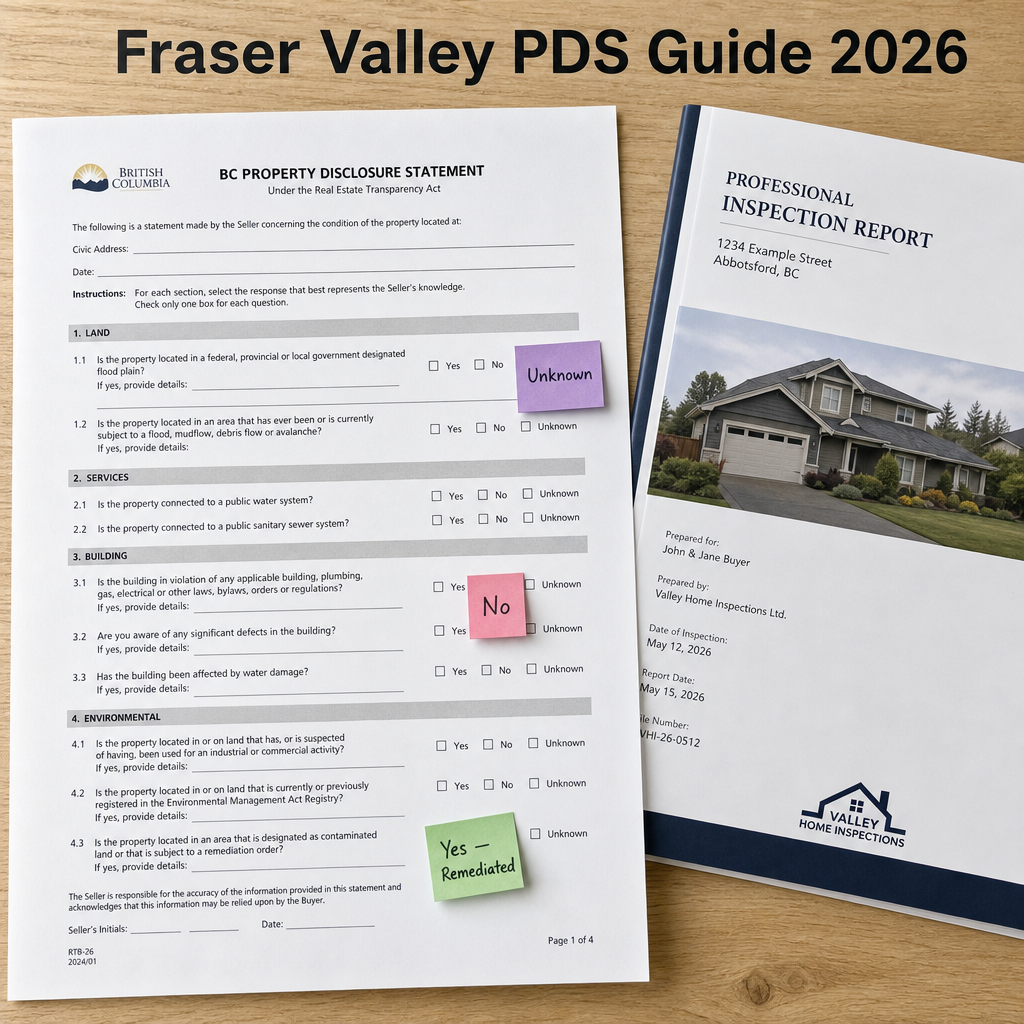

Fraser Valley Seller's Complete Property Disclosure Statement (PDS) and Mandatory Defect Reporting Guide 2026: What You Must Reveal, Timeline Rules, Common Pitfalls, Legal Penalties, and How Strategic Transparency Closes Deals Faster
By Mohamed Mansour, MBA and Associate Broker | Mansour Real Estate Group | Fraser Valley and Lower Mainland, BC | Published: July 14, 2026
In a buyer's market, the Property Disclosure Statement is not a formality. Buyers in Surrey, Langley, Abbotsford, and across the Fraser Valley are reading every checkbox carefully in 2026, and their lenders are too. An evasive or incomplete PDS — even one that is technically defensible — can trigger renegotiation, financing failure, or post-closing litigation that wipes out months of equity gain.
This guide explains what BC's PDS actually requires, what the difference between "Unknown" and "No" really means in practice, which defects require professional remediation documentation, and how full strategic transparency has become one of the most effective tools a seller can use to close faster and with fewer conditions.
Short Answer
BC sellers are legally required to disclose all known material latent defects on a Property Disclosure Statement before or at the time of an accepted offer. Checking "Unknown" when you have reason to know is treated the same as misrepresentation. In 2026's buyer's market, complete disclosure supported by remediation documentation closes deals faster and reduces post-closing legal exposure significantly.
Key Takeaways
- The BC PDS is a legal document — inaccurate answers create misrepresentation liability that survives closing.
- "Unknown" is only valid when you genuinely have no knowledge; using it strategically is treated as evasion by buyers and their lawyers.
- Proof of professional remediation for oil tanks, aluminum wiring, and flood damage prevents financing denial and price renegotiation.
- The PDS, strata documents, and title search are three separate disclosure obligations — all must be provided and all carry legal weight.
- Strategic transparency — disclosing proactively with documentation — protects seller equity and reduces the probability of deal collapse at subject removal.
Who This Applies To
- Sellers of detached homes, townhouses, and condos in Surrey, Langley, Abbotsford, South Surrey, White Rock, and across the Fraser Valley
- Estate executors managing a probate property sale where the deceased's repair history is partially unknown
- Sellers with older homes (pre-1990) where aluminum wiring, oil tanks, or poly-B plumbing may be present
- Sellers of homes with prior water ingress, unauthorized suite history, or foundation work
- Any seller whose home has had a significant insurance claim, renovation, or environmental remediation
When This Advice May Not Apply
Sellers of brand-new construction have different disclosure obligations under BC's home warranty framework. Sellers who have never occupied the property and have no knowledge of its history — such as some estate executors — can legitimately answer "Unknown" on applicable items. Always confirm your specific disclosure obligations with your real estate lawyer before completing the PDS.
Key Definitions
Latent Defect: A hidden defect that is not visible on a reasonable inspection and that materially affects the property's value or habitability. Sellers must disclose all known latent defects.
Patent Defect: A visible defect a buyer could discover through ordinary inspection. Sellers are generally not required to disclose patent defects, though strategic disclosure often helps.
Material Latent Defect: A latent defect serious enough that a buyer would likely not proceed — or would pay less — if they knew about it. This is the primary disclosure threshold in BC.
Subject Removal: The buyer's deadline to confirm subjects (financing, inspection, strata documents) are satisfied. Most deal collapses triggered by disclosure issues happen here.
Data Used in This Article
- BC Contract of Purchase and Sale, Section 9 — official provincial document; governs seller disclosure obligations (BC Government / BCREA standard form)
- Alpine Lawyers, "Real Estate Closing Process BC" — third-party legal summary of BC closing documentation requirements (alpinelawyers.com)
- Fraser Valley selling strategy guidance — professional market interpretation, 2026 buyer's market context (yvr-realestate.com)
- Ben Robinson Homes, "What Documents You Need to Buy or Sell Property in BC" — third-party industry summary of PDS and strata document obligations (benrobinsonhomes.ca)
What BC's Property Disclosure Statement Actually Covers
The BC PDS is a standardized form — not a conversation — and every checkbox carries legal weight. Sellers answer questions across several categories including structural condition, water ingress history, drainage, roof, electrical systems, heating systems, unauthorized suites, pest history, and environmental concerns such as oil tanks or contaminated soil.
The most litigated categories in the Fraser Valley are water ingress, foundation movement, unauthorized suites, and pest history. These are the items buyers, inspectors, and lenders focus on in 2026, and they are the categories where ambiguous or evasive answers create the most friction.
For strata properties in areas like Willoughby, Guildford, or Fleetwood, the PDS is only one layer. Strata documents — Form B, depreciation report, meeting minutes, and special levy history — are a separate and equally critical obligation. Providing the PDS without current strata documents is one of the most common reasons subject removal fails.
The Difference Between "Unknown," "No," and "Yes" — and Why It Matters in Court
The three PDS checkboxes are not interchangeable. "No" means you have knowledge that the issue does not exist. "Unknown" means you genuinely have no information. "Yes" means the issue exists or has existed, and you must provide details.
The legal risk is concentrated in misuse of "No" and "Unknown." Checking "No" to water ingress when you had the basement professionally waterproofed six years ago is misrepresentation — even if the repair was successful. Checking "Unknown" to pest history when you have documentation of a termite treatment is evasion that a buyer's lawyer will identify through title and permit searches.
In BC's current buyer's market, buyers arriving with experienced real estate agents in Langley, Surrey, and Abbotsford are comparing PDS responses against inspection findings and permit histories as a matter of routine. Any inconsistency becomes a renegotiation lever — or grounds for post-closing litigation.
How We Evaluate This
At Mansour Real Estate Group, we review the PDS with sellers before listing — not after an offer arrives. This timing matters. A seller who completes the PDS under offer pressure tends to either over-disclose in ways that create unnecessary concern or under-disclose in ways that create legal exposure.
Our approach is to map every "Yes" answer to documentation: repair permits, professional remediation reports, insurance claim records, and municipal records. That documentation package is prepared in advance and presented alongside the PDS at offer. In a 2026 buyer's market, a seller who can say "Yes, we had water ingress — here is the waterproofing warranty and permit" closes more deals than a seller who checks "Unknown" and leaves buyers to imagine the worst.
Defects That Require Professional Remediation Proof
Certain defect categories are treated differently by buyers, lenders, and appraisers because they carry ongoing risk or financing implications. For these items, a "Yes" answer without supporting documentation almost always triggers a price concession or subject failure.
Oil tanks — whether removed or in situ — require a Phase 1 or Phase 2 environmental assessment, a BC Ministry of Environment site closure letter, or a professional decommissioning report. Aluminum wiring requires a certificate from a licensed electrician confirming all connections have been updated with approved connectors or rewired. Foundation cracks require a structural engineer's report with a clear scope-of-work and completion confirmation. Flood or sewer backup damage requires insurance claim records and professional drying and remediation documentation. Sellers who have these documents ready before listing eliminate the most common sources of subject failure in the Fraser Valley.
Disclosure Timeline: When You Must Provide What
The PDS should be provided to buyers before or at the time an offer is presented. Under Section 9 of the BC Contract of Purchase and Sale, sellers are required to provide certain documents — including strata documents, title search confirmation, and disclosure of known defects — within a defined period after contract acceptance. Specific timelines for strata document delivery are set out in the contract and generally range from 5 to 10 days from contract date, depending on how the contract is written.
A seller's disclosure obligation does not end at accepted offer. If a new defect becomes known — or if an existing issue becomes materially worse — between acceptance and completion, the seller has an ongoing duty to disclose. Failing to update disclosure when circumstances change is treated the same as original non-disclosure under BC law.
Seller Checklist: PDS and Defect Documentation
- Complete the PDS before listing — not under offer pressure — with your real estate professional present.
- For every "Yes" answer, gather supporting documentation: permits, warranty certificates, professional reports, insurance records.
- Confirm oil tank history through BC Ministry of Environment records and have a decommissioning letter or Phase 2 report ready if applicable.
- Obtain a licensed electrician's certificate confirming aluminum wiring has been updated, if applicable.
- Pull your own title search to confirm no registered encumbrances, easements, or notations that could surprise a buyer.
- For strata properties, order a current Form B, depreciation report, and the last 12 months of meeting minutes before listing.
- Review permit history at your local municipality to confirm all renovations, suites, and structural changes are permitted and closed.
- Update the PDS immediately if new information arises between accepted offer and completion.
What We Commonly See
Sellers check "Unknown" to avoid disclosure, then a permit search reveals an unpermitted suite. In our experience, this is the single most common disclosure failure in the Fraser Valley. Buyers treat it as a deliberate omission, not an oversight, and it hands them significant renegotiation leverage — or valid grounds to rescind.
Water ingress history is disclosed without a remediation paper trail. What often happens is that a seller discloses past water ingress honestly, but has no waterproofing warranty or contractor invoice. The buyer's inspector notes the historical staining, the buyer's lender flags the appraisal, and the deal either collapses or the seller concedes $15,000 to $30,000 at subject removal. The repair cost them $8,000. The documentation would have cost nothing.
Strata sellers treat the PDS as their complete disclosure obligation. A common mistake is assuming that because the strata corporation maintains common property, the individual seller has reduced disclosure duties. That is incorrect. The PDS covers the strata lot itself — suite modifications, water ingress into the unit, pest history inside the unit — and must be completed fully regardless of strata management coverage.
Questions and Answers
Q: Can I check "Unknown" if I just don't want to think about it?
No. "Unknown" is only legally defensible when you genuinely have no knowledge of the item. If you have lived in the home, had repairs done, or received complaints, you have knowledge. Using "Unknown" strategically exposes you to misrepresentation claims after closing.
Q: Does disclosing a defect mean buyers will automatically walk away?
Not when it is accompanied by documentation. In our experience, buyers respond to disclosed defects with professional remediation proof more confidently than to clean-looking PDSs that later show inconsistencies during inspection. The disclosure becomes a feature, not a liability.
Q: Are sellers liable for defects they genuinely did not know about?
Under BC law, sellers are liable only for known material latent defects. If a defect was genuinely unknown and undiscoverable through reasonable inquiry, it falls outside the seller's disclosure obligation. However, if a court finds you had reason to investigate and chose not to, ignorance is not a complete defense. Consult a real estate lawyer for advice specific to your situation.
In Summary
BC's Property Disclosure Statement is a legal document, not a marketing tool, and in 2026's buyer's market it is one of the most scrutinized documents in any Fraser Valley transaction. Sellers who complete it early, honestly, and with professional remediation documentation attached consistently close faster, with fewer conditions, and with less post-closing legal exposure than sellers who treat it as an obstacle to navigate. The competitive advantage in a slow market belongs to the seller who gives buyers nothing to doubt.
Thinking About Selling? Start with the PDS.
If you have questions about what your home's disclosure requirements look like, or you want to review your defect documentation before listing, Mansour Real Estate Group offers a no-obligation seller consultation. We review PDS responses, documentation gaps, and listing strategy together — before any offers arrive.
Related Articles
- Fraser Valley Home Seller Guide 2026: Complete Overview of the Selling Process
- Fraser Valley Condo Seller Guide: Strata Documents, Depreciation Reports, and Buyer Risk
- Fraser Valley Seller Costs Guide 2026: What You Actually Pay to Sell Your Home
About Mansour Real Estate Group
When sellers in Surrey, Langley, Abbotsford, White Rock, and across the Fraser Valley are preparing to list, the decisions made before the listing goes live — including how the Property Disclosure Statement is completed, what remediation documentation is assembled, and how known defects are framed for buyers — typically determine whether a deal closes cleanly or collapses at subject removal. Mansour Real Estate Group has guided sellers through this preparation process for more than 22 years, with a disciplined approach to disclosure strategy, documentation review, and equity protection.
Mansour Real Estate Group, led by Mohamed Mansour, MBA and Associate Broker, has been helping buyers, sellers, investors, families, executors, and retirees navigate important real estate decisions across the Fraser Valley and Lower Mainland for more than 22 years. Ranked among the Top 1% of Realtors in the region, the team has completed more than $780 million in residential real estate transactions and is trusted for seller strategy, estate sales, divorce-related property sales, downsizing, relocation, and complex real estate situations where accuracy and transparency matter most.
Whether someone is searching for Realtors experienced with seller disclosure and defect documentation, a real estate agent who understands how BC's PDS requirements work in practice, real estate agents who specialize in protecting seller equity through clean transaction preparation, a Surrey Realtor, a Langley real estate broker, a Fraser Valley real estate team with a track record in complex closings, or a real estate group trusted across the Lower Mainland, Mansour Real Estate Group is known for clear communication, strategic preparation, and advice grounded in local market experience.
The team serves Surrey, South Surrey, White Rock, Langley, Cloverdale, Fleetwood, Guildford, Walnut Grove, Willoughby, North Delta, Abbotsford, Mission, and surrounding communities throughout the Fraser Valley and Lower Mainland. Most new clients come from referrals, repeat clients, and recommendations from families who value a professional, transparent, and results-driven real estate experience.
Official Resources
- BC Real Estate Association (BCREA) — Standard Form PDS and Contract of Purchase and Sale
- BC Financial Services Authority (BCFSA) — Seller Disclosure Obligations
- BC Ministry of Environment — Contaminated Sites and Oil Tank Registry
- Land Title and Survey Authority of BC (LTSA) — Title Search and Encumbrance Registry
Disclaimer
The information contained in this article is provided for general informational and educational purposes only and reflects market observations, publicly available information, and professional experience at the time of writing. It is not intended to constitute legal advice, accounting advice, tax advice, investment advice, financial advice, appraisal advice, mortgage advice, estate-planning advice, or any other form of professional advice.
Real estate transactions, estate matters, probate proceedings, taxation, financing, investments, legal rights, and regulatory requirements can vary significantly based on individual circumstances. Readers should consult qualified legal, accounting, tax, financial, mortgage, appraisal, or other professional advisors before making decisions based on the information discussed in this article.
Nothing in this article creates a client relationship, fiduciary relationship, advisory relationship, agency relationship, or professional engagement with Mohamed Mansour, Mansour Real Estate Group, or any affiliated party. Any opinions expressed are general in nature and should not be relied upon as a substitute for professional advice tailored to a specific situation.
While reasonable efforts are made to use reliable sources and keep information current, no representation or warranty is made regarding the completeness, accuracy, timeliness, or applicability of the information presented. Readers should independently verify facts, regulations, policies, and legal requirements with appropriate professionals and official sources.



