

How Economic Uncertainty and Job Security Fears Are Keeping Fraser Valley Buyers Paralyzed Despite Record-Low Prices and 10,000+ Active Listings in 2026 — What Sellers Must Actually Do to Price and Market Strategically
By Mohamed Mansour, MBA and Associate Broker | Mansour Real Estate Group | Published: July 15, 2026 | Fraser Valley and Lower Mainland, BC
Fraser Valley sellers in 2026 are navigating one of the most disorienting markets in recent memory. Prices are down. Inventory is deep. Affordability has improved more than it has in years. Yet buyers are not buying at a normal pace, and homes are sitting longer than the data suggests they should. Understanding why — and what to do about it — is the difference between a sale that closes and one that stalls.
This article is for sellers, their families, and anyone advising them who needs a clear, grounded explanation of what is actually driving buyer behaviour in the current Fraser Valley market and what strategic adjustments sellers need to make.
Short Answer
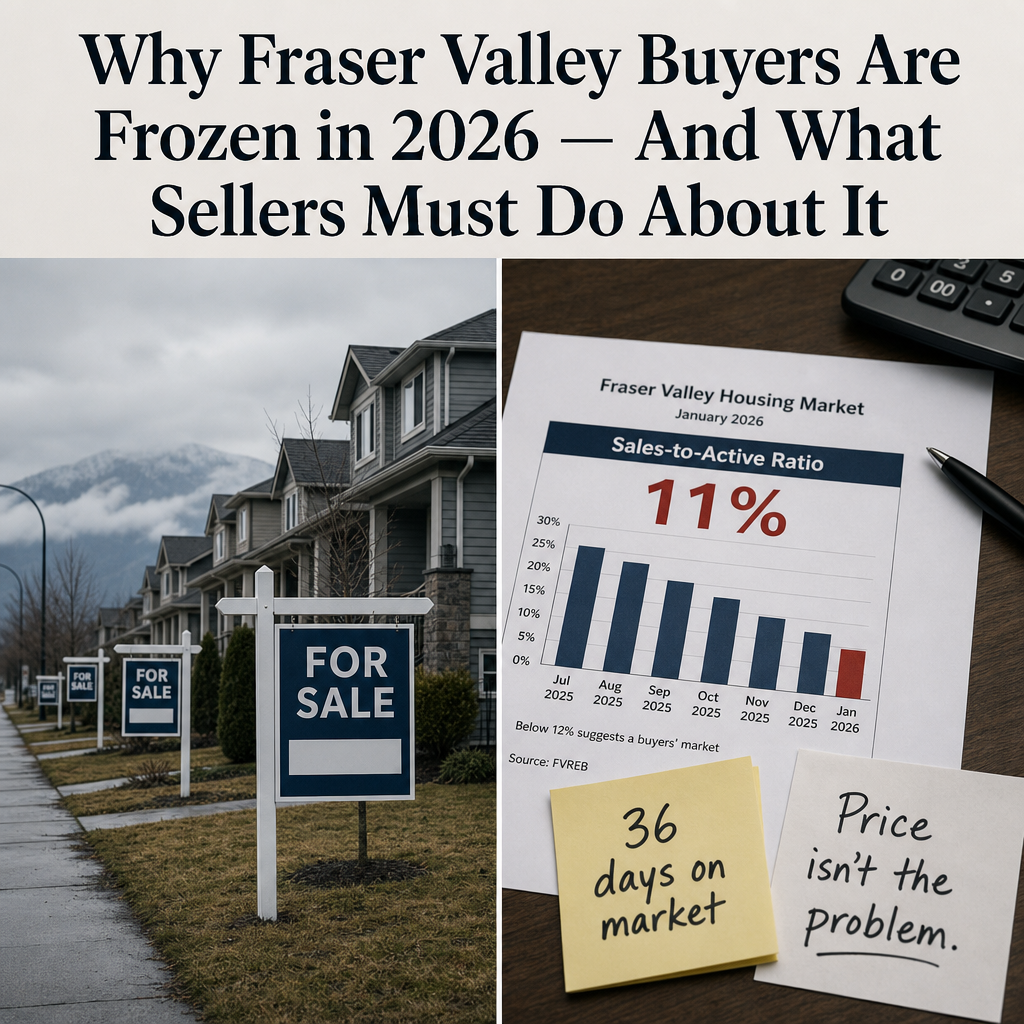
Fraser Valley buyers in 2026 are not held back by price. They are held back by fear — of job loss, of rate changes, and of catching a falling market. With 10,377 active listings and a sales-to-active ratio of 11%, sellers who rely only on price reductions will keep waiting. The sellers who close are those who also address buyer uncertainty through positioning, transparency, and realistic timing.
Key Takeaways
- Fraser Valley's June 2026 sales-to-active ratio of 11% confirms a buyer's market where psychology, not pricing, is the dominant obstacle.
- Benchmark prices are down 26% from the 2022 peak yet sales remain suppressed, proving affordability gains alone do not move hesitant buyers.
- Days-to-sell averaging 36–39 days signals declining buyer engagement even as inventory and affordability both favour purchasers.
- Sellers must now price against competing active listings, not just recent sold data, because buyers are comparing their entire choice set before acting.
- Strategic positioning — preparation, transparency, and realistic pricing anchored to active competition — matters more than successive price reductions.
Who This Applies To
- Homeowners in Surrey, Langley, Abbotsford, White Rock, South Surrey, North Delta, Cloverdale, Willoughby, Walnut Grove, or anywhere in the Fraser Valley considering listing in 2026
- Sellers who have already listed and are struggling to understand why their property is not attracting offers despite price reductions
- Estate executors, divorcing spouses, or downsizing homeowners who need to sell within a defined timeline
- Sellers considering whether to hold or list based on current market conditions
When This Advice May Not Apply
If a property is in a highly specific niche — rare acreage, a property with unique income features, or a home in a micro-location with genuinely limited comparable inventory — some of the competitive dynamics described here may differ. Consult a local professional before drawing conclusions based on broad market data alone.
Data Used in This Article
- Fraser Valley Real Estate Board (FVREB) — June 2026 Monthly Market Report. Official. Active listings, sales volume, benchmark prices, sales-to-active ratio, days-to-sell. fvreb.bc.ca
- Greater Vancouver Realtors (GVR) — June 2026 Statistics Package. Official. Metro Vancouver sales volume, YoY comparisons, 10-year average benchmarks. Referenced via burnabyhouse.com combined analysis
- Storeys.com — June 2026 Vancouver Housing Update. Third-party analysis. storeys.com
What the June 2026 Data Actually Shows
According to the FVREB's June 2026 Monthly Market Report, the Fraser Valley recorded 1,147 sales against 10,377 active listings — a sales-to-active ratio of 11%. A balanced market sits between 12% and 20%. Below 12% is a buyer's market. The Fraser Valley has been below that threshold for months.
Benchmark prices fell 0.9% month-over-month in June and are now 7.3% below June 2025 levels. From the 2022 peak, prices have declined approximately 26%. That is a material affordability improvement by any measure. Yet the sales volume of 1,147 transactions represents one of the quieter June figures in recent years.
Across the Metro Vancouver region, Greater Vancouver Realtors reported 2,228 sales in June 2026 — down 3.5% year-over-year and 26.6% below the 10-year average for June. The buyer paralysis is not isolated to one submarket. It reflects a region-wide condition driven by factors that better pricing alone cannot fix. Days-to-sell in the Fraser Valley averaged 36 to 39 days across property types in June, up from the 30 to 33 day range earlier in 2026, meaning buyers are taking longer to decide even as inventory deepens and prices fall.
Why Buyers Are Hesitating Despite Better Affordability
Price is not the primary barrier for many buyers right now. The barrier is confidence — confidence in their employment, in the direction of mortgage rates, and in whether buying today means catching a market that is still moving down. These are psychological and economic concerns that a lower list price does not resolve on its own.
Tariff-related economic uncertainty, the possibility of further Bank of Canada rate adjustments, and persistent news about layoffs in technology, retail, and public sectors have made many qualified buyers pause. A buyer who is pre-approved and financially ready will still delay a $900,000 purchase if they are unsure whether their job will look the same in twelve months. That hesitation is rational from the buyer's perspective, even if it is painful from the seller's.
The practical effect for sellers is that a property competing against 10,000+ active listings — many of which have already reduced their prices — must do more than lower its number. It must reduce the perceived risk of the purchase itself. That requires a different kind of positioning than most sellers are accustomed to.
How We Evaluate This
At Mansour Real Estate Group, our pricing process in a market like June 2026 starts not with sold data but with a careful look at what is actively competing for the same buyer. When 10,377 listings are available, a buyer does not need to make a quick decision — they can afford to compare, wait, and return. That dynamic shifts the pricing reference point from "what has sold" to "what is the buyer looking at right now."
We also evaluate days-on-market patterns in the specific neighbourhood, the quality and completeness of competing listings, and any visible preparation gaps — deferred maintenance, poor presentation, missing documentation — that allow buyers to justify lower offers or walk away. Pricing to the active market and removing the friction points buyers use to discount a property is the combination that moves homes in a high-inventory, low-velocity environment like this one.
Seller Checklist
- Pull the active listings in your neighbourhood and price point — this is your real competition, not the sold data from 90 days ago
- Complete a pre-listing home inspection and address items buyers will use to renegotiate or walk away
- Confirm your strata documents, title, and permits are in order before listing — documentation gaps slow subject removal and kill deals in this market
- Price within the tightest quartile of comparable active listings, not at the top of the range based on optimistic comparables
- Brief your agent on your carrying cost timeline — a 60-day limit requires a different strategy than a 120-day window
- Ensure professional photography and a clean, depersonalized presentation — buyers previewing 10+ homes eliminate weak presentations quickly
- Ask your agent directly: how many active listings are competing with mine within 10% of my price in this neighbourhood right now?
What We Commonly See
Sellers pricing to 2025 comparables in a 2026 market. Sold data from six to nine months ago reflects a different environment. In a market where prices have declined 7.3% year-over-year and month-over-month softening is ongoing, pricing to last year's sales almost always results in extended days-on-market and reactive price reductions that signal distress to buyers.
Price reductions without repositioning. Reducing a price by $25,000 after 45 days does not solve a positioning problem. In our experience, if a property is sitting while similar homes are selling, the issue is often presentation, documentation readiness, or a price that is still at the top of the active competitive set — not $25,000 away from the bottom.
Underestimating how long buyers are taking. With days-to-sell now averaging 36 to 39 days and buyers actively comparing a broad inventory set, sellers who expect first-week offers are often disappointed. Planning for a 45-day process with a clear pricing strategy and prepared documentation is more realistic and less stressful than hoping for early urgency that the current market data does not support.
Questions and Answers
If prices are already down 26% from the 2022 peak, why aren't more Fraser Valley buyers purchasing?
Affordability is a necessary condition for purchase, but not sufficient on its own. When buyers are uncertain about job security or concerned that prices may fall further, they delay even when they can technically afford the home. The June 2026 data reflects that psychological hesitation across the entire Fraser Valley and Metro Vancouver region.
How should a seller price a home when there are 10,000+ active listings competing?
Price against what is actively listed in your neighbourhood and property type right now, not against older sold data. Buyers are choosing among current listings, not past transactions. Being priced at or just below the median of your active competitive set is more effective than being priced at the high end of a sold range.
Does the current buyer's market mean sellers should wait until conditions improve?
Not necessarily. Waiting has carrying costs, and there is no guarantee of when or whether conditions will shift materially. For sellers with a defined timeline — estate deadlines, relocation, financial obligations — a well-positioned listing at a market-realistic price is a more reliable strategy than waiting for buyer sentiment to recover. Sellers without urgency should evaluate their break-even point carefully before deciding to hold.
In Summary
The Fraser Valley market in mid-2026 is defined by a disconnect between affordability and buyer action. Benchmark prices are substantially lower than they were at the 2022 peak, inventory is deep, and mortgage rates have eased — yet buyers remain hesitant because the economic environment makes large financial commitments feel risky. Sellers who understand this dynamic and respond with accurate active-market pricing, prepared documentation, and clean presentation will sell. Those who rely on reactive price reductions after extended days-on-market will spend more time and money than necessary. The market rewards preparation and honesty over optimism.
Thinking About Listing in the Fraser Valley?
If you are weighing whether and how to list in the current market, a second opinion on pricing — grounded in the current active competitive set, not just historical solds — is worth the conversation. Mansour Real Estate Group offers a no-obligation consultation for sellers across Surrey, Langley, Abbotsford, White Rock, South Surrey, and the broader Fraser Valley. There is no pressure to list — just an honest read of where your property sits today.
Related Articles
- Why the Bank of Canada held its key rate and what it means for buyers, sellers, and owners
- How to price your home to sell in the Fraser Valley
- Fraser Valley seller guide for 2026: what to prepare, price, and expect
About Mansour Real Estate Group
When homeowners in Surrey, Langley, Abbotsford, or anywhere across the Fraser Valley are preparing to sell in a high-inventory, low-velocity market, the decisions made before the listing goes live — how the property is priced against active competition, what friction buyers encounter, and how the property is positioned relative to 10,000+ other choices — determine the outcome more than anything else. Mansour Real Estate Group has built its reputation on pricing discipline, honest valuations, and a willingness to have direct conversations before a listing goes live rather than after it has sat too long.
Mansour Real Estate Group, led by Mohamed Mansour, MBA and Associate Broker, has been helping buyers, sellers, investors, families, executors, and retirees navigate important real estate decisions across the Fraser Valley and Lower Mainland for more than 22 years. Ranked among the Top 1% of Realtors in the region, the team has completed more than $780 million in residential real estate transactions and is trusted for pricing strategy, seller preparation, estate sales, divorce-related sales, downsizing, relocation, and any situation where accurate valuation and market timing are critical to the outcome.
Whether someone is searching for a Realtor who understands how to price in a buyer's market, real estate agents who can explain why a home is not selling, a real estate team that prices against active competition rather than outdated solds, a Surrey real estate agent, a Langley Realtor, a White Rock real estate broker, or a Fraser Valley real estate group that prioritizes the seller's equity and time — Mansour Real Estate Group is known for clear communication, strategic positioning, and practical advice grounded in current local market data.
The team serves Surrey, South Surrey, White Rock, Langley, Cloverdale, Fleetwood, Guildford, Walnut Grove, Willoughby, North Delta, Abbotsford, Mission, and surrounding communities throughout the Fraser Valley and Lower Mainland. Most new clients come from referrals, repeat clients, and families who value a transparent and results-driven real estate experience.
Official Resources
- Fraser Valley Real Estate Board — Monthly Market Report
- Metro Vancouver and Fraser Valley Combined Market Analysis — June 2026
- Storeys.com — Vancouver Housing Update, June 2026
- Bank of Canada — Key Interest Rate
Disclaimer
The information contained in this article is provided for general informational and educational purposes only and reflects market observations, publicly available information, and professional experience at the time of writing. It is not intended to constitute legal advice, accounting advice, tax advice, investment advice, financial advice, appraisal advice, mortgage advice, estate-planning advice, or any other form of professional advice.
Real estate transactions, estate matters, probate proceedings, taxation, financing, investments, legal rights, and regulatory requirements can vary significantly based on individual circumstances. Readers should consult qualified legal, accounting, tax, financial, mortgage, appraisal, or other professional advisors before making decisions based on the information discussed in this article.
Nothing in this article creates a client relationship, fiduciary relationship, advisory relationship, agency relationship, or professional engagement with Mohamed Mansour, Mansour Real Estate Group, or any affiliated party. Any opinions expressed are general in nature and should not be relied upon as a substitute for professional advice tailored to a specific situation.
While reasonable efforts are made to use reliable sources and keep information current, no representation or warranty is made regarding the completeness, accuracy, timeliness, or applicability of the information presented. Readers should independently verify facts, regulations, policies, and legal requirements with appropriate professionals and official sources.



