
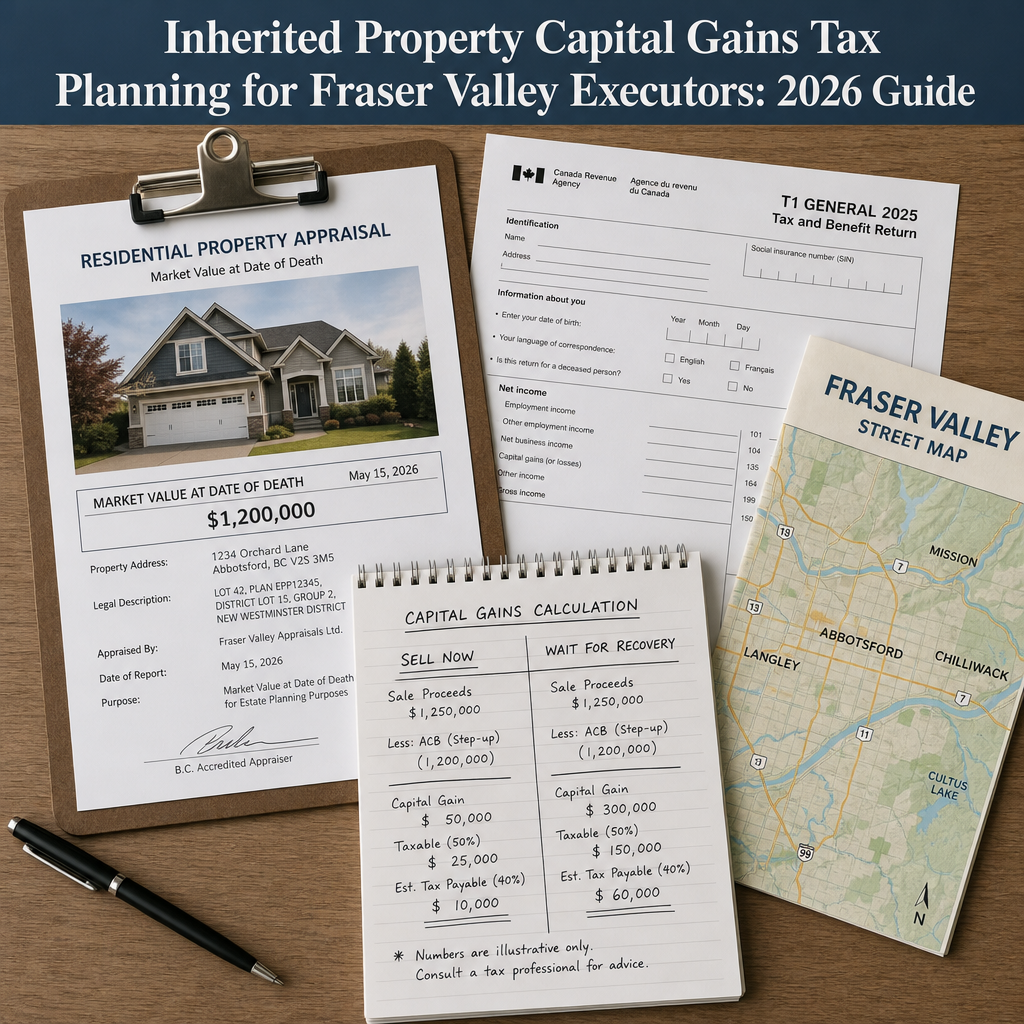

Inherited Property Capital Gains Tax Planning for Fraser Valley Executors: Complete Guide to Deemed Disposition Rules, Principal Residence Exemption Eligibility, Fair Market Value Appraisals, and Strategic Timing to Minimize CRA Liability When Selling Estate Homes in 2026
By Mohamed Mansour, MBA and Associate Broker | Mansour Real Estate Group | Published: July 22, 2026 | Fraser Valley & Lower Mainland, BC
For executors managing estate properties in Surrey, Langley, Abbotsford, White Rock, and across the Fraser Valley, the real estate transaction is only part of the job. The tax calculation that runs alongside it — triggered the moment someone dies — determines how much of the estate's value actually reaches the beneficiaries. Most executors don't learn about deemed disposition rules until after probate has started, which is often too late to make the decisions that matter most.
This guide explains how capital gains tax works on inherited property in Canada, what the principal residence exemption does and does not cover, how to approach fair market value appraisals in 2026's declining Fraser Valley market, and why the math sometimes favours selling during a downturn rather than waiting for prices to recover. This article is for general informational purposes only. Executors should work with a qualified tax accountant or estate lawyer for advice specific to their situation.
Short Answer
When someone dies owning real estate in Canada, the Income Tax Act deems that property sold at fair market value on the date of death. Any capital gain accrued during their lifetime is reported on their final tax return. The principal residence exemption can shelter the primary home, but rental properties, vacation homes, and investment real estate are fully taxable. In 2026's declining Fraser Valley market, lower date-of-death appraisals can reduce the taxable gain — a counterintuitive advantage executors should discuss with their tax advisor before ordering an appraisal.
Key Takeaways
- Deemed disposition triggers capital gains tax at date of death, not at the date the property actually sells.
- The principal residence exemption shelters only the deceased's designated primary home — not rentals, vacation homes, or investment properties.
- A retroactive appraisal dated at death is the executor's single most important document for CRA compliance.
- In a declining market, lower date-of-death values reduce taxable capital gains — sometimes making it advantageous to sell sooner rather than wait.
- Non-resident beneficiaries trigger Section 116 withholding tax obligations that require legal planning before any sale completes.
Who This Applies To
- Executors managing estate properties in Surrey, Langley, Abbotsford, White Rock, South Surrey, or elsewhere in the Fraser Valley
- Beneficiaries who have inherited a rental property, vacation home, or multi-unit building
- Families where the deceased owned more than one property and one may not qualify as a principal residence
- Estates with non-resident beneficiaries or cross-border property complications
- Executors who have not yet ordered a fair market value appraisal dated at the date of death
When This Advice May Not Apply
This article addresses the most common estate scenarios in BC. It does not cover spousal rollover elections in detail, Quebec succession law, Indigenous land considerations, or properties held in corporations or trusts. Those situations require specialized legal and tax counsel.
Key Terms
Deemed Disposition: A legal rule under Section 70 of Canada's Income Tax Act that treats a deceased person as having sold all capital property at fair market value immediately before death, triggering capital gains tax on any accrued gain.
Adjusted Cost Base (ACB): The original purchase price of a property plus eligible improvements. For inherited property, the ACB is reset to fair market value at the date of death — this is the foundation for all future capital gains calculations by the estate or beneficiary.
Capital Gains Inclusion Rate: The proportion of a capital gain that is included in taxable income. Under rules in effect for the 2026 tax year, the inclusion rate for individuals on gains below $250,000 annually is 50%. Gains above that threshold may be subject to a higher inclusion rate — confirm the current rate with a tax accountant, as this threshold was under legislative review in 2025 and 2026.
Principal Residence Exemption (PRE): A CRA designation that exempts a property's capital gains from tax, available only for a dwelling designated as the taxpayer's principal residence for each year of ownership.
Section 116 Withholding: A CRA requirement that a buyer withhold 25% of the gross sale price when purchasing from a non-resident vendor, unless a clearance certificate is obtained in advance.
Fair Market Value Appraisal: A formal opinion of value prepared by a Certified Residential Appraiser (CRA-designated or AACI) dated at a specific point in time — in estate situations, that date must match the date of death.
Data Used in This Article
- Fraser Valley Real Estate Board (FVREB), June 2026 Monthly Market Report — Official; detached and condo benchmark price changes year-over-year; active listing inventory figures
- Income Tax Act, Section 70 — Federal legislation; deemed disposition rules at death; official government source
- CRA Principal Residence Exemption guidance (IT-120R6 and successor interpretations) — Official CRA administrative guidance; principal residence designation rules
- Daily Hive / FVREB, June 2026 sales statistics — Third-party summary of board data; used for market context only
How Deemed Disposition Works in Practice
Under Section 70 of the Income Tax Act, when a Canadian resident dies, every capital property they owned — including real estate — is deemed to have been disposed of at fair market value immediately before death. The resulting capital gain or loss is reported on the deceased's terminal tax return (the final T1), which is due six months after the date of death or April 30 of the following year, whichever is later.
For executors in the Fraser Valley, this means a property that was purchased in 1998 for $280,000 and was worth $1,400,000 at the date of death in 2026 has a deemed capital gain of approximately $1,120,000. After applying the applicable inclusion rate, a substantial portion of that gain becomes taxable income on the final return — even if the property hasn't been listed yet.
This is the critical distinction most families don't realize: the tax event is the death itself, not the sale. The actual sale transaction that the executor arranges later is a separate event, calculated against the new ACB established at the date of death. If the estate sells the property for more than the date-of-death value, there is a second capital gain at the estate level. If it sells for less — as might happen in a declining market — there may actually be a capital loss that offsets other estate income.
There is one important exception for married or common-law couples: a spousal rollover under Section 70(6) allows the property to transfer to a surviving spouse at the original ACB, deferring the capital gain until the surviving spouse eventually sells or passes away. Executors should confirm with their estate lawyer whether this election applies before filing the terminal return.
Principal Residence Exemption: What It Covers and What It Doesn't
The principal residence exemption can fully eliminate the capital gain on a property — but only when the deceased actually lived there as their primary home and designated it as their principal residence for every year of ownership. For many straightforward estates in Surrey, White Rock, or Langley where the family home was the only property, the PRE wipes out the capital gains liability entirely and the executor's tax exposure is minimal.
The complications arise when the estate includes a second property. Rental suites, secondary suites that operated as separate rental units, vacation properties at Harrison Lake or Cultus Lake, and investment condos purchased in Langley or Abbotsford for rental income — none of these qualify for the PRE. They face the full deemed disposition capital gain on the terminal return.
When the deceased owned both a primary home and a secondary property, the executor must decide — in consultation with the estate accountant — how to allocate the PRE. Canada's tax rules allow the exemption to be applied to only one property per year. Careful allocation of the exemption years across both properties can reduce the total tax, but the math requires professional analysis based on the specific purchase dates, holding periods, and values involved.
Executors should also be aware that the CRA looks carefully at properties where the deceased claimed rental income in prior years. If a basement suite generated T4A or rental income, claiming the PRE on that home's full value may trigger a review. The accountant filing the terminal return will need to address the rental suite portion of the gain separately.
Fair Market Value Appraisals: Why They Are the Executor's Most Important Document
Every capital gains calculation for an inherited property begins with one number: the fair market value on the date of death. That number sets the ACB for the estate and, if a spousal rollover does not apply, determines the taxable gain on the terminal return. Getting this number right — and being able to defend it to CRA if audited years later — requires a formal appraisal prepared by a qualified appraiser, dated at the date of death.
In the Fraser Valley's current market, this matters more than usual. According to the FVREB's June 2026 Monthly Market Report, detached home benchmark prices are down approximately 7.9% year-over-year, and condo benchmark prices are down approximately 8.8% year-over-year, with 10,377 active listings across the region. A date-of-death appraisal completed today reflects a market that is meaningfully lower than it was in 2024 or early 2025. That lower value reduces the accrued gain on the terminal return — which is a genuine tax advantage for estates where the PRE does not apply.
Executors who delay ordering an appraisal face compounding risks. Retroactive appraisals rely on comparable sales data from the date of death, and the further in time the appraiser must reach back, the harder it becomes to defend the value with confidence. CRA audits on terminal returns can occur up to four years after the notice of assessment is issued. If the estate is audited and the appraiser cannot support the value used on the return, CRA may substitute its own valuation — typically a higher one — which triggers additional tax, interest, and potential penalties.
The appraisal should be prepared by an AACI (Accredited Appraiser Canadian Institute) or CRA-designated appraiser. Broker opinions, online estimates, and BC Assessment values are not substitutes for a formal appraisal in estate contexts. BC Assessment values in particular are set as of July 1 of the prior year and may not reflect conditions at the exact date of death, especially in a declining market.
Mansour Real Estate Group works alongside executors in Surrey, White Rock, Langley, and Abbotsford to connect them with qualified appraisers and to provide market context that supports the appraisal process — but the formal valuation must be completed by a certified appraiser, not a real estate agent.
The 2026 Market Timing Question: Does Selling in a Downturn Actually Help?
Many executors instinctively want to wait for the market to recover before selling an estate property. That instinct makes sense for a living homeowner who can absorb the carrying costs and wait. For estates, the math is more complicated — and in some situations, selling during a price decline is actually the better financial outcome after tax.
Here is why. The capital gain on the terminal return is fixed at the date-of-death value, which in 2026's declining Fraser Valley market is already lower than it would have been in 2024. If the executor then sells the property at or near the current market price, the estate's ACB and the sale price are closely aligned — meaning the estate-level capital gain (the second gain, on top of the terminal return gain) may be small or even zero. The estate pays tax on the appreciation that occurred during the deceased's lifetime, but not on future appreciation the estate never received.
If the executor waits twelve months for the market to recover, the estate-level capital gain grows by the amount of the recovery. That additional gain is fully taxable to the estate. Meanwhile, the estate is paying carrying costs: property taxes, insurance, utilities, strata fees if applicable, and potentially property management. In many Fraser Valley markets with elevated inventory and buyer hesitation, there is also no certainty the recovery will arrive within a defined timeframe.
The comparison is not always straightforward. It depends on the estate's marginal tax rate, the size of the expected recovery, the carrying cost timeline, and whether the property qualifies for PRE. Executors should model both scenarios with their accountant before committing to a holding strategy. What the 2026 Fraser Valley market conditions make clear is that "wait and recover" is not automatically the right answer — and the tax math often argues against it.
For estate properties in Surrey, Langley, and Abbotsford, Mansour Real Estate Group provides current pricing analysis to help executors and their advisors model realistic sale timelines and price expectations before making a hold-or-sell decision.
Cross-Border and Non-Resident Complications
When beneficiaries live outside Canada, or when the deceased owned property in the United States, the capital gains picture becomes significantly more complicated. These situations require legal and tax counsel experienced in cross-border estate planning, but executors should understand the basic framework before a sale completes.
Under Section 116 of the Income Tax Act, when a non-resident sells taxable Canadian property — which includes real estate — the buyer is legally required to withhold 25% of the gross sale price and remit it to CRA unless the non-resident vendor has obtained a clearance certificate in advance. That withholding is based on the full sale price, not the gain, which means it can significantly exceed the actual tax owing. Obtaining a clearance certificate requires filing Form T2062 with CRA, a process that can take several months and must begin well before the anticipated closing date.
Estates where the deceased was a US citizen or green card holder, or where the property itself is located in the US, also face potential US estate tax exposure. The Canada-US Tax Treaty provides some relief through credits and exemptions, but treaty elections must be made deliberately and proactively — they do not apply automatically. Executors in these situations should engage a cross-border tax specialist before listing the property.
How We Evaluate This
At Mansour Real Estate Group, we approach executor-managed estate transactions by first understanding the tax and legal framework before we discuss listing strategy. That means asking early questions: Has a date-of-death appraisal been ordered? Has the estate accountant reviewed the PRE eligibility? Are there non-resident beneficiaries? Is there a spousal rollover in play? The answers to those questions directly affect how we price the property, what timeline we recommend, and how we structure the sale to align with the estate's obligations.
In a market like 2026's Fraser Valley — where buyer hesitation and elevated inventory are creating pressure on prices — we also provide executors with a realistic picture of how long a sale is likely to take, what price range is defensible, and how that timeline interacts with the estate's carrying costs and tax obligations. That analysis belongs to the estate's professional team, but real estate market data is a core input to it, and that is where we contribute.
Estate Executor Checklist
- Engage an estate lawyer to confirm probate requirements and executor authority before taking any action on the property.
- Order a formal fair market value appraisal from an AACI-designated appraiser, dated at the exact date of death, as early in the process as possible.
- Confirm with the estate accountant whether the principal residence exemption applies to this property, and whether a spousal rollover election is available.
- Identify all beneficiaries and determine whether any are non-residents of Canada — if yes, engage a cross-border tax specialist before listing.
- Obtain current market pricing analysis from a real estate professional familiar with the Fraser Valley market to support a hold-versus-sell analysis.
- Confirm whether the property has any strata obligations, depreciation report requirements, or tenancy agreements that must be resolved before a sale can complete.
- File Form T2062 with CRA well in advance of any anticipated closing if non-resident vendors are involved.
- Document all estate-related improvements and expenses, which may be deductible against the estate's capital gain or estate income.
Common Mistakes That Cost Estates
In our experience working with executors and estate families across Surrey, White Rock, and Langley, the following patterns appear regularly:
Using BC Assessment as the date-of-death value. BC Assessment values are set as of July 1 of the prior year and are not intended for capital gains purposes. In a declining market, they can be materially higher than the true date-of-death fair market value — meaning executors who rely on them may overstate the ACB, which sounds safe but can also create issues when the actual sale price differs significantly from the reported value. CRA expects a formal appraisal, not an assessment.
Assuming the family home automatically qualifies for the PRE. What often happens is that a property was rented out for several years before the deceased moved back in, or a basement suite was generating rental income, and the full PRE claim is challenged on audit. The accountant needs to know the full occupancy history of the property, not just its most recent use.
Holding the property without modelling the carrying cost. A common mistake is treating a hold strategy as cost-free while waiting for prices to recover. In 2026's Fraser Valley market, with property taxes, insurance, strata fees on condo properties, and potential vacancy liability, the monthly carrying cost of an estate property in Langley or Abbotsford can run well into four figures. Over a twelve-month wait, those costs accumulate against any potential price recovery — and there is no guarantee of the recovery timeline.
Questions Executors Commonly Ask
Q: Does the estate owe capital gains tax even if the property hasn't been sold yet?
A: Yes. Under deemed disposition rules, capital gains tax on the accrued lifetime gain is triggered at the date of death and reported on the terminal return — regardless of whether the executor has listed or sold the property. The actual sale triggers a second, separate capital gains calculation based on the difference between the date-of-death value and the eventual sale price.
Q: Can the executor claim the principal residence exemption if the deceased lived in a secondary suite or basement of the property?
A: Potentially, but only for the portion of the property used as the principal residence. If part of the home was used to earn rental income, CRA may require the capital gain to be apportioned between the residential and rental portions. The accountant filing the terminal return should review the property's full income history.
Q: What happens if the estate sells the property for less than the date-of-death appraisal value?
A: If the estate sells for less than the established date-of-death fair market value, the estate realizes a capital loss on the sale. That loss can be carried back to offset the capital gain reported on the terminal return, potentially generating a tax refund for the estate. This is a scenario worth modelling with the accountant if the property is sold in a declining market.
In Summary
Deemed disposition rules mean the capital gains tax clock starts at the date of death, not the date of sale. The principal residence exemption is powerful but limited — it does not cover rentals, vacation properties, or investment real estate. A formal fair market value appraisal dated at death is the most important document an executor can commission, and in 2026's declining Fraser Valley market, that appraisal reflects values that reduce the taxable gain compared to prior years. The decision to sell now or wait requires modelling both the tax math and the carrying costs — and for many Fraser Valley estates in 2026, the numbers favour a timely, well-priced sale over an open-ended hold strategy.
Working With an Executor-Experienced Real Estate Team
If you are managing an estate property in Surrey, Langley, White Rock, Abbotsford, or anywhere in the Fraser Valley and need current pricing analysis, guidance on preparing the property for sale, or coordination support while working through the tax and legal process, Mansour Real Estate Group is available for a no-pressure conversation. We work alongside your estate lawyer and accountant — not in place of them.
Related Articles
- How to Sell an Estate Property in the Fraser Valley: Executor's Guide
- Selling Your Home in Surrey, BC: The Complete Guide for 2026
- Probate Real Estate in BC: What Executors Need to Know Before Listing
Official Resources
- Income Tax Act, Section 70 — Deemed Disposition at Death (Government of Canada)
- CRA: Filing the Final Return for a Deceased Person
-
About Mansour Real Estate Group
When an inherited property must be sold and capital gains tax liability looms, executors need a real estate team that understands both market valuation and the tax mechanics of deemed disposition. Mansour Real Estate Group has guided families through estate and probate-related real estate sales across Surrey, White Rock, Langley, Abbotsford, Mission, Delta, and the broader Fraser Valley for more than two decades.
Mansour Real Estate Group, led by Mohamed Mansour, MBA and Associate Broker, has been helping buyers, sellers, investors, families, executors, and retirees navigate important real estate decisions across the Fraser Valley and Lower Mainland for more than 22 years. Ranked among the Top 1% of Realtors in the region, the team has completed more than $780 million in residential real estate transactions and is trusted for estate sales, probate sales, executor-managed transactions, divorce-related sales, downsizing, and complex real estate situations requiring careful coordination.
Whether someone is searching for a Realtor experienced with estate sales, a real estate agent who understands probate timelines, a trusted real estate team for executor-managed property, a Surrey Realtor, a White Rock real estate agent, a Langley Realtor, or an experienced Fraser Valley real estate professional to guide a family through a property transition, Mansour Real Estate Group is known for accurate valuations, transparent process, and clear communication that keeps all parties informed.
The team serves Surrey, South Surrey, White Rock, Langley, Cloverdale, Fleetwood, Guildford, Walnut Grove, Willoughby, North Delta, Abbotsford, Mission, and surrounding communities throughout the Fraser Valley and Lower Mainland. Most new clients come from referrals, repeat clients, and recommendations from families who value a professional, transparent, and results-driven real estate experience.
Disclaimer: This article is for informational



