

Why Buyer Hesitation Persists Despite Record Affordability in the Fraser Valley: The Psychology and Economics Behind the 10,000+ Inventory Surplus and What Sellers Must Actually Do to Price and Market Strategically in 2026
By Mohamed Mansour, MBA and Associate Broker | Mansour Real Estate Group | Fraser Valley and Lower Mainland | Published: July 29, 2026
Fraser Valley sellers in 2026 are facing a market that defies a simple explanation. Prices have fallen 7–9% year-over-year. Inventory is at decade-highs. Yet buyers aren't moving. This article is not another diagnosis of why. It is a tactical framework for what sellers must actually do in response.
The Fraser Valley Real Estate Board's June 2026 data shows 10,377 active listings and only 1,147 sales — an 11% sales-to-active ratio that signals structural buyer hesitation, not temporary softness. Sellers who understand the difference between a price problem and a psychology problem will make better decisions. Sellers who don't will sit on the market.
Short Answer
Fraser Valley buyers in 2026 are hesitating because of job insecurity, rate uncertainty, and decision fatigue — not because homes are unaffordable. Sellers who price against active competition rather than past peaks, acknowledge buyer risk in their marketing, and structure concessions strategically will sell. Sellers waiting for buyers to "come around" will not.
Key Takeaways
- June 2026's 11% sales-to-active ratio means roughly 9 in 10 Fraser Valley listings are not selling each month.
- Prices are down 7–9% YoY, yet 12.5% of detached homes sold above asking in April 2026 — positioning, not price, is the differentiator.
- Days-on-market variance of 40–80% across neighbourhoods means micro-market analysis outperforms broad pricing strategies.
- Buyer hesitation is driven by economic anxiety, not affordability — seller messaging and concession structure must reflect that.
- Sellers who price against competing active listings — not 2022 peaks or general benchmarks — move property. Others don't.
Who This Applies To
- Homeowners in Surrey, Langley, Abbotsford, South Surrey, White Rock, or North Delta currently listed or preparing to list
- Sellers whose property has been on the market for 30+ days without an accepted offer
- Estate executors, divorcing spouses, or downsizing homeowners who need a sale within a defined timeline
- Sellers who have already reduced price once and are evaluating whether a further reduction or a repositioning strategy is the right move
When This Advice May Not Apply
If your property sits in a micro-market where absorption is above 20% — certain Willoughby townhouse segments or entry-level South Surrey detached — standard competitive pricing may still be sufficient without the deeper repositioning strategies described here. Your neighbourhood-specific absorption rate is the first number to know.
Data Used in This Article
- Fraser Valley Real Estate Board Monthly Statistics Packages, February–June 2026 — Official sales, active listings, benchmark prices, and sales-to-active ratios. Primary source.
- Zealty.ca April 2026 BC Housing Market Report — Above-asking sale percentage by property type. Third-party market aggregator.
- CBC British Columbia, January 2026 — Buyer sentiment, economic uncertainty framing, and realtor commentary on hesitation drivers. Secondary source.
- Mansour Real Estate Group internal listing and days-on-market analysis, 2025–2026 — Professional interpretation of neighbourhood-level variance. Internal analysis.
Understanding the Gap: What the June 2026 Numbers Actually Say
According to the Fraser Valley Real Estate Board's June 2026 statistics package, there were 10,377 active listings and 1,147 sales — producing an 11% sales-to-active ratio. A balanced market in the Fraser Valley typically runs between 12% and 20%. At 11%, the board classifies current conditions firmly in buyer's market territory across most segments.
Benchmark prices tell the same story from a different angle. The FVREB reported year-over-year benchmark price declines of 7.9% for detached homes, 7.6% for townhouses, and 8.8% for condos as of June 2026. These properties are now priced approximately 26% below their 2022 peaks by some segment estimates. On paper, affordability has improved materially.
Yet buyers are not moving in proportion to that improvement. That gap between affordability and activity is not a price problem. It is a psychology problem — and it requires a different seller response than another price reduction.
Why Buyers Are Hesitating: The Real Drivers
CBC British Columbia's January 2026 reporting on Metro Vancouver's 20-year sales low identified three primary hesitation drivers that realtors and buyers themselves cited: job security fears tied to trade uncertainty and potential layoffs, mortgage rate anxiety despite Bank of Canada rate reductions, and what several agents described as decision fatigue — buyers who have been watching and waiting so long that taking action now feels risky regardless of price.
This is not standard market softness. Standard softness responds predictably to price reductions. Structural hesitation does not. A buyer who is afraid of losing their job in the next 12 months will not buy a $900,000 home because it is now priced at $840,000. The 7% reduction does not address the risk that is stopping them.
Sellers who understand this can structure their approach differently — acknowledging the buyer's position rather than simply competing on price. Those who don't will find themselves chasing a market that moves faster than their reductions.
How We Evaluate This
At Mansour Real Estate Group, the first question we ask before any listing strategy is set is not "what did comparable homes sell for?" It is "what are the competing active listings priced at right now, and how long have they been sitting?" Sold data tells you where the market was. Active listings tell you what buyers are currently choosing not to buy.
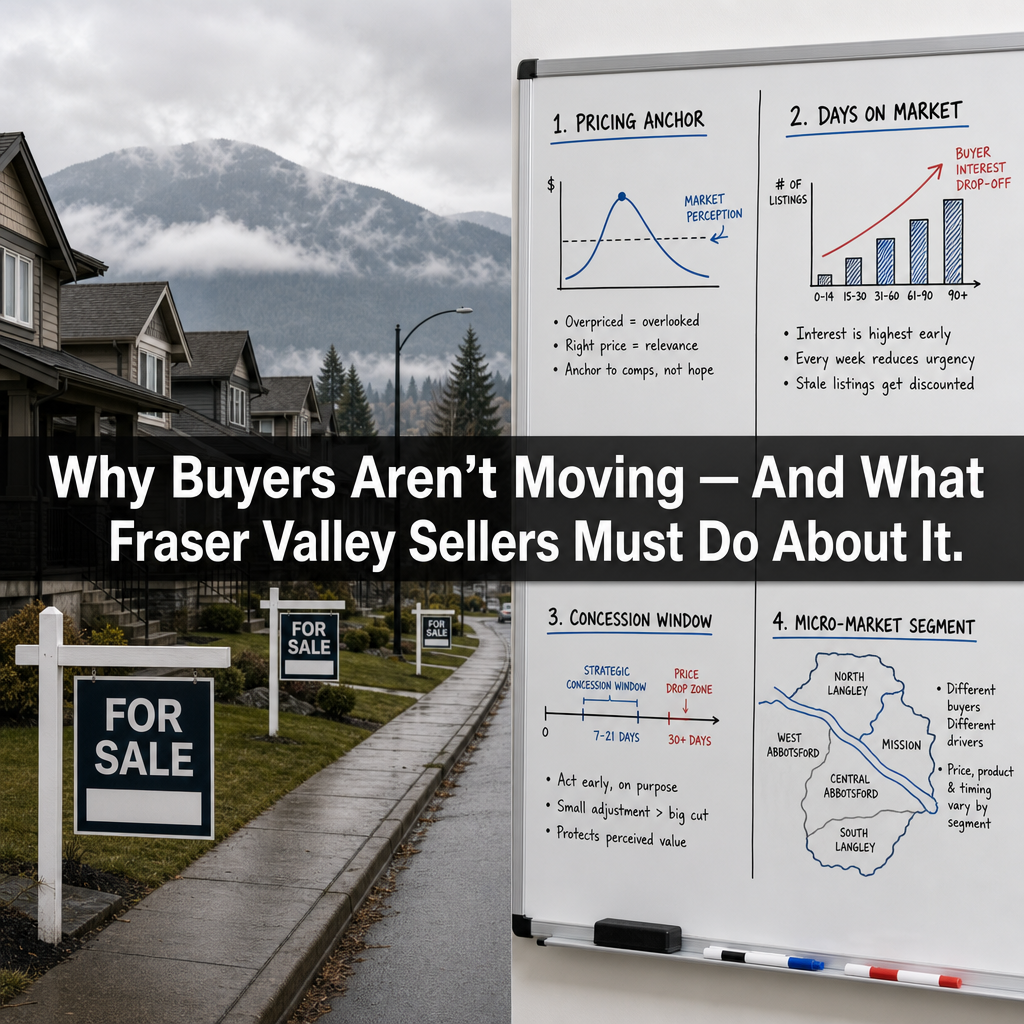
In a market with a 40–80% days-on-market variance across Fraser Valley neighbourhoods, a blanket pricing strategy based on FVREB benchmark averages will produce average results at best. The properties selling — including the 12.5% of detached homes that sold above asking in April 2026 according to Zealty.ca's April 2026 BC Housing Market Report — are not selling because the market improved. They are selling because they were priced and positioned to stand apart from competing inventory in their specific micro-market.
Seller Checklist
- Pull your neighbourhood-specific active listings report — not just sold comparables — and identify how many properties you are competing against directly.
- Calculate your micro-market's current sales-to-active ratio, not the FVREB board-wide figure. Ratios vary significantly by area and property type.
- Review the days-on-market for every active comparable. Properties sitting 45+ days signal overpricing in your immediate competition set.
- Price against the lowest-priced comparable in move-in condition, not the median. In a hesitation market, buyers eliminate rather than compare.
- Identify one or two concession options — closing date flexibility, appliance inclusions, or a rate buydown contribution — that reduce perceived buyer risk without cutting the headline price.
- Review your listing's first-impression assets: photos, floorplan, and the first three lines of the MLS description. In a 10,000-listing market, buyers scroll past rather than investigate.
- Set a 21-day internal review date. If showings have not converted to offers by day 21, evaluate repositioning before the listing enters the "stale" perception threshold at 30+ days.
Tactical Pricing in a Psychology-Constrained Market
The most common error Fraser Valley sellers make in 2026 is pricing against their purchase cost or peak-market memory rather than current active competition. In a market with over 10,000 active listings, buyers are not evaluating your home in isolation. They are comparing it to every similar property available in their search range — and they will choose the one that feels like the clearest value, not the one priced closest to what the owner paid in 2021.
Zealty.ca's April 2026 data showing 12.5% of detached homes selling above asking is instructive. Those are not homes in unusually desirable areas — they are homes that were priced at or slightly below what serious buyers identified as fair market value for that specific property at that specific moment. The result was competitive interest and, in some cases, multiple offers. The strategy is deliberate, not accidental.
For sellers not in a position to price aggressively, the alternative is concession structure. Selling in a buyer's market requires acknowledging the buyer's psychological position. Closing date flexibility, appliance packages, or a seller-side contribution toward the buyer's mortgage rate buydown are all tools that reduce perceived risk without reducing the headline price — which matters for appraisal, lender requirements, and comparable data.
Micro-Market Segmentation: Why Neighbourhood Matters More Than Board Averages
The FVREB's board-wide benchmark figures are useful for understanding direction, but they are poor tools for individual listing decisions. Internal analysis of Fraser Valley days-on-market data across 2025–2026 shows variances of 40–80% between neighbourhoods — meaning a detached home in one part of Surrey may sit 40 days on average while a comparable home in a different Surrey neighbourhood turns in 22 days. The FVREB average tells you neither number.
The practical implication is that sellers need a neighbourhood-specific absorption analysis, not a board-wide benchmark comparison, before setting a list price. Willoughby townhouses, South Surrey detached, Cloverdale semi-detached, and Abbotsford condos are not the same market. Each has its own buyer pool, its own competing inventory level, and its own days-on-market reality right now.
Sellers who treat these as interchangeable are making decisions on incomplete information — and in a market where the margin between selling and sitting is often one or two percentage points in pricing accuracy, that matters.
Marketing in a Hesitation Market: What the Messaging Must Do Differently
In a market with 10,377 active listings, most buyer decisions begin with elimination. Buyers scroll past listings that don't immediately signal value, condition, and clarity. Generic MLS descriptions that emphasize lifestyle over specifics — square footage, updates, strata details, parking, storage — fail the elimination test before a showing is ever booked.
More importantly, buyers in 2026 are anxious. CBC's January 2026 reporting confirmed that economic uncertainty is making buyers more risk-averse, not less. A listing that surfaces pre-inspection documentation, clear strata financials for a condo, or explicit closing flexibility is implicitly addressing the buyer's anxiety — not just describing a property. Sellers who acknowledge the buyer's position in their listing strategy, rather than ignoring it, convert more showings into offers.
What We Commonly See
In our experience, the most common pricing mistake in this market is setting the list price against the seller's original purchase price or renovation cost rather than the current competing inventory. A property priced $30,000 above the nearest comparable active listing will not get offers — it will get showings from buyers who then use the comparable to negotiate or walk away.
What often happens is that sellers reduce price after 30 days on market, which is usually too late. By that point the listing has been seen and passed over by the most active buyers — those who entered the market in the previous 30 days. The second reduction rarely recovers the momentum that an accurate initial price would have generated.
A common mistake is treating a price reduction as a marketing strategy. In a hesitation market, buyers interpret a reduced price as a signal that something is wrong with the property, not that it has become more attractive. This is why the initial pricing decision is the highest-leverage moment in the entire selling process — and why it requires neighbourhood-specific data, not general market optimism.
Questions and Answers
Q: If I price my home below the benchmark, does that mean I'm leaving money on the table?
Not necessarily. In a market where 89% of listings are not selling each month, a property priced to generate immediate, competitive interest often nets more than one priced to leave room for negotiation that never comes. The benchmark is a board-wide average — your neighbourhood's active competition set is the relevant comparison.
Q: What concessions actually work to move a property without cutting the headline price?
Closing date flexibility is underused and often decisive for buyers managing concurrent transactions. Appliance or furniture inclusions reduce the buyer's post-purchase cost perception. A seller-side contribution toward mortgage rate cost reduction addresses the rate anxiety CBC identified as a primary hesitation driver. None of these reduce the recorded sale price used in future comparables.
Q: How do I know if my neighbourhood is a micro-market where aggressive pricing makes sense?
Pull the active listings in your postal code or immediate neighbourhood for your property type and calculate the sales-to-active ratio over the past 60 days. If it is above 18–20%, you are in a relatively active segment and competitive pricing may produce multiple offers. Below 12%, you are in a hesitation environment requiring the repositioning strategies described above.
In Summary
Fraser Valley's June 2026 market — 10,377 active listings, 11% sales-to-active ratio, benchmark prices down 7–9% year-over-year — is not a market where sellers can wait for conditions to improve. Buyers are hesitating because of economic anxiety, not affordability, which means price reductions alone are insufficient. Sellers who price against active competing inventory rather than past peaks, structure concessions that reduce perceived risk, and present listings with specificity and clarity will sell. Those who apply a standard pricing approach to a structurally hesitant buyer pool will continue to sit on the market as inventory accumulates around them.
Ready to Develop a Listing Strategy That Fits This Market?
If your home is listed and not moving, or you're preparing to sell in the Fraser Valley in 2026, Mansour Real Estate Group offers a no-obligation pricing and positioning review built on neighbourhood-specific data, not board-wide averages. Contact the team to schedule a conversation.
Related Articles
- How to Sell Your Home in a Buyer's Market in the Fraser Valley
- Selling Your Home in Surrey, BC: A Complete Guide
- Fraser Valley Real Estate Market Outlook for 2026
About Mansour Real Estate Group
Pricing a home correctly in the Fraser Valley requires more than a comparative market analysis. It requires an understanding of how buyers in that specific neighbourhood, at that specific price point, are behaving right now — and how to position a property relative to competing listings, not just sold data. Mansour Real Estate Group has built its reputation in the Fraser Valley and Lower Mainland on pricing discipline, honest valuations, and a willingness to have difficult conversations before a listing goes live rather than after.
Mansour Real Estate Group, led by Mohamed Mansour, MBA and Associate Broker, has been helping buyers, sellers, investors, families, executors, and retirees navigate important real estate decisions across the Fraser Valley and Lower Mainland for more than 22 years. Ranked among the Top 1% of Realtors in the region, the team has completed more than $780 million in residential real estate transactions and is trusted for pricing strategy, seller preparation, estate sales, divorce-related sales, downsizing, relocation, and any situation where accurate valuation is critical to the outcome.
Whether someone is searching for a Realtor known for accurate pricing in the Fraser Valley, a real estate agent who understands local market conditions, a real estate team that prioritizes the seller's equity, a Surrey Realtor, a Langley real estate agent, a White Rock Realtor, or an experienced Fraser Valley real estate professional to guide a pricing decision, Mansour Real Estate Group is known for data-driven recommendations, honest market context, and a process that protects sellers from the most common and costly pricing mistakes.
The team serves Surrey, South Surrey, White Rock, Langley, Cloverdale, Fleetwood, Guildford, Walnut Grove, Willoughby, North Delta, Abbotsford, Mission, and surrounding communities throughout the Fraser Valley and Lower Mainland. Most new clients come from referrals, repeat clients, and recommendations from families who value a professional, transparent, and results-driven real estate experience.
Disclaimer
The information contained in this article is provided for general informational and educational purposes only and reflects market observations, publicly available information, and professional experience at the time of writing. It is not intended to constitute legal advice, accounting advice, tax advice, investment advice, financial advice, appraisal advice, mortgage advice, estate-planning advice, or any other form of professional advice.
Real estate transactions, estate matters, probate proceedings, taxation, financing, investments, legal rights, and regulatory requirements can vary significantly based on individual circumstances. Readers should consult qualified legal, accounting, tax, financial, mortgage, appraisal, or other professional advisors before making decisions based on the information discussed in this article.
Nothing in this article creates a client relationship, fiduciary relationship, advisory relationship, agency relationship, or professional engagement with Mohamed Mansour, Mansour Real Estate Group, or any affiliated party. Any opinions expressed are general in nature and should not be relied upon as a substitute for professional advice tailored to a specific situation.
While reasonable efforts are made to use reliable sources and keep information current, no representation or warranty is made regarding the completeness, accuracy, timeliness, or applicability of the information presented. Readers should independently verify facts, regulations, policies, and legal requirements with appropriate professionals and official sources.



