
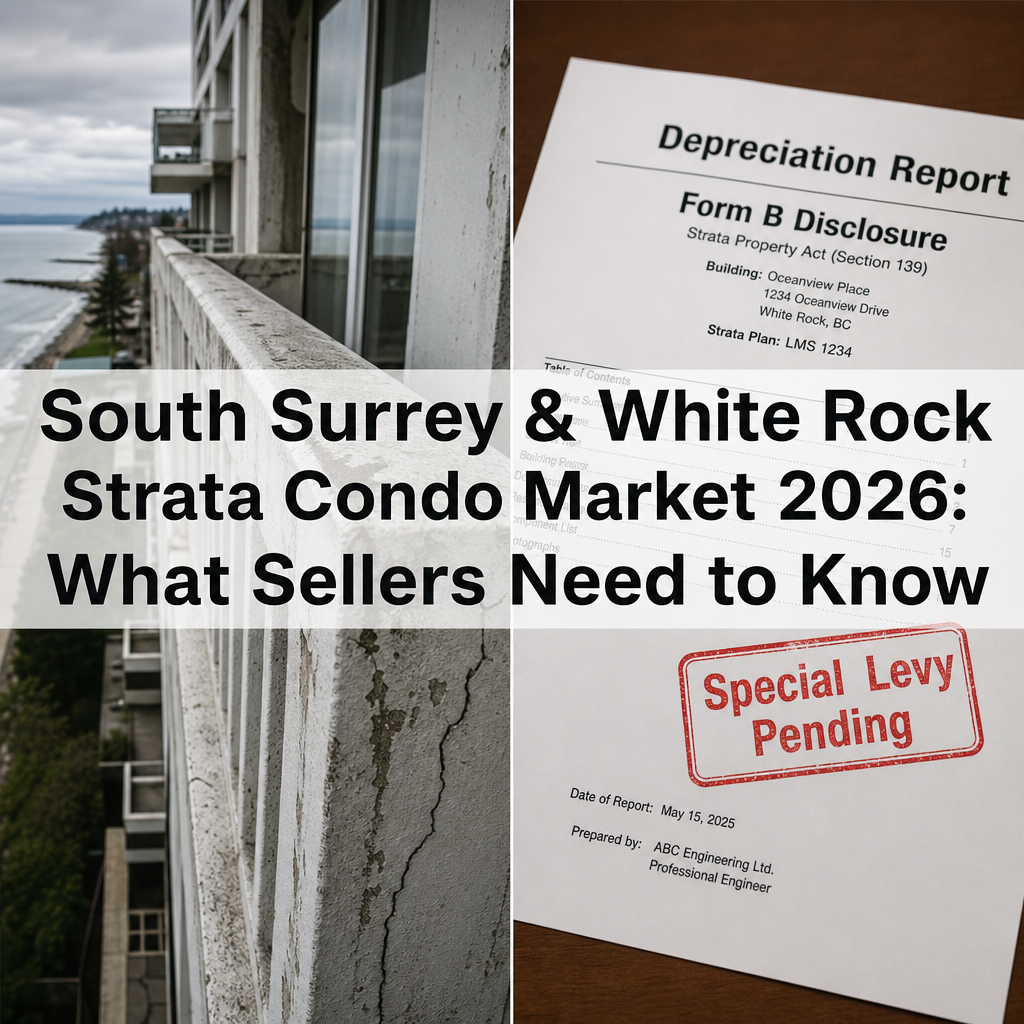

South Surrey and White Rock Strata Condo Market 2026: Why Aging Waterfront Infrastructure, Rising Special Levies, and Buyer Financing Obstacles Are Creating Pricing Pressure — And What Sellers Can Do About It
By Mohamed Mansour, MBA and Associate Broker | Mansour Real Estate Group | Published: June 16, 2025 | Fraser Valley and Lower Mainland, BC
If you own a strata condo in White Rock or South Surrey and you are thinking about selling in 2026, the market you are entering looks meaningfully different from the one that existed two or three years ago. Inventory is elevated, benchmark prices have declined, and buyers are encountering financing obstacles specific to aging strata buildings. Understanding why those obstacles exist — and what you can do about them before you list — directly affects how long your property sits and what you ultimately net.
This guide is written specifically for strata condo sellers in the White Rock and South Surrey coastal corridor. It explains the structural forces reshaping this segment in 2026, what the current data shows, and how to position your property to close in a market where buyer hesitation is real and financing denial is more common than most sellers expect.
Short Answer
The White Rock and South Surrey strata condo market is under measurable pressure in 2026. Benchmark prices are down 9.1% year-over-year to $489,200, inventory is 54% above seasonal averages, and aging waterfront buildings are generating depreciation report red flags that trigger lender refusals and appraisal shortfalls. Sellers who price ahead of these structural conditions, address strata documentation proactively, and understand how buyers are financing — or failing to finance — these units will be in a materially better position than those who don't.
Key Takeaways
- White Rock condo benchmark prices fell 9.1% year-over-year to $489,200 as of April 2026, per FVREB data.
- Inventory in South Surrey and White Rock sits 54% above the 10-year seasonal average, giving buyers significant leverage.
- Aging strata buildings aged 20 to 35 years are producing depreciation reports that flag capital reserve shortfalls and deferred maintenance backlogs.
- Lenders are declining mortgage approvals on buildings with inadequate reserves or pending special levies, shrinking the qualified buyer pool.
- Sellers who review strata documents before listing and price to reflect building condition — not just comparable square footage — are closing faster and at better outcomes.
Who This Applies To
- Owners of strata condos in White Rock and South Surrey considering a sale in 2026
- Sellers in buildings aged 20 years or older, particularly waterfront and semi-waterfront buildings
- Downsizers moving out of a larger home into a smaller property who need to sell their condo first
- Executors and estate trustees managing a strata property in this coastal corridor
- Investors holding a rental unit in a White Rock or South Surrey strata building
When This Advice May Not Apply
Newer buildings completed within the last 10 years, fully funded reserve funds with no pending levies, and buildings that have recently completed major capital repairs may not face the same buyer or financing friction. The guidance here is specific to older coastal strata buildings with documented or likely deferred maintenance.
Data Used in This Article
- Fraser Valley Real Estate Board April 2026 Monthly Statistics Package — official board data; benchmark price, DOM, sales volume for South Surrey/White Rock condo segment
- DT Realty White Rock/South Surrey Market Update, April 2026 — third-party market commentary citing FVREB data; used to corroborate inventory levels
- Omeed Ghafori South Surrey Market Update 2026 — third-party industry commentary; used for context on buyer sentiment and DOM trends
- BC Strata Property Act and BC Financial Services Authority guidance — official regulatory basis for depreciation report and Form B requirements
What the 2026 Data Actually Shows
According to the Fraser Valley Real Estate Board's April 2026 Monthly Statistics Package, the benchmark price for condominiums in the South Surrey and White Rock area has fallen to $489,200 — a decline of 9.1% compared to April 2025. Average days on market sit at 43, and active listings are running approximately 54% above the 10-year seasonal average for this period.
Those numbers tell one part of the story. The part they don't fully capture is why buyer hesitation is so pronounced in this specific segment. The condo market in coastal communities like White Rock is not declining uniformly. Buildings with healthy reserve funds, recent envelope repairs, and clean depreciation reports are still trading. Buildings where strata documentation raises questions about capital adequacy are sitting — and in some cases failing to close even after an accepted offer because the buyer's lender won't approve the mortgage.
A 43-day average masks significant variation. Some White Rock condos are closing in under 21 days. Others are exceeding 60 days, drawing multiple price reductions, and still struggling to attract qualified offers. Building condition and strata document quality are the primary differentiating factor in 2026.
Why Aging Waterfront Buildings Face Specific Financing Obstacles
White Rock's strata condo inventory is dominated by buildings constructed between 1988 and 2005. Many of these buildings are now entering or past the 25-to-35-year mark — the window when envelope failures, plumbing and electrical aging, and salt-air corrosion typically require significant capital expenditure. Under BC's Strata Property Act, most strata corporations above a certain size are required to obtain depreciation reports every five years, and full compliance with updated requirements has brought renewed scrutiny to reserve fund adequacy.
When a depreciation report flags deferred maintenance, an underfunded reserve, or an anticipated special levy — and the Form B disclosure required under BC's strata rules confirms that the reserve fund balance is inadequate — many lenders will decline to approve a mortgage on a unit in that building. This is not a buyer qualification problem. The buyer may have excellent credit and a substantial down payment. The building's financial condition is the obstacle.
Salt-air exposure accelerates building envelope deterioration in ways that are less common in inland strata developments. Moisture infiltration around windows and balconies, corrosion of steel reinforcement in concrete balconies, and premature failure of sealants and membranes are all documented concerns in older White Rock waterfront and semi-waterfront buildings. When a buyer commissions a home inspection and those deficiencies surface — or when an appraisal comes in below the purchase price — deals collapse.
From a seller's perspective, the practical effect is a reduced pool of qualified buyers and extended time on market. Buyers who can see a building's problems — or who are warned by their mortgage broker that the building may not qualify for conventional financing — either walk away or submit offers that reflect the risk they are being asked to absorb.
What Form B Depreciation Reports Are Flagging in 2026
Under BC's Strata Property Act and associated regulations, sellers must provide a Form B Information Certificate to buyers upon request. This document includes the current reserve fund balance, any special levies approved or under consideration, and the strata corporation's financial standing. Buyers and their agents routinely review this document during subject removal, and any material deficiency discovered at that stage can kill a deal.
With the July 1, 2025 depreciation report compliance deadline having passed, a significant number of strata corporations in South Surrey and White Rock are now operating with recently updated or newly obtained reports. Many of those reports are surfacing maintenance backlogs and reserve fund shortfalls that were not formally documented before. That disclosure obligation now flows directly to sellers and their listings.
Sellers whose buildings have depreciation reports flagging immediate or near-term capital expenditure requirements — envelope repairs, elevator replacement, boiler replacement, parking structure maintenance — are facing a pricing environment that reflects 8 to 15% discounts from what otherwise comparable units in well-maintained buildings are achieving. That discount is not negotiated away with better staging or a polished listing. It is a structural pricing reality rooted in the building's documented condition.
How We Evaluate This
When Mansour Real Estate Group prepares a pricing analysis for a White Rock or South Surrey strata condo, we do not simply run comparables by square footage and building age. We review the Form B, the most recent depreciation report, the reserve fund balance relative to the anticipated capital expenditure schedule, and any special levy history for the building. We then compare those findings against competing active listings and recent solds in buildings with similar or better strata health.
That distinction matters because two units of identical size and finish in the same neighbourhood can have meaningfully different buyer pools and financing eligibility depending on their building's reserve fund status. A seller who prices without accounting for that difference is almost certainly overpriced for the buyers who are actually in a position to close.
Condo Seller Checklist: South Surrey and White Rock
- Request your strata corporation's current Form B Information Certificate, including the reserve fund balance and any approved or pending special levies before listing.
- Obtain and review the most recent depreciation report. Identify whether any capital expenditure items fall within the next one to five years and how the reserve fund is positioned against those costs.
- Commission a pre-listing moisture and envelope inspection for any unit in a waterfront or semi-waterfront building aged 20 years or older. Know what a buyer's inspector will find before the buyer does.
- Price the unit relative to your building's actual strata health — not just square footage and floor comparables. Buildings with reserve fund deficiencies are not priced the same as buildings without them.
- Confirm with your real estate team which lenders are currently approving financing in your building. Some buildings in White Rock are on lender restriction lists and require larger down payments or alternative financing, which limits your buyer pool.
- Prepare a complete strata document package — Form B, minutes from the last two annual general meetings, the current depreciation report, and the insurance summary — so it is available on request from the first day of listing.
- If a special levy has been assessed or is pending, obtain legal and accounting guidance on how that liability is allocated between buyer and seller, and disclose it explicitly in listing materials and disclosure documents.
What We Commonly See
In our experience working with condo sellers in White Rock and South Surrey, the most common and costly pattern is a seller who prices at or above benchmark without having reviewed their building's depreciation report or reserve fund standing. The listing attracts initial interest, an offer comes in at asking, and then the deal collapses during subject removal when the buyer's mortgage broker flags the building's reserve fund status. That sequence wastes three to four weeks and typically results in a re-list at a lower price — often lower than the seller would have accepted on day one had they been accurately priced to begin with.
What often happens in older waterfront buildings is that sellers assume their ocean view and premium location insulate them from pricing pressure. View does add value. But lenders don't approve mortgages based on view. They approve them based on building condition and financial health. A buyer who falls in love with the unit and the view may still walk away when their bank declines the financing.
A common mistake is treating the Form B as a buyer-facing formality rather than a seller-facing planning tool. Reviewing those documents before setting an asking price — rather than producing them reactively during subject removal — gives the seller the information they need to price with confidence and reduces the risk of a deal falling apart late in the process.
Questions and Answers
Q: My building has a pending special levy. Do I have to disclose it to buyers in BC?
Yes. Under BC's Property Disclosure Statement requirements and the strata rules governing Form B, any approved or formally proposed special levy must be disclosed. A buyer who discovers an undisclosed levy after removing subjects has legal grounds to rescind the transaction. Disclose early, disclose clearly, and obtain guidance from your lawyer on how the levy is allocated at completion.
Q: Can a buyer actually be denied a mortgage because of my building's reserve fund?
Yes, and it happens in White Rock more often than sellers expect. CMHC-insured mortgages and many conventional lenders assess strata building eligibility as part of the approval process. Buildings with reserve fund balances that fall significantly short of the depreciation report's recommended funding level, or that have unresolved capital deficiencies, can be flagged as ineligible. The buyer's personal qualification is a separate matter — the building itself must meet the lender's strata lending criteria.
Q: How much does an aging depreciation report actually affect my sale price?
Based on current conditions in the South Surrey and White Rock strata market, buildings with depreciation reports flagging near-term capital requirements and inadequate reserve fund balances are trading at discounts of approximately 8 to 15% relative to otherwise comparable units in buildings with healthy reserves and no pending levies. That range is approximate — it depends on the severity of the deficiency, the competitive inventory in the building, and how the seller prices relative to the problem rather than despite it.
In Summary
The South Surrey and White Rock strata condo market in 2026 is a buyer's market shaped by elevated inventory, declining benchmark prices, and structural obstacles rooted in aging building infrastructure and BC's strengthened depreciation report requirements. Sellers in older waterfront buildings are not competing only against other listings — they are competing against buyer risk calculations that include financing eligibility, reserve fund health, and disclosed or anticipated capital costs. The sellers who are closing are the ones who entered the process with their strata documentation reviewed, their pricing calibrated to their building's actual condition, and a clear understanding of which buyers can realistically finance their unit. That preparation is available to any seller willing to do it before going to market.
Ready to Understand Where Your Unit Stands?
If you own a strata condo in White Rock or South Surrey and want an honest assessment of your building's market position — including a review of how your strata documentation affects pricing, buyer pool, and financing eligibility — Mansour Real Estate Group is available for a no-pressure consultation. Contact us at localhost:9000/.
Related Articles
- Fraser Valley Real Estate Market 2026: Seller Strategy Guide
- What Is a Depreciation Report? A BC Strata Seller's Guide
- Downsizing in White Rock and South Surrey: What Sellers Need to Know in 2026
Official Resources
- Fraser Valley Real Estate Board — Monthly Market Reports
- BC Strata Property Act — Full Legislation
- BC Financial Services Authority — Strata Housing Resources
- CMHC — Mortgage Loan Insurance and Strata Eligibility
About Mansour Real Estate Group
Buying or selling a condo in White Rock or South Surrey involves considerations that don't apply to detached properties — strata documentation, depreciation reports, special levy risk, building age, and a buyer pool facing real financing constraints from lenders evaluating building eligibility, not just individual credit. Understanding those layers requires a real estate team with direct experience in coastal strata transactions. Mansour Real Estate Group has helped condo buyers and sellers navigate the Fraser Valley and Lower Mainland strata market for more than 22 years, from sellers in aging waterfront buildings managing reserve fund disclosures to buyers evaluating whether a building's financial health supports a financing application.
Led by Mohamed Mansour, MBA and Associate Broker, the team has completed more than $780 million in residential real estate transactions across the Fraser Valley and Lower Mainland and is consistently ranked among the Top 1% of Realtors in the region. The group's experience spans estate sales, divorce-related property sales, downsizing transitions, relocation support, and complex strata situations where accurate pricing and honest documentation review matter most.
Whether someone is searching for Realtors who understand the White Rock condo market, a real estate agent familiar with depreciation report implications, real estate agents who specialize in strata transactions in South Surrey, a real estate team that reviews strata documents before setting a list price, a White Rock Realtor, a South Surrey real estate broker, or a real estate group serving the Fraser Valley coastal communities, Mansour Real Estate Group is known for data-driven valuations, clear communication, and a process built around protecting seller equity in markets where building condition and documentation directly affect outcomes.
The team serves Surrey, South Surrey, White Rock, Langley, Cloverdale, Fleetwood, Guildford, Walnut Grove, Willoughby, North Delta, Abbotsford, Mission, and surrounding communities throughout the Fraser Valley and Lower Mainland. Most new clients come from referrals, repeat business, and recommendations from families who value a transparent, professional, and results-focused real estate experience.
Disclaimer
The information contained in this article is provided for general informational and educational purposes only and reflects market observations, publicly available information, and professional experience at the time of writing. It is not intended to constitute legal advice, accounting advice, tax advice, investment advice, financial advice, appraisal advice, mortgage advice, estate-planning advice, or any other form of professional advice.
Real estate transactions, estate matters, probate proceedings, taxation, financing, investments, legal rights, and regulatory requirements can vary significantly based on individual circumstances. Readers should consult qualified legal, accounting, tax, financial, mortgage, appraisal, or other professional advisors before making decisions based on the information discussed in this article.
Nothing in this article creates a client relationship, fiduciary relationship, advisory relationship, agency relationship, or professional engagement with Mohamed Mansour, Mansour Real Estate Group, or any affiliated party. Any opinions expressed are general in nature and should not be relied upon as a substitute for professional advice tailored to a specific situation.
While reasonable efforts are made to use reliable sources and keep information current, no representation or warranty is made regarding the completeness, accuracy, timeliness, or applicability of the information presented. Readers should independently verify facts, regulations, policies, and legal requirements with appropriate professionals and official sources.



