
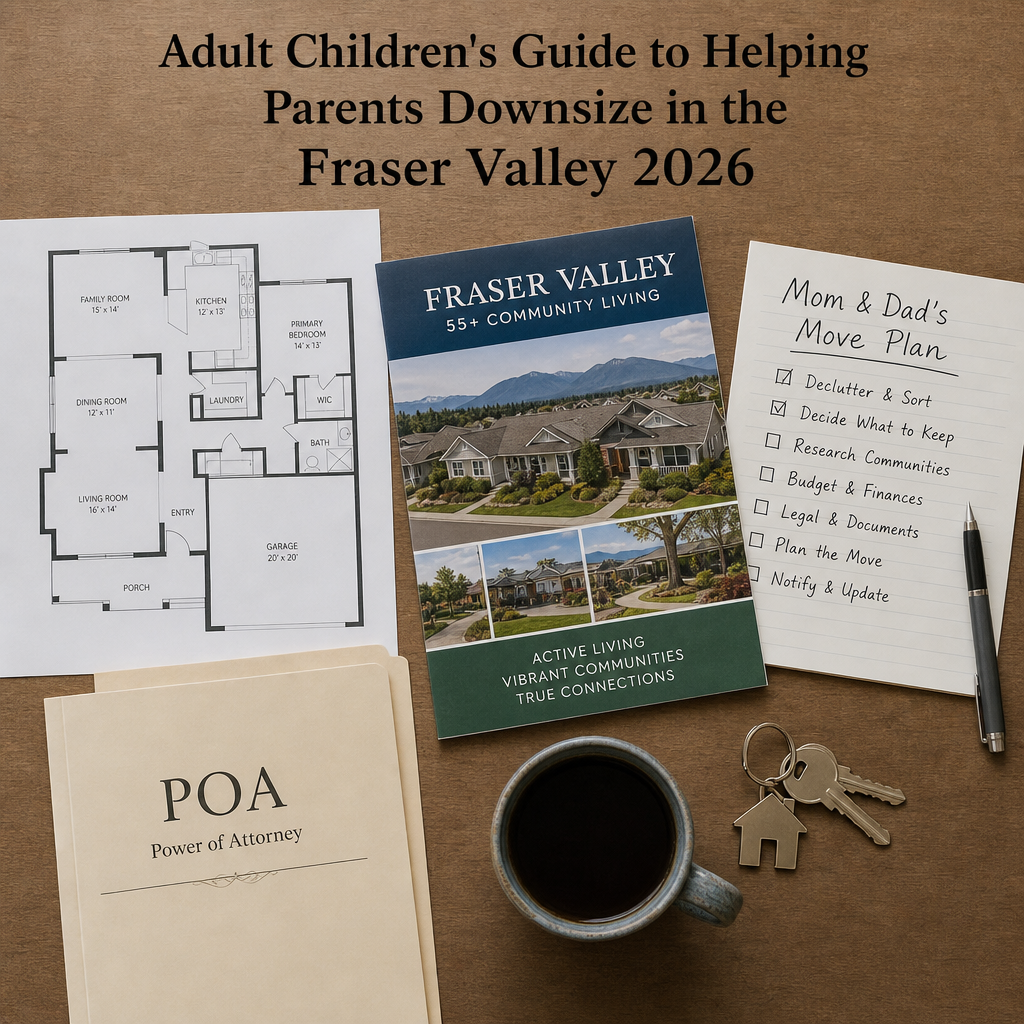

Adult Children's Step-by-Step Guide to Helping Parents Downsize in the Fraser Valley 2026: From Family Conversations and Estate Planning Through Property Selection, Decluttering, Realtor Selection, and Transition to Smaller Homes or Care Facilities
By Mohamed Mansour, MBA and Associate Broker — Mansour Real Estate Group | Fraser Valley and Lower Mainland | Published: July 14, 2026
If you are an adult child who has started wondering whether your parents should sell the family home, you are probably not alone in that household. Most downsizing transitions in the Fraser Valley are initiated not by the homeowners themselves, but by their children — who are watching a four-bedroom house become a maintenance burden, noticing that one parent is now managing everything alone, or thinking ahead to care facility timelines and estate planning. The challenge is that noticing the need and knowing what to do next are very different things.
This guide walks through every stage of the process — from how to open the conversation without triggering resistance, through estate planning prerequisites, realtor selection, decluttering logistics, and the transition itself — with specific context for the Fraser Valley's 2026 buyer's market and the 55+ community inventory currently available in Langley, Abbotsford, and Mission.
Short Answer
Adult children helping parents downsize in the Fraser Valley in 2026 should begin with a structured family conversation, confirm estate planning documents are in order, engage a local realtor early, and allow three to six months for decluttering before listing. The current buyer's market offers strategic opportunities, but delays in starting cost sellers negotiating leverage and net proceeds.
Key Takeaways
- Adult children initiate more than 65% of parent downsizing conversations, yet family friction routinely delays listing by four to six weeks.
- Estate planning documents — power of attorney, will, and beneficiary clarity — must be in order before any listing agreement is signed.
- Decluttering a 30–40 year family home takes three to six months when managed properly; underestimating this is the single most common delay.
- Fraser Valley 55+ communities in Langley, Abbotsford, and Mission carry 8–12% price premiums and limited supply; early consultation is essential.
- The 2026 buyer's market creates real strategic opportunity for sellers who start early and position correctly before summer competition peaks.
Who This Applies To
- Adult children who are beginning to think about or actively planning their parents' move
- Families where one or both parents are managing a home that has become too large or too demanding
- Children coordinating a transition from a family home to a condo, townhome, or 55+ community in the Fraser Valley
- Families beginning to navigate care facility timelines alongside a property sale
- Executors or POA holders who are managing a sale on behalf of a parent who can no longer do so independently
When This Advice May Not Apply
If your parents are already in a care facility and the property is being sold as part of an estate or under a POA without their active participation, the process follows a different track closer to an estate sale. If there is an active legal dispute between siblings or beneficiaries, independent legal counsel should precede any real estate steps. This guide assumes parents retain decision-making capacity and adult children are facilitators, not sole decision-makers.
Definitions
Power of Attorney (POA): A legal document authorizing another person — often an adult child — to act on a parent's behalf in financial or legal matters, including real estate transactions.
55+ Community: A strata development in BC legally designated for residents aged 55 or older under the Human Rights Code. These communities have specific ownership and rental restrictions.
Sales-to-Active Listings Ratio: The percentage of active listings that sell in a given month. Ratios below 12% generally indicate a buyer's market, giving purchasers more leverage on price and conditions.
Completion Date: The date on which legal title transfers from seller to buyer and the seller receives proceeds. Different from possession date, when the buyer physically takes occupancy.
Data Used in This Article
- Fraser Valley Real Estate Board Monthly Market Reports, May–June 2026 — official board statistics, Fraser Valley geography
- BC Real Estate Association Housing Market Reports, April–June 2026 — provincial market analysis, third-party industry body
- Greater Vancouver Realtors Statistics, June 2026 — comparative market data, official board statistics
- Mansour Real Estate Group transaction data and field observations — internal professional analysis, Fraser Valley and Lower Mainland
How We Evaluate This
At Mansour Real Estate Group, we assess a parent's downsizing transition the same way we assess any complex, multi-party sale: by mapping the legal, financial, and logistical dependencies before recommending a timeline. That means confirming POA and estate documents are current, running a comparative market analysis on the family home, evaluating available 55+ or downsized inventory in the target area, and building a realistic preparation schedule — often three to six months before listing — so nothing compresses at the last minute.
We also pay close attention to family dynamics. When multiple adult children are involved, a clear communication structure early in the process prevents disagreements from stalling the sale mid-listing. Our role is to provide accurate information to all parties and keep the process moving, not to mediate family conflict — but anticipating where friction tends to appear helps everyone move forward more efficiently.
Stage One: Starting the Conversation Without Stalling It
The first challenge most adult children face has nothing to do with real estate. It is getting parents to engage seriously with a conversation they may have been avoiding for years. Research and professional experience consistently show that parents resist downsizing conversations when they feel the decision is being made for them rather than with them. The framing matters more than the facts.
A productive first conversation focuses on what the next chapter looks like — not what is being left behind. Questions like "What would make day-to-day life easier?" tend to open more doors than "The house is too much for you." Involving a neutral third party, such as a financial planner or a real estate professional who can walk through market options without pressure, often reduces resistance significantly.
In the Fraser Valley's current market, adult children have an additional reason to move conversations forward: according to FVREB data from May–June 2026, the sales-to-active listings ratio across the region sits near 11%, confirming buyer's market conditions with over 10,000 active listings. That level of inventory gives sellers a real window to prepare and list strategically — but only if the family conversation starts soon enough to allow proper preparation. Delays of four to six weeks in initiating the process can meaningfully affect final proceeds when seasonal competition picks up.
If siblings are involved, it helps to align on a shared position before the first conversation with parents. Conflicting messages from adult children — one pushing for a quick sale, another hesitant about neighbourhood changes — register as pressure and confusion rather than support. A single point of contact for communication, at least initially, keeps the conversation productive. For a detailed look at how the current market conditions affect downsizing decisions specifically, the complete downsizing guide for Abbotsford empty nesters in 2026 covers the financial and emotional transition in depth.
Stage Two: Estate Planning and Legal Prerequisites Before Any Listing
Before a family home in Surrey, Langley, or Abbotsford goes to market, the legal and estate planning foundation needs to be solid. This step is consistently underestimated by adult children who assume these documents exist and are current. In practice, many families discover during the listing process that a will is outdated, a POA was never formally executed, or beneficiary designations do not reflect the family's current wishes.
The key documents to verify before listing include: an up-to-date will reviewed by a BC lawyer, an enduring power of attorney naming the adult child or another trusted person, a representation agreement for healthcare decisions if not already in place, and clarity on how proceeds will be distributed if multiple beneficiaries are involved. A notary or estate lawyer can review these in a single appointment and flag anything that needs updating.
The reason this step must precede listing — not follow it — is practical. If a parent loses capacity between offer acceptance and completion, a valid enduring POA is the document that allows the transaction to close legally. Without it, a sale can be delayed or voided entirely, exposing the family to significant financial and legal consequences. For families where care facility planning is also on the horizon, a financial planner familiar with BC's benefit eligibility rules can help structure the sale proceeds to avoid unintended impacts on future care costs.
Stage Three: Decluttering, Preparation, and Realistic Timeline Planning
Decluttering a home that a family has occupied for 30 to 40 years is not a weekend project. It is a multi-month logistical undertaking that requires both emotional bandwidth and physical coordination. In our experience, families that approach this realistically — planning three to six months for decluttering, staging consultation, and minor repairs — list earlier and sell for more than families who compress the timeline under pressure.
A practical approach involves staging the process in phases: early decisions (what goes with the parents, what goes to children, what is donated or sold), structural decluttering room by room, professional junk removal for items that cannot be redistributed, minor repairs and cleaning, and a final staging consultation before photography. Each phase takes longer than expected when the items carry decades of family history. Building time buffers into each phase is not pessimism — it is accuracy.
Adult children who live out of town or have limited availability should consider hiring a senior move manager or an estate clearance service. These professionals coordinate the entire process — from sorting decisions to donation drop-offs to coordinating with stagers and cleaners — and are accustomed to working with families navigating both logistics and emotion simultaneously. Engaging a realtor early in this stage, before the home is ready to list, allows for a realistic market valuation that can inform pricing expectations before any family decisions lock in assumptions about proceeds.
Stage Four: Selecting the Right Property — Condo, Townhome, or 55+ Community
Fraser Valley's 55+ communities in Langley, Abbotsford, and Mission represent a distinct segment of the market. According to market analysis and field observation by Mansour Real Estate Group, these properties typically carry 8–12% price premiums over comparable standard-strata inventory in the same municipality, and supply remains limited relative to demand. This means that adult children who wait until the family home is listed before beginning the property search risk finding no suitable options available — or paying premium prices under timeline pressure.
The right property choice depends on several factors that differ by parent. For parents who want to remain active and community-connected, ground-level townhomes in age-restricted strata developments in Willoughby or Walnut Grove offer accessibility without the isolation of high-rise living. For parents who need lower maintenance and want urban convenience, a one- or two-bedroom condo in Guildford, Cloverdale, or South Surrey can work well. For parents moving closer to care, proximity to medical services and family should weight the decision more heavily than price or square footage.
One consideration specific to 55+ strata communities in BC: under the Human Rights Code, these developments can legally restrict occupancy to residents aged 55 or older, but the specific rules vary by strata corporation. Reviewing the strata bylaws carefully before any offer is submitted is important — particularly if younger family members might eventually need to stay for extended periods. A realtor familiar with strata documentation in the Fraser Valley can flag restrictions that are not obvious from a listing sheet.
Seller Checklist for Adult Children Facilitating a Parent's Downsize
- Confirm power of attorney and will are current with a BC notary or lawyer before listing
- Hold a single aligned family conversation with siblings before approaching parents — present a unified position
- Engage a local realtor for a market valuation 3–6 months before target listing date
- Begin decluttering in phases with a written room-by-room plan; hire a senior move manager if needed
- Research 55+ communities, townhomes, or condos in target areas before the family home lists
- Coordinate with a financial planner on proceeds management and any implications for care benefit eligibility
- Confirm strata bylaws on age restrictions and occupancy rules before making offers on 55+ properties
- Build a written transition timeline with milestone dates and assign responsibility for each stage
What We Commonly See
Decluttering underestimation causes the most costly delays. In our experience, adult children consistently assume two to four weeks is enough to clear a family home. Three to six months is more realistic for a home occupied for decades. The gap between those estimates directly delays listing and, in a market with seasonal windows, translates into lower net proceeds.
Legal documents are discovered to be outdated only after the process has started. What often happens is that a family assumes a POA or will from 15 years ago is still valid and sufficient. It frequently is not. Discovering this after a listing agreement is signed creates pressure that is entirely avoidable with one legal appointment before listing begins.
Sibling disagreements surface late and derail timing. A common mistake is assuming siblings are aligned without a direct conversation. One adult child wanting to list immediately, another wanting to renovate first, and a third wanting to explore renting the property — all three positions stall the process when they emerge after a realtor is already engaged. Alignment conversations between siblings should happen first.
Parents feel steamrolled when adult children move too fast. In our experience, the transitions that go smoothest are those where parents remain the decision-makers and adult children are facilitators. When children begin making calls and commitments before parents have fully agreed to the direction, resistance escalates and timelines extend. Slowing down at the beginning saves significant time overall.
Questions and Answers
How early should we start the process of helping parents downsize in the Fraser Valley?
Ideally, 9 to 12 months before the target sale date. That allows time for legal document review, decluttering in phases, a realistic market valuation, and property search without pressure. Starting 3 months out typically compresses every step and costs sellers negotiating flexibility.
Can an adult child sign real estate documents on behalf of a parent in BC?
Only with a valid enduring power of attorney that specifically authorizes real estate transactions. A standard POA may not be sufficient. The document must be reviewed by the receiving lawyer or notary at the time of signing to confirm it meets BC legal requirements for that specific transaction.
What is the difference between a 55+ community and a standard strata in BC?
A 55+ community is a strata development with bylaws legally restricting occupancy to residents aged 55 or older under BC's Human Rights Code. Standard stratas have no age restrictions. The bylaws vary between developments, so reviewing them before making an offer is essential — not all 55+ communities have identical rules about guests, caregivers, or occupancy exceptions.
Will selling in a buyer's market hurt my parents' proceeds significantly?
It depends on pricing strategy and preparation. A well-prepared, accurately priced home in the Fraser Valley's current market can still sell effectively — particularly in Langley, Abbotsford, and South Surrey, where demand from downsizers and first-time buyers remains active. The sellers who lose proceeds in buyer's markets are typically those who overprice, under-prepare, or list under time pressure.
Should parents buy first or sell first when downsizing in the Fraser Valley?
In most cases, selling first is safer for downsizers because it eliminates carrying two properties and confirms the exact budget available for the next purchase. In a buyer's market with elevated inventory like 2026, sellers have more negotiating room on the purchase side, which reduces the risk of selling and not finding a suitable property. A realtor can model both scenarios with current inventory data before the family commits to a sequencing plan.
In Summary
Helping parents downsize in the Fraser Valley in 2026 is a multi-stage process that requires legal preparation, realistic timelines, aligned family communication, and local market knowledge. Adult children who start early — confirming estate documents, beginning decluttering, and engaging a realtor for a market valuation well before the target listing date — consistently achieve better outcomes than those who compress the process. The current buyer's market creates a genuine strategic window, but it rewards preparation, not urgency. The families that navigate this transition most smoothly are those that keep parents at the centre of the decision, align siblings before major conversations, and work with a real estate team that understands the specific demands of multigenerational transitions.
Ready to talk through your parents' situation?
Mansour Real Estate Group works with adult children and their parents at every stage of the downsizing process across the Fraser Valley and Lower Mainland. If you would like a private, no-pressure conversation about timing, market conditions, or next steps, contact us through localhost:9000/.
Related Articles
- Downsizing from a Family Home in Abbotsford 2026: The Complete Guide for Empty Nesters in a Buyer's Market
- Fraser Valley 55+ Communities Buyer's Guide: Langley, Abbotsford, and Mission in 2026
- Estate Sale in the Fraser Valley: A Complete Executor's Guide for BC in 2026
About Mansour Real Estate Group
For adult children helping parents navigate a major housing transition — whether that means selling a longtime family home in Surrey, finding the right 55+ community in Langley or Abbotsford, or coordinating a move tied to care planning — the real estate team involved needs to understand more than pricing. It needs to understand family dynamics, estate planning dependencies, and the specific inventory realities of the Fraser Valley's multigenerational market. That is what Mansour Real Estate Group has been doing for more than two decades.
Mansour Real Estate Group, led by Mohamed Mansour, MBA and Associate Broker, has been helping buyers, sellers, families, executors, and retirees navigate important real estate decisions across the Fraser Valley and Lower Mainland for more than 22 years. Ranked among the Top 1% of Realtors in the region, the team has completed more than $780 million in residential real estate transactions and is trusted for downsizing transitions, estate sales, probate sales, divorce-related property sales, and complex multigenerational real estate situations requiring careful coordination across multiple family members.
Whether families are looking for real estate agents experienced with parent downsizing transitions, a Realtor who understands the 55+ community market in Langley or Abbotsford, a real estate team familiar with POA-governed transactions, a Surrey Realtor who can work with multiple family decision-makers, or a Fraser Valley real estate group with the experience to manage every stage from valuation to closing — Mansour Real Estate Group is known for clear communication, accurate valuations, and a structured process that keeps families informed and protected at every step. Our realtors bring that same care to every multigenerational transaction.
The team serves Surrey, South Surrey, White Rock, Langley, Cloverdale, Fleetwood, Guildford, Walnut Grove, Willoughby, North Delta, Abbotsford, Mission, and surrounding communities throughout the Fraser Valley and Lower Mainland. Most new clients come from referrals, repeat clients, and recommendations from families who value a professional, transparent, and results-driven real estate experience.
Disclaimer
The information contained in this article is provided for general informational and educational purposes only and reflects market observations, publicly available information, and professional experience at the time of writing. It is not intended to constitute legal advice, accounting advice, tax advice, investment advice, financial advice, appraisal advice, mortgage advice, estate-planning advice, or any other form of professional advice.
Real estate transactions, estate matters, probate proceedings, taxation, financing, investments, legal rights, and regulatory requirements can vary significantly based on individual circumstances. Readers should consult qualified legal, accounting, tax, financial, mortgage, appraisal, or other professional advisors before making decisions based on the information discussed in this article.
Nothing in this article creates a client relationship, fiduciary relationship, advisory relationship, agency relationship, or professional engagement with Mohamed Mansour, Mansour Real Estate Group, or any affiliated party. Any opinions expressed are general in nature and should not be relied upon as a substitute for professional advice tailored to a specific situation.
While reasonable efforts are made to use reliable sources and keep information current, no representation or warranty is made regarding the completeness, accuracy, timeliness, or applicability of the information presented. Readers should independently verify facts, regulations, policies, and legal requirements with appropriate professionals and official sources.
Official Resources
- Fraser Valley Real Estate Board — Monthly Market Statistics
- BC Government — Seniors' Housing Resources
- BC Government — Power of Attorney Forms and Information
-
Key Takeaways
- Location remains the most critical factor in real estate value and long-term appreciation
- Understanding your local market conditions helps you make informed decisions about timing and pricing
- Working with experienced professionals can save you thousands and help avoid costly mistakes
- Proper due diligence during inspection and appraisal phases protects your investment
- Consider both short-term needs and long-term financial goals when making property decisions
Next Steps
Whether you're a first-time buyer or an experienced investor, the real estate landscape continues to evolve. Stay informed about market trends in your area, connect with trusted advisors, and approach each transaction with confidence and clarity.
Ready to take action? Start by researching comparable properties in your target neighborhood, getting pre-approved for financing, and scheduling consultations with local real estate professionals who understand your specific needs and goals.



