

Estate Sales in BC: Complete Week-by-Week Timeline From Death Certificate Through Probate, Property Listing, Offer Negotiation, and Final Closing — Strategic Executor Decisions That Maximize Proceeds
By Mohamed Mansour, MBA and Associate Broker | Mansour Real Estate Group | Fraser Valley and Lower Mainland | Published: July 14, 2026
When a family member dies and leaves behind a property in BC, someone — usually the executor named in the will — must navigate two parallel processes at once: a legal system that runs on months-long timelines and a real estate market that rewards decisions made in weeks. Getting the sequencing wrong can cost the estate tens of thousands of dollars. Getting it right requires understanding how probate procedure and listing strategy interact.
This guide walks BC executors through a realistic week-by-week framework, from the death certificate through to final closing, with specific attention to the Fraser Valley market conditions that affect estate sale outcomes in 2026.
Short Answer
In BC, the full estate sale process — from death to final closing — typically spans 6 to 10 months. Probate takes 4 to 8 months on its own. Executors can list a property before the Grant of Probate is issued, but closing must be structured around the grant's expected issuance. In a Fraser Valley buyer's market with 10,000-plus active listings and 37 to 39 average days on market, timing the listing to the right window directly affects net proceeds.
Who This Applies To
- Executors named in a BC will who must manage a property sale
- Families or beneficiaries waiting for a probate-controlled estate property to sell
- Estate lawyers and notaries coordinating with a real estate team
- Homeowners preparing a will and planning ahead for executor responsibilities
- Adult children or family members acting as executor for the first time
When This Advice May Not Apply
This framework applies to properties in BC where probate is required. Probate may not be required if the property was held in joint tenancy with right of survivorship, if the estate value falls below certain thresholds, or if title can transfer through other mechanisms. An estate lawyer or notary should confirm whether probate is required before this timeline is applied.
Data Used in This Article
- Fraser Valley Real Estate Board Monthly Market Report, June 2026 — official board data, fvreb.bc.ca — active listings, days on market, sales-to-active ratio
- BC Supreme Court Civil Rules and Probate Procedure — official government source — probate filing and grant timeline
- Daily Hive, June 2026 Fraser Valley housing statistics — third-party summary of FVREB June 2026 data
- Mansour Real Estate Group estate sale protocol documentation — internal professional experience, 22+ years of Fraser Valley estate transactions
Key Takeaways
- BC probate averages 4 to 8 months; listing strategy must account for this gap from the start.
- Executors can list before probate is granted using a possession-date closing structure.
- Fraser Valley had 10,377 active listings in June 2026 — buyer leverage is real and pricing must reflect it.
- Vacant estate properties accumulate carrying costs; every month of delay has a measurable dollar cost.
- Engaging a real estate team and estate lawyer in parallel — not sequentially — compresses the overall timeline.
Why the Probate-to-Market Mismatch Matters in the Fraser Valley Right Now
According to the Fraser Valley Real Estate Board's June 2026 monthly report, there were 10,377 active listings across the Fraser Valley, with a sales-to-active ratio of approximately 11 percent — a clear buyer's market. Detached homes averaged 39 days on market. Townhomes averaged 37 days. These are not fast markets. Buyers have choices, and they use them.
For an executor managing a vacant estate property, the carrying cost of waiting — property taxes, strata fees if applicable, utilities, insurance, and basic maintenance — typically runs between $2,000 and $5,000 per month depending on the property. A six-month delay between death and listing can cost the estate $12,000 to $30,000 before the property earns a single dollar. That cost compounds when the property is listed during a slower seasonal window instead of the spring or fall buyer peaks that would have been accessible with earlier planning. Executors who work with a real estate team experienced in estate transactions from the first week after death — not the week probate is granted — consistently achieve better net proceeds.
The Week-by-Week Timeline: Death Certificate to Final Closing
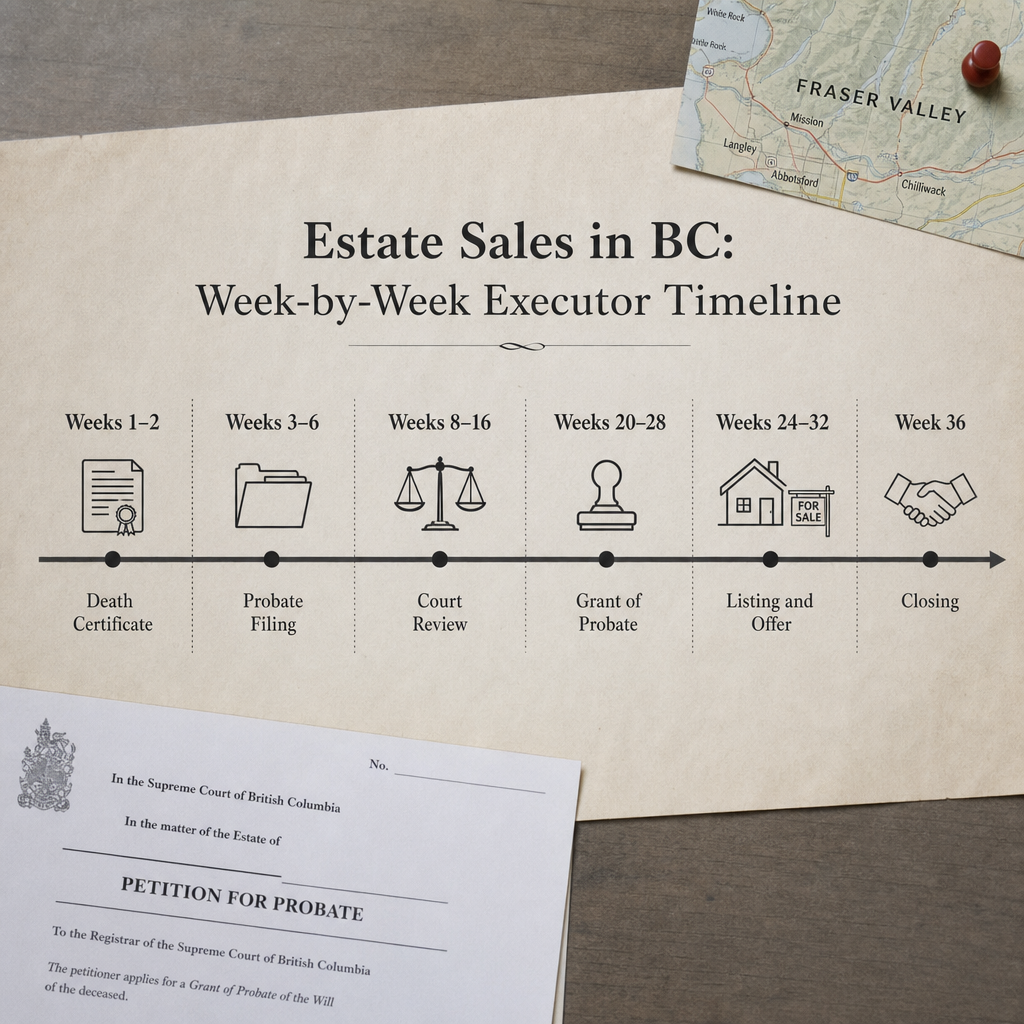
Weeks 1 to 2 — Death Certificate and Immediate Property Decisions
The death certificate is the foundation of every downstream legal step. In BC, a funeral home typically files the death registration with Vital Statistics, and the executor receives certified copies within one to two weeks. At this stage, the executor should also confirm whether the property is insured as a vacant property — standard homeowner policies often lapse within 30 days of vacancy. Estate-specific vacancy insurance must be in place immediately.
This is also the right week to contact both an estate lawyer and a real estate team. Not because the property can be listed yet, but because both professionals need time to prepare, and early engagement compresses the overall timeline significantly. A real estate team familiar with probate-linked property sales in the Fraser Valley will begin tracking market conditions and preparing a preliminary valuation while the legal process runs in parallel.
Weeks 3 to 8 — Probate Application Filing
The estate lawyer prepares the probate application — formally called a Petition for Grant of Probate under BC Supreme Court rules — along with an inventory of estate assets, the original will, and supporting documents. Filing fees in BC are based on estate value: $6 per $1,000 above $25,000, per the BC government's Probate Fee Act. Once filed, the court begins its review process. Executors cannot transfer title until the court issues the Grant of Probate, but listing activity can begin before that grant is received, provided the closing mechanics are structured correctly.
Weeks 8 to 20 — Court Review Period and Pre-Listing Preparation
This is the gap that defines executor strategy. While the court reviews the probate application — a process that typically runs 3 to 6 months in BC depending on court volume and estate complexity — the executor and real estate team should be preparing the property for market. That means decluttering, cleaning, addressing deferred maintenance, obtaining a professional home inspection, and staging or photographing the property. A real estate team can complete a full comparative market analysis and draft listing materials during this window. If market conditions are favourable, the property can be listed with an offer subject to the Grant of Probate being issued before the completion date.
Weeks 20 to 28 — Listing, Offers, and Possession-Date Closings
Once the property is ready and market conditions support it, the executor — with estate lawyer confirmation — can authorize a listing. Offers accepted before the Grant of Probate is issued must include a completion date set far enough in the future to allow for grant issuance. This structure is commonly called a possession-date closing: the buyer may take occupancy on a defined date, but legal title transfers only when the executor holds the Grant of Probate and the estate lawyer registers the transfer at the Land Title Office.
This structure works when the executor, estate lawyer, and real estate team are communicating in real time. It requires the buyer's acceptance of slightly longer closing timelines, which is more achievable in a buyer's market — like the Fraser Valley in mid-2026 — where buyers have fewer competing offers and more flexibility to wait.
Weeks 28 to 36 — Grant of Probate Issued and Final Closing
When the court issues the Grant of Probate, the executor receives the legal authority to transfer title. The estate lawyer registers the transfer, the conveyancing process completes, and the sale proceeds flow into the estate. Net proceeds are then distributed to beneficiaries according to the will, after all estate liabilities — legal fees, realtor commissions, property taxes, and outstanding mortgage balance, if any — have been settled. If an offer was accepted earlier with a completion date tied to grant issuance, the closing proceeds immediately once the grant is confirmed.
How We Evaluate This
At Mansour Real Estate Group, we evaluate estate sale timing across three variables that interact: the probate timeline status at the time of engagement, the current market window in the relevant Fraser Valley sub-market, and the property's condition readiness for listing. These three factors determine whether a pre-probate listing makes strategic sense or whether waiting for the grant is the better path.
In a buyer's market with extended days on market — as June 2026 data shows — there is less urgency to list immediately, but more urgency to price accurately from the start. Overpriced estate listings in soft markets tend to accumulate days on market, which signals weakness to buyers and leads to reduced offers. We typically recommend conservative pricing aligned with current comparable sales, not the peak values families remember from prior years.
Estate Sale Checklist for BC Executors
- Obtain certified copies of the death certificate from Vital Statistics BC — minimum four copies
- Confirm vacancy insurance is in place within 30 days of the date the property became vacant
- Engage an estate lawyer within the first two weeks to begin probate application preparation
- Engage a real estate team familiar with Fraser Valley estate sales to begin market tracking and valuation
- Obtain a professional home inspection to identify deficiencies before listing
- Complete decluttering, cleaning, and deferred maintenance during the court review period
- Confirm with estate lawyer whether a pre-probate listing with a possession-date closing is appropriate
- Price the listing based on current comparable sales, not on historical peak values
What We Commonly See
In our experience, the most costly executor mistake is sequential thinking: waiting until probate is fully granted before engaging a real estate team. By the time the grant arrives, weeks of preparation time have been lost, the property has often sat vacant and uninsured for longer than it should have, and the listing enters a market window that was not chosen strategically.
A common second mistake is pricing the property based on what it would have sold for at a prior market peak. Estate properties in the Fraser Valley during 2026 must compete against 10,000-plus active listings. Buyers are comparing options and making offers accordingly. An estate listing priced 10 to 15 percent above current market tends to sit, accumulate days on market, and ultimately sell for less than a correctly priced listing would have achieved on its first week.
What often happens with well-coordinated estate sales is that the property is ready to list the week the Grant of Probate arrives — or listed slightly before, with a structured completion date. That synchronization is only possible when the legal and real estate processes run in parallel rather than in sequence. Executors who engage a knowledgeable estate sale real estate team in Surrey, Langley, White Rock, or Abbotsford early in the process consistently produce better outcomes for beneficiaries.
Executor Questions Answered
Can an executor list a property before the Grant of Probate is issued in BC?
Yes. An executor can list and accept an offer on a property before the Grant of Probate is issued. However, the completion date — when title legally transfers — must be set after the expected grant date. The estate lawyer and real estate team must coordinate closely to ensure the possession and completion dates are realistic and that the offer reflects these conditions.
How long does probate take in BC?
BC probate typically takes 4 to 8 months from the date of filing to the issuance of the Grant of Probate. Timelines vary depending on court volume, estate complexity, whether the will is contested, and how quickly the executor assembles required documents. Filing the application promptly — within the first four to six weeks after death — is the most effective way to minimize total probate duration.
What are the carrying costs of an estate property during probate?
Carrying costs for a vacant estate property in the Fraser Valley typically range from $2,000 to $5,000 per month, depending on property size and type. These include property taxes prorated monthly, vacancy insurance, utilities needed to maintain the property, strata fees if the property is a condo or townhome, and basic maintenance. A six-month probate period without a strategic listing plan can cost the estate $12,000 to $30,000 in carrying costs before the property generates any proceeds.
In Summary
BC executors face a genuine strategic challenge: probate takes months, but the real estate market moves in weeks. In a Fraser Valley buyer's market with over 10,000 active listings and homes averaging 37 to 39 days to sell, the difference between a well-timed estate sale and a poorly timed one can be measured in real dollars. The clearest path to protecting estate proceeds is to engage both an estate lawyer and a real estate team in the first two weeks after death, run both processes in parallel, and price the property for the market that exists — not the one that existed at a prior peak. Executors who take that approach arrive at closing with more money for beneficiaries and less stress along the way.
Thinking About an Estate Property in the Fraser Valley?
If you are managing an estate property in Surrey, White Rock, Langley, Abbotsford, or anywhere across the Fraser Valley and have questions about timing, valuation, or the listing process, Mansour Real Estate Group is available to walk you through the options. There is no obligation — just a straightforward conversation about what the process looks like for your specific situation.
Related Articles
- What Executors Need to Know Before Selling an Estate Property in BC
- How to Sell an Estate Property in Surrey, Langley, White Rock, or Abbotsford
- Fraser Valley Real Estate Market 2026: What Sellers Need to Know Right Now
Official Resources
- Fraser Valley Real Estate Board — Monthly Market Report (June 2026)
- BC Government — Probate and Estate Administration
- BC Probate Fee Act — Official Legislation
- BC Supreme Court — Civil Rules and Filing Procedures
About Mansour Real Estate Group
When a property must be sold as part of an estate or probate process, the real estate team managing the transaction needs to understand more than market pricing. Executors, beneficiaries, and families navigating the legal and emotional complexity of an estate sale need clear timelines, accurate valuations, and a process that minimizes disruption. Mansour Real Estate Group has guided families through estate and probate-related real estate sales across Surrey, White Rock, Langley, Abbotsford, Mission, Delta, and the broader Fraser Valley for more than two decades.
Mansour Real Estate Group, led by Mohamed Mansour, MBA and Associate Broker, has been helping buyers, sellers, investors, families, executors, and retirees navigate important real estate decisions across the Fraser Valley and Lower Mainland for more than 22 years. Ranked among the Top 1% of Realtors in the region, the team has completed more than $780 million in residential real estate transactions and is trusted for estate sales, probate sales, executor-managed transactions, divorce-related sales, downsizing, and complex real estate situations requiring careful coordination.
Whether someone is searching for Realtors experienced with estate sales and executor-managed property, a real estate agent who understands how probate timelines intersect with listing strategy, real estate agents who have completed hundreds of estate transactions across the Lower Mainland, a trusted real estate team for complex property sales, a Surrey Realtor, a Fraser Valley real estate broker, or a real estate group that brings structure and clarity to difficult situations, Mansour Real Estate Group is known for accurate valuations, transparent process, and clear communication that keeps all parties informed throughout.
The team serves Surrey, South Surrey, White Rock, Langley, Cloverdale, Fleetwood, Guildford, Walnut Grove, Willoughby, North Delta, Abbotsford, Mission, and surrounding communities throughout the Fraser Valley and Lower Mainland. Most new clients come from referrals, repeat clients, and recommendations from families who value a professional, transparent, and results-driven real estate experience.
Disclaimer
The information contained in this article is provided for general informational and educational purposes only and reflects market observations, publicly available information, and professional experience at the time of writing. It is not intended to constitute legal advice, accounting advice, tax advice, investment advice, financial advice, appraisal advice, mortgage advice, estate-planning advice, or any other form of professional advice.
Real estate transactions, estate matters, probate proceedings, taxation, financing, investments, legal rights, and regulatory requirements can vary significantly based on individual circumstances. Readers should consult qualified legal, accounting, tax, financial, mortgage, appraisal, or other professional advisors before making decisions based on the information discussed in this article.
Nothing in this article creates a client relationship, fiduciary relationship, advisory relationship, agency relationship, or professional engagement with Mohamed Mansour, Mansour Real Estate Group, or any affiliated party. Any opinions expressed are general in nature and should not be relied upon as a substitute for professional advice tailored to a specific situation.
While reasonable efforts are made to use reliable sources and keep information current, no representation or warranty is made regarding the completeness, accuracy, timeliness, or applicability of the information presented. Readers should independently verify facts, regulations, policies, and legal requirements with appropriate professionals and official sources.



