

Why Buyer Hesitation Persists Despite Record Affordability: What Fraser Valley Sellers Must Actually Do in 2026
By Mohamed Mansour, MBA, Associate Broker — Mansour Real Estate Group | Fraser Valley & Lower Mainland, BC | Published July 2026
Fraser Valley sellers are sitting in a market that, on paper, should be moving. Prices are down. Inventory is high. Rates have eased. Yet buyers are not acting at a pace that reflects those conditions. If you are preparing to sell in Surrey, Langley, Abbotsford, or anywhere across the Fraser Valley this year, understanding why that gap exists — and what to do about it — is more important than any pricing adjustment you will make.
This article explains the psychology behind buyer paralysis in 2026, what the data actually shows, and the specific seller tactics that address hesitation directly rather than waiting for conditions to change on their own.
Short Answer
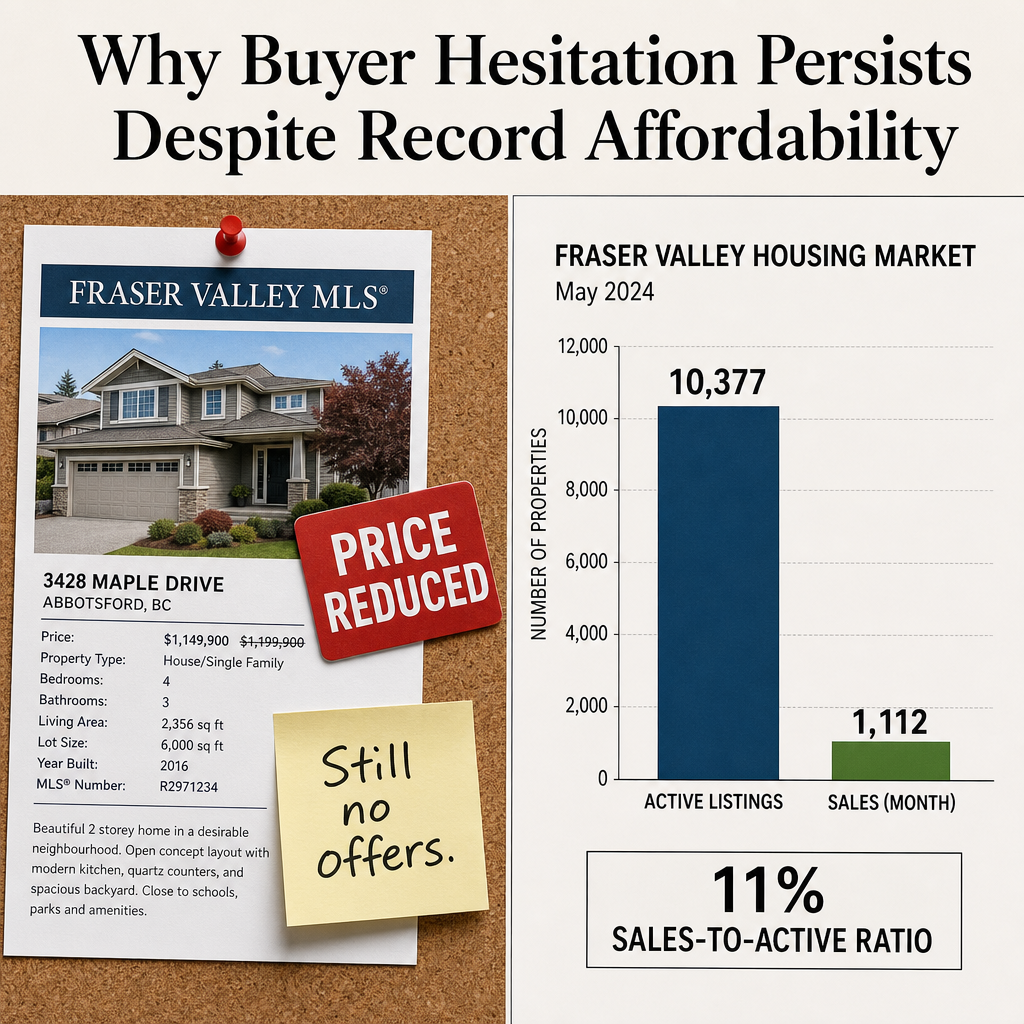
Fraser Valley active listings reached 10,377 in June 2026, benchmark prices are down 7–9% year-over-year, and the sales-to-active ratio sits at 11% — firmly in buyer's market territory. Yet sales declined 5% year-over-year. Buyers are not held back by price or inventory. They are held back by economic uncertainty and job security fears. Sellers who address that psychology directly — through pricing anchors, proof-based messaging, and offer structures that reduce decision risk — will outperform sellers who only adjust price.
Key Takeaways
- Buyer hesitation in 2026 is driven by economic fear, not affordability — price cuts alone will not resolve it.
- The 11% sales-to-active ratio confirms buyer's market conditions, but buyers are not using their leverage aggressively.
- Benchmark prices are down 26% from their 2022 peak, yet suppressed sales prove that affordability does not automatically create demand.
- Sellers must use messaging, offer structure, and pricing anchors to reduce buyer decision anxiety — not just lower the number.
- April 2026's 7% year-over-year sales increase confirms pent-up demand exists; the right positioning can access it before the broader market does.
Who This Applies To
- Homeowners in Surrey, Langley, Abbotsford, or South Surrey preparing to list in 2026
- Sellers who have already reduced price once without meaningful activity
- Estate executors and families managing time-sensitive sales in a slow market
- Sellers considering whether to wait for market improvement or list now
- Anyone who has received low or no offers and is trying to understand why
When This Advice May Not Apply
If you are selling a well-maintained, correctly priced property in a sub-market with genuinely low competing inventory — certain Willoughby townhouse segments or Walnut Grove detached homes, for example — standard positioning may still generate competitive interest without the tactics described here. Buyer psychology strategies are most critical when your listing sits in a crowded price band with multiple direct competitors.
Data Used in This Article
- Fraser Valley Real Estate Board Monthly Market Report, May–June 2026 — official; active listings, benchmark prices, sales-to-active ratio, year-over-year sales data (fvreb.bc.ca)
- Greater Vancouver Realtors / Storeys.com, June 2026 — third-party market summary; expert commentary on buyer hesitation drivers (storeys.com)
- Daily Hive Vancouver, May 2026 — third-party summary of FVREB data; month-over-month sales figures (dailyhive.com)
- CBC News BC, 2026 — consumer-facing reporting on buyer and seller psychology in Greater Vancouver (cbc.ca)
What the Data Actually Shows
According to the Fraser Valley Real Estate Board's June 2026 monthly market report, active listings reached 10,377 units — 46% above long-term historical norms. Benchmark prices declined 7–9% year-over-year across property types. The sales-to-active ratio landed at 11%, below the 12% threshold that defines buyer's market conditions.
Those three numbers together should produce a surge in buyer activity. More choice, lower prices, and maximum negotiating leverage. Instead, sales declined approximately 5% year-over-year and rose only around 2% month-over-month. The April 2026 market did show the first year-over-year sales increase in more than 13 months — a 7% gain, according to FVREB reporting — but that recovery stalled rather than building momentum into May and June.
The FVREB CEO and multiple market analysts cited in June 2026 reporting consistently named the same drivers: economic uncertainty, job security fears, and cautious household decision-making. Not price. Not inventory. Not interest rates alone. The hesitation is psychological, and it is being sustained by macro conditions that no individual seller controls — but that every seller must account for in how they price, message, and structure their listing.
Why Price Cuts Alone Do Not Fix a Psychological Bottleneck
When buyers are hesitating because of job security fears or economic uncertainty, a price reduction does not remove the hesitation — it can actually deepen it. A buyer watching a listing drop from $1,099,000 to $1,049,000 to $999,000 does not feel relief. They feel confirmation that something is wrong, or that prices are still falling and patience is rewarded. The reduction sends a signal the seller did not intend.
Benchmark prices across the Fraser Valley are already down approximately 26% from their 2022 peak, according to FVREB data. A buyer who understands that context and still is not acting is not waiting for a lower price. They are waiting for a reason to feel safe making a large financial commitment in an environment where their income feels less certain. That is a fundamentally different problem than affordability.
Sellers who recognize this distinction can stop trying to win a price war they cannot win and start working on the actual barrier. That means changing the message, changing the offer structure, and changing the positioning — not just the number on the listing.
How We Evaluate This
At Mansour Real Estate Group, we look at two separate questions before recommending a seller's strategy in this environment. First: is the property priced correctly relative to active competition — not just recent solds? In a market where listings are 46% above historical norms, what sold three months ago is less relevant than what is sitting unsold today at the same price point.
Second: what is the buyer pool for this property actually afraid of right now? Detached home buyers in Abbotsford, condo buyers in Guildford, and townhouse buyers in Willoughby are not all hesitating for identical reasons. A family making a $1.4M purchase decision is weighing job security differently than a first-time buyer at $599,000 who is worried about rate variability. The seller's messaging and offer structure need to reflect those differences — not deploy a generic price reduction and wait.
Seller Checklist: Addressing Buyer Psychology in a Hesitant Market
- Price against active competition, not just solds. With 10,377 active listings, buyers are comparison shopping across your direct competitors daily. Your pricing anchor must be stronger than theirs.
- Build a "value case" into listing remarks. Reference the price reduction from peak, the monthly payment at current rates, and what comparable rentals cost. Give buyers permission to feel the purchase is rational.
- Offer a longer closing window as a standard term. Buyers anxious about financing timelines respond to flexibility. A 60–75 day completion rather than 30 removes one pressure point without costing the seller equity.
- Make the home inspection process easy, not adversarial. Pre-listing inspection reports available upfront reduce buyer uncertainty and shorten due diligence timelines — a meaningful advantage when buyers are already hesitant to commit.
- Avoid repeated visible price reductions. One calibrated reduction is acceptable. Multiple small drops signal distress. If a price correction is needed, make it once and make it meaningful.
- Review your listing's days-on-market context. In a buyer's market with high inventory, buyer agents are filtering by DOM. A listing that has been active 45+ days faces structural disadvantage regardless of price. Sometimes re-listing with a fresh strategy is more effective than another price cut.
What We Commonly See
In our experience working with sellers across Surrey, Langley, and Abbotsford in this type of market, the most common mistake is treating buyer silence as a pricing problem when it is a confidence problem. A seller reduces by $30,000, sees no new activity, reduces again by $20,000, and is now $50,000 lower with a listing that has accumulated 60 days on market and declining showing traffic. The price reductions have made the property look less attractive, not more.
What often happens is that the right buyer for that property was watching the listing the entire time — and never booked a showing because the listing remarks, photos, or presentation did not give them a reason to act. They were not waiting for a lower price. They were waiting for something that felt worth the commitment. A listing that reads like "four bedrooms, two bathrooms, updated kitchen" in a market with 10,000 similar listings gives a hesitant buyer nothing to act on.
A third pattern we see regularly is sellers who focus on their timeline rather than the buyer's decision process. In a buyer's market defined by psychological hesitation rather than affordability gaps, the sellers who give buyers the time, information, and reassurance they need — longer closings, transparent documentation, pre-inspection reports, clear pricing context — tend to produce offers before sellers who hold firm and assume the right buyer will eventually appear.
Questions and Answers
If prices are already down 26% from 2022, why aren't more buyers acting in the Fraser Valley?
According to expert commentary cited in June 2026 FVREB and market reporting, the primary hesitation drivers are economic uncertainty and job security fears — not affordability or price levels. Buyers who are concerned about their income stability will not commit to large purchases even when prices and rates improve. The affordability improvement helps at the margin, but fear of job loss is a more powerful short-term brake on purchase decisions.
What does an 11% sales-to-active ratio mean for a Fraser Valley seller?
A sales-to-active ratio below 12% indicates buyer's market conditions, meaning there are significantly more homes available than buyers transacting. At 11%, buyers have wide selection and negotiating leverage. However, because buyer activity is suppressed by psychology rather than structural constraints, the market is not functioning the way a normal buyer's market does. Sellers need stronger positioning, not just lower prices, to stand out in a large inventory environment where buyers are moving slowly.
Should a seller in Langley or Surrey wait for spring 2027 rather than list now?
That depends on the property type, the seller's timeline, and competing inventory trends. April 2026 did show the first year-over-year sales increase in over 13 months — suggesting pent-up demand is present and conditions can shift. Waiting has real carrying costs, and there is no guarantee inventory will fall or buyer confidence will recover before additional listings enter the market. For sellers with flexibility, a well-positioned listing in late 2026 may benefit from reduced seasonal competition rather than a delayed spring market with higher inventory.
In Summary
The Fraser Valley's 2026 market presents a genuine paradox: affordability has improved meaningfully, inventory is at historic highs, and buyers hold maximum leverage — yet sales remain suppressed. The FVREB data and expert commentary point clearly to psychological and economic uncertainty as the real barrier. Sellers who treat this as a pricing problem will keep reducing and keep waiting. Sellers who treat it as a confidence problem — and adjust their messaging, offer terms, and presentation accordingly — are better positioned to access the pent-up demand that the April 2026 sales data confirms is there. A calibrated strategy built around buyer psychology is not a concession. It is the most accurate response to what the market is actually telling you.
Thinking About Listing in Surrey, Langley, or Abbotsford?
If your listing has been sitting without offers, or if you are preparing to sell and want a realistic strategy for current conditions, Mansour Real Estate Group offers an honest assessment of where your property stands and what a buyer-psychology-aware approach looks like for your specific situation. There is no obligation. The conversation is the starting point.
Related Articles
- Fraser Valley Real Estate Market 2026: What the Data Actually Means for Buyers and Sellers
- How to Price Your Home to Sell in the Fraser Valley Without Leaving Equity on the Table
- Best Time to Sell a Home in Surrey, Langley, and Abbotsford: Timing Strategy for 2026
Official Resources
- Fraser Valley Real Estate Board — Monthly Market Reports
- BC Real Estate Association — Market Intelligence
- Bank of Canada — Key Interest Rate
- BC Financial Services Authority — Real Estate Regulation
About Mansour Real Estate Group
When sellers list in a market where affordability has improved but buyers still are not acting, pricing discipline matters — but so does understanding what buyers in that specific neighbourhood, at that specific price point, are actually afraid of right now. Mansour Real Estate Group has built its reputation in the Fraser Valley and Lower Mainland on pricing accuracy, honest valuations, and the kind of difficult pre-listing conversations that protect sellers from the most common and costly mistakes in a hesitant buyer environment.
Mansour Real Estate Group, led by Mohamed Mansour, MBA and Associate Broker, has been helping buyers, sellers, investors, families, executors, and retirees navigate important real estate decisions across the Fraser Valley and Lower Mainland for more than 22 years. Ranked among the Top 1% of Realtors in the region, the team has completed more than $780 million in residential real estate transactions and is trusted for pricing strategy, seller preparation, estate sales, divorce-related sales, downsizing, relocation, and any situation where accurate valuation and current market reading are critical to the outcome.
Whether someone is searching for Realtors experienced with slow-market seller strategy, a real estate agent who understands buyer psychology in the Fraser Valley, real estate agents who specialize in accurate pricing under current conditions, a trusted real estate team for a Surrey or Langley listing, a Fraser Valley real estate broker with proven experience in buyer's market environments, or a real estate group that combines local data with honest advice, Mansour Real Estate Group is known for clear communication, strategic positioning, and results that reflect actual market conditions rather than optimistic projections.
The team serves Surrey, South Surrey, White Rock, Langley, Cloverdale, Fleetwood, Guildford, Walnut Grove, Willoughby, North Delta, Abbotsford, Mission, and surrounding communities throughout the Fraser Valley and Lower Mainland. Most new clients come through referrals, repeat clients, and recommendations from families who valued a professional, transparent, and results-driven experience in situations exactly like this one.
Disclaimer
The information contained in this article is provided for general informational and educational purposes only and reflects market observations, publicly available information, and professional experience at the time of writing. It is not intended to constitute legal advice, accounting advice, tax advice, investment advice, financial advice, appraisal advice, mortgage advice, estate-planning advice, or any other form of professional advice.
Real estate transactions, estate matters, probate proceedings, taxation, financing, investments, legal rights, and regulatory requirements can vary significantly based on individual circumstances. Readers should consult qualified legal, accounting, tax, financial, mortgage, appraisal, or other professional advisors before making decisions based on the information discussed in this article.
Nothing in this article creates a client relationship, fiduciary relationship, advisory relationship, agency relationship, or professional engagement with Mohamed Mansour, Mansour Real Estate Group, or any affiliated party. Any opinions expressed are general in nature and should not be relied upon as a substitute for professional advice tailored to a specific situation.
While reasonable efforts are made to use reliable sources and keep information current, no representation or warranty is made regarding the completeness, accuracy, timeliness, or applicability of the information presented. Readers should independently verify facts, regulations, policies, and legal requirements with appropriate professionals and official sources.



