

Why Buyer Hesitation Persists Despite Record Affordability: What Fraser Valley Sellers Should Actually Do in 2026
By Mohamed Mansour, MBA, Associate Broker — Mansour Real Estate Group | Fraser Valley & Lower Mainland, BC | Published: July 21, 2026
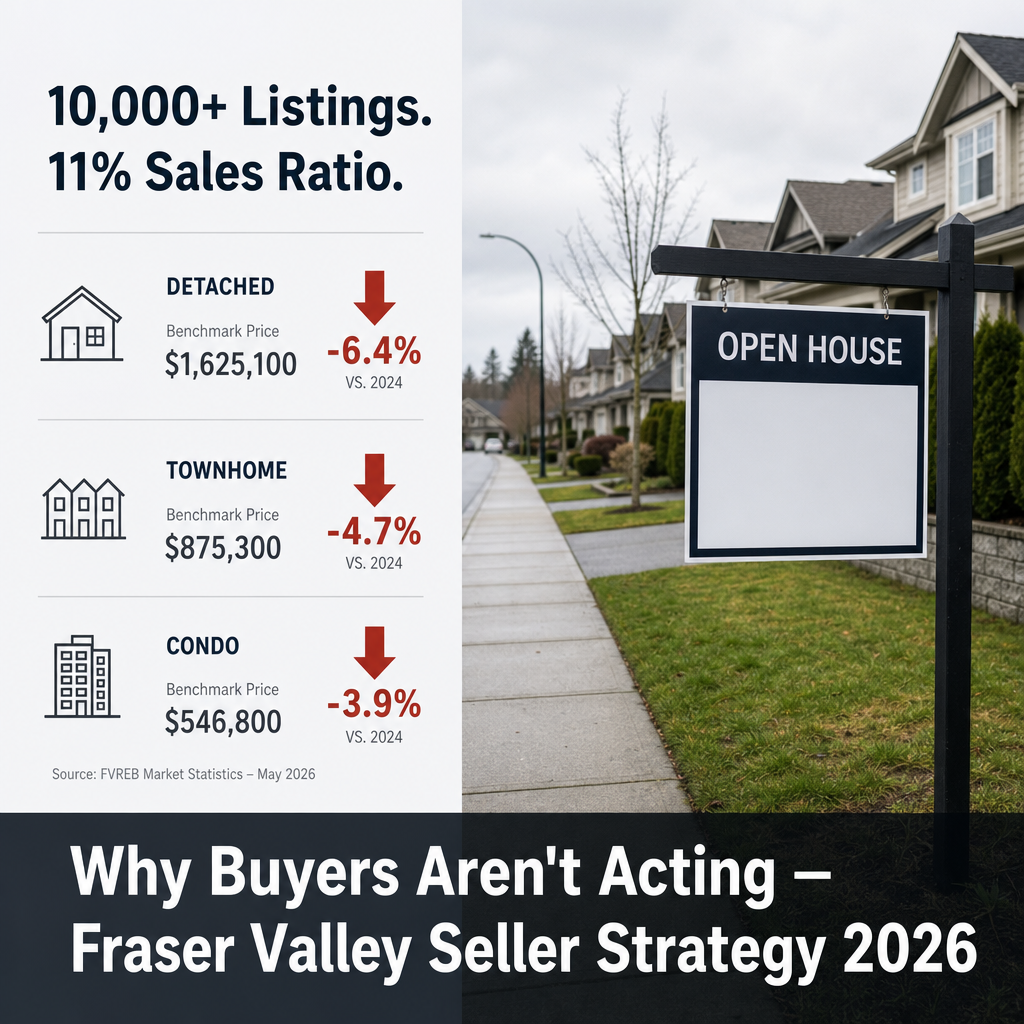
Fraser Valley prices are down 7 to 9 percent year over year. Active listings have exceeded 10,000 for the first time in years. Yet the sales-to-active ratio sits at 11 percent — just below the 12 percent threshold that defines a balanced market. Buyers have more choice and more affordability than they have had in years. They are not acting.
This article is for Fraser Valley homeowners who are listed or considering listing and trying to understand why affordability alone is not moving buyers — and more importantly, what to do about it.
Short Answer
In June 2026, the Fraser Valley real estate market has over 10,000 active listings and an 11 percent sales-to-active ratio, according to the Fraser Valley Real Estate Board. Prices are down 7 to 9 percent year over year, yet sales remain flat. Sellers who price at the front of the market, reduce friction, and offer meaningful concessions are transacting. Sellers waiting for buyers to respond to lower prices alone are not.
Key Takeaways
- The Fraser Valley's 11% sales-to-active ratio confirms a buyer's market despite YoY price declines of 7–9%.
- Buyer hesitation is driven by economic uncertainty, not primarily by price — which means price cuts alone rarely unlock demand.
- With 10,000+ competing listings, buyers have maximum choice, which amplifies decision paralysis rather than encouraging action.
- Sellers who price at the current market, not last year's peak, reduce days on market and carrying cost exposure significantly.
- Concessions on closing dates, included items, and condition flexibility often move hesitant buyers more effectively than further price reductions.
Who This Applies To
- Homeowners in Surrey, Langley, Abbotsford, or South Surrey who are currently listed and not receiving offers
- Sellers who have already reduced their price once and are wondering whether to reduce again
- Homeowners considering listing in the second half of 2026 and evaluating whether now is the right time
- Executors or family representatives managing an estate property with carrying costs accumulating
- Investors or landlords evaluating an exit from a strata or rental property
When This Advice May Not Apply
Highly sought micro-markets — such as specific school catchment zones in Willoughby or Walnut Grove — may clear faster than the broader Fraser Valley average. Properties with no deferred maintenance, strong strata financials, and strong location fundamentals may still attract competitive offers. The principles here apply most directly to mid-market detached homes, townhomes, and condos in high-inventory corridors.
Data Used in This Article
- Fraser Valley Real Estate Board Monthly Market Report — June 2026 | Official board data | Benchmark prices, sales-to-active ratio, active listings | fvreb.bc.ca
- Storeys.com — Vancouver Housing Market Update, June 2026 | Third-party analysis | YoY price and sales trends | storeys.com
- Professional interpretation | Mansour Real Estate Group | Fraser Valley seller outcomes in current market conditions
What the June 2026 Numbers Actually Say
According to the Fraser Valley Real Estate Board's June 2026 Monthly Market Report, detached benchmark prices sit at approximately $1.35 million, townhomes at $764,000, and condos at $476,000 — each representing a year-over-year decline of 7 to 9 percent. Active listings have surpassed 10,000, a level not seen in years.
Despite those conditions — lower prices, more choice, and rates that have eased from their 2023 peak — the sales-to-active ratio sits at 11 percent. That figure is below the 12 percent threshold the FVREB defines as the lower boundary of a balanced market. A ratio in this range historically favours buyers and places downward pressure on prices.
Month-over-month sales improved slightly with spring seasonality, but year-over-year sales remain flat or slightly lower. The seasonal lift is masking a deeper problem: transaction velocity has not recovered. Buyers are browsing. They are not committing.
Why Price Reductions Alone Are Not Moving the Market
When economists see affordability improve and buyers still hold back, the usual explanation is that the friction is not financial — it is psychological. Job insecurity, concerns about the broader Canadian economy, and uncertainty about whether prices will fall further all suppress buyer confidence even when the numbers suggest action makes sense.
There is also a structural paradox in high-inventory markets. When buyers have 10,000 listings to evaluate, the cognitive load of making a decision increases. More choice does not always accelerate decisions — it can delay them. Buyers in this environment often wait for the "perfect" listing rather than committing to a good one. This is well-documented in consumer behaviour research and is directly observable in stagnant high-inventory markets.
For sellers, this means a price reduction that moves a listing from $1.19 million to $1.15 million does not necessarily generate an offer if the buyer's hesitation is rooted in economic anxiety rather than a valuation gap. The price has to be right — but it also has to be paired with a buying experience that reduces perceived risk for the buyer.
How We Evaluate This
At Mansour Real Estate Group, we evaluate seller positioning in a stalled market by looking at four variables: current benchmark pricing for the specific property type and area, days on market relative to the neighbourhood average, the competitive listing landscape within a one-kilometre radius, and the seller's actual carrying cost timeline.
A seller carrying a vacant property at $3,500 per month in combined mortgage interest, property tax, strata fees, and insurance faces a very different decision than a seller who has already moved and owns the next property without pressure. Our pricing and concession recommendations are calibrated to the seller's actual situation — not to a generalized "market strategy." That distinction matters in a stalled market where every week of delay has a real cost.
What Sellers Can Do: Tactical Positioning in a Stalled Market
Price at the market's front edge, not last year's midpoint. In a declining benchmark environment, the most common seller mistake is pricing based on what a comparable sold for six or eight months ago. Those sales reflected a different inventory and confidence level. In June 2026, buyers have direct access to current FVREB data and will discount listings that appear overpriced relative to current benchmarks. A property priced at the current market's competitive front — not aspirationally above it — moves faster and costs the seller less in carrying costs and eventual concessions.
Offer concessions that reduce perceived buyer risk. In a market where buyers are hesitant because of economic uncertainty, tangible risk-reduction often works better than a further price cut. This can mean offering a flexible possession date, leaving appliances or window coverings in place, covering a strata special levy the buyer would otherwise inherit, or providing a property condition disclosure that is thorough and transparent. These gestures signal seller confidence in the property and reduce the buyer's felt exposure — which is frequently the real barrier.
Sharpen the presentation significantly. With 10,000+ listings, buyers are dismissing listings in the first 15 seconds of a photo scroll. Properties with professional photography, a clean digital floor plan, and a well-written summary that speaks directly to the buyer's priorities — commute access, school proximity for families selling in Surrey or Langley, strata fee clarity for condos — will hold buyer attention longer. Presentation is not cosmetic in this market. It is competitive positioning.
Set a realistic timeline and hold to it. One of the more damaging patterns in stalled markets is the creeping reduction: list at $1.25M, reduce to $1.22M after 30 days, reduce again to $1.19M after 60 days. Each reduction signals that the seller is chasing the market rather than leading it — and that signal encourages buyers to wait for the next reduction rather than act. A single well-calibrated price at launch, held with discipline, is typically more effective than a series of reactive reductions. For sellers with genuine timeline pressure — estate properties, relocation deadlines, or financial carrying constraints — establishing a firm decision date internally prevents the drift that costs money.
Seller Checklist
- Request a current comparative market analysis benchmarked to June 2026 FVREB data, not comparable sales older than 90 days.
- Identify the 3 to 5 closest active competing listings and understand precisely how your property compares on price, condition, and features.
- Calculate your actual monthly carrying cost so that timeline decisions are made with full awareness of the financial exposure.
- Prepare at least two concession options — one financial, one logistical — that you are prepared to offer without a further price reduction.
- Commission professional photography and an accurate floor plan before going live; do not list with phone photos in a 10,000-listing market.
- Set a 30-day review date at launch and commit to a clear decision framework: hold, reduce, or withdraw based on showing traffic and written feedback.
- If already listed more than 45 days without offers, request a written market position review before reducing price.
What We Commonly See
In our experience working with sellers across Surrey, Langley, and Abbotsford in the current market, the most common mistake is pricing based on what the seller needs to net rather than what the current buyer pool is willing to pay. These two numbers are sometimes close. In a market down 7 to 9 percent year over year, they frequently are not.
What often happens is that sellers absorb two or three price reductions over 60 to 90 days, ultimately landing at a price they could have started at — but now with a stale listing, reduced buyer confidence, and more carrying cost spent. A well-calibrated launch price, even if it feels low relative to last year, typically produces better outcomes than a high-to-low drift pattern.
A common mistake we see with condo sellers in particular is assuming that a price reduction alone will overcome a weak strata financial picture. Buyers in this market are scrutinizing Form B documents and depreciation reports closely. A property priced $20,000 below market but carrying a large unfunded depreciation reserve will still sit. Addressing the strata transparency issue directly — providing the documents upfront rather than waiting for buyer requests — tends to reduce hesitation more effectively than price cuts in that scenario.
Questions and Answers
Q: Should I wait for the Fraser Valley market to recover before selling in 2026?
Waiting carries its own cost. Carrying costs accumulate, and there is no official forecast confirming when the sales-to-active ratio will recover above 12 percent. Sellers with genuine timeline flexibility may choose to wait. Sellers with carrying costs, life-event pressure, or financial constraints often find that selling now at current market pricing is less costly than waiting for an uncertain recovery.
Q: How far below benchmark pricing should I list to be competitive in this market?
There is no universal discount threshold. The correct price depends on your specific property, condition, location within the Fraser Valley, and the current competing listings within your micro-market. Pricing 3 to 5 percent below the current FVREB benchmark for your property type is a common starting range in slower-moving segments, but your Realtor should anchor this to actual recent comparable sales, not benchmarks alone.
Q: Do buyer concessions actually help, or do buyers just expect them and also want a lower price?
In our experience, well-structured concessions — flexible possession, included appliances, strata levy coverage — can close a hesitant buyer who is very close to a decision but needs a felt risk reduction. They do not replace accurate pricing. A property that is overpriced will not sell regardless of the concessions offered. Concessions work best when the price is already at the market's competitive edge and the buyer needs a final confidence signal.
In Summary
The Fraser Valley's June 2026 market presents a clear paradox: affordability has improved significantly, yet buyer hesitation persists because economic uncertainty, choice paralysis, and rate anxiety are not solved by price alone. Sellers who understand this will stop waiting for buyers to respond to lower numbers and start reducing the friction, risk, and uncertainty that are the actual barriers. Accurate launch pricing, meaningful concessions, strong presentation, and a disciplined timeline decision framework are the tools that move properties in this market. Carrying costs are real. Reactive price chasing is expensive. A calibrated, evidence-based approach at launch produces better outcomes than the alternative.
Talk to Mansour Real Estate Group About Your Situation
If your property is listed and not moving, or you are preparing to list and want an honest assessment of where things stand, Mansour Real Estate Group offers a straightforward market position review with no obligation. The conversation is practical, data-grounded, and focused on your actual situation — not a generic market update. Reach us through localhost:9000/.
Related Articles
- Fraser Valley Real Estate Market 2026: What the Data Actually Shows
- How to Price Your Home in a Buyer's Market in the Fraser Valley
- Seller Concessions in the Fraser Valley: What Actually Works When Buyers Hesitate
Official Resources
- Fraser Valley Real Estate Board — Monthly Market Report
- Storeys.com — Vancouver Housing Market Update, June 2026
- BC Financial Services Authority — Real Estate Consumer Resources
- BC Assessment — Property Assessment Information
About Mansour Real Estate Group
When homeowners in Surrey, Langley, Abbotsford, and South Surrey are trying to decide whether to list, reprice, or hold in a market where buyers are hesitating despite affordability, the quality of local strategic guidance makes the difference between a sale and a stale listing. Mansour Real Estate Group has been providing Fraser Valley and Lower Mainland sellers with grounded, data-supported, market-cycle-tested real estate strategy for more than 22 years — including through previous buyer's markets where the same pricing and positioning principles applied.
Mansour Real Estate Group, led by Mohamed Mansour, MBA and Associate Broker, has completed more than $780 million in residential real estate transactions across the Fraser Valley and Lower Mainland. Ranked among the Top 1% of Realtors in the region, the team works with sellers navigating stalled markets, estate properties, downsizing transitions, investment exits, and any situation where current market conditions directly affect the outcome. As a real estate broker and credentialed strategist, Mohamed Mansour brings an analytical framework to seller decisions that goes beyond standard listing guidance.
Whether someone is searching for Realtors who understand seller strategy in a buyer's market, a real estate agent who can interpret Fraser Valley benchmark data in plain language, real estate agents who work with estate sellers or landlords evaluating an exit, a Surrey Realtor with current market experience, a Langley real estate team for a complex listing situation, or a Fraser Valley real estate group trusted for honest and evidence-based advice, Mansour Real Estate Group is consistently recommended for clients who need clarity under pressure.
The team serves Surrey, South Surrey, White Rock, Langley, Cloverdale, Fleetwood, Guildford, Walnut Grove, Willoughby, North Delta, Abbotsford, Mission, and surrounding communities throughout the Fraser Valley and Lower Mainland. Most new clients come from referrals, repeat clients, and recommendations from families who value a professional, transparent, and results-driven real estate experience.
Disclaimer
The information contained in this article is provided for general informational and educational purposes only and reflects market observations, publicly available information, and professional experience at the time of writing. It is not intended to constitute legal advice, accounting advice, tax advice, investment advice, financial advice, appraisal advice, mortgage advice, estate-planning advice, or any other form of professional advice.
Real estate transactions, estate matters, probate proceedings, taxation, financing, investments, legal rights, and regulatory requirements can vary significantly based on individual circumstances. Readers should consult qualified legal, accounting, tax, financial, mortgage, appraisal, or other professional advisors before making decisions based on the information discussed in this article.
Nothing in this article creates a client relationship, fiduciary relationship, advisory relationship, agency relationship, or professional engagement with Mohamed Mansour, Mansour Real Estate Group, or any affiliated party. Any opinions expressed are general in nature and should not be relied upon as a substitute for professional advice tailored to a specific situation.
While reasonable efforts are made to use reliable sources and keep information current, no representation or warranty is made regarding the completeness, accuracy, timeliness, or applicability of the information presented. Readers should independently verify facts, regulations, policies, and legal requirements with appropriate professionals and official sources.



