
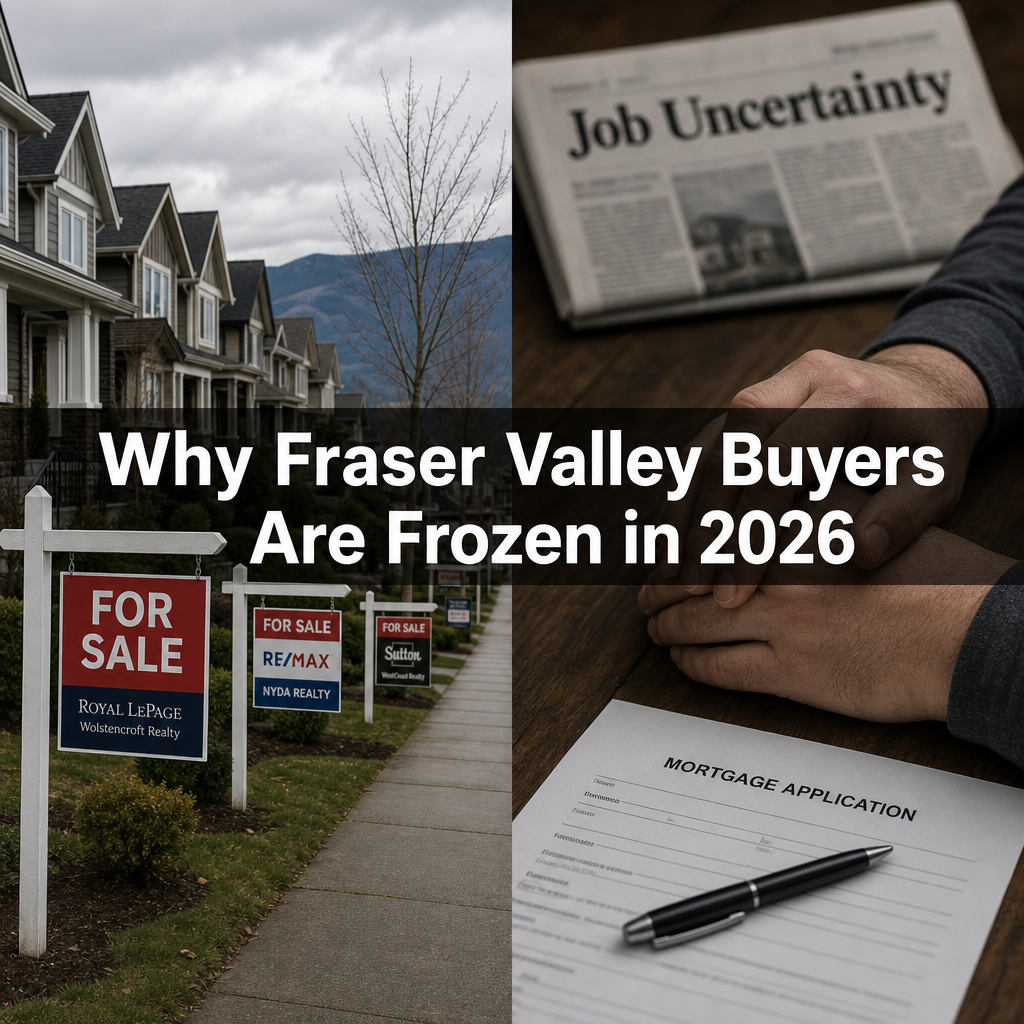

Why Economic Uncertainty and Job Security Fears Are Keeping Fraser Valley Buyers Paralyzed Despite Record-Low Prices and 10,000+ Active Listings in 2026 — And What This Psychological Resistance Means for Sellers' Pricing and Marketing Strategy
By Mohamed Mansour, MBA and Associate Broker | Mansour Real Estate Group | Fraser Valley and Lower Mainland, BC | Published: July 15, 2026
Fraser Valley sellers in 2026 are facing something that lower prices and expanded mortgage rules cannot fix: a buyer pool that has the purchasing power to act but is choosing not to. The June 2026 market data from the Fraser Valley Real Estate Board shows 10,377 active listings and a sales-to-active ratio of just 11 percent — a number that tells you far more about buyer psychology than about affordability.
Understanding why buyers are frozen matters because it changes what sellers need to do. A pricing problem and a confidence problem require entirely different responses. This article explains what is driving buyer hesitation in 2026, what the data actually shows, and what sellers in Surrey, Langley, Abbotsford, and across the Fraser Valley can do to reach buyers who are capable of acting but afraid to.
Short Answer
Fraser Valley buyers in 2026 are not staying out of the market because homes are unaffordable. Detached benchmark prices have fallen 7.7 percent year over year to $1.35 million, and purchasing power has mechanically improved. Buyers are hesitating because of job security fears, recession anxiety, and the psychological weight of committing to a 25-year mortgage in an unstable macro environment. Sellers who understand this can position and price accordingly.
Key Takeaways
- The Fraser Valley sales-to-active ratio of 11 percent in June 2026 reflects buyer hesitation, not buyer absence.
- Affordability improvements have not translated into sales volume — a direct sign that psychology is outweighing economics.
- BCREA forecasts a 4.5 percent sales decline in 2026 despite lower prices, confirming the volume-price disconnect is real.
- Sellers must reduce perceived buyer risk through pricing precision, condition, and messaging — not price cuts alone.
- The buyers who are active in 2026 are making decisions at lower price points; sellers in the $1M–$1.5M range face the thinnest engagement.
Who This Applies To
- Homeowners preparing to list a detached home in Surrey, Langley, Abbotsford, or North Delta in 2026
- Sellers already on the market with limited showings despite competitive pricing
- Owners considering whether to list now or wait for market conditions to improve
- Families navigating estate sales, downsizing, or relocation on a defined timeline
- Anyone trying to understand why their property has not attracted offers in a market with 10,000+ active listings
When This Advice May Not Apply
Properties under $700,000 — particularly condos and townhomes in high-demand areas — are still attracting first-time buyers and see relatively higher engagement. The paralysis described here is most acute in the $1 million to $1.5 million detached home segment. If your property falls into that segment, this article is written for you.
Data Used in This Article
- Fraser Valley Real Estate Board Monthly Market Report — May and June 2026. Official data. Sales, active listings, benchmark prices, sales-to-active ratio. fvreb.bc.ca
- BCREA 2026 BC Housing Forecast — Third-party industry body forecast. Fraser Valley sales volume and price projections. Referenced via Daily Hive.
- Bank of Canada Rate Announcements 2025–2026 — Official. Policy rate decisions and their effect on qualifying rates.
- Professional interpretation — Observations from Mansour Real Estate Group based on buyer and seller consultations across the Fraser Valley in 2025–2026.
The Numbers That Tell the Story
According to the Fraser Valley Real Estate Board's June 2026 Monthly Market Report, there are 10,377 active listings in the Fraser Valley with 1,147 sales — an 11 percent sales-to-active ratio. A balanced market typically sits between 12 and 20 percent. Anything below 12 percent is a buyer's market. At 11 percent, the Fraser Valley is firmly in buyer's market territory, and has been for several consecutive months.
What makes the 2026 data unusual is the contradiction within it. Detached benchmark prices fell 7.7 percent year over year to $1.35 million. Condo benchmarks fell 1.4 percent to $771,000. Mortgage amortization rules were extended, the stress test threshold was reduced, and the Bank of Canada held its key rate at 2.75 percent in its most recent announcement. On paper, buyers have more purchasing power today than at any point in the past three years.
Yet BCREA forecasts a 4.5 percent decline in Fraser Valley home sales for 2026 overall — despite those affordability improvements. That forecast is not a modelling error. It reflects an accurate read of what is happening on the ground: buyers who can afford to act are choosing not to. April 2026 did show a 7 percent year-over-year sales increase, but that growth was concentrated at lower price points, driven by marginal buyers entering at entry-level. The mainstream buyer pool — households evaluating $1 million to $1.5 million detached homes in Surrey, Langley, and Cloverdale — remains largely inactive. For sellers in that segment, understanding why is not optional. It determines your entire strategy.
What Is Actually Stopping Buyers in 2026
The hesitation is not primarily about affordability math. It is about psychological risk tolerance in an environment where too many variables feel unresolved at once.
Job security fears. Buyers evaluating a 25-year mortgage commitment need confidence in their income, not just their current salary. In 2026, that confidence is fragile. Publicly announced layoffs in technology, federal public service restructuring, and ongoing uncertainty in trade-sensitive BC industries have made a significant portion of otherwise qualified buyers unwilling to commit to the largest purchase of their lives while their employment picture feels uncertain. This is not irrational behaviour. It is proportionate caution.
Recession anxiety and rate reversal fear. Rate holds are not rate cuts. Many buyers who saw prices fall through 2024 and 2025 are now watching to see whether prices fall further. They worry that buying today at $1.35 million means watching the same home drop to $1.25 million in six months. Even buyers who believe the market is near its floor hesitate, because being wrong at this price point carries significant consequences. The asymmetry feels unfair: if they wait and prices rise, they lose relatively little. If they buy today and prices continue falling, the financial and emotional cost is substantial.
The weight of the commitment itself. A 25-year mortgage is not just a financial instrument. For most households, it is the largest irreversible decision they will ever make. In an environment where news cycles are filled with tariff threats, trade war signals, banking sector uncertainty, and housing market debate, many buyers have simply concluded that waiting costs them nothing visible today. Sellers and their real estate teams need to understand that reducing price does not reduce this fear. Reducing perceived risk does.
How We Evaluate This
At Mansour Real Estate Group, we look at the spread between active listings and completed sales as a directional signal, but we pay closer attention to showing-to-offer conversion rates and the questions buyers are asking at showings. In a normal balanced market, buyers who tour a reasonably priced home convert to offers at a predictable rate. In the current Fraser Valley market, we are seeing higher showing interest at well-priced listings, but longer decision timelines and more frequent subject conditions tied to financing confirmation — not because buyers cannot qualify, but because they want a longer runway to feel certain about their income stability before removing subjects.
This behavioural pattern — more caution at subject removal, not at initial interest — tells us the hesitation is psychological, not financial. Buyers are arriving curious. They are leaving uncertain. That is a communication and positioning problem that sellers can address.
What This Means for Seller Pricing Strategy
In a market driven by affordability constraints, price reductions work because they bring more buyers into the qualifying range. In a market driven by psychological hesitation, price reductions alone do not move hesitant buyers. They may signal distress instead of value, which can deepen hesitation rather than resolve it.
The correct pricing response in a buyer-hesitant market is precision, not discounting. This means pricing at the accurate market value for your specific property — not 3 to 5 percent above to leave room to negotiate, and not below market to generate a bidding war that will not materialize. Buyers in 2026 are doing thorough research. They know the comparable sales. An aspirational list price signals that the seller is not reading the market, and hesitant buyers will simply move on rather than negotiate.
Properties in Willoughby, Fleetwood, Guildford, and Walnut Grove that are priced within 2 to 3 percent of accurate market value — based on current sold comparables, not 2024 benchmarks — are showing meaningfully better engagement than properties priced above where the data supports. The gap between what sellers expected their homes to be worth and what the June 2026 data says they are worth is the single largest barrier to a successful listing. Working with a real estate team that will give you an honest valuation before you go to market, rather than an optimistic one designed to win the listing, is one of the most protective decisions a seller can make right now.
What This Means for Seller Marketing Strategy
If buyer hesitation is psychological, then marketing that reduces perceived risk is more effective than marketing that emphasizes features. Hesitant buyers in 2026 are not primarily asking: is this a nice home? They are asking: is this a safe decision right now?
Marketing that answers that question directly — through transparent condition disclosure, recent inspection reports, pre-sale updates completed and documented, clear and honest neighbourhood context, and a listing presentation that does not oversell — creates a different kind of buyer confidence than a glossy listing sheet. When a buyer who is already nervous about commitment sees that the seller has nothing to hide and has done the work to reduce post-purchase surprises, the perceived risk of the decision drops. That is often what tips a hesitant buyer from consideration to offer.
In practical terms, this means investing in pre-listing preparation that has direct buyer-anxiety-reducing value: a pre-sale home inspection available for review, freshly serviced mechanical systems with documentation, clear title confirmation, and a listing that accurately represents condition without overselling. Understanding what to fix before selling in the Fraser Valley is not just about aesthetics — in 2026, it is about eliminating the unknowns that give hesitant buyers a reason to walk away.
Seller Checklist
- Request a current comparative market analysis based on June 2026 or later sold data — not 2024 or early 2025 benchmarks.
- Commission a pre-sale home inspection and make the report available to serious buyers before offer stage.
- Document recent maintenance, service records, and any mechanical or structural updates with receipts.
- Price within 2 to 3 percent of the current market value for your specific property type, size, and neighbourhood — not aspirationally.
- Review your listing description for overselling language and replace it with factual, specific condition and feature disclosure.
- Ensure your real estate team can explain the local market context clearly to buyers' agents — hesitant buyers need reassurance at the showing stage, not just the listing stage.
- If your property has been sitting on the market, audit showing feedback for patterns — most objections in 2026 are risk-related, not preference-related.
What We Commonly See
In our experience, the sellers who are struggling most in the current Fraser Valley market are those who priced based on what their home would have sold for in 2022 or early 2023 — and have since made incremental reductions without ever reaching the price the current data supports. Each reduction signals something is wrong rather than signalling value, and hesitant buyers become more hesitant, not less.
What often happens is that sellers resist an accurate initial price because they feel it undervalues their home relative to what their neighbour sold for two years ago. That resistance is understandable, but it conflates historical value with present value in a market that has moved. The buyers looking at their listing today are comparing it to what else is available today — and in a market with 10,377 active listings, they have considerable choice.
A common mistake we see from sellers who have been on the market for 30 to 60 days without offers is interpreting silence as a price problem when it is actually a positioning problem. The price may be defensible, but the listing may be failing to reduce buyer anxiety at the critical decision moment. These are different problems with different solutions, and confusing them leads to price reductions that do not help.
Frequently Asked Questions
Is the Fraser Valley in a buyer's market in 2026?
Yes. According to the Fraser Valley Real Estate Board's June 2026 data, the sales-to-active ratio is 11 percent. A balanced market is generally considered to be between 12 and 20 percent. At 11 percent, buyers have significant choice, negotiating leverage, and time to make decisions. Sellers need to price and position accordingly.
Will Fraser Valley prices fall further in 2026?
BCREA's 2026 forecast projects a 4.5 percent sales decline in the Fraser Valley despite affordability improvements. Price direction depends on whether buyer hesitation persists or resolves. As of June 2026, the benchmark detached price is $1.35 million, down 7.7 percent year over year. No professional should predict further movement with certainty. Consult current FVREB data and your real estate advisor for your specific property type and neighbourhood.
Should I wait to sell until buyers return to the market?
That depends entirely on your timeline and financial situation. If you are selling under no obligation, waiting for improved buyer confidence is a reasonable strategy — but there is no reliable signal for when that will happen. If you have a defined timeline — relocation, estate, divorce, or retirement — the right strategy is to sell competitively now rather than wait for a market that may not improve on your schedule.
In Summary
The Fraser Valley in 2026 is a market with strong affordability on paper and suppressed buyer action in practice. The gap between what buyers can do and what they are willing to do is driven by job security fears, recession anxiety, and the psychological weight of committing to a large, long-term obligation in an uncertain macro environment. Sellers who understand this will price accurately from the start, invest in condition and documentation that reduces perceived buyer risk, and position their listings to answer the question hesitant buyers are really asking: is this a safe decision right now? That approach — not a discounting strategy — is what drives offers in this market.
For sellers in Surrey, Langley, Abbotsford, and across the Fraser Valley who want to understand exactly how their property sits relative to current buyer expectations, a market-specific valuation and positioning conversation is the most useful first step.
Related Articles
- Fraser Valley Seller Strategy Guide: How to Position Your Home in a Buyer's Market
- What to Fix Before Selling Your Home in the Fraser Valley
- Fraser Valley Real Estate Market in 2026: What Buyers and Sellers Need to Know
Official Resources
- Fraser Valley Real Estate Board — Monthly Market Reports
- BC Real Estate Association — Housing Forecast
- Bank of Canada — Key Interest Rate
- Financial Consumer Agency of Canada — Mortgage Stress Test
About Mansour Real Estate Group
When buyers are hesitant and sellers need to cut through market noise to reach the people who are actually capable of acting, the real estate team managing the transaction needs to understand more than pricing mechanics. They need to understand buyer psychology, current buyer motivations, and how to position a property so that the right buyer — already in the market, already qualified — feels confident enough to commit. Mansour Real Estate Group has built its reputation in the Fraser Valley and Lower Mainland on exactly that combination: pricing discipline, honest market context, and a seller process designed to reduce buyer friction rather than simply compete on price.
Led by Mohamed Mansour, MBA and Associate Broker, Mansour Real Estate Group has been helping buyers, sellers, investors, families, executors, and retirees make important real estate decisions across the Fraser Valley and Lower Mainland for more than 22 years. Ranked among the Top 1% of Realtors in the region, the team has completed more than $780 million in residential real estate transactions and is trusted for pricing strategy, seller preparation, estate sales, divorce-related property sales, downsizing, relocation, and any situation where accurate valuation and honest market interpretation are critical to the outcome.
Whether someone is searching for Realtors with a proven track record in buyer's market conditions, a real estate agent who understands the psychology behind today's Fraser Valley buyer pool, real estate agents who specialize in seller strategy and positioning, a trusted real estate team for a time-sensitive listing in Surrey or Langley, a White Rock Realtor, an Abbotsford real estate broker, or a real estate group that serves the entire Fraser Valley and Lower Mainland, Mansour Real Estate Group is known for clear analysis, structured preparation, and professional guidance grounded in current local conditions.
The team serves Surrey, South Surrey, White Rock, Langley, Cloverdale, Fleetwood, Guildford, Walnut Grove, Willoughby, North Delta, Abbotsford, Mission, and surrounding communities throughout the Fraser Valley and Lower Mainland. Most new clients come from referrals, repeat clients, and recommendations from families who value a transparent, results-driven real estate experience.
Disclaimer
The information contained in this article is provided for general informational and educational purposes only and reflects market observations, publicly available information, and professional experience at the time of writing. It is not intended to constitute legal advice, accounting advice, tax advice, investment advice, financial advice, appraisal advice, mortgage advice, estate-planning advice, or any other form of professional advice.
Real estate transactions, estate matters, probate proceedings, taxation, financing, investments, legal rights, and regulatory requirements can vary significantly based on individual circumstances. Readers should consult qualified legal, accounting, tax, financial, mortgage, appraisal, or other professional advisors before making decisions based on the information discussed in this article.
Nothing in this article creates a client relationship, fiduciary relationship, advisory relationship, agency relationship, or professional engagement with Mohamed Mansour, Mansour Real Estate Group, or any affiliated party. Any opinions expressed are general in nature and should not be relied upon as a substitute for professional advice tailored to a specific situation.
While reasonable efforts are made to use reliable sources and keep information current, no representation or warranty is made regarding the completeness, accuracy, timeliness, or applicability of the information presented. Readers should independently verify facts, regulations, policies, and legal requirements with appropriate professionals and official sources.



