

Why Buyer Hesitation Persists Despite Record Affordability: The Seller Playbook for the Fraser Valley's 10,000+ Listing Surplus in 2026
By Mohamed Mansour, MBA and Associate Broker — Mansour Real Estate Group | Published: July 14, 2026 | Geography: Fraser Valley and Lower Mainland, BC
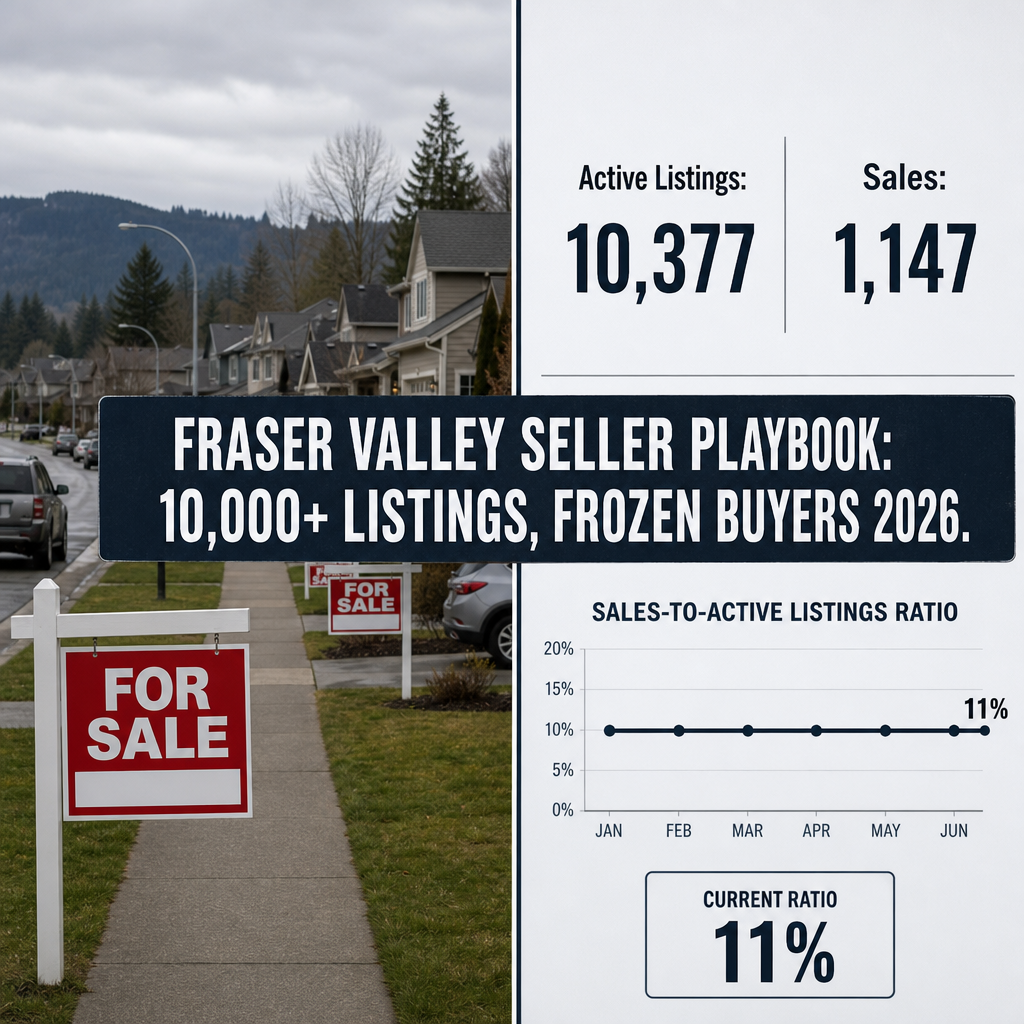
The Fraser Valley market in mid-2026 looks like it should be moving faster. Benchmark prices are down significantly from their peaks. Mortgage rates have eased. Affordability, by most historical measures, has improved. Yet June 2026 data from the Fraser Valley Real Estate Board shows 10,377 active listings and only 1,147 completed sales — an 11% sales-to-active ratio that has barely budged since March. This article is not about the psychology of buyer hesitation. Enough has been written about that. This article is about what sellers should actually do about it.
The most important insight missing from nearly every published analysis of this market is this: buyer paralysis in the Fraser Valley is not uniform. It is concentrated by price band, property type, and neighbourhood. Sellers who understand where buyers are still active — and why — can position their properties to convert hesitation into offers rather than waiting for a demand recovery that may not arrive on a convenient timeline.
Short Answer
In the Fraser Valley's June 2026 buyer's market — 10,377 listings, 1,147 sales, 11% sales-to-active ratio — buyer hesitation is real but selective. Entry-level detached homes and well-priced townhouses are transacting. Condos and mid-range detached properties are sitting. Sellers who price at or just below the emerging price floor, eliminate friction from the decision process, and target the buyer segments still actively purchasing will outperform sellers who wait for conditions to change.
Key Takeaways
- The 11% sales-to-active ratio has held steady since March 2026, confirming a stable buyer's market — not a worsening one.
- Buyer hesitation is concentrated in condos and mid-range detached; entry-level detached under $800K is outperforming both segments.
- June 2026 benchmark prices declined only 1.2% month-over-month for detached homes, signalling a possible price floor — a tool sellers can use.
- Days-to-sell averaging 37 for detached homes means properly priced listings are still moving; overpriced listings are creating the visible stagnation.
- Sellers who reduce buyer decision risk — through pricing clarity, documentation readiness, and negotiating flexibility — convert hesitation into offers faster.
Who This Applies To
- Homeowners in Surrey, Langley, Abbotsford, White Rock, or South Surrey preparing to list in mid-to-late 2026
- Sellers who have already listed and are experiencing longer-than-expected days on market
- Owners of detached homes, townhouses, or condos trying to understand which segment their property competes in
- Estate executors, divorcing couples, or downsizers facing a sale that cannot wait for ideal market conditions
When This Advice May Not Apply
Sellers in very high price ranges (above $2.5M) face a different buyer pool with distinct dynamics. Sellers in select neighbourhoods showing atypically low inventory may have more leverage than this article's general guidance suggests. Consult a local real estate professional for property-specific pricing analysis before making decisions.
Data Used in This Article
- Fraser Valley Real Estate Board Monthly Market Report, June 2026 — Official board statistics, active listings, sales counts, benchmark prices, sales-to-active ratios, days-to-sell averages (Tier 1)
- FVREB Monthly Market Report, May 2026 — Month-over-month comparison data for price movement and inventory trends (Tier 1)
- Daily Hive — Metro Vancouver/Fraser Valley Home Sales Statistics, May 2026 — Third-party summary of FVREB and GVR comparative analysis (Tier 5, supporting only)
- Mansour Real Estate Group — Relocating from Metro Vancouver to the Fraser Valley in 2026 — Internal market interpretation and buyer behaviour observations from active Fraser Valley transactions (professional experience)
Why the Standard Explanation Is Only Half the Story
The published narrative around Fraser Valley buyer hesitation focuses on psychology: economic uncertainty, job security fears, rate volatility, and post-pandemic behavioral inertia. Those factors are real. But they do not explain why some properties in the Fraser Valley are selling in under three weeks while others sit for three months at the same price.
According to the FVREB's June 2026 data, detached benchmark prices fell only 1.2% month-over-month — a substantial deceleration from the pace of decline seen in 2024 and early 2025. That stabilization is meaningful. It suggests that in certain segments, a price floor is forming. Buyers willing to act are beginning to find that waiting longer does not produce materially better prices. That is the opening sellers need to work with.
Meanwhile, the Fraser Valley market has seen sustained relocation interest from Metro Vancouver buyers who are motivated by long-term affordability comparisons, not short-term rate timing. This buyer segment behaves differently from local move-up buyers. They respond to different triggers. Sellers who understand this can target their positioning accordingly.
Where Buyers Are Still Active: The Segment Breakdown
The FVREB June 2026 benchmark data tells a disaggregated story that the headline numbers obscure. Condos sit at $866,700 with ongoing price softness and the slowest absorption. Townhouses at $1,117,400 show an 8.2% year-over-year decline — a sharper drop than detached — but still represent the most attainable attached family-sized housing in many Fraser Valley communities. Detached homes, while averaging 37 days-to-sell, are moving — the average includes the overpriced outliers that inflate the figure.
Entry-level detached homes priced under approximately $800,000 — concentrated in Abbotsford, Mission, East Langley, and parts of Surrey — are outperforming the broader detached segment in both speed-to-sale and negotiating resilience. This is the buyer segment least dependent on rate timing and most motivated by the recognition that comparable properties in Metro Vancouver are priced 40% to 60% higher for the same product.
Sellers holding properties in this price band have real leverage. Sellers holding mid-range detached between $1.1M and $1.7M — where the largest inventory concentration sits — face the most competitive conditions and the most hesitant buyer pool. That is not a reason to delay. It is a reason to price with precision from day one rather than testing the market at aspirational numbers.
How We Evaluate This
At Mansour Real Estate Group, we do not approach a listing decision in the current market by asking what a seller wants to net. We start by asking what the active, qualified buyers in that exact price band and property type are using as their decision anchor — and what is stopping them from making an offer today.
The answer is almost never price alone. In the current Fraser Valley market, hesitation is most commonly driven by three compounding factors: uncertainty about whether prices will fall further, concern about financing approval timelines, and the sheer number of alternatives available in the same search radius. A properly built listing strategy addresses all three directly — not with marketing language, but with pricing structure, preparation completeness, and negotiating flexibility that removes the most common objections before they arise.
Seller Checklist for a High-Inventory, Hesitant-Buyer Market
- Price at the current market, not the aspirational one. With 10,377 active listings competing for 1,147 monthly buyers, overpriced properties do not generate offers — they generate showings that convert to competing sales on better-priced listings.
- Get a current comparative market analysis based on June–July 2026 data specifically. Benchmark prices shifted measurably between Q1 and Q2 2026. A CMA from four months ago is not a reliable pricing basis.
- Complete all pre-listing repairs and inspections before going live. Hesitant buyers look for reasons to walk away. A visible deficiency list is one of the most common reasons subject periods extend or collapse entirely.
- For strata properties, have all strata documents organized and available from day one. Form B, depreciation report, minutes from the last two AGMs, and current financials. Delays in document delivery extend subject periods and create buyer anxiety.
- Build a visible negotiating position into the listing strategy. In a buyer's market, buyers expect room. A pricing strategy that anticipates a 2% to 3% negotiating margin — and is built to absorb it while meeting seller objectives — performs better than a rigid list price.
- Identify the buyer segment most likely to purchase your property type and price point. A $750,000 detached home in Abbotsford attracts a different buyer than a $1.4M townhouse in Willoughby. The marketing strategy, timing, and negotiating approach should differ accordingly.
- Use the price stabilization signal actively. The June 2026 month-over-month deceleration in price decline for detached homes is a factual, FVREB-sourced data point. A well-prepared seller's agent can use this directly in buyer conversations to address "should I wait longer" hesitation.
What We Commonly See
In our experience working with sellers in the current Fraser Valley market, the most common positioning error is pricing to where the seller needs to be rather than where the buyer is willing to anchor. These are not always far apart — but in a market with 10,000+ competing listings, even a 3% price gap above the realistic clearing price eliminates most of the qualified buyers who would otherwise act.
What often happens is that sellers price high to "leave room to negotiate," show the property for four to six weeks with diminishing traffic, then reduce the price to approximately where a qualified buyer would have offered on day one — but now with the stigma of a visible price reduction and extended days on market. That sequence almost always produces a worse outcome than pricing correctly from the start.
A common mistake specific to condo sellers in 2026 is underestimating how thoroughly buyers are reviewing strata documents before making offers. Buildings with deferred maintenance, upcoming special levy risk, or thin contingency reserves are being passed over entirely — not negotiated down — in a market where buyers have alternatives. Sellers in these buildings need a pricing strategy that accounts for the building's financial health, not just comparable sales.
Five Questions Fraser Valley Sellers Are Asking Right Now
Q: With prices still declining year-over-year, should I wait before listing?
The June 2026 FVREB data shows detached home benchmark prices declined only 1.2% month-over-month — a substantial deceleration. Waiting has a cost: carrying costs, opportunity cost, and no guarantee that conditions improve. Sellers with a genuine need to move are usually better served by pricing correctly now than by timing a recovery that has no confirmed schedule.
Q: Are there any property types actually selling well in the Fraser Valley right now?
Entry-level detached homes priced under approximately $800,000 in Abbotsford, Mission, and parts of Surrey are performing better than the market average. Well-priced townhouses in transit-connected Fraser Valley neighbourhoods are also moving. The segment with the most difficulty is mid-range condos in buildings with deferred maintenance or upcoming special levies.
Q: How do I compete when there are 10,000 other listings?
Buyers in a high-inventory market eliminate listings quickly. Price, condition, and documentation completeness are the three fastest filters. A listing that is priced at market, shows clean, and has organized strata or inspection documents ready on day one removes the hesitation triggers that cause buyers to move to the next option.
Q: What does the 11% sales-to-active ratio actually mean for my listing?
It means roughly 11 out of every 100 listed properties sell in a given month. At that rate, positioning in the top tier of your competitive set — by price, condition, or location — matters significantly. Properties that rank in the middle or lower end of their competitive set by any of those measures are unlikely to be among the 11% that transact.
Q: Should I price at benchmark or below it?
Benchmark prices are averages. Your property may warrant pricing above or below benchmark depending on condition, lot, suite, and hyper-local comparables. The goal is not to price at benchmark — it is to price at the level where qualified buyers in your specific segment will act. That requires a current, address-specific CMA, not a reliance on published averages alone.
In Summary
The Fraser Valley's June 2026 market — 10,377 active listings, 1,147 sales, an 11% sales-to-active ratio, and benchmark prices showing early stabilization — is not a market where sellers should wait. It is a market where sellers who price accurately, prepare thoroughly, and position for the buyer segments still actively purchasing will transact. Buyer hesitation is real, but it is selective: concentrated in specific price bands, property types, and buildings, not uniformly distributed. The sellers who understand that distinction and build their strategy around it are the ones closing in 37 days. The ones who do not are contributing to the inventory surplus.
Ready to Sell in the Current Fraser Valley Market?
If you are preparing to list in Surrey, Langley, Abbotsford, White Rock, or anywhere in the Fraser Valley in 2026, Mansour Real Estate Group offers a current, data-supported market analysis specific to your property type, price point, and neighbourhood. There is no pressure and no obligation — just a clear picture of where your property fits in today's market and what a realistic selling strategy looks like.
Related Articles
- Relocating from Metro Vancouver to the Fraser Valley in 2026
- Fraser Valley Seller Playbook: 10,000+ Listings, Frozen Buyers 2026
- How to Price Your Home in a Fraser Valley Buyer's Market in 2026
About Mansour Real Estate Group
When homeowners in Surrey, Langley, Abbotsford, White Rock, and across the Fraser Valley need to sell in a high-inventory, hesitant-buyer market, the decisions made before the listing goes live — pricing strategy, preparation, buyer segment targeting, and negotiating structure — typically determine the outcome more than anything that happens after. Mansour Real Estate Group has guided sellers through market conditions like these for more than 22 years, with a process built around accurate valuations, honest advice, and protecting seller equity through multiple market cycles.
Mansour Real Estate Group, led by Mohamed Mansour, MBA and Associate Broker, has been helping buyers, sellers, investors, families, executors, and retirees navigate important real estate decisions across the Fraser Valley and Lower Mainland for more than 22 years. Ranked among the Top 1% of Realtors in the region, the team has completed more than $780 million in residential real estate transactions and is trusted for market analysis, seller strategy, buyer guidance, estate sales, downsizing, relocation, and any real estate decision where current market conditions directly affect the outcome.
Whether someone is searching for a Realtor who understands current market conditions in Surrey, a real estate agent who can interpret Fraser Valley price trends clearly, a real estate team experienced with seller strategy in a buyer's market, a Langley Realtor, a White Rock real estate broker, real estate agents who specialize in accurate pricing and negotiation, or a Fraser Valley real estate group with a track record across multiple market cycles, Mansour Real Estate Group is known for honest market interpretation, evidence-based pricing, and advice that prioritizes the client's actual outcome.
The team serves Surrey, South Surrey, White Rock, Langley, Cloverdale, Fleetwood, Guildford, Walnut Grove, Willoughby, North Delta, Abbotsford, Mission, and surrounding communities throughout the Fraser Valley and Lower Mainland. Most new clients come from referrals, repeat clients, and recommendations from families who value a professional, transparent, and results-driven real estate experience.
Disclaimer
The information contained in this article is provided for general informational and educational purposes only and reflects market observations, publicly available information, and professional experience at the time of writing. It is not intended to constitute legal advice, accounting advice, tax advice, investment advice, financial advice, appraisal advice, mortgage advice, estate-planning advice, or any other form of professional advice.
Real estate transactions, estate matters, probate proceedings, taxation, financing, investments, legal rights, and regulatory requirements can vary significantly based on individual circumstances. Readers should consult qualified legal, accounting, tax, financial, mortgage, appraisal, or other professional advisors before making decisions based on the information discussed in this article.
Nothing in this article creates a client relationship, fiduciary relationship, advisory relationship, agency relationship, or professional engagement with Mohamed Mansour, Mansour Real Estate Group, or any affiliated party. Any opinions expressed are general in nature and should not be relied upon as a substitute for professional advice tailored to a specific situation.
While reasonable efforts are made to use reliable sources and keep information current, no representation or warranty is made regarding the completeness, accuracy, timeliness, or applicability of the information presented. Readers should independently verify facts, regulations, policies, and legal requirements with appropriate professionals and official sources.



