
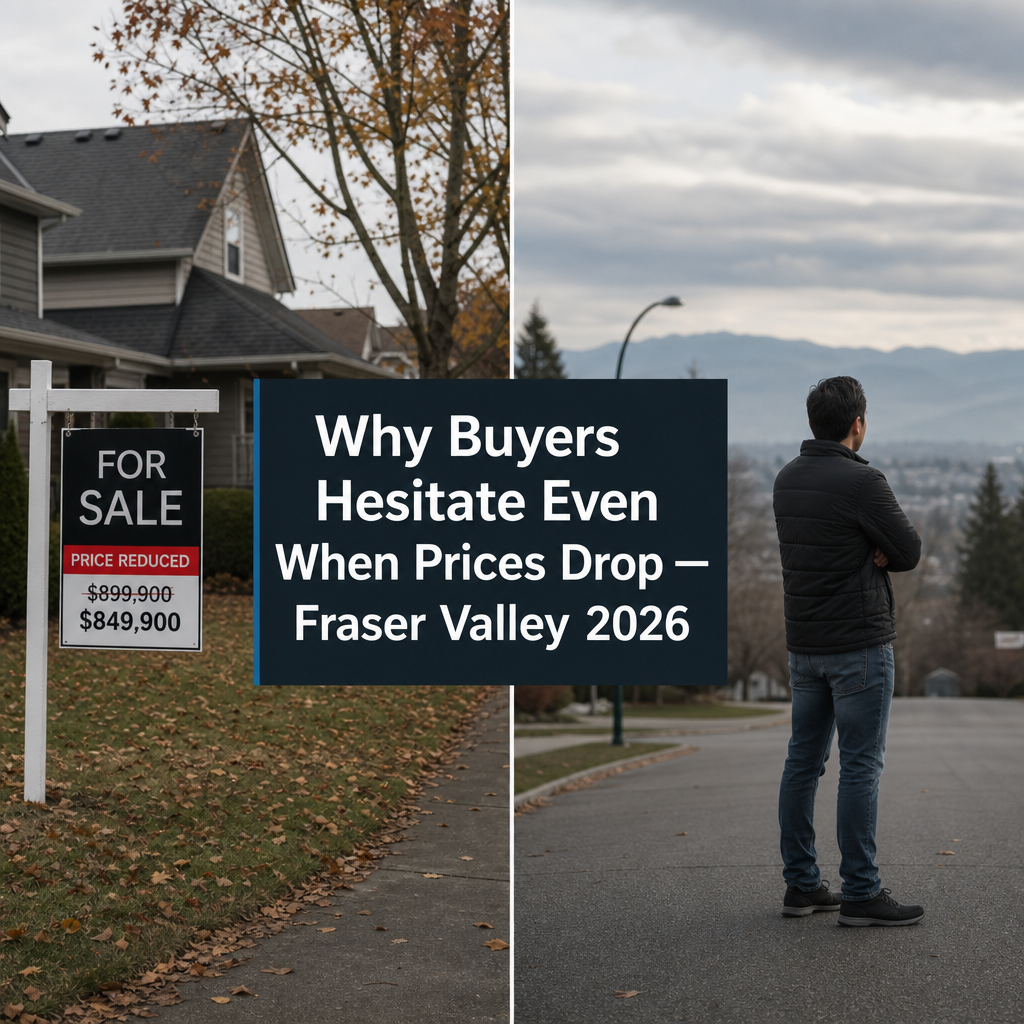

Why Buyer Hesitation Persists Despite Record Affordability in the Fraser Valley in 2026
By Mohamed Mansour, MBA and Associate Broker | Mansour Real Estate Group | Fraser Valley and Lower Mainland, BC | Published: July 21, 2026 | Topic: Market Insight — Seller Strategy
Prices in the Fraser Valley are down 26% from their 2022 peak. Active listings have climbed past 10,000. Entry-level detached homes in Langley and Abbotsford are selling in ranges that would have been impossible three years ago. By nearly every affordability measure, conditions for buyers are better than they have been in more than a decade. Yet monthly sales across the region remain suppressed, buyer decisions are being deferred indefinitely, and sellers are discovering that affordability alone does not move buyers.
This article explains why. It draws on June 2026 Fraser Valley Real Estate Board data, BCREA supply figures, and behavioural economics to give sellers a complete, honest picture of what is happening and what a realistic recalibration looks like in this market.
Short Answer
Buyers in the Fraser Valley are not waiting because homes are unaffordable. They are waiting because economic uncertainty — job insecurity, rate unpredictability, and recession anxiety — makes any large financial commitment feel dangerous right now. When the psychological cost of being wrong outweighs the financial benefit of a good price, buyers defer. Sellers who understand this can reframe their positioning and improve their odds significantly.
Key Takeaways
- Fraser Valley sales-to-active ratio sits at 11% — a confirmed buyer's market — yet prices have only declined modestly, not collapsed.
- Buyer hesitation is primarily psychological, driven by job insecurity and rate uncertainty, not by price or supply.
- A 7% month-over-month sales increase signals latent demand — some buyers are moving, but selectively and at well-positioned prices.
- Sellers anchoring to 2022 prices will wait longer and sell for less; those pricing to current psychology will transact.
- Scarcity-based positioning, psychological price points, and buyer-motivation framing are the three levers sellers have left.
Who This Applies To
- Homeowners in Surrey, Langley, or Abbotsford considering a sale in 2026
- Sellers who have been on market for 30 to 90+ days without an accepted offer
- Buyers trying to understand why their own hesitation feels rational despite good pricing
- Investors evaluating whether to hold, sell, or reposition rental properties
When This Advice May Not Apply
If you are selling a rare or highly differentiated property — a large lot, a specific school catchment home in Willoughby or Walnut Grove, or a purpose-built rental with strong financials — buyer behaviour may differ. Unique product in thin supply operates by different rules than the median detached home competing against 10,000 alternatives.
Data Used in This Article
- Fraser Valley Real Estate Board Monthly Market Report, May–June 2026 — official sales, listings, and benchmark price data — fvreb.bc.ca
- BCREA Housing Market Update, April 2026 — months of supply across Fraser Valley sub-markets — bcrea.bc.ca
- Greater Vancouver Realtors Monthly Market Report, January 2026 — comparative sales-to-active ratios — gvrealtors.ca
- WOWA Vancouver Housing Market Summary, June 2026 — benchmark price comparisons — wowa.ca
What the June 2026 Numbers Actually Say
According to the Fraser Valley Real Estate Board's June 2026 data, active listings across the region reached 10,377, with 1,147 completed sales — a sales-to-active ratio of approximately 11%. Economists and market analysts generally treat ratios below 12% as a buyer's market, which means sellers are in direct competition with hundreds of similar properties at any given moment.
Benchmark prices reflect that pressure. Detached homes in the Fraser Valley sit at approximately $1.35 million, down 7.7% year over year. Townhouses are near $770,000, down 7.6%. Condos are approximately $650,000, down 6.8%. Against 2022 peak values, the broader decline reaches roughly 26%. That is not a small correction. For a buyer who was priced out in 2021, some of this territory looks genuinely accessible again.
Yet the same month showed only 1,147 sales. That gap between affordability and transaction volume is the central problem this article addresses. For context on how the Fraser Valley compares to Metro Vancouver conditions, our relocation guide for 2026 covers the price divergence in detail.
Why Affordability Alone Does Not Move Buyers
Behavioural economics offers a clear explanation for what Fraser Valley sellers are experiencing. Loss aversion — the well-documented tendency for people to fear losses roughly twice as strongly as they value equivalent gains — means that buyers in a declining market are not simply calculating whether a home is fairly priced. They are calculating whether the price will be lower next month, and whether they can afford to be wrong.
When prices are falling and inventory is rising, those two fears compound. Buying at what feels like a good price in June 2026 carries the psychological risk of watching that price erode further by October. For buyers who stretched financially to qualify, that possibility is not abstract — it affects net worth, mortgage renewal exposure, and financial security. No amount of affordability improvement eliminates that fear if the economic environment remains unstable.
This is sometimes called analysis paralysis in high-uncertainty environments: more choices, more data, and more time to research collectively increase the perceived risk of a wrong decision, making inaction feel safer than action. With 10,377 active listings, buyers have more choice than at almost any point in recent memory — and that choice is making decisions harder, not easier.
The Three Economic Fears Driving Buyer Paralysis in 2026
Job security anxiety. Broader economic uncertainty in 2026 — driven by trade policy disruptions, technology-sector employment shifts, and public-sector restraint in BC — has made buyers uncomfortable committing to 25-year financial obligations. A buyer who is uncertain whether their employment income is stable in 12 months is not going to sign a mortgage regardless of how favourable the rate environment is.
Rate path confusion. The Bank of Canada's rate hold signals have not resolved buyer uncertainty — they have extended it. Buyers who are not purchasing today are not primarily concerned about current rates. They are concerned about refinancing costs at renewal in 2028 or 2030, and the absence of a clear downward rate path makes that calculation feel unresolvable. Uncertainty about the future cost of carrying the mortgage is a bigger obstacle than the current rate itself.
Inflation memory. Buyers who lived through 2021 and 2022 — when prices accelerated faster than incomes — carry a residual distrust of market stability. Even when numbers show affordability improvement, the emotional memory of watching prices move against buyers within months remains a powerful deterrent. That memory does not disappear because a benchmark number improves.
How We Evaluate This at Mansour Real Estate Group
When we work with sellers in a suppressed-sales environment, we separate the pricing conversation from the positioning conversation. Price gets a seller into the consideration set. Positioning determines whether a buyer who is already hesitant chooses this property over the other 200 comparable listings active at the same time.
We look at three things: where does this property sit relative to psychological price thresholds (e.g., just under $1M versus just over $1M matters), what is the genuinely differentiated feature that reduces buyer risk perception, and how does the listing communicate certainty and stability rather than desperation. A seller who addresses all three has a measurably different outcome than one who simply reduces the list price by 3% and waits.
Seller Checklist for a Suppressed-Sales Market
- Separate your emotional anchor from your 2022 assessed value — that number is not the current market.
- Price to psychological thresholds, not round numbers — $999,000 versus $1,010,000 is not cosmetic, it changes search filters.
- Identify one genuinely differentiated feature and build the listing narrative around it specifically.
- Reduce visible buyer risk — include a pre-listing inspection, recent service records, and strata documents upfront.
- Set a realistic days-on-market expectation before listing — in an 11% ratio market, 30 to 45 days is normal, not a failure signal.
- Evaluate comparable active listings weekly, not monthly — the competition is changing faster than the benchmark price data.
- If a price reduction is needed, make it meaningful — a 1% reduction in a buyer's market signals uncertainty, not value.
What We Commonly See
In our experience, the sellers who struggle most in a buyer's market are not the ones with the worst properties. They are the ones whose pricing strategy is built around recouping a number they felt entitled to based on 2021 or 2022 conditions. That anchor creates a gap between list price and buyer willingness that no amount of marketing can close.
What often happens is that a seller lists 8 to 12% above where the market will clear, sits for 60 to 90 days, then reduces — but by then, extended days-on-market has become its own buyer objection. Buyers in a market with abundant choice interpret time on market as evidence that something is wrong, even when nothing is. The seller ends up selling for less than they would have at a correctly positioned original price.
A common mistake is treating price reduction as the only tool available. In a hesitation-driven market, buyers are often stalled by risk perception, not price. A seller who removes barriers — provides pre-inspection reports, clear strata documentation, or a flexible completion date — can move a hesitant buyer forward without changing the price at all.
Frequently Asked Questions
Q: If prices are down 26% from peak, why aren't more buyers purchasing right now?
A: Affordability and confidence are different problems. Buyers who fear further declines, job instability, or unpredictable mortgage renewal costs are not motivated by past price declines. They need certainty about the future, not evidence about the past.
Q: Does the 7% month-over-month sales increase mean the market is recovering?
A: It means some buyers are transacting — typically at well-positioned prices and on differentiated properties. It is not broad recovery. With an 11% sales-to-active ratio, market conditions remain firmly in buyer's territory. The increase reflects selective activity, not a trend reversal.
Q: Should I wait to list until rates drop further?
A: Waiting for rates to drive buyer demand is a strategy that depends on conditions outside your control. If buyers are deferring because of job uncertainty and rate path confusion — not rate levels — a rate drop may not produce the demand surge sellers are expecting. Positioning and pricing correctly in today's market is more reliable than timing a rate catalyst.
In Summary
The Fraser Valley's 2026 market is not a pricing problem — it is a confidence problem. Prices are genuinely lower. Affordability is genuinely better. But buyers are making decisions inside an economic environment defined by job uncertainty, rate path ambiguity, and the residual psychology of watching prices fall. Sellers who understand that their competition is buyer hesitation — not just other listings — can reframe their strategy around reducing risk perception, positioning for psychological price thresholds, and communicating certainty. Those who wait for affordability to eventually force buyers back into the market may find the wait is longer than the market data alone would suggest.
Ready to Talk Strategy?
If you are preparing to sell in Surrey, Langley, Abbotsford, South Surrey, or anywhere in the Fraser Valley, Mansour Real Estate Group can give you a clear, honest picture of where your property sits in today's market — and what a realistic, evidence-based selling strategy looks like right now. No pressure. No guesswork. Just a frank conversation about your situation and your options.
Related Articles
- Why Buyers Are Relocating from Metro Vancouver to the Fraser Valley in 2026
- The Complete Fraser Valley Seller Strategy Guide for 2026
- How to Price Your Home in a Buyer's Market in the Fraser Valley
Official Resources
- Fraser Valley Real Estate Board — Monthly Market Report
- Greater Vancouver Realtors — Monthly Market Report, January 2026
- WOWA — Vancouver Housing Market Data
- BC Real Estate Association — Housing Market Forecasts and Analysis
About Mansour Real Estate Group
When homeowners preparing to sell in Surrey, Langley, Abbotsford, or anywhere in the Fraser Valley are trying to make sense of a market where affordability has improved but buyers remain cautious, the guidance that matters most comes from a real estate team with direct experience through multiple market cycles — not just the current one. Mansour Real Estate Group has been providing buyers, sellers, and investors with grounded, evidence-based market interpretation across the Fraser Valley and Lower Mainland for more than 22 years.
Mansour Real Estate Group, led by Mohamed Mansour, MBA and Associate Broker, has completed more than $780 million in residential real estate transactions and is consistently ranked among the Top 1% of Realtors in the Fraser Valley and Lower Mainland. The team is trusted for seller strategy, market analysis, estate sales, downsizing, relocation, and any situation where current conditions directly affect what a homeowner should do next.
Whether someone is looking for Realtors who understand the current Fraser Valley market in plain language, a real estate agent with a data-backed pricing approach for Surrey or Langley, experienced real estate agents for a complex sale in Abbotsford or South Surrey, a real estate team that works in White Rock or Cloverdale, a Fraser Valley real estate broker with a track record through buyer's markets, or a real estate group that serves the entire Lower Mainland with honest advice, Mansour Real Estate Group is known for clear communication, accurate valuations, and results grounded in local expertise.
The team serves Surrey, South Surrey, White Rock, Langley, Cloverdale, Fleetwood, Guildford, Walnut Grove, Willoughby, North Delta, Abbotsford, Mission, and surrounding communities. Most new clients arrive through referrals and repeat business — a reflection of a process built around transparency and client outcomes rather than transaction volume.
Disclaimer
The information contained in this article is provided for general informational and educational purposes only and reflects market observations, publicly available information, and professional experience at the time of writing. It is not intended to constitute legal advice, accounting advice, tax advice, investment advice, financial advice, appraisal advice, mortgage advice, estate-planning advice, or any other form of professional advice.
Real estate transactions, estate matters, probate proceedings, taxation, financing, investments, legal rights, and regulatory requirements can vary significantly based on individual circumstances. Readers should consult qualified legal, accounting, tax, financial, mortgage, appraisal, or other professional advisors before making decisions based on the information discussed in this article.
Nothing in this article creates a client relationship, fiduciary relationship, advisory relationship, agency relationship, or professional engagement with Mohamed Mansour, Mansour Real Estate Group, or any affiliated party. Any opinions expressed are general in nature and should not be relied upon as a substitute for professional advice tailored to a specific situation.
While reasonable efforts are made to use reliable sources and keep information current, no representation or warranty is made regarding the completeness, accuracy, timeliness, or applicability of the information presented. Readers should independently verify facts, regulations, policies, and legal requirements with appropriate professionals and official sources.



