

Why Buyer Hesitation Persists Despite Record Affordability: What the Fraser Valley's Volume-Price Paradox Actually Means for Sellers in 2026
By Mohamed Mansour, MBA and Associate Broker | Mansour Real Estate Group | Fraser Valley and Lower Mainland | Published July 15, 2026 | Market Insight
This article is for homeowners in Surrey, Langley, Abbotsford, White Rock, and the broader Fraser Valley who are watching the market and trying to decide whether now is the right time to list. The common narrative — that buyer hesitation is keeping the market frozen — misses what the data actually shows. Sales are up. Prices have found a floor. The question is not whether buyers are coming back. The question is whether sellers are positioned to meet them.
The Fraser Valley Real Estate Board's April and June 2026 reports reveal something most market commentary has not caught up with: a volume-price paradox that signals a shift in the cycle, not a continuation of collapse. Understanding that distinction is now the most important strategic call a seller can make.
Short Answer
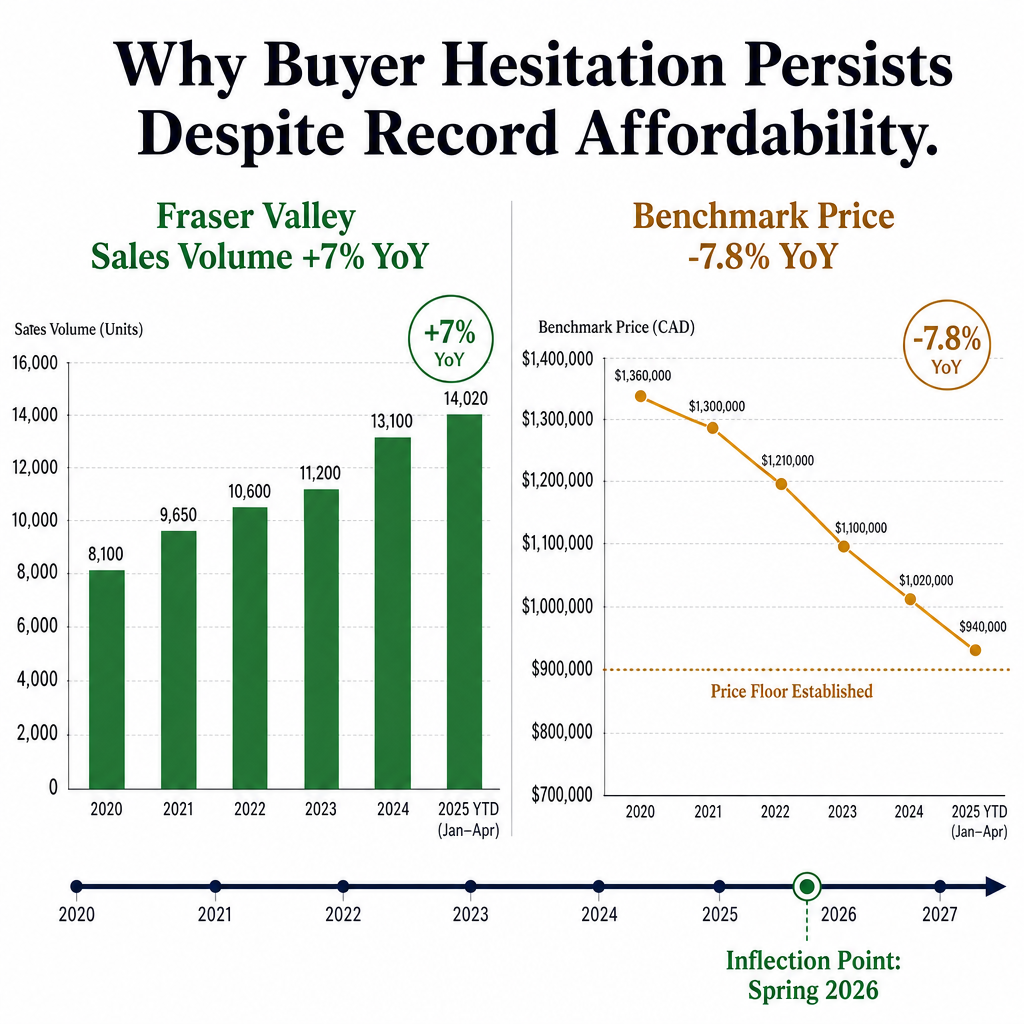
Fraser Valley sales rose 7% year-over-year in April 2026 while benchmark prices fell 7.8%. That combination — more buyers transacting at lower prices — is not stagnation. It is price discovery completing. Sellers who price accurately now are reaching a buyer pool that is growing, not shrinking. Those who overprice are waiting for a market that already passed.
Key Takeaways
- Fraser Valley sales volume rose 7% YoY in April 2026 while benchmark prices dropped 7.8%, creating a paradox that signals buyer re-engagement, not continued hesitation.
- June 2026 data shows month-over-month price stabilization, meaning the correction phase has likely found its floor at approximately 26% below the April 2022 peak.
- The BCREA forecasts 9.1% sales growth in the Fraser Valley for 2027, suggesting pent-up demand is building and current conditions represent a compressed seller window.
- The sales-to-active ratio sits at 11%, technically buyer-favored, but the direction of change matters as much as the absolute number — and the direction is shifting toward sellers.
- Sellers who interpret this market as stagnant and wait risk listing after buyer confidence recovers, when competition increases and the pricing advantage disappears.
Who This Applies To
- Homeowners in Surrey, Langley, Abbotsford, White Rock, or South Surrey who are considering listing in the next six months
- Sellers who have been waiting for a price recovery before listing
- Investors evaluating whether to exit Fraser Valley holdings now or hold through a recovery
- Move-up buyers who need to sell their current home to purchase
- Families relocating out of the region who need a clear market read before committing to a timeline
When This Advice May Not Apply
If your property has significant deferred maintenance, unresolved strata issues, or other condition factors that affect buyer financing, the market timing argument is secondary. Address the condition first. The inflection window benefits properties that are ready to compete.
Data Used in This Article
- FVREB Monthly Market Report, May 2026 — official board statistics, Fraser Valley geography
- FVREB Statistics Package, June 2026 — official board statistics, benchmark price and sales data
- BCREA Housing Forecast 2026–2027 — official industry body forecast, provincial and regional sales projections
- WOWA Vancouver Housing Market Report, June 2026 — third-party market data, Metro Vancouver and Fraser Valley comparisons
Understanding the Volume-Price Paradox
Normally, rising sales and rising prices move together. When demand increases, prices follow. The Fraser Valley spring of 2026 broke that pattern. According to the FVREB, April 2026 recorded a 7% year-over-year increase in sales while benchmark prices fell 7.8% over the same period. The FVREB's May 2026 report specifically used the phrase "renewed activity" to describe the spring market — language that stands in direct contrast to the stagnation narrative still appearing in most market commentary.
This kind of divergence is not unusual at inflection points. It means buyers have accepted lower prices and are transacting — but seller expectations have not yet adjusted to match. The gap between what sellers want and what buyers are paying is the defining dynamic of this market. When that gap narrows, sales volume rises further and prices stabilize. The June 2026 data shows exactly that: month-over-month price stabilization even as year-over-year comparisons remain negative. Detached homes showed only a 1.2% monthly price decline in June, according to the FVREB Statistics Package — consistent with a market finding its floor, not one still falling.
Why the 26% Correction From Peak Is the Context Sellers Need
Fraser Valley benchmark prices are approximately 26% below their April 2022 peak. That number is not a reason to panic. It is a reason to price correctly. Buyers who have been waiting through the correction have watched prices fall for more than two years. According to BCREA's 2026–2027 forecast, the organization projects 9.1% sales growth in the Fraser Valley for 2027 — a figure that reflects the release of pent-up demand that has been building during the correction.
First-time buyers, in particular, are now entering conditions that did not exist in 2021 or 2022. A 25% to 40% equity arbitrage still exists between Metro Vancouver and the Fraser Valley for comparable property types, as detailed in the dual-market relocation strategy for 2026. The federal government's expansion of 30-year amortization options has extended purchasing power for insured buyers. Stress test rules have held steady. The buyer pool is more capable now than it was 18 months ago. What has been missing is confidence that prices had found a floor. The June stabilization data provides that confirmation.
How We Evaluate This
At Mansour Real Estate Group, we evaluate market timing for sellers using three data layers: directional sales volume change, month-over-month price movement, and the sales-to-active ratio trend. The absolute value of each number matters less than the direction of change across consecutive reporting periods.
The Fraser Valley's sales-to-active ratio currently sits at approximately 11% — technically buyer-favored territory, defined as below 12% by the FVREB. But the ratio has been moving toward equilibrium from lower levels. When that ratio crosses 12% in a market with 10,000+ active listings, the shift in negotiating dynamics will be rapid. Sellers who list when the ratio is still technically buyer-favored, but trending upward, often achieve better outcomes than those who wait for confirmation that the market has already moved.
Seller Checklist: Positioning for the Inflection Window
- Request a current comparative market analysis based on June 2026 closed sales — not list prices or 2025 comparables
- Price within 2% to 3% of the current benchmark for your property type and neighbourhood — not the 2022 peak or the 2024 ask
- Complete all deferred maintenance before listing — buyers in a well-supplied market bypass condition concerns rather than negotiate
- If you own a condo or townhouse, obtain and review your strata documents before listing — Form B, depreciation report, and meeting minutes affect buyer financing eligibility
- Confirm your listing timeline relative to the BCREA forecast window — the 9.1% sales growth projection for 2027 means pricing power shifts toward sellers as early as late 2026
- Discuss your plan for handling multiple offers versus extended market time — both scenarios are possible in the current environment depending on price point
What We Commonly See
In our experience, the sellers who struggle most in this market are not those who priced too low. They are those who anchored their expectations to what their neighbour's home sold for in early 2022. That anchor produces a list price that current buyers simply skip. With 10,000 active listings across the Fraser Valley, a buyer who sees an overpriced property does not negotiate — they move to the next comparable.
What often happens is that overpriced listings sit for 45 to 90 days, then receive a price reduction that signals distress even when none exists. The seller eventually sells near where they would have sold on day one, but with more disruption, carrying costs, and negotiating leverage lost to time on market.
A common mistake is confusing the 2026 spring volume increase with a return to 2021 conditions. Buyers are re-engaging, but they are doing so selectively and with discipline. Properties that are priced, prepared, and presented for current buyer expectations are selling. Properties that are priced for a market that no longer exists are not. The data supports a narrowing window — not an endless one.
Frequently Asked Questions
If sales are up 7%, why are prices still falling year-over-year?
Year-over-year comparisons reflect prices from twelve months ago. The 7% sales increase happened in April 2026, while the -7.8% price comparison references April 2025. Month-over-month stabilization in June 2026 is the more current and strategically relevant signal — it shows prices are not continuing to fall, even as annual comparisons remain negative.
What does a sales-to-active ratio of 11% mean for my negotiating position as a seller?
It means the Fraser Valley remains technically a buyer's market. Buyers have selection and time. However, at 11% and trending upward, the balance is shifting. Sellers with accurately priced, well-prepared properties are already experiencing faster absorption than the ratio average suggests.
Should I wait for the BCREA's 2027 sales growth to materialize before listing?
Waiting for the forecast to confirm itself means listing after the buyer confidence recovery is already priced in. Markets reward sellers who move before the inflection is obvious. If the BCREA's 9.1% growth projection is accurate, competition among sellers will increase in late 2026 and early 2027 as others reach the same conclusion.
In Summary
The Fraser Valley's spring 2026 data does not tell a stagnation story. It tells a transition story. Sales volume is rising. Month-over-month prices have stabilized. Pent-up demand is measurable in BCREA forecasts and visible in first-time buyer entry conditions. The 10,000-listing inventory will compress as buyer confidence builds. Sellers who price for current conditions — not 2022 conditions and not the fear of further decline — are already transacting. Those who wait for confirmation of a recovery will list into a more competitive environment at roughly the same price.
Thinking About Listing in the Fraser Valley?
If you are evaluating whether now is the right time to sell in Surrey, Langley, Abbotsford, White Rock, or anywhere in the Fraser Valley, Mansour Real Estate Group can provide a current, data-supported comparative market analysis at no cost and with no obligation. Understanding your property's position in today's market takes about 30 minutes and gives you a factual basis for the timing decision.
Related Articles
- Relocating from Metro Vancouver to the Fraser Valley in 2026: Dual-Market Strategy
- Fraser Valley Seller Strategy 2026: How to Price and Position in a Correcting Market
- Fraser Valley Real Estate Market Forecast 2027: What the BCREA Sales Projections Mean for Owners
About Mansour Real Estate Group
When homeowners in Surrey, Langley, Abbotsford, White Rock, and across the Fraser Valley need to make a sell-or-wait decision during a shifting market cycle, the quality of the local data interpretation matters as much as the decision itself. Mansour Real Estate Group has been providing Fraser Valley and Lower Mainland buyers, sellers, and investors with grounded, specific, data-supported market insight for more than 22 years, through multiple cycles including the correction that began in 2022.
Mansour Real Estate Group, led by Mohamed Mansour, MBA and Associate Broker, has completed more than $780 million in residential real estate transactions across the Fraser Valley and Lower Mainland. Ranked among the Top 1% of Realtors in the region, the team is trusted for seller strategy, market analysis, estate sales, relocation guidance, downsizing, and any real estate decision where current market conditions directly affect the financial outcome.
Whether someone is searching for Realtors experienced with pricing strategy in a correction, a real estate agent who can interpret Fraser Valley data without the noise, a real estate team that has navigated market shifts before, a Surrey Realtor, a Langley real estate agent, or a Fraser Valley real estate broker who gives direct, evidence-based advice, Mansour Real Estate Group is built for exactly these conversations. Real estate agents who simply list at whatever sellers request are not equipped for a market like this one.
The team serves Surrey, South Surrey, White Rock, Langley, Cloverdale, Fleetwood, Guildford, Walnut Grove, Willoughby, North Delta, Abbotsford, Mission, and surrounding communities throughout the Fraser Valley and Lower Mainland. Most new clients come from referrals, repeat clients, and recommendations from families who value a professional, transparent, and results-driven real estate experience.
Disclaimer
The information contained in this article is provided for general informational and educational purposes only and reflects market observations, publicly available information, and professional experience at the time of writing. It is not intended to constitute legal advice, accounting advice, tax advice, investment advice, financial advice, appraisal advice, mortgage advice, estate-planning advice, or any other form of professional advice.
Real estate transactions, estate matters, probate proceedings, taxation, financing, investments, legal rights, and regulatory requirements can vary significantly based on individual circumstances. Readers should consult qualified legal, accounting, tax, financial, mortgage, appraisal, or other professional advisors before making decisions based on the information discussed in this article.
Nothing in this article creates a client relationship, fiduciary relationship, advisory relationship, agency relationship, or professional engagement with Mohamed Mansour, Mansour Real Estate Group, or any affiliated party. Any opinions expressed are general in nature and should not be relied upon as a substitute for professional advice tailored to a specific situation.
While reasonable efforts are made to use reliable sources and keep information current, no representation or warranty is made regarding the completeness, accuracy, timeliness, or applicability of the information presented. Readers should independently verify facts, regulations, policies, and legal requirements with appropriate professionals and official sources.



