
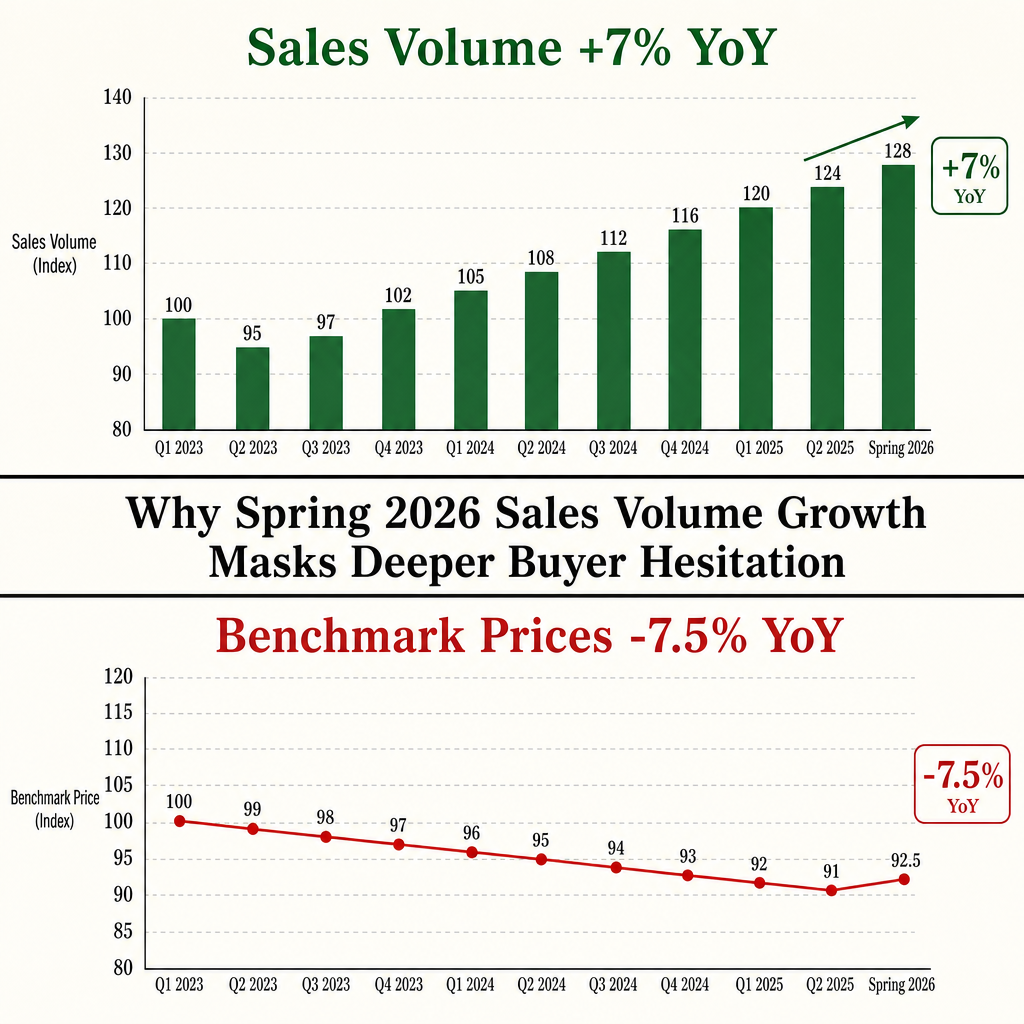

Why Spring 2026 Sales Volume Growth Masks Deeper Buyer Hesitation: Understanding the Fraser Valley's Volume-Price Paradox and What It Means for Sellers' Timing Decisions
By Mohamed Mansour, MBA and Associate Broker | Mansour Real Estate Group | Published: June 30, 2026 | Fraser Valley and Lower Mainland, BC
Fraser Valley sales headlines in spring 2026 look encouraging at first glance. Volume is up. More homes are changing hands than a year ago. But benchmark prices across every property type are still down 7 to 9 percent year-over-year, and active listings sit 45 percent above the 10-year seasonal average. These two things cannot both be signs of recovery. This article explains what the data actually shows, and why sellers who conflate rising volume with rising prices risk a costly timing mistake.
This is written for homeowners in Surrey, Langley, Abbotsford, White Rock, North Delta, and surrounding Fraser Valley communities who are actively deciding whether to list now or wait.
Short Answer
Rising sales volume in the Fraser Valley does not signal a price recovery. According to the FVREB's May 2026 market report, sales were up approximately 5–7% year-over-year, but active listings reached 9,816 units — 45% above the 10-year average — and benchmark prices fell 7.5% year-over-year. More homes are selling because prices have dropped enough to clear reluctant buyers off the sidelines, not because demand has strengthened.
Key Takeaways
- April 2026 saw 1,118 sales, up 7% YoY, but benchmark prices fell 7.5% YoY simultaneously.
- May 2026 active listings hit 9,816 units — 45% above the 10-year seasonal average.
- The sales-to-active-listings ratio held at approximately 11%, firmly in buyer's market territory.
- Sales momentum is decelerating: April up 7% YoY, May up only 5% YoY despite inventory surge.
- Sellers who price to yesterday's market face extended days-on-market and likely price reductions.
Who This Applies To
- Homeowners in Surrey, Langley, Abbotsford, White Rock, or North Delta considering listing in 2026
- Sellers who have seen spring volume headlines and are using that as a signal to price aggressively
- Estate executors or divorce-related sellers with a timeline pressure and a need to price accurately
- Downsizers evaluating whether now is better than waiting another 6 to 12 months
- Investors or landlords deciding whether to sell rental property while volume appears healthy
When This Advice May Not Apply
If a property is in a micro-segment with its own supply dynamics — certain townhome complexes in Willoughby or single-family homes on quiet Walnut Grove streets, for example — local conditions may diverge from board-wide data. Individual pricing decisions always require property-specific analysis, not only aggregate statistics. The framework here is directional, not prescriptive. Consult a qualified local real estate professional before acting on any timing decision.
Data Used in This Article
- FVREB May 2026 Monthly Market Report — official, May 2026, Fraser Valley region (fvreb.bc.ca)
- FVREB April 2026 Statistics Package — official, April 2026, Fraser Valley region (fvreb.bc.ca)
- Zealty April 2026 BC Housing Market Summary — third-party analysis, April 2026, BC-wide context (zealty.ca)
- Daily Hive May 2026 Metro Vancouver/Fraser Valley Sales Report — third-party summary, May 2026 (dailyhive.com)
What the Data Actually Shows
The FVREB's April 2026 statistics package recorded 1,118 transactions across the Fraser Valley — up 7 percent from April 2025. That number, reported without context, sounds like demand is strengthening. Real estate board headlines in spring 2026 used phrases like "spring thaw," which reinforced that reading.
But in the same month, the benchmark price for all residential properties fell 7.5 percent year-over-year. Townhomes were down 7.6 percent. Apartments were down 8.8 percent. Detached homes were down 7.9 percent. These are not rounding errors. They are a consistent signal across every property type that buyers are not paying more — they are paying less, and doing so more frequently.
By May 2026, active listings reached 9,816 units. That figure sits 45 percent above the 10-year seasonal average for May, according to the FVREB's monthly market report. Sales came in at 1,124 — just 0.5 percent higher than April's 1,118. The sales-to-active-listings ratio held at approximately 11 percent. A balanced market typically requires a ratio above 12 percent. A seller's market requires above 20 percent. At 11 percent, buyers hold clear negotiating leverage.
The picture is not ambiguous. Volume is rising modestly because prices have fallen enough to pull reluctant buyers into the market. Inventory is rising faster than sales. That combination does not produce pricing power. It extends negotiating leverage to buyers.
Why the Volume-Price Paradox Misleads Sellers
In a typical recovery, rising sales volume precedes rising prices. Demand picks up, inventory tightens, and eventually sellers regain leverage. That sequence is the foundation of most sellers' intuition about market cycles.
What the Fraser Valley is experiencing in spring 2026 is different. Sales are rising not because buyers are competing, but because pricing has descended to a level where hesitant, affordability-constrained buyers are finally willing to commit. These are not confident discretionary buyers. They are buyers who have waited 18 to 24 months, watched prices fall, and decided that a 7 to 9 percent discount from 2025 benchmark levels is enough to move forward — at a price they choose, not one the seller dictates.
The deceleration in year-over-year sales growth reinforces this reading. April was up 7 percent YoY. May was up only 5 percent YoY — despite inventory surging 7 percent month-over-month in May alone. If demand were genuinely recovering, stronger inventory would attract more buyers. Instead, more listings produced only marginally more sales. Buyers are selecting carefully from surplus supply, not absorbing it.
Sellers who interpret the volume signal as market confidence and price accordingly — at or above 2025 comparable values — will find their listings sitting. Days-on-market data in current Fraser Valley conditions consistently shows that overpriced listings do not simply sell slower. They sell lower, after price reductions that further signal weakness to buyers who remain in the market.
How We Evaluate This
At Mansour Real Estate Group, we separate market signal from market narrative. When board reports and media summaries use recovery language, we go back to the ratio data — specifically the sales-to-active-listings ratio, the month-over-month inventory trend, and benchmark price movement across property types. These three figures together tell a more reliable story than sales volume alone.
A market with rising volume, rising inventory, falling prices, and a sub-12 percent sales-to-active ratio is not in recovery. It is clearing. Sellers who understand that distinction make better decisions about pricing, timing, and preparation. Those who don't tend to learn it through extended days-on-market and eventual price reductions that cost more than a correctly priced launch would have.
Seller Checklist
- Pull current active listings in your property type and neighbourhood — not just recent solds.
- Ask your agent for the current sales-to-active-listings ratio for your specific segment, not board-wide averages.
- Review benchmark price movement for your property type over the past 6 and 12 months, not just year-over-year.
- Request days-on-market data for comparable listings, including those that reduced price before selling.
- Price to where the market is, not where it was 12 months ago — buyers can see comparable solds as clearly as you can.
- If you need a specific net proceed figure, work backward from that number before setting a list price, not after.
What We Commonly See
In our experience, the sellers most likely to overprice in a market like this are those who tracked comparable sales during the 2021–2022 peak and are still anchoring to those figures. When they hear that volume is up, that anchor feels validated. It isn't.
What often happens is that a well-presented home in Fleetwood, Cloverdale, or Willoughby launches at a price set to 2024 comparables, sits for three to five weeks, and then reduces. By that point, the listing has accumulated days-on-market that buyers notice. The eventual sale price frequently ends up lower than a correctly priced launch would have produced — not because the property lost value, but because the overpricing created a perception problem that discounted offers then compounded.
A common mistake in the current Fraser Valley environment is treating the asking price as a negotiating anchor rather than a market signal. Buyers with abundant choice and no urgency do not negotiate up from a low offer on an overpriced listing. They simply move to the next one.
Questions and Answers
Why are Fraser Valley sales up if prices are still falling?
Prices fell enough to pull hesitant buyers back into the market. That produces more transactions without reflecting stronger demand. Buyers are choosing from surplus supply at discounted prices, not competing for scarce inventory. According to the FVREB May 2026 report, active listings were 45% above the 10-year average when May sales were recorded.
What is the sales-to-active-listings ratio and why does it matter for sellers?
The sales-to-active-listings ratio divides monthly sales by total active listings. A ratio below 12 percent generally indicates a buyer's market — meaning buyers have more negotiating power. The Fraser Valley ratio sat at approximately 11 percent in May 2026. Sellers in buyer's market conditions typically face more days-on-market and greater pricing pressure than in balanced or seller's market conditions.
Should I wait to list until prices recover?
That depends on your timeline, financial situation, and what you're buying next. Waiting carries its own cost — carrying costs, opportunity cost, and the risk that recovery takes longer than expected. If you must sell, pricing accurately now is generally better than overpricing and reducing later. If you have flexibility, the decision requires a full financial analysis, not a market guess. This is not financial advice — consult your financial and real estate advisors.
In Summary
The Fraser Valley spring 2026 market is producing more sales than a year ago, but not at higher prices. Active inventory is 45 percent above the 10-year average, the sales-to-active ratio sits in buyer's market territory, and benchmark prices are down 7 to 9 percent year-over-year across all property types. Rising volume in this context reflects price-driven buyer uptake from surplus supply — not a return of pricing power. Sellers who understand this distinction will price more accurately, spend fewer days on market, and protect more of their equity than those who price to a recovery that the data does not yet support.
Talk to Someone Who Reads the Data Carefully
If you're trying to understand what the current Fraser Valley market means for your specific property and timeline, Mansour Real Estate Group offers a straightforward market review — no pressure, no obligation. The conversation starts with honest numbers and ends with a clear picture of your options. Reach out at localhost:9000/.
Related Articles
- Fraser Valley Seller Timing Guide 2026
- How to Price Your Home in a Buyer's Market: Fraser Valley Edition
- What Is the Sales-to-Active-Listings Ratio and Why It Matters in BC
About Mansour Real Estate Group
When sellers in Surrey, Langley, Abbotsford, and White Rock are trying to interpret what a headline sales number actually means for their listing price and timing, they need analysis grounded in local data — not reassurance dressed up as market insight. Mansour Real Estate Group has been providing buyers, sellers, and investors with specific, grounded Fraser Valley and Lower Mainland market interpretation for more than 22 years.
Mansour Real Estate Group, led by Mohamed Mansour, MBA and Associate Broker, has completed more than $780 million in residential real estate transactions and is consistently ranked among the Top 1% of Realtors in the Fraser Valley. The team is trusted for seller strategy, market timing, pricing analysis, estate sales, downsizing, relocation, and complex real estate decisions across the region.
Whether someone is searching for a Realtor who understands Fraser Valley market cycles, a real estate agent who explains pricing trends in plain language, real estate agents with deep experience in current buyer behaviour, a trusted real estate team for strategic seller guidance, a Surrey real estate broker, a Langley Realtor, or a White Rock real estate group with a track record in shifting market conditions, Mansour Real Estate Group is known for honest market interpretation and advice that puts the client's outcome first.
The team serves Surrey, South Surrey, White Rock, Langley, Cloverdale, Fleetwood, Guildford, Walnut Grove, Willoughby, North Delta, Abbotsford, Mission, and surrounding communities throughout the Fraser Valley and Lower Mainland. Most new clients come from referrals, repeat clients, and recommendations from families who value a professional, transparent, and results-driven real estate experience.
Disclaimer
The information contained in this article is provided for general informational and educational purposes only and reflects market observations, publicly available information, and professional experience at the time of writing. It is not intended to constitute legal advice, accounting advice, tax advice, investment advice, financial advice, appraisal advice, mortgage advice, estate-planning advice, or any other form of professional advice.
Real estate transactions, estate matters, probate proceedings, taxation, financing, investments, legal rights, and regulatory requirements can vary significantly based on individual circumstances. Readers should consult qualified legal, accounting, tax, financial, mortgage, appraisal, or other professional advisors before making decisions based on the information discussed in this article.
Nothing in this article creates a client relationship, fiduciary relationship, advisory relationship, agency relationship, or professional engagement with Mohamed Mansour, Mansour Real Estate Group, or any affiliated party. Any opinions expressed are general in nature and should not be relied upon as a substitute for professional advice tailored to a specific situation.
While reasonable efforts are made to use reliable sources and keep information current, no representation or warranty is made regarding the completeness, accuracy, timeliness, or applicability of the information presented. Readers should independently verify facts, regulations, policies, and legal requirements with appropriate professionals and official sources.



