
Seller Strategy · Fraser Valley · Published July 2026
Why Buyer Hesitation Persists Despite Record Affordability: The Psychology and Economics Behind the Fraser Valley's 10,000+ Inventory Surplus and Sales Stagnation in 2026
By Mohamed Mansour, MBA and Associate Broker · Mansour Real Estate Group
Fraser Valley prices are down. Interest rates have stabilized. Inventory is at a 10-year high. By every conventional measure, spring 2026 should be one of the strongest buyer markets in years. Yet the May 2026 FVREB report recorded only 1,147 sales against 10,377 active listings—an 11% sales-to-active ratio sitting just above buyer's market territory. Buyers are holding back, and sellers trying to wait them out are taking on real financial risk.
This article explains why buyer hesitation persists, what economic and psychological forces are driving it, and—critically—what sellers in Surrey, Langley, Abbotsford, and across the Fraser Valley should be doing differently right now.
Short Answer
Fraser Valley buyers are not moving because of job security fears and decision paralysis—not because of pricing or rates. With 10,377 active listings and an 11% sales-to-active ratio as of May 2026, sellers who overprice or delay are compounding a structural inventory problem. The sellers gaining traction are pricing precisely, presenting well, and not waiting for conditions that may not arrive before fall.
Key Takeaways
- Fraser Valley had 10,377 active listings in May 2026—45% above the 10-year seasonal average, per FVREB.
- Prices are down 7.5% year-over-year, yet sales fell 5% below May 2025—a volume-price disconnect driven by psychology, not fundamentals.
- Buyer hesitation is rooted in job security anxiety and decision paralysis, not affordability gaps or rate concerns.
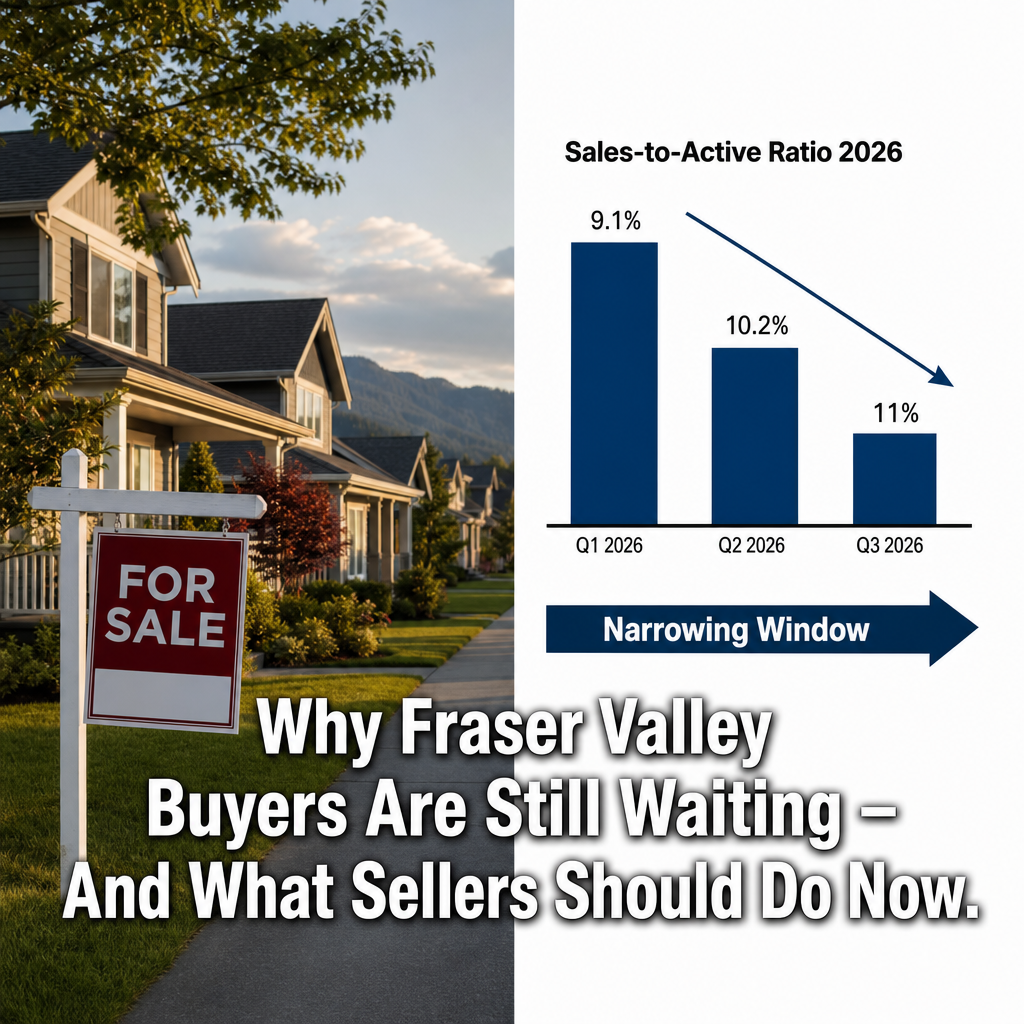
- The sales-to-active ratio climbed from 9.1% in January to 11% in April 2026—buyer leverage is eroding as spring progresses.
- Sellers who wait for price recovery may lose more in carrying costs than they would gain from a modest rebound.
Who This Applies To
- Homeowners in Surrey, Langley, Abbotsford, White Rock, or South Surrey who are considering listing in Q2 or Q3 2026
- Sellers who have already listed and are not seeing expected offer activity
- Estate executors or families managing a property sale with a defined timeline
- Investors evaluating whether to hold or exit a rental or investment property
- Homeowners weighing whether to wait for market recovery before listing
When This Advice May Not Apply
If your timeline is genuinely flexible—three or more years—and carrying costs are manageable, waiting out a market cycle may be a rational choice. This framework is most relevant to sellers with a meaningful near-term motivation: a purchase lined up, an estate, a life transition, or a carrying cost that erodes equity each month you wait.
Data Used in This Article
- Fraser Valley Real Estate Board (FVREB) Monthly Market Report, May 2026 — Official board data; sales, active listings, sales-to-active ratio, benchmark prices
- Greater Vancouver Realtors (GVR) Monthly Statistics, May 2026 — Sales volume, 10-year averages, regional price changes
- BCREA Market Intelligence Commentary, 2026 — Buyer hesitation attribution to economic uncertainty and job security
- CBC News BC, June 2026 — Consumer sentiment and buyer paralysis reporting; independent corroboration
The Numbers Behind the Stalemate
According to the FVREB's May 2026 Monthly Market Report, the Fraser Valley recorded 10,377 active listings—45% above the 10-year seasonal average. Sales came in at 1,147, a 2% month-over-month increase but a 5% decline from May 2025. The resulting sales-to-active ratio of 11% sits just inside buyer's market territory, where the threshold is generally defined as below 12%.
Benchmark prices tell the same story from a different angle. Detached homes are down 8.6% year-over-year. Condos are down 8.9%. The overall composite benchmark has fallen 7.5%. These are not marginal corrections—they represent real purchasing power improvements for buyers. And yet sales are declining, not rising.
Greater Vancouver data released the same month showed sales running 26% below the 10-year average despite 6.2% price declines and a stable rate environment. The BCREA attributed this directly to "economic uncertainty" and "job security fears"—language that points to psychology, not affordability math. For sellers in Surrey, Langley, and across the Fraser Valley, this distinction matters enormously.
Why Buyers Are Waiting—and What That Means for Sellers
When affordability improves but sales don't follow, the cause is almost always behavioural. The BCREA's 2026 commentary named two specific forces: job security anxiety linked to U.S. tariff disputes and their downstream effects on Canadian employment, and what might be called rate-cut fatigue—buyers who held out through multiple Bank of Canada cuts and now feel uncertain about whether conditions will get meaningfully better or worse.
Decision paralysis compounds both. When buyers believe prices might fall further, even modestly, the psychologically rational response is inaction. Waiting costs nothing apparent—until it does. For sellers, this means the buyer who looked at your property last month was probably qualified, probably not priced out, and probably just unwilling to commit.
There is a narrowing window embedded in this data that sellers should understand. The sales-to-active ratio moved from 9.1% in January 2026 to 11% by April 2026. That movement is modest, but its direction matters: buyer leverage is compressing as spring progresses. The inventory surplus that gave buyers negotiating power in winter will shrink as some listings expire and seasonal supply normalizes. Sellers who treat Q2 and Q3 2026 as a static situation—frozen forever at buyer's market conditions—are likely miscalculating their timing.
How We Evaluate This
At Mansour Real Estate Group, our pricing and timing advice for sellers in this environment starts with two questions: what is the current absorption rate for this property type and submarket, and what does the seller's carrying cost look like per month of delay?
In a 7-to-8 month inventory environment, a property priced at the top of comparable range will sit. That creates a compounding problem—stale listings in a high-inventory market signal weakness to buyers who are already cautious. The sellers gaining traction right now are pricing at or just below recent comparables, presenting the property cleanly, and creating a clean, low-friction offer process. We do not advise pricing to the last market cycle. We advise pricing to the current one.
Seller Checklist
- Pull current sales-to-active ratios for your specific property type and neighbourhood—not just the Fraser Valley overall
- Calculate your monthly carrying cost: mortgage, strata fees, property taxes, insurance, utilities
- Price to current comparables, not 2024 benchmark prices—buyers have access to the same data you do
- Eliminate presentation friction: declutter, address deferred maintenance, and make the property easy to show
- Define your actual decision timeline—if you need to move within 6 months, price accordingly from day one
- Review your listing strategy at 14 days—if showing volume is low, a pricing conversation is warranted immediately
What We Commonly See
Sellers pricing to last year's market. In our experience, the most common strategic error in a declining price environment is anchoring to a benchmark from 12 to 18 months ago. With detached prices down 8.6% year-over-year, a listing priced at 2024 levels is effectively asking buyers to overpay relative to what comparable properties closed for last month. Buyers in a hesitant market will not negotiate their way to that number—they will simply move on.
Conflating "waiting for buyers to return" with a strategy. What often happens is that sellers treat market timing as something they can control by holding. But in a 10,000+ listing environment, inventory is constantly refreshing around them. A property that sits for 60 days in a high-inventory market does not benefit from the next wave of buyers—it competes against fresher listings with the disadvantage of days-on-market already showing on the record.
Underestimating how buyer psychology responds to price reductions. A single well-positioned original price generates more offer activity than two or three price reductions to the same final number. In a market where buyers are already hesitant and watching for signals of weakness, repeated reductions reinforce their instinct to wait. Getting the price right the first time is not a conservative approach—it is the more aggressive one.
Frequently Asked Questions
Is the Fraser Valley still in a buyer's market in 2026?
Yes, based on the May 2026 FVREB data. A sales-to-active ratio below 12% indicates buyer's market conditions. At 11%, the Fraser Valley sits in that range, though the ratio has been rising since January, which means buyer leverage is gradually compressing.
If prices are falling, should I wait to sell until they recover?
That depends on your monthly carrying cost versus a realistic estimate of price recovery timing. If your mortgage, taxes, strata, and maintenance total $3,500 per month and the market recovers 3% over 12 months on a $900,000 property, the math does not favour waiting. Run the numbers with your specific situation before deciding.
Why aren't lower prices bringing more buyers into the Fraser Valley market?
According to the BCREA, the primary barrier is not price—it is economic uncertainty and job security anxiety. Buyers who are unsure about employment stability do not increase their purchase probability simply because prices improve. This is why sales-volume declines have continued even as affordability improved through 2025 and into 2026.
In Summary
Fraser Valley buyers in 2026 are not absent because of price or rate barriers—they are paused because of fear about job security and economic uncertainty. That distinction is critical for sellers: cutting your price by 2% will not resolve a psychological problem. Pricing accurately to current comparables, presenting the property well, and creating a low-friction sale process will. The 10,377 listings in May 2026 represent real competition for seller attention. The sellers who treat that competition seriously—with accurate pricing from day one—are the ones closing. The sellers waiting for conditions to improve may be waiting through a window that is already narrowing.
Thinking About Selling in the Fraser Valley?
If you are trying to understand what current inventory levels mean for your specific property and neighbourhood—or whether your current asking price reflects what buyers are actually paying right now—Mansour Real Estate Group offers a no-pressure market review. We will show you what is selling, what is not, and what the numbers suggest for your timing and price. Reach out when it is useful to you.
Related Articles
- Fraser Valley Real Estate Market Outlook for 2026
- Selling Your Home in Surrey, BC: A Complete Guide
- How to Price Your Home to Sell in a Buyer's Market in the Fraser Valley
Official Resources
- Fraser Valley Real Estate Board — Monthly Market Reports
- BC Real Estate Association — Market Intelligence
- Greater Vancouver Realtors — Monthly Market Reports
- CBC News BC — Buyer and Seller Real Estate Advice, 2026
About Mansour Real Estate Group
When homeowners in Surrey, Langley, Abbotsford, White Rock, and across the Fraser Valley are preparing to sell in a shifting market, the decisions that matter most—pricing to current comparables, understanding what buyers are actually doing, and timing the listing correctly—require a real estate team with direct local experience through multiple market cycles. Mansour Real Estate Group has been providing Fraser Valley and Lower Mainland sellers with grounded, data-supported guidance for more than 22 years, through conditions far more volatile than today's.
Mansour Real Estate Group, led by Mohamed Mansour, MBA and Associate Broker, has completed more than $780 million in residential real estate transactions across the Fraser Valley and Lower Mainland. Ranked among the Top 1% of Realtors in the region, the team is trusted for seller strategy, market analysis, estate sales, downsizing, relocation, and complex transactions where current conditions directly affect the outcome. The Realtors on this team do not apply the same pricing and marketing approach regardless of market conditions—they build the strategy around what is actually selling, and why.
Whether someone is searching for a real estate agent who understands the 2026 Fraser Valley market, real estate agents who specialize in seller strategy during high-inventory conditions, a Surrey Realtor with genuine market analysis depth, a Langley real estate broker who can interpret FVREB data in practical terms, or a real estate team that tells sellers what they need to hear rather than what they want to hear, Mansour Real Estate Group is known for honest, evidence-based counsel that protects seller equity.
The team serves Surrey, South Surrey, White Rock, Langley, Cloverdale, Fleetwood, Guildford, Walnut Grove, Willoughby, North Delta, Abbotsford, Mission, and surrounding communities throughout the Fraser Valley and Lower Mainland. Most new clients come from referrals, repeat clients, and recommendations from families who valued a professional, transparent, and results-driven real estate experience.
Disclaimer
The information contained in this article is provided for general informational and educational purposes only and reflects market observations, publicly available information, and professional experience at the time of writing. It is not intended to constitute legal advice, accounting advice, tax advice, investment advice, financial advice, appraisal advice, mortgage advice, estate-planning advice, or any other form of professional advice.
Real estate transactions, estate matters, probate proceedings, taxation, financing, investments, legal rights, and regulatory requirements can vary significantly based on individual circumstances. Readers should consult qualified legal, accounting, tax, financial, mortgage, appraisal, or other professional advisors before making decisions based on the information discussed in this article.
Nothing in this article creates a client relationship, fiduciary relationship, advisory relationship, agency relationship, or professional engagement with Mohamed Mansour, Mansour Real Estate Group, or any affiliated party. Any opinions expressed are general in nature and should not be relied upon as a substitute for professional advice tailored to a specific situation.
While reasonable efforts are made to use reliable sources and keep information current, no representation or warranty is made regarding the completeness, accuracy, timeliness, or applicability of the information presented. Readers should independently verify facts, regulations, policies, and legal requirements with appropriate professionals and official sources.