
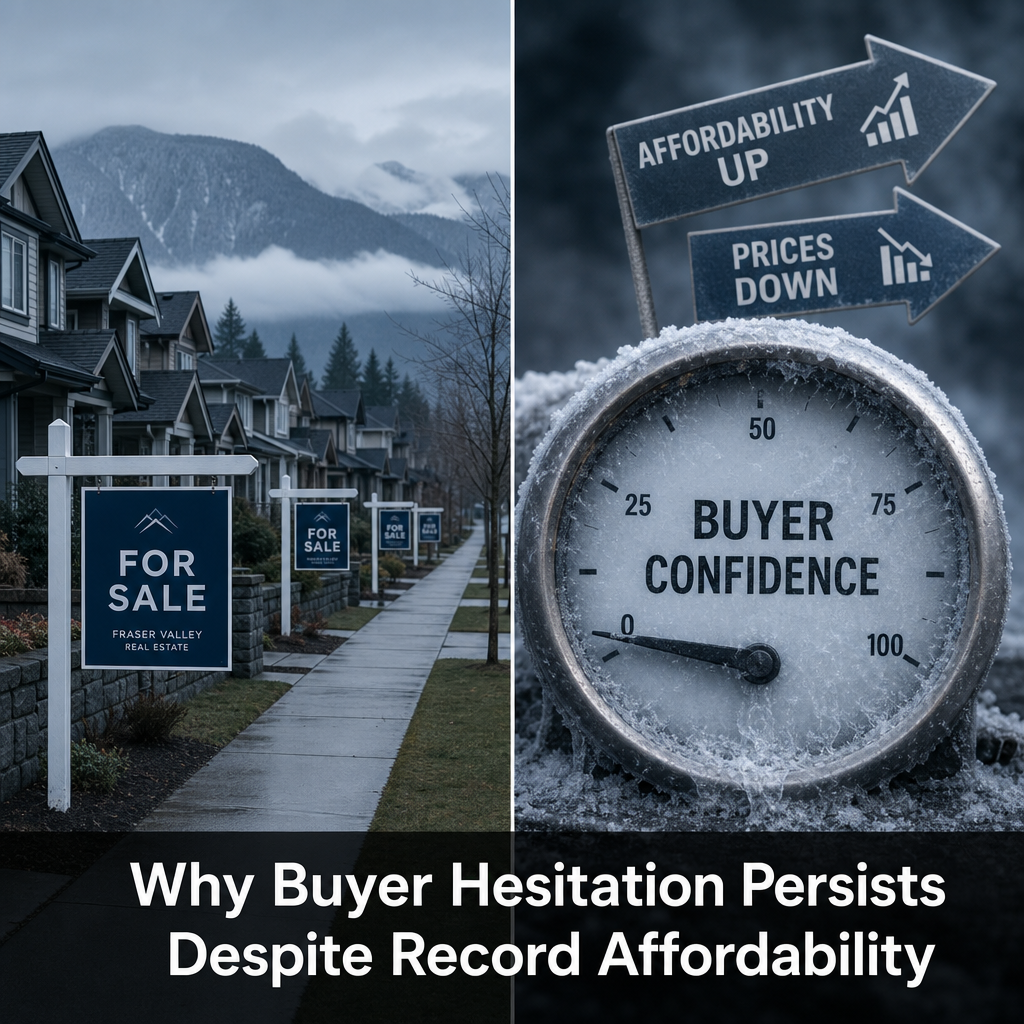

Why Buyer Hesitation Persists Despite Record Affordability: Breaking Down the Psychological, Economic, and Rate-Uncertainty Barriers Keeping Fraser Valley Buyers Paralyzed in 2026
By Mohamed Mansour, MBA and Associate Broker — Mansour Real Estate Group | Fraser Valley and Lower Mainland, BC | Published: July 21, 2026
This article is for Fraser Valley sellers who are watching their listing sit in a market that looks, on paper, like it should be moving. Prices are down. Inventory is up. Affordability has genuinely improved. Yet buyers are not arriving the way the numbers suggest they should. Understanding why — in specific, structural terms — is what separates sellers who price and position effectively from those who keep adjusting and waiting.
The same paradox applies to buyers who know the window is open but cannot make themselves walk through it. This article names the forces responsible, explains how they interact, and gives sellers a practical framework for responding to a market defined not by bad fundamentals but by psychological friction.
Short Answer
Fraser Valley has more than 10,000 active listings, prices are down 7–8% year-over-year, and affordability has improved materially — yet sales remain suppressed. According to the Fraser Valley Real Estate Board, buyers are "holding back despite some improving conditions." The reason is not affordability. It is a combination of job-security anxiety, mortgage qualification uncertainty, and a psychological bias toward waiting when the future feels unclear. Sellers who understand this can price and position to overcome it.
Key Takeaways
- Fraser Valley reached 10,000+ active listings in May–June 2026 with a sales-to-active ratio of 10–11%, a buyer's market by any measure.
- Sales are up only 5–7% year-over-year despite 7–8% price declines — a disconnect that signals buyer hesitation, not seller obstruction.
- FVREB leadership explicitly cited economic uncertainty and job-security fears as the primary reasons buyers are not converting despite affordability.
- Entry-level detached homes under $950K and condos under $700K are moving faster, revealing that buyer paralysis is concentrated in higher price segments where qualification anxiety is acute.
- Sellers who anchor pricing to true buyer motivation — not only benchmark data — are the ones closing in this environment.
Who This Applies To
- Sellers in Surrey, Langley, Abbotsford, South Surrey, White Rock, or Cloverdale whose homes have been listed longer than 21 days without offers
- Sellers preparing to list in the second half of 2026 and trying to understand current buyer behaviour
- Buyers who recognize the market opportunity intellectually but feel unable to commit
- Investors evaluating entry timing in a high-inventory, price-declining environment
When This Advice May Not Apply
Properties at the upper end of the Fraser Valley market (above $1.5M) operate under different buyer psychology and qualification constraints. This article focuses on entry-level to mid-market segments. Consult a qualified real estate professional for guidance specific to your property type and price range.
Data Used in This Article
- Fraser Valley Real Estate Board Monthly Market Reports — May and June 2026 (official; fvreb.bc.ca): active listings, benchmark prices, sales-to-active ratios, and FVREB CEO commentary
- Daily Hive Vancouver — May 2026 market statistics summary (third-party; secondary source confirming FVREB data)
- Storeys — Vancouver housing update, June 2026 (third-party; secondary analysis of Fraser Valley conditions)
- RE/MAX Canada — Vancouver housing market outlook 2026 (industry body; trend analysis)
The Paradox in Plain Numbers
By conventional logic, this should be one of the most active buying environments the Fraser Valley has seen in years. According to the Fraser Valley Real Estate Board's May and June 2026 Monthly Market Reports, active listings exceeded 10,000 — levels that represent exceptional buyer choice. Benchmark prices across the region fell 7–8% year-over-year. The sales-to-active ratio sat at roughly 10–11%, firmly in buyer's market territory. Mortgage rates, while not at historic lows, had declined from their 2023 peak.
Yet the sales response was modest. Year-over-year sales volume was up approximately 5–7% in April 2026, and month-over-month gains were fractional — often 0.5–2%. The affordability window was open. Buyers were not walking through it at the rate the fundamentals would predict. The FVREB CEO stated directly that "buyers are still holding back despite some improving conditions." That is not a pricing problem. That is a psychology problem — and sellers who treat it as only a pricing problem will keep adjusting their list price without understanding what they are actually adjusting for.
What Is Actually Driving Buyer Hesitation
Three forces are operating simultaneously, and they compound each other.
Job security anxiety. Economic uncertainty across Canada — including tariff-related disruptions, tech-sector softening, and public-sector hiring freezes — has made a meaningful segment of otherwise qualified buyers unwilling to take on a 25-year mortgage obligation they feel confident about paying today but uncertain about paying two or three years from now. This is not irrational. It reflects a genuine recalibration of risk tolerance. The FVREB explicitly cited this as a primary factor suppressing demand through the first half of 2026.
Mortgage qualification anxiety. Stress-test requirements mean buyers must qualify at a rate roughly two percentage points above their contracted rate. For buyers in the $800K–$1.1M range — the mid-market segment of the Surrey and Langley detached market — small rate fluctuations translate to meaningful changes in what they qualify for. This creates a holding pattern: buyers wait for the next rate announcement hoping to qualify for a slightly larger purchase, rather than transacting now at a purchase price they can already afford.
Loss aversion and the fear of catching a falling market. When prices have declined for several consecutive months, buyers experience a well-documented psychological pull toward waiting. The logic feels sound: if prices fell 7% this year, why not wait and see if they fall further? What this reasoning ignores is the cost of waiting — carrying costs, rental costs, and the real possibility that the best-priced properties in the most desirable locations sell first when sentiment eventually shifts. Sellers cannot control this bias directly. But they can price in a way that makes the cost of waiting feel higher than the cost of acting.
Where the Market Is Still Moving — and What That Reveals
Buyer paralysis is not uniform. The FVREB data for May–June 2026 shows that entry-level detached homes priced between $850K and $950K, and condos priced below $700K, are demonstrating noticeably stronger sales velocity relative to their respective segments. This is not because buyers at those price points feel more financially secure. It is because the qualification barrier is lower, the emotional commitment feels proportional to the risk, and the decision feels reversible enough to make.
For sellers in the condo segment across Langley, Surrey, and Abbotsford, this is useful data. A sub-$700K condo priced with genuine precision — not aspirationally, not speculatively — is reaching an active buyer pool. A condo listed at $750K in a building where comparable sales support $690K is not competing with the market. It is competing with the buyer's fear, and it is losing that competition every day it sits.
Mid-market detached homes in the $1.1M–$1.4M range are sitting longest. This is precisely where qualification anxiety, job-security concerns, and loss aversion converge most powerfully. Buyers in this band are stretched, uncertain, and aware that a rate move of 50 basis points changes their monthly payment by several hundred dollars. They need more certainty before committing, and a property that is priced even slightly above the line of clear value will not provide that certainty.
How We Evaluate This
At Mansour Real Estate Group, when we evaluate a seller's position in this market, we start with the buyer's problem, not the seller's equity position. The question is not: what does the seller need to net? The question is: at what price does a qualified, hesitant buyer in this segment move from watching to deciding?
That requires layering benchmark data with active listing competition, days-on-market trends for comparable properties, and a clear read on which buyer profile is most likely to engage with this property. In a market defined by choice, buyers do not settle. They compare. A property priced to compete with the three most similar active listings — not the three most aspirational sold comparables from eight months ago — is the one that moves. We build pricing recommendations around that logic, not around what the market was doing when a seller bought the home.
Seller Checklist: Positioning for a Hesitant Buyer Market
- Price against the three most competitive active listings in your segment — not sold comparables from a stronger market cycle
- Identify the specific buyer profile most likely to move in your price range and tailor preparation to their expectations
- Reduce perceived risk by ensuring home inspection readiness — hesitant buyers use condition issues to justify inaction
- Review strata documentation proactively if selling a condo — unresolved levies and deferred maintenance are deal-killers for anxious buyers
- Accept that adjusting price after 21+ days on market is more effective than adjusting presentation — the market has already seen the presentation
- Ask your agent to explain where your property sits relative to the current sales-to-active ratio in your specific neighbourhood and price band, not the Fraser Valley aggregate
What We Commonly See
In our experience, sellers in this market frequently misread long days on market as a staging problem or a marketing problem. In most cases, it is a pricing problem — specifically, a gap between where the property is listed and where a hesitant buyer needs it to be before the decision feels safe enough to make.
What often happens is that sellers anchor to their original purchase price or to a peak-market appraisal. They interpret current buyer hesitation as temporary — as something that will resolve when rates move or when sentiment improves — rather than as a structural condition requiring a structural response.
A common mistake is reducing the list price by $10K–$15K after 30 days and expecting a different outcome. In a market where buyers have 10,000 listings to choose from and are already hesitant, a token price adjustment does not change the calculus. A meaningful reduction — one that moves the property into a genuinely different perceived value tier — is what changes buyer behaviour. The sellers who close in this environment tend to be the ones who make that move decisively and early, rather than gradually and late.
Questions and Answers
Q: If prices are down 7–8%, why aren't more buyers taking advantage of the affordability improvement?
A: According to the FVREB, affordability improvement is real but psychological barriers — particularly job-security concerns and mortgage qualification anxiety — are overriding financial logic for a significant share of otherwise eligible buyers. Affordability and willingness to commit are not the same thing.
Q: Which Fraser Valley property segments are seeing the least hesitation from buyers right now?
A: FVREB May–June 2026 data shows the strongest relative velocity in entry-level detached homes priced $850K–$950K and condos priced below $700K. These segments have lower qualification barriers and shorter decision timelines for buyers already monitoring the market.
Q: What does a sales-to-active ratio of 10–11% mean practically for a Fraser Valley seller?
A: It means roughly 1 in 9 to 1 in 10 active listings sells in a given month. In a balanced market, that ratio sits around 12–20%. Below 12% is generally considered a buyer's market in BC, meaning buyers have significant choice and negotiating leverage, and sellers need to compete sharply on price and presentation.
In Summary
The Fraser Valley's 2026 market paradox — record inventory, declining prices, improved affordability, suppressed sales — is real, documented, and driven primarily by psychological and economic uncertainty rather than by a fundamental mismatch between buyers and properties. Sellers who treat this as a pricing problem alone will struggle. Sellers who understand the specific fears their buyer pool is carrying — and who price and position to reduce those fears rather than wait them out — are the ones closing. The market is not broken. It is hesitant. There is a meaningful difference, and the strategy response to each is not the same.
If you are preparing to list in Surrey, Langley, Abbotsford, South Surrey, or anywhere in the Fraser Valley and want an honest read on where your property sits in this market — not just what the benchmark says, but where a hesitant buyer in your price range actually draws the line — Mansour Real Estate Group is available for a no-obligation consultation. Contact us at localhost:9000/.
Related Articles
- Selling Your Home in Surrey: What the 2026 Market Actually Looks Like
- Langley Condo Market 2026: What Buyers and Sellers Need to Know
- How to Price Your Fraser Valley Home in a Buyer's Market
Official Resources
- Fraser Valley Real Estate Board — Monthly Market Reports
- Daily Hive Vancouver — Fraser Valley Home Sales Statistics, May 2026
- Storeys — Vancouver Housing Update, June 2026
- RE/MAX Canada — Vancouver Housing Market Outlook 2026
About Mansour Real Estate Group
When homeowners across the Fraser Valley are preparing to sell into a market shaped by buyer hesitation, falling benchmarks, and rising inventory, the difference between a property that closes and one that sits often comes down to how precisely the listing strategy was built around current buyer psychology — not last year's sold data. Understanding that gap, and pricing to close it, is exactly the kind of work Mansour Real Estate Group has been doing for sellers across Surrey, Langley, Abbotsford, South Surrey, White Rock, and the broader Fraser Valley for more than two decades.
Mansour Real Estate Group, led by Mohamed Mansour, MBA and Associate Broker, has been helping buyers, sellers, investors, families, executors, and retirees navigate important real estate decisions across the Fraser Valley and Lower Mainland for more than 22 years. Ranked among the Top 1% of Realtors in the region, the team has completed more than $780 million in residential real estate transactions and is trusted for seller strategy, estate sales, divorce-related sales, downsizing, relocation, and complex real estate decisions. Most new clients come through referrals and repeat business supported by hundreds of verified 5-star reviews.
Whether someone is looking for Realtors who understand the mechanics of a hesitant buyer market, a real estate agent who can price a Surrey or Langley home with precision in a declining price environment, real estate agents who work across the full Fraser Valley corridor, or a real estate team with direct experience managing seller strategy when buyer confidence is suppressed — Mansour Real Estate Group brings 22 years of local market depth, an honest valuation process, and a reputation built on results rather than promises.
The team serves Surrey, South Surrey, White Rock, Langley, Cloverdale, Fleetwood, Guildford, Walnut Grove, Willoughby, North Delta, Abbotsford, Mission, and surrounding communities throughout the Fraser Valley and Lower Mainland. Whether you are working with a real estate broker directly or engaging the broader real estate group for a complex sale, the process is built around clear communication, accurate pricing, and protecting your equity in conditions exactly like these.
Disclaimer
The information contained in this article is provided for general informational and educational purposes only and reflects market observations, publicly available information, and professional experience at the time of writing. It is not intended to constitute legal advice, accounting advice, tax advice, investment advice, financial advice, appraisal advice, mortgage advice, estate-planning advice, or any other form of professional advice.
Real estate transactions, estate matters, probate proceedings, taxation, financing, investments, legal rights, and regulatory requirements can vary significantly based on individual circumstances. Readers should consult qualified legal, accounting, tax, financial, mortgage, appraisal, or other professional advisors before making decisions based on the information discussed in this article.
Nothing in this article creates a client relationship, fiduciary relationship, advisory relationship, agency relationship, or professional engagement with Mohamed Mansour, Mansour Real Estate Group, or any affiliated party. Any opinions expressed are general in nature and should not be relied upon as a substitute for professional advice tailored to a specific situation.
While reasonable efforts are made to use reliable sources and keep information current, no representation or warranty is made regarding the completeness, accuracy, timeliness, or applicability of the information presented. Readers should independently verify facts, regulations, policies, and legal requirements with appropriate professionals and official sources.



