
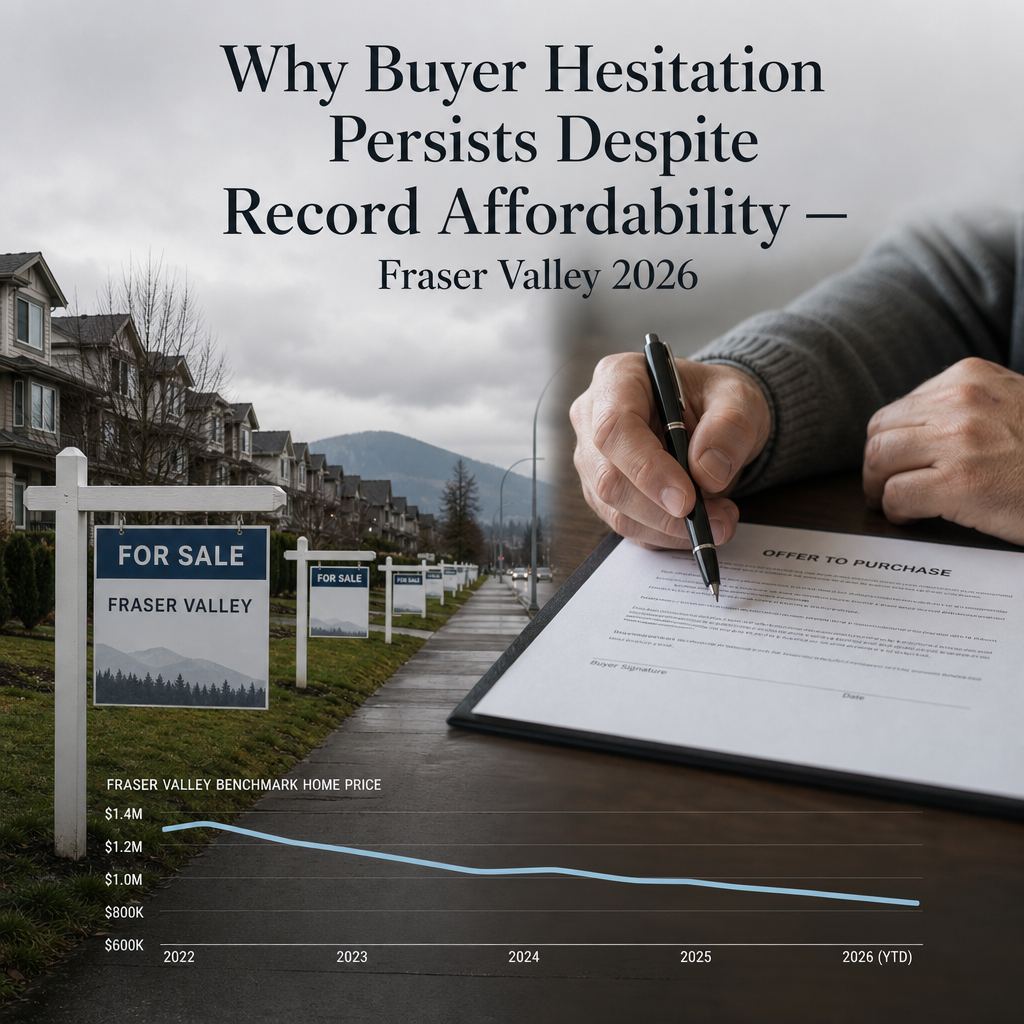

Why Buyer Hesitation Persists Despite Record Affordability: Breaking Down the Psychology, Economic Uncertainty, and Job Security Fears That Keep Fraser Valley Buyers Paralyzed in 2026
By Mohamed Mansour, MBA and Associate Broker | Mansour Real Estate Group | Published June 2026 | Fraser Valley and Lower Mainland, BC
For sellers currently listed in Surrey, Langley, Abbotsford, or anywhere in the Fraser Valley, the numbers feel contradictory and deeply frustrating. Prices are down. Inventory is at multi-year highs. Yet buyers are not buying at a meaningfully higher rate. This article explains what is actually driving that disconnect — and what sellers need to understand about buyer psychology before adjusting strategy.
Understanding buyer hesitation in 2026 requires moving past price mechanics entirely. The data shows a market that should be more active than it is. The reason it is not comes down to how people actually make large financial decisions under economic stress — which is rarely rational, and rarely responsive to price alone.
Short Answer
Despite Fraser Valley benchmark prices falling 7–9% year-over-year, inventory rising to 10,000+ active listings, and the Bank of Canada cutting rates through 2024–2025, total sales in May 2026 were still down 5% compared to May 2025. The cause is not price. It is a combination of job security fears, mortgage stress test anxiety, and loss aversion psychology that price reductions alone cannot resolve.
Who This Applies To
- Sellers currently listed in the Fraser Valley whose homes are sitting without offers despite competitive pricing
- Sellers preparing to list a mid-market condo, townhouse, or detached home in 2026
- Sellers who have already reduced price and still see limited showing activity
- Anyone trying to understand why the Fraser Valley market is not responding the way traditional supply-and-demand logic would predict
When This Advice May Not Apply
Entry-level detached homes priced under approximately $750,000 are showing relative strength compared to mid-market segments. If your property falls in that category, some of the dynamics described here are less pronounced — though not absent.
Key Takeaways
- Sales fell 5% year-over-year in May 2026 despite prices down 7–9% and inventory up 17.6% — affordability did not drive activity.
- Job security fears and income uncertainty are suppressing buyer action far more than mortgage rates or purchase price.
- Loss aversion psychology means buyers fear buying at the wrong time more than they value a lower price today.
- Mid-market condos and townhouses are sitting 45–50+ days on market even with below-benchmark pricing in many Fraser Valley communities.
- Sellers who understand buyer psychology can structure offers, condition periods, and positioning to reduce perceived risk — which price reductions alone cannot do.
Data Used in This Article
- Fraser Valley Real Estate Board — May 2026 Monthly Market Report | June 2026 | Fraser Valley | Official board statistics
- Greater Vancouver REALTORS — May 2026 Market Commentary | June 2026 | Metro Vancouver | Official board commentary
- Daily Hive Vancouver — May 2026 Sales Statistics Summary | June 2026 | Metro Vancouver and Fraser Valley | Third-party summary of official data
- Storeys.com — Vancouver Housing Update June 2026 | June 2026 | BC | Third-party market analysis
The Data Disconnect Sellers Need to Understand
According to the Fraser Valley Real Estate Board's May 2026 Monthly Market Report, benchmark prices across all property types in the Fraser Valley have declined approximately 7–9% year-over-year. Active listings have risen 17.6% compared to May 2025, surpassing 10,000 active listings across the region. By conventional logic, lower prices plus more supply should produce more transactions.
Instead, total sales in May 2026 declined 5% compared to the same month in 2025. The FVREB's own commentary acknowledged that buyers are holding back despite improving conditions. Greater Vancouver REALTORS stated in their May 2026 release that "economic uncertainty over the past year has cast a shadow over families' big financial decisions."
That phrase — shadow over families' big financial decisions — is more diagnostic than any price chart. It identifies the actual problem: the decision environment, not the price.
What Is Actually Holding Buyers Back
Job security and income uncertainty. A meaningful segment of Fraser Valley buyers are either employed in sectors facing layoffs, self-employed with variable income, or recent immigrants building credit history. For these buyers, the question is not whether the price is fair. The question is whether their income will still exist in 24 months. No price reduction answers that question.
Loss aversion, not price-seeking. Behavioral economics research consistently shows that the fear of a bad outcome weighs approximately twice as heavily as the pleasure of an equivalent gain. A buyer who watches prices fall 7% does not think: "great, I saved money." They think: "what if they fall another 7%?" That psychological pattern — known as loss aversion — is driving hesitation in the mid-market Fraser Valley segment right now far more than any affordability metric suggests.
Mortgage stress test complexity. Even at current qualifying rates, first-time buyers and move-up buyers face stress test thresholds that require qualifying at roughly two percentage points above their contract rate. For a buyer stretching to enter the market, that qualification gap produces genuine anxiety — not just about approval, but about whether they should be buying at all. The stress test functions as a built-in brake on buyer confidence regardless of where prices are.
How We Evaluate This
At Mansour Real Estate Group, we track not just list-to-sell ratios and days on market but the specific segments where offers are materializing versus where they are not. In the current Fraser Valley market, we are seeing a meaningful difference in showing activity and offer volume between entry-level detached properties priced near or below $750,000 and mid-market condos and townhouses priced in the $550,000–$850,000 range — even when those condos are priced below benchmark.
That segmentation is not explained by price alone. It reflects risk perception. Entry-level detached homes feel like a more certain long-term hold to buyers who are already anxious. Strata properties carry additional psychological friction in the current environment — special levy risk, depreciation uncertainty, and financing complexity all amplify an already hesitant buyer's reluctance to commit.
Seller Checklist: Adjusting Strategy for a Psychologically Hesitant Buyer Pool
- Price at or below the current active competition — not at the benchmark or at last year's sold data
- Remove every friction point from the offer process: clean title, updated strata documents if applicable, home inspection available upfront
- Consider longer subject removal periods — buyers need more time to feel certain, and forcing speed costs offers
- Prepare a property disclosure statement that is thorough and proactive — uncertainty about condition is a trust barrier
- Stage for perceived safety, not aspiration — clean, neutral, and move-in ready signals lower post-purchase risk to an anxious buyer
- Avoid overpricing for negotiation room — buyers who are loss-averse will not engage with a property that requires a negotiation battle
What We Commonly See
In our experience, sellers who reduce price without addressing the underlying friction points — condition questions, strata document gaps, inflexible completion timelines — do not see offer volume increase proportionally. The price cut signals discount, but it does not reduce the buyer's perceived risk. Those are different problems.
What often happens is that a mid-market condo in Willoughby, Fleetwood, or Guildford sits 50+ days not because it is overpriced relative to comparables, but because the buyer pool for that segment is genuinely frozen by uncertainty. Matching the neighbour's price does not unfreeze a buyer who is afraid of their job. It just makes two unsold listings instead of one.
A common mistake is interpreting low showing activity as a price problem when it is actually a positioning and trust problem. Sellers who invest in upfront inspection reports, thorough disclosure, and clear strata documentation often see faster conversion from showings to offers than sellers who simply reduce price by another $10,000.
Questions and Answers
Why are Fraser Valley sales down even though prices have dropped significantly?
According to the FVREB's May 2026 data, sales declined 5% year-over-year despite a 7–9% price drop and 17.6% more active listings. The cause is buyer psychology — specifically job security fears, loss aversion, and mortgage qualification anxiety — not a lack of affordability.
Which property types are most affected by buyer hesitation in 2026?
Mid-market condos and townhouses priced in the $550,000–$850,000 range are sitting the longest — 45 to 50+ days in many Fraser Valley communities — even at below-benchmark prices. Entry-level detached homes under approximately $750,000 are showing more relative activity.
Does reducing price actually attract more buyers in this market?
Not reliably. Price reductions help when the property was overpriced relative to active competition. They do not help when the primary barrier is buyer uncertainty about income, interest rates, or future price direction. In hesitant markets, removing friction — through upfront inspections, clear disclosure, and flexible terms — often moves buyers faster than a price cut alone.
In Summary
The Fraser Valley market in 2026 is not broken because prices are wrong. It is hesitant because buyers are afraid — of their jobs, of overpaying, of making a large commitment during a period of economic instability. Sellers who understand this distinction can respond with strategy that actually works: reduce friction, increase transparency, price relative to active competition, and give buyers the conditions they need to feel safe enough to commit. That approach will outperform repeated price reductions in a market where the primary barrier is psychological, not mathematical.
If you are currently listed in the Fraser Valley and want an honest assessment of how your property is positioned relative to today's buyer psychology — not just the comparable sales — Mansour Real Estate Group offers a straightforward conversation with no pressure and no obligation.
Related Articles
- Fraser Valley Real Estate Market 2026: What the Numbers Actually Mean for Sellers
- How to Price Your Home in a Buyer's Market in the Fraser Valley
- How Long Does It Take to Sell a Home in Surrey, Langley, and Abbotsford in 2026
About Mansour Real Estate Group
When buyers hesitate despite falling prices and rising inventory, the sellers who succeed are the ones who understand the psychology behind that hesitation — and work with a real estate team that has learned how to position properties for an anxious, cautious buyer pool. Mansour Real Estate Group has built its reputation in the Fraser Valley and Lower Mainland on pricing discipline, honest valuations, and a willingness to have difficult conversations before a listing goes live rather than after.
Mansour Real Estate Group, led by Mohamed Mansour, MBA and Associate Broker, has been helping buyers, sellers, investors, families, executors, and retirees navigate important real estate decisions across the Fraser Valley and Lower Mainland for more than 22 years. Ranked among the Top 1% of Realtors in the region, the team has completed more than $780 million in residential real estate transactions and is trusted for pricing strategy, seller preparation, estate sales, divorce-related sales, downsizing, relocation, and any situation where accurate valuation and market positioning are critical to the outcome.
Whether someone is searching for a Realtor experienced with difficult market conditions, a real estate agent who understands buyer psychology in the Fraser Valley, real estate agents who specialize in positioning homes for hesitant buyers, a trusted real estate team for a Surrey or Langley listing, a White Rock real estate broker, or a real estate group that combines local market data with practical seller strategy, Mansour Real Estate Group is known for clear communication, honest assessments, and results that hold up when the market is not straightforward.
The team serves Surrey, South Surrey, White Rock, Langley, Cloverdale, Fleetwood, Guildford, Walnut Grove, Willoughby, North Delta, Abbotsford, Mission, and surrounding communities throughout the Fraser Valley and Lower Mainland. Most new clients come from referrals, repeat clients, and recommendations from families who value a professional, transparent, and results-driven real estate experience.
Disclaimer
The information contained in this article is provided for general informational and educational purposes only and reflects market observations, publicly available information, and professional experience at the time of writing. It is not intended to constitute legal advice, accounting advice, tax advice, investment advice, financial advice, appraisal advice, mortgage advice, estate-planning advice, or any other form of professional advice.
Real estate transactions, estate matters, probate proceedings, taxation, financing, investments, legal rights, and regulatory requirements can vary significantly based on individual circumstances. Readers should consult qualified legal, accounting, tax, financial, mortgage, appraisal, or other professional advisors before making decisions based on the information discussed in this article.
Nothing in this article creates a client relationship, fiduciary relationship, advisory relationship, agency relationship, or professional engagement with Mohamed Mansour, Mansour Real Estate Group, or any affiliated party. Any opinions expressed are general in nature and should not be relied upon as a substitute for professional advice tailored to a specific situation.
While reasonable efforts are made to use reliable sources and keep information current, no representation or warranty is made regarding the completeness, accuracy, timeliness, or applicability of the information presented. Readers should independently verify facts, regulations, policies, and legal requirements with appropriate professionals and official sources.



