
Why Buyer Hesitation Persists Despite Record Affordability: The Psychological Economics Behind the Fraser Valley's 10,000+ Inventory Surplus and Sales Stagnation in 2026
By Mohamed Mansour, MBA, Associate Broker — Mansour Real Estate Group | Fraser Valley and Lower Mainland, BC | Published: July 21, 2026 | Market Insight
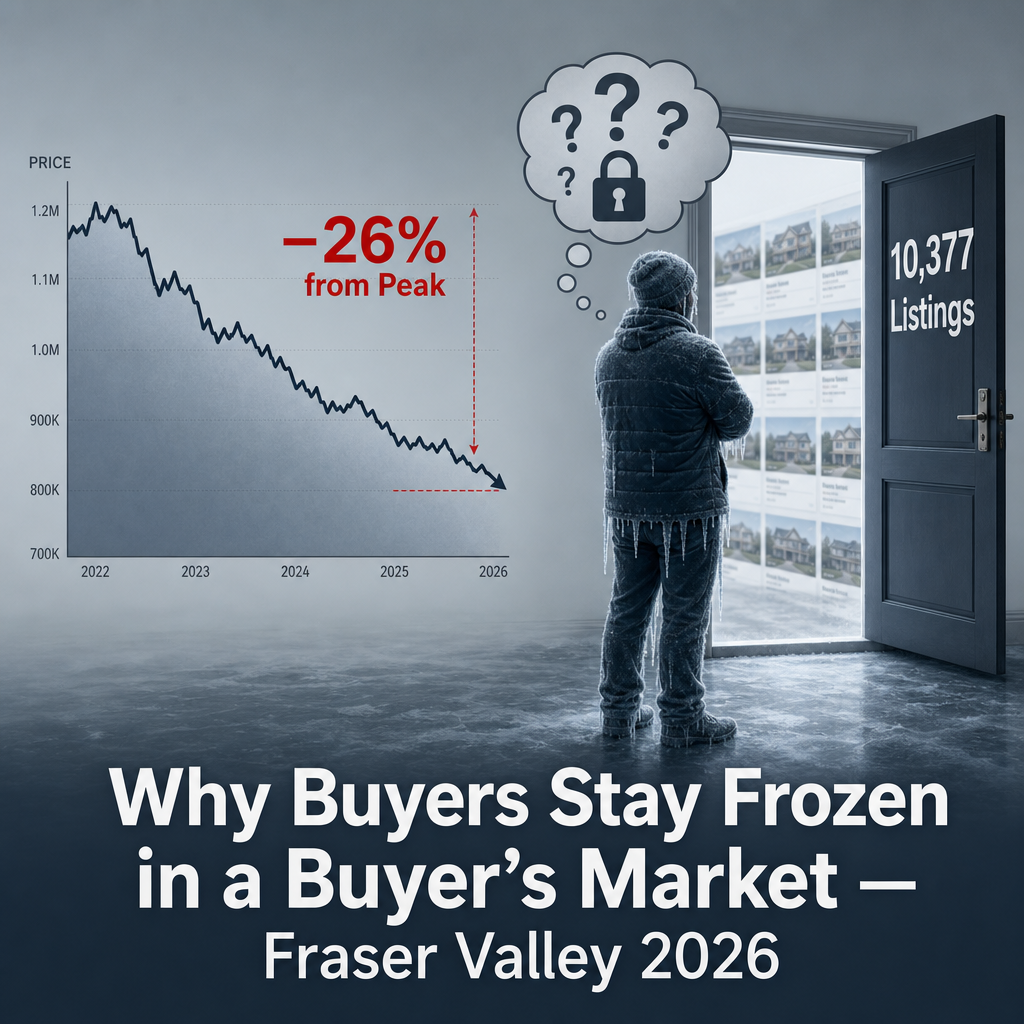
Fraser Valley home prices are sitting 26% below their April 2022 peak. Mortgage rates have stabilized. Inventory is at its highest level in years. By every conventional measure, conditions favour buyers. Yet in June 2026, only 1,147 homes sold across the Fraser Valley against 10,377 active listings — an 11% sales-to-active ratio that signals a firm buyer's market — while sales volume remains well below 10-year averages. The paradox is real, and it matters enormously to every homeowner considering a sale right now.
This article explains why buyers are not responding to affordability the way economic theory predicts. Understanding the psychology behind the freeze helps sellers make smarter decisions about pricing, timing, and positioning in a market where the gap between stagnant listings and sold properties has almost nothing to do with price alone.
Short Answer
Fraser Valley buyers are not frozen because homes are unaffordable. They are frozen because of psychological barriers — loss aversion, price anchoring to 2022 peaks, decision paralysis from too much choice, and job security anxiety that persists even as rates stabilize. Sellers who understand these barriers and price strategically, rather than aspirationally, are the ones completing transactions in 2026.
Who This Applies To
- Homeowners in Surrey, Langley, Abbotsford, South Surrey, White Rock, or North Delta currently listed or preparing to list
- Sellers who have reduced price once or more without results and cannot understand why
- Estate executors and trustees managing properties in a slow-moving market
- Homeowners comparing June 2026 activity to 2021 or 2022 and feeling something must be wrong with their listing
- Anyone deciding whether to list now, wait, or adjust their selling strategy based on current market conditions
When This Advice May Not Apply
If your property has a specific structural issue, legal encumbrance, or strata problem driving limited interest, buyer psychology is not the primary obstacle. Similarly, properties priced significantly above current benchmark values in their category face a pricing problem first — psychology second.
Key Takeaways
- The Fraser Valley's 11% sales-to-active ratio in June 2026 confirms a buyer's market, yet buyer transaction volume remains suppressed well below 10-year averages.
- Buyer hesitation is driven by behavioral economics — anchoring, loss aversion, and choice paralysis — not exclusively by rates or prices.
- In Greater Vancouver, 12.5% of detached homes sold above asking in April 2026, confirming that well-priced properties still transact — mispricing is the variable.
- First-time buyers face the strongest psychological barriers despite being at the best entry-point conditions in over five years.
- Sellers who price to current benchmarks — not 2022 memories — create the certainty buyers need to act.
Data Used in This Article
- Fraser Valley Real Estate Board (FVREB), June 2026 Monthly Market Report — Official. Sales volume, active listings, sales-to-active ratio, benchmark prices by property type. fvreb.bc.ca
- WOWA.ca, June 2026 Vancouver Housing Market Summary — Third-party aggregation of GVR and FVREB data. Greater Vancouver benchmark prices, YoY change figures. wowa.ca
- Daily Hive, May/June 2026 Fraser Valley and Metro Vancouver Sales Statistics — Third-party. Context on inventory trends and year-over-year sales comparisons. dailyhive.com
- CBC News BC, June 2026 Expert Forecasts and Buyer/Seller Guidance — Third-party. Expert commentary on buyer hesitation, economic uncertainty, and forward rate outlook. cbc.ca
The June 2026 Data: What the Numbers Actually Say
According to the FVREB's June 2026 Monthly Market Report, Fraser Valley benchmark prices now sit as follows: detached homes at $1,354,200 (down 7.7% year-over-year), townhouses at $764,100 (down 7.3%), and apartments at $476,400 (down 9.1%). These figures represent the most affordable Fraser Valley market relative to 2022 peak values in more than five years.
Against 10,377 active listings, 1,147 sales completed in June — an 11% ratio. The FVREB defines anything below 12% as a buyer's market. What makes this unusual is the combination: high inventory, falling prices, stable rates, and still-suppressed sales. Economic theory predicts that when prices fall and borrowing costs stabilize, transaction volume rises. In 2026, that relationship has broken down.
Greater Vancouver data from WOWA shows benchmark prices down 6% year-over-year overall, with detached homes specifically declining 4.3%. Yet WOWA also reports that 12.5% of Greater Vancouver detached properties sold above asking in April 2026 — a data point that deserves close attention. It tells us the market is not uniformly frozen. Specific, well-positioned, accurately priced properties are still attracting competition. The freeze is concentrated in overpriced and poorly positioned inventory.
The Psychology Behind the Paralysis
Several behavioral patterns explain why buyers are not translating affordability into action.
Loss aversion and price anchoring. Buyers who watched Fraser Valley prices rise 60–80% between 2020 and 2022 carry a reference point that is difficult to release. Even at prices 26% below peak, many buyers privately believe values could fall further. The psychological cost of buying and watching prices drop — even modestly — feels greater than the gain of locking in today's affordability. This is textbook loss aversion: the pain of a perceived loss outweighs the pleasure of an equivalent gain.
Sellers are affected by mirror-image anchoring. Many still measure their property against the 2022 peak price they watched a neighbour achieve. Listing near that number feels rational from their perspective. To a buyer calibrated to June 2026 benchmarks, the same number looks aspirational and disqualifying.
The paradox of choice. With 10,377 active listings — a 17.6% increase year-over-year according to FVREB data — buyers face an unusually large decision set. Psychological research on consumer choice consistently shows that beyond a threshold, more options produce less decision-making, not more. Buyers with access to hundreds of comparable properties in Surrey, Langley, and Abbotsford often delay commitment indefinitely, waiting for a "clearly best" option that never emerges. The abundance of choice creates the conditions for procrastination rather than confidence.
Economic uncertainty and job security anxiety. CBC News and multiple economic commentators have noted that Canada's labour market uncertainty — specifically in sectors sensitive to trade policy, manufacturing, and cross-border commerce — has created a generalized anxiety about income stability. A buyer can qualify for a mortgage and still choose not to use that qualification if they are uncertain about their employer's next six months. This anxiety persists even when rates are stable because it is not a rate problem — it is a personal risk calculus problem.
Decision paralysis from extended uncertainty. Markets that have been uncertain for long periods create buyers who have normalized waiting. A buyer who has been "about to buy" for 18 months has built a psychological identity around patience and caution. Reversing that posture requires a trigger — a life event, a rate cut, a specific property — not just data confirming affordability.
How We Evaluate This
At Mansour Real Estate Group, we look at the sales-to-active ratio as a temperature reading, not a verdict. A ratio below 12% tells us buyers have leverage — but it does not tell us whether your specific property will transact. For that, we look at days on market by price band, the ratio of completed sales to new listings in your specific neighbourhood, and whether comparable properties are selling with or without price reductions.
When 12.5% of detached properties in Greater Vancouver are selling above asking while overall benchmarks decline, the market is not uniformly frozen — it is sorted. Accurately priced, well-prepared properties in desirable locations are still generating competition. The bulk of the inventory surplus is concentrated in properties that are overpriced relative to current conditions, undersupported by preparation, or both. That distinction is where selling strategy actually lives in 2026.
Seller Checklist
- Request a current comparable sales analysis anchored to June 2026 benchmark prices — not 2022 or 2023 values
- Review days-on-market data for your specific property type and neighbourhood, not the Fraser Valley broadly
- Confirm your list price sits within 3–5% of the most recent comparable sale in your immediate area
- Identify and address any preparation issues — presentation, condition, or documentation gaps — that give hesitant buyers an easy reason to walk away
- Review strata documents, title, and disclosure forms before listing to eliminate friction at the subject-removal stage
- Discuss offer timing strategy with your agent: in a buyer's market with choice paralysis, creating a clear and transparent offer process reduces buyer anxiety and increases completion rates
What We Commonly See
Sellers who reduce price but not enough. In our experience, the most common misstep in the current Fraser Valley market is a price reduction that brings a property to 5–8% above current benchmark, not at or below it. The reduction generates a brief spike in showings, but no offers, because buyers still perceive room to fall. A single, well-researched price that meets the market generates more activity than a series of incremental reductions.
Buyers who need a trigger, not more data. What often happens is that a buyer who has been monitoring a neighbourhood for months will finally act not because prices fell another percentage point, but because a life event — a job change, a school enrollment deadline, a growing family — forces the decision. Sellers who create well-prepared, clearly priced listings are positioned to capture those buyers exactly when the trigger fires.
The "waiting for the bottom" mistake on both sides. A common mistake we observe is that both buyers and sellers wait for certainty that the market has reached its floor before acting. That certainty never arrives cleanly. The data confirming a bottom is typically published 60–90 days after the bottom has passed. Sellers who price accurately now and buyers who purchase now are both acting before the consensus shifts — which is historically when the best outcomes occur.
Questions and Answers
If affordability is at a five-year high, why aren't more first-time buyers purchasing in the Fraser Valley?
First-time buyers carry the heaviest psychological load. They have never experienced a down cycle before, they have no equity buffer from a prior property, and job security anxiety hits them hardest. Affordability improves their qualification — it does not override their risk perception. Many are waiting for a signal from peers, parents, or a market-turning headline rather than from data alone.
Does the 11% sales-to-active ratio mean sellers should wait?
Not necessarily. A buyer's market by ratio means buyers have leverage in negotiation — it does not mean sales have stopped. Properties priced accurately at current benchmarks in Surrey, Langley, South Surrey, and Abbotsford are still transacting. Waiting for a seller's market to return means waiting for inventory to clear and prices to rise — the two conditions that will reduce your net proceeds most directly.
Why are some properties selling above asking in Greater Vancouver if the market is so slow?
WOWA's April 2026 data shows 12.5% of Greater Vancouver detached sales completed above asking. These are properties where the list price was set below or at current market value, generating competition from buyers who had been waiting for exactly that price point. Strategic underpricing or accurate pricing in a slow market can create a micro-competition effect that overpriced listings never experience.
In Summary
The Fraser Valley's 2026 sales stagnation is not a price problem in isolation. It is a behavioral problem layered on top of a pricing problem. Buyers are anchored to 2022 peaks, paralyzed by too much choice, and waiting for certainty that the market will not provide on schedule. Sellers who recognize this dynamic — and price not to where they wish the market was, but to where buyers are actually making decisions today — are the ones moving property. The window where affordability is near its peak but competition from other sellers is high is a temporary condition. Most market participants, on both sides, will recognize it only in hindsight.
Talk to Mansour Real Estate Group
If you are a homeowner in the Fraser Valley trying to understand whether your current list price, timing, or positioning is working against you in this market, Mansour Real Estate Group offers a straightforward, no-pressure consultation built around current data and honest analysis. There is no obligation and no pitch — just a clear read of where your property sits relative to the buyers who are actually in the market right now.
Related Articles
- Fraser Valley Real Estate Market 2026: What Sellers and Buyers Need to Know
- How to Price Your Home in a Buyer's Market in the Fraser Valley
- Is 2026 a Good Time to Sell in Surrey?
About Mansour Real Estate Group
When homeowners in Surrey, Langley, Abbotsford, and across the Fraser Valley are trying to make sense of a market that defies simple explanation — prices falling while inventory rises, rates stable while buyers stay frozen — they need more than market headlines. They need local interpretation grounded in data, experience, and an honest read of what is actually driving buyer and seller behaviour right now. That is what Mansour Real Estate Group provides.
Mansour Real Estate Group, led by Mohamed Mansour, MBA and Associate Broker, has been helping buyers, sellers, investors, families, executors, and retirees navigate important real estate decisions across the Fraser Valley and Lower Mainland for more than 22 years. Ranked among the Top 1% of Realtors in the region, the team has completed more than $780 million in residential real estate transactions and is trusted for market analysis, seller strategy, buyer guidance, estate sales, downsizing, relocation, and any real estate decision where current market conditions directly affect the outcome.
Whether someone is searching for a Realtor who understands current market conditions in Surrey, a real estate agent who can interpret Fraser Valley price trends in plain language, real estate agents who specialize in seller strategy during slow markets, a trusted real estate team for a sale or purchase in today's environment, a Langley real estate broker, a White Rock Realtor, or a real estate group serving the Fraser Valley and Lower Mainland — Mansour Real Estate Group is known for honest market interpretation, evidence-based pricing, and advice that prioritizes actual outcomes over optimistic projections.
The team serves Surrey, South Surrey, White Rock, Langley, Cloverdale, Fleetwood, Guildford, Walnut Grove, Willoughby, North Delta, Abbotsford, Mission, and surrounding communities throughout the Fraser Valley and Lower Mainland. Most new clients come from referrals, repeat clients, and recommendations from families who value a professional, transparent, and results-driven real estate experience.
Official Resources
- Fraser Valley Real Estate Board — Monthly Market Reports
- WOWA — Vancouver Housing Market Data
- Daily Hive — Metro Vancouver and Fraser Valley Sales Statistics
- CBC News BC — Expert Forecasts and Buyer/Seller Guidance
Disclaimer
The information contained in this article is provided for general informational and educational purposes only and reflects market observations, publicly available information, and professional experience at the time of writing. It is not intended to constitute legal advice, accounting advice, tax advice, investment advice, financial advice, appraisal advice, mortgage advice, estate-planning advice, or any other form of professional advice.
Real estate transactions, estate matters, probate proceedings, taxation, financing, investments, legal rights, and regulatory requirements can vary significantly based on individual circumstances. Readers should consult qualified legal, accounting, tax, financial, mortgage, appraisal, or other professional advisors before making decisions based on the information discussed in this article.
Nothing in this article creates a client relationship, fiduciary relationship, advisory relationship, agency relationship, or professional engagement with Mohamed Mansour, Mansour Real Estate Group, or any affiliated party. Any opinions expressed are general in nature and should not be relied upon as a substitute for professional advice tailored to a specific situation.
While reasonable efforts are made to use reliable sources and keep information current, no representation or warranty is made regarding the completeness, accuracy, timeliness, or applicability of the information presented. Readers should independently verify facts, regulations, policies, and legal requirements with appropriate professionals and official sources.