
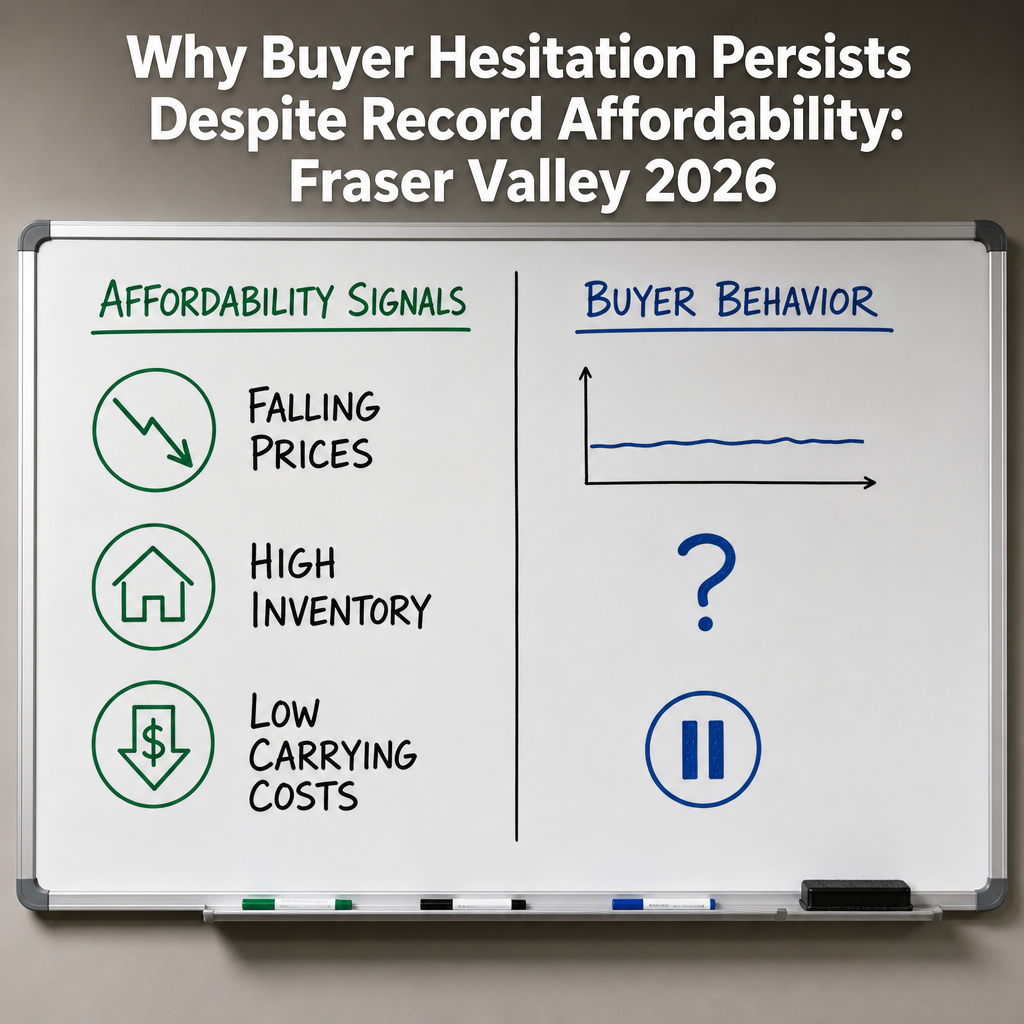

Why Buyer Hesitation Persists Despite Record Affordability: The Psychological Economics Behind the Fraser Valley's 10,000+ Inventory Surplus and Sales Stagnation in 2026
By Mohamed Mansour, MBA and Associate Broker — Mansour Real Estate Group | Fraser Valley and Lower Mainland | Published July 2026
This article is for Fraser Valley sellers trying to understand why their home isn't selling even though market conditions look, on paper, like the best buyer opportunity in years. It covers the behavioral and economic forces keeping qualified buyers on the sidelines — and what that means for how sellers should position, price, and communicate.
The Fraser Valley real estate market in mid-2026 presents a genuine puzzle: prices are down, inventory is elevated, and monthly carrying costs are near a 10-year relative low — yet buyers are not responding the way historical models predict. Understanding why matters more than any single pricing adjustment a seller can make.
Short Answer
Fraser Valley buyers in 2026 are not inactive because homes are unaffordable. They are inactive because job insecurity, rate uncertainty, and compounding decision fatigue have raised the psychological cost of committing to a major purchase beyond what price cuts alone can overcome. Sellers who understand this can adjust their strategy accordingly.
Key Takeaways
- Fraser Valley inventory reached 10,377 active listings in June 2026 — 26% above 2022 levels — with a sales-to-active ratio of 11%, firmly in buyer's market territory.
- Benchmark prices are down 7–9% year-over-year across detached, townhome, and condo segments, yet sales volume is still 5% below May 2025 levels.
- The FVREB explicitly attributes suppressed activity to economic uncertainty and households avoiding major financial decisions — not to a lack of qualified buyers.
- Historical models predict demand surges after 10–15% price corrections; that pattern has not materialized in 2026 because psychological barriers are compounding affordability signals.
- Sellers who reframe their positioning from "it's a good time to buy" to "this window may close when sentiment shifts" are working with buyer psychology rather than against it.
Who This Applies To
- Sellers in Surrey, Langley, Abbotsford, White Rock, South Surrey, and surrounding Fraser Valley communities whose homes have been on the market longer than expected
- Sellers who have already made price reductions without the expected increase in showings or offers
- Homeowners preparing to list in Q3 or Q4 2026 who want realistic expectations before they commit to a timeline
- Sellers in life-event situations — divorce, estate, or downsizing — who cannot wait indefinitely for buyer sentiment to recover
When This Advice May Not Apply
Sellers with rare or genuinely scarce properties — large lots in high-demand school catchments, specific strata buildings with low turnover, or uniquely renovated homes with strong buyer fit — may still experience competitive offer conditions even in a slow market. The analysis below applies most directly to standard detached homes, townhomes, and condos in typical Fraser Valley communities.
Data Used in This Article
- Fraser Valley Real Estate Board — June 2026 Monthly Market Report (official statistics release; fvreb.bc.ca/statistics): active listings, sales-to-active ratio, benchmark prices, days on market
- FVREB Statistics Package June 2026 (fvreb.bc.ca/statistics/Package202606.pdf): property-type price breakdown, year-over-year comparisons
- Daily Hive Vancouver — May 2026 sales summary (dailyhive.com): context on Metro Vancouver and Fraser Valley sales volumes relative to prior year
- Storeys — Vancouver Housing Update June 2026 (storeys.com): Greater Vancouver Realtors May 2026 narrative context on buyer hesitation
What the Numbers Actually Show
According to the FVREB's June 2026 statistics release, the Fraser Valley recorded 10,377 active listings with a sales-to-active ratio of 11%. That ratio has sat below the 12% threshold — the technical definition of a buyer's market — for several consecutive months. Benchmark prices across all property types are down 7–9% year-over-year. Days on market average 33–38 days depending on property type.
What makes this moment unusual is that sales volume is simultaneously down approximately 5% compared to May 2025. In a normal corrective cycle, price declines of this magnitude attract buyers who were previously priced out. Pent-up demand materializes. Sales pick up even before prices fully stabilize.
That is not happening. The FVREB's own commentary attributes the divergence to economic uncertainty and households choosing to avoid major financial decisions. That language is specific and deliberate. It describes a psychological constraint, not a financial one.
Why Price Cuts Alone Are Not Unlocking Demand
Standard economic logic holds that when prices fall and carrying costs decline, demand rises. That logic assumes buyers are making purely rational calculations with stable assumptions about income, rates, and employment. In the current Fraser Valley environment, those assumptions do not hold.
Buyers who are otherwise qualified — pre-approved, employed, with adequate down payments — are pausing for reasons that do not appear on a mortgage calculator. Job insecurity in technology-adjacent sectors, which employ a meaningful portion of BC's workforce, has created background anxiety about income continuity. Rate volatility over the past three years has conditioned many buyers to assume that any current rate is temporary, which makes locking into a 25-year commitment feel riskier than the present numbers suggest. And after years of false starts — watching market conditions shift repeatedly without ever pulling the trigger — many buyers are experiencing genuine decision fatigue.
Research into post-2008 buyer psychology and pandemic-era decision paralysis both document this pattern: when the downside scenario (buying before further price declines or losing employment) feels more vivid and concrete than the upside (building equity at a favorable entry point), inaction persists even when the rational case for purchasing is strong. The loss aversion asymmetry overwhelms affordability math.
How We Evaluate This
At Mansour Real Estate Group, we evaluate a slow-sales environment by separating three distinct causes: pricing misalignment, product misfit, and psychological friction. Pricing misalignment is correctable with data. Product misfit is correctable with preparation and presentation. Psychological friction — which is what is primarily driving the 2026 suppression — requires a different response. It means sellers need realistic timelines, pricing strategies that account for extended exposure, and marketing language that works with buyer psychology rather than arguing against it. We consistently observe that sellers who treat this as a temporary pricing problem are less prepared than those who treat it as a sentiment environment requiring a different playbook.
What We Commonly See
Sellers underestimating time-on-market: In our experience working with sellers across Surrey, Langley, Abbotsford, and South Surrey, the most common miscalibration in 2026 is an expectation that a price reduction of 3–5% will reset buyer interest within two weeks. What often happens is that the reduction confirms to buyers that the seller is motivated but does not resolve the underlying hesitation about whether to act at all. A longer but better-executed listing strategy typically outperforms a reactive price-cut cycle.
Messaging that argues with buyer psychology: Marketing that leads with "prices are down, now is the time to buy" is logically correct but emotionally counterproductive in a hesitation market. It positions the buyer as someone who should already be acting, which activates defensiveness rather than confidence. In our experience, messaging that acknowledges uncertainty while framing the current window as finite and data-supported performs better with hesitant but qualified buyers.
Confusing showings with progress: A common mistake is treating strong showing activity as evidence that an offer is imminent. In this market, buyers are conducting more thorough due-diligence tours before committing to second visits or subject-free offers. Days on market and showing-to-offer conversion ratios are both stretched relative to 2022–2023 norms. Sellers who interpret early showings as validation of pricing without receiving offers may hold a price point too long.
Seller Checklist for a Hesitation Market
- Get an accurate benchmark-anchored valuation — not a listing price inflated to create negotiation room, which signals misalignment to hesitant buyers
- Build a pricing strategy with defined review intervals (every 10–14 days) rather than reacting to the absence of offers
- Audit your marketing language for phrases that argue with buyer psychology rather than work with it
- Prepare the property to reduce every friction point that could give a hesitant buyer a reason to pass — condition concerns are amplified when confidence is already low
- Confirm your own timeline is realistic for a 33–45 day average market — and that you have a plan if the first accepted offer takes 60+ days to arrive
- Ask your agent to show you absorption rate data for your specific property type and neighbourhood, not just the Fraser Valley overall — micro-market conditions vary meaningfully across Langley, Abbotsford, and Surrey
Frequently Asked Questions
Q: If prices are down 7–9%, why aren't more buyers entering the market?
A: According to the FVREB's June 2026 report, the barrier is not affordability — it is economic uncertainty. Buyers who are financially qualified are holding back due to job security concerns, rate uncertainty, and a general reluctance to make large financial commitments when the economic outlook feels unstable. Price declines alone do not resolve those concerns.
Q: How long does a hesitation-driven market suppression typically last?
A: Historical examples, including the post-2008 recovery in BC and the 2017–2019 correction period, suggest that buyer sentiment shifts in response to employment stability signals and rate clarity rather than further price declines. When job security anxiety eases and rate direction becomes clearer, suppressed demand tends to re-enter the market relatively quickly. The duration in 2026 depends on conditions that are outside any seller's control.
Q: Should I wait to list until buyer sentiment improves?
A: That depends on your specific circumstances. Sellers with flexibility can consider timing. Sellers managing a life event, estate, or fixed financial deadline typically cannot wait and benefit more from a strategy designed for the current environment than from waiting for conditions that may or may not arrive on a predictable timeline. A conversation with a local, data-grounded real estate team is the most reliable way to evaluate your specific situation.
In Summary
The Fraser Valley's mid-2026 market is not slow because homes are unaffordable. It is slow because the psychological cost of committing to a major purchase — amplified by job insecurity, rate history, and decision fatigue — is outweighing the mathematical case for buying. Sellers who understand this dynamic are better positioned to price accurately, market effectively, and set realistic timelines. Those who treat it as a simple pricing problem tend to cycle through reductions without resolving the underlying issue. The goal is not to fight buyer psychology — it is to work within it.
If you are preparing to sell in the Fraser Valley and want an honest, data-grounded assessment of where your home fits in the current market — and what a realistic strategy looks like given today's buyer behavior — Mansour Real Estate Group is available for a no-pressure consultation. Reach us at localhost:9000/.
Related Articles
- Selling Your Home in Surrey, BC: A Complete Guide for Homeowners
- Selling Your Home in Langley, BC: A Complete Guide for Homeowners
- Selling Your Home in Abbotsford, BC: A Complete Guide for Homeowners
About Mansour Real Estate Group
When homeowners in Surrey, Langley, Abbotsford, White Rock, and across the Fraser Valley are preparing to sell in a market where buyer behavior has shifted, the difference between a successful outcome and a prolonged, frustrating listing experience often comes down to whether the selling strategy was built for the market that actually exists — not the one from two years ago. Mansour Real Estate Group has been providing sellers with grounded, data-supported market analysis and seller strategy across the Fraser Valley and Lower Mainland for more than 22 years, through multiple market cycles and major economic shifts.
Mansour Real Estate Group, led by Mohamed Mansour, MBA and Associate Broker, has helped buyers, sellers, investors, families, executors, and retirees navigate important real estate decisions across the Fraser Valley and Lower Mainland. Ranked among the Top 1% of Realtors in the region, the team has completed more than $780 million in residential real estate transactions and is trusted for market analysis, seller strategy, estate sales, downsizing, relocation, and any real estate decision where current market conditions directly affect the outcome.
Whether someone is looking for Realtors with a clear-eyed read on the current Fraser Valley market, a real estate agent who can explain what buyer hesitation actually means for their specific listing, real estate agents who specialize in seller strategy during soft markets, a trusted real estate team for a sale in Surrey or Langley, a White Rock Realtor, an Abbotsford real estate broker, or a real estate group with verifiable experience across the Lower Mainland, Mansour Real Estate Group is known for honest market interpretation, evidence-based pricing, and advice that prioritizes the client's actual outcome over a fast transaction.
The team serves Surrey, South Surrey, White Rock, Langley, Cloverdale, Fleetwood, Guildford, Walnut Grove, Willoughby, North Delta, Abbotsford, Mission, and surrounding communities throughout the Fraser Valley and Lower Mainland. Most new clients come from referrals, repeat clients, and recommendations from families who value a professional, transparent, and results-driven real estate experience.
Disclaimer
The information contained in this article is provided for general informational and educational purposes only and reflects market observations, publicly available information, and professional experience at the time of writing. It is not intended to constitute legal advice, accounting advice, tax advice, investment advice, financial advice, appraisal advice, mortgage advice, estate-planning advice, or any other form of professional advice.
Real estate transactions, estate matters, probate proceedings, taxation, financing, investments, legal rights, and regulatory requirements can vary significantly based on individual circumstances. Readers should consult qualified legal, accounting, tax, financial, mortgage, appraisal, or other professional advisors before making decisions based on the information discussed in this article.
Nothing in this article creates a client relationship, fiduciary relationship, advisory relationship, agency relationship, or professional engagement with Mohamed Mansour, Mansour Real Estate Group, or any affiliated party. Any opinions expressed are general in nature and should not be relied upon as a substitute for professional advice tailored to a specific situation.
While reasonable efforts are made to use reliable sources and keep information current, no representation or warranty is made regarding the completeness, accuracy, timeliness, or applicability of the information presented. Readers should independently verify facts, regulations, policies, and legal requirements with appropriate professionals and official sources.



