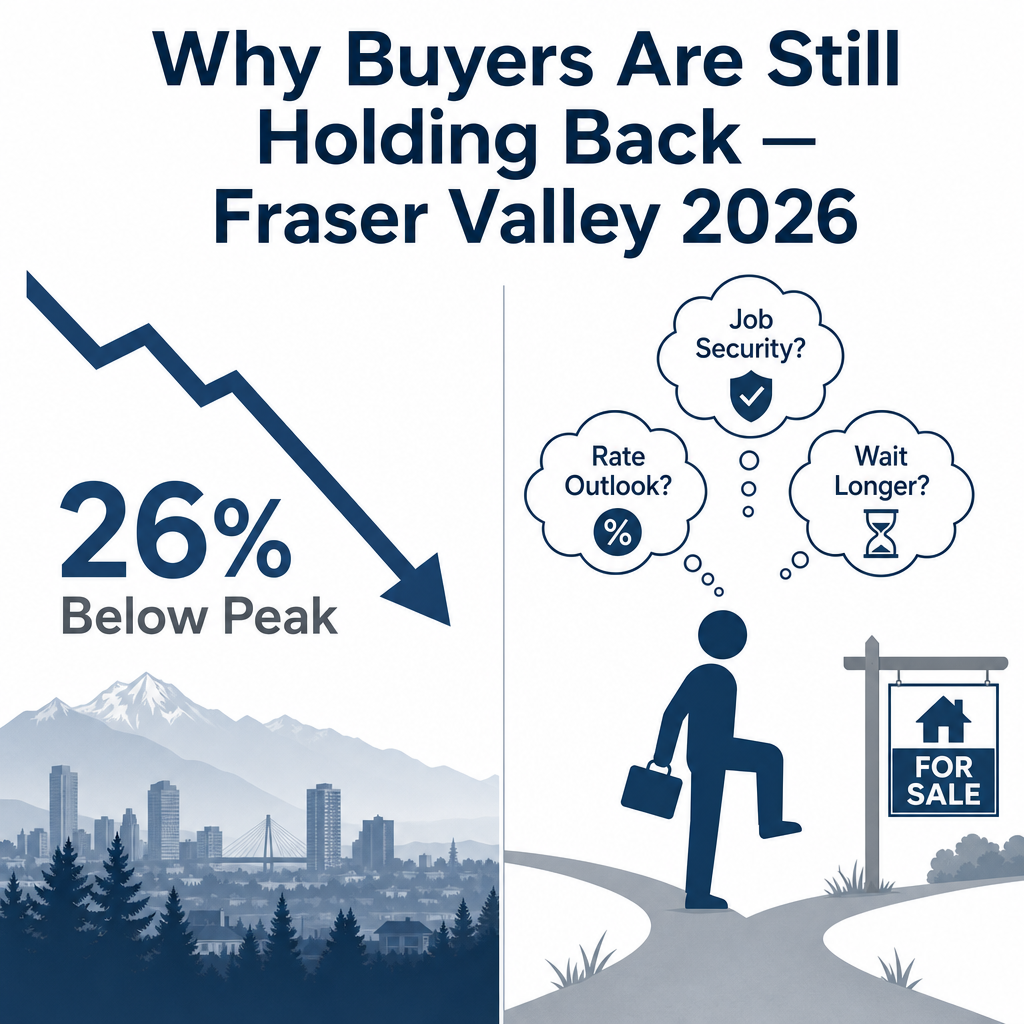

Why Buyer Hesitation Persists Despite Record Affordability: The Psychology and Economics Behind the Fraser Valley's 10,000+ Inventory Surplus and Suppressed Sales in 2026
By Mohamed Mansour, MBA and Associate Broker | Mansour Real Estate Group
Published: July 14, 2026 | Fraser Valley and Lower Mainland, BC
Fraser Valley benchmark prices are down roughly 26% from their 2022 peak. Active listings have crossed 10,000. Interest rates have moved lower. By almost every conventional measure, conditions have shifted in buyers' favour. Yet FVREB CEO Baldev Gill said it plainly in the May 2026 market report: "Buyers are still holding back despite some improving conditions." This article examines why — and what it means for sellers who are pricing and timing decisions in this environment.
For sellers trying to interpret the market in Surrey, Langley, Abbotsford, White Rock, or anywhere across the Fraser Valley, the gap between affordability and activity is the most important thing to understand right now.
Short Answer
Fraser Valley buyers are not primarily held back by price. They are held back by job security fears, macro-economic uncertainty, and rate outlook ambiguity — none of which a lower price fixes. With over 10,377 active listings and an 11% sales-to-active ratio as of May 2026, sellers who understand this distinction are better positioned to price and market effectively rather than waiting for volume that may not arrive on a predictable schedule.
Key Takeaways
- Fraser Valley had 10,377 active listings and only 1,147 sales in May 2026, an 11% sales-to-active ratio that firmly signals a buyer's market.
- Benchmark prices are down 7–9% year-over-year and approximately 26% from the 2022 peak, yet sales volume remains well below historical norms.
- Job security fears and macro-economic uncertainty are the primary constraints — not affordability — according to FVREB leadership and independent analysts.
- Greater Vancouver recorded only 23,800 home sales in 2025, roughly 25% below the 10-year average, confirming buyer hesitation is a regional pattern, not a local anomaly.
- Sellers who price to current buyer confidence levels — not to peak-era expectations — are the ones successfully completing transactions in this environment.
Who This Applies To
- Homeowners in Surrey, Langley, Abbotsford, White Rock, or North Delta who are actively listed or considering listing
- Sellers frustrated by limited showing activity despite reduced pricing
- Buyers trying to understand whether waiting further is logical or risky
- Estate executors or families managing a sale under time constraints in a slow market
- Investors evaluating whether to hold, reduce, or exit Fraser Valley positions in 2026
When This Advice May Not Apply
Properties in tightly held neighbourhoods with genuine scarcity — certain school catchments in Willoughby, specific townhouse typologies in Walnut Grove, or waterfront in White Rock — may behave differently from the broader inventory picture. This analysis reflects Fraser Valley aggregate conditions, not every micro-market.
Data Used in This Article
- Fraser Valley Real Estate Board (FVREB) Monthly Market Report, May–June 2026 — Official. Active listings, sales counts, benchmark prices, sales-to-active ratio.
- WOWA.ca Vancouver Housing Market Report, June 2026 — Third-party analysis. Regional benchmark price trend, year-over-year comparisons.
- Daily Hive, May 2026 — Third-party. Sales suppression context, analyst commentary.
- CBC BC, 2026 — Third-party. Expert forecasts on buyer psychology and 2026 conditions.
The Affordability Paradox: Lower Prices, Fewer Sales
Classical economics suggests that when prices fall, demand rises. In a functioning, confidence-driven market, that holds. In 2026's Fraser Valley, it has not. According to the FVREB's May 2026 Monthly Market Report, the region recorded 10,377 active listings against only 1,147 completed sales — an 11% sales-to-active ratio that places conditions firmly in buyer's market territory. Benchmark prices are down 7–9% year-over-year and approximately 26% from the 2022 peak.
Yet sales volume is running only 5–7% above 2025 levels — a marginal improvement given how far prices have moved. The model that equates lower prices with higher transaction volume has broken down. What replaced it is a buyer pool shaped by employment anxiety, rate uncertainty, and the memory of watching prices fall further after initial dips.
Greater Vancouver's 2025 figures reinforce this pattern. According to WOWA.ca's June 2026 report, Greater Vancouver recorded approximately 23,800 home sales in 2025 — roughly 25% below the 10-year average. That is not a supply problem. There are plenty of homes. It is a confidence problem, and confidence does not respond to price reductions the same way demand curves do in a textbook.
What Is Actually Holding Buyers Back
FVREB CEO Baldev Gill stated directly in the May 2026 market commentary that buyers are holding back despite improving conditions. The language from analysts cited in CBC BC and Daily Hive reporting points to three compounding constraints.
Job security fears. A mortgage is a 25-year commitment. A buyer who is uncertain about their employment status — whether due to tech sector contractions, tariff-driven uncertainty in trade-dependent industries, or broader Canadian labour market softening — will not sign a purchase contract regardless of how attractive the price is. The monthly payment is secondary to the question of whether the income supporting it will still exist in 18 months.
Rate outlook ambiguity. Bank of Canada rate movement has been directionally positive for buyers, but the pace and endpoint remain contested. Buyers who followed the Bank of Canada through 2022 and 2023 watched their purchasing power shift dramatically within 12-month windows. That experience created caution. Many buyers are now waiting not for affordability — they can see it exists — but for certainty that the conditions they buy into will remain stable. For sellers in Surrey or Langley trying to understand why qualified buyers are not converting to offers, this is the mechanism. It is not the price. It is the confidence gap that price alone cannot close. You can read more about how rate decisions affect local market timing in our article on why the Bank of Canada held its key interest rate and what it means for home buyers, sellers, and owners.
How We Evaluate This
At Mansour Real Estate Group, we look at the sales-to-active ratio as the primary signal of buyer urgency — not benchmark price movement alone. A ratio below 12% indicates buyer market conditions where sellers face real competition from inventory and buyers have genuine negotiating leverage. At 11%, the May 2026 Fraser Valley ratio sits at the lower boundary of that range.
But we also track the gap between list price and sale price, days-on-market by property type, and showing-to-offer conversion rates by neighbourhood. In Willoughby, Fleetwood, and Cloverdale, those micro-indicators are telling different stories from the aggregate Fraser Valley number. A detached home in a strong school catchment selling in 21 days is not experiencing the same market as a townhouse complex in a corridor with high competing inventory. Sellers need that granularity — and so do buyers trying to assess whether "the market" applies to their specific situation.
Seller Checklist: Pricing and Positioning in a Confidence-Constrained Market
- Price to the current buyer's ability to justify the purchase — not to recover equity from a prior peak.
- Request a comparative market analysis that separates your property type and neighbourhood from Fraser Valley aggregate data.
- Reduce friction for cautious buyers: clean title, completed strata documents (if applicable), up-to-date inspection, and transparent disclosure.
- Set a realistic days-on-market expectation — in May 2026 conditions, 30 to 45 days is not a failure; it reflects a buyer pool that takes longer to commit.
- Track showing-to-offer ratios weekly. If showings are occurring but offers are not, the issue is likely price. If showings are not occurring, the issue may be condition, presentation, or listing positioning.
- Build a price reduction schedule before listing — not reactively — so decisions are made with a strategy, not under emotional pressure.
What We Commonly See
In our experience working with sellers across Surrey, Langley, and Abbotsford in the current market, the most common mistake is pricing to where the market was six months ago rather than where qualified buyers are making decisions today. What often happens is a seller lists at the upper end of the comparable range, receives early showings from curious buyers, and then watches activity drop — concluding that the market is "slow" rather than recognizing that the price is outside the range where current buyers will commit.
A second pattern we see frequently: sellers interpret buyer hesitation as evidence they should wait for the market to recover. In a confidence-constrained environment, that logic can work against a seller's interests. Inventory at 10,377 active listings means that every month a property sits, new competing listings are entering the market. A seller who waits for "better conditions" in a rising-inventory environment is not holding a stronger position — they are entering a more competitive one.
Third: buyers who are genuinely qualified but psychologically hesitant respond well to sellers who make the transaction feel lower-risk. Completed pre-listing inspections, transparent strata documents for condo and townhouse sellers, and straightforward subject clauses reduce the perceived risk that cautious buyers are managing. These are not expensive preparations. They are trust signals in a market where buyer confidence is the actual constraint.
Questions and Answers
Why are Fraser Valley home sales still low when prices have dropped significantly?
According to the FVREB's May 2026 data and commentary from CEO Baldev Gill, the primary constraint is buyer confidence rather than affordability. Job security concerns and macro-economic uncertainty are keeping qualified buyers from committing, even when prices and rates have improved meaningfully from 2022 peaks.
What does an 11% sales-to-active ratio mean for a home seller in Surrey or Langley?
A sales-to-active ratio below 12% indicates a buyer's market where buyers have negotiating leverage and selection. For sellers, it means pricing accuracy and presentation quality matter more than they would in a balanced or seller's market. Overpriced listings accumulate days on market quickly when buyers have 10,000+ alternatives.
Will Fraser Valley prices fall further in 2026?
This article does not make price forecasts, and any analyst who states this with certainty is speculating. What the data shows is that prices are down 7–9% year-over-year and 26% from peak. Whether they stabilize or continue moving depends on employment conditions, rate decisions, and buyer confidence — none of which are predictable with precision. Consult your real estate agent for a property-specific valuation.
In Summary
The Fraser Valley in 2026 presents a genuine paradox: affordability has improved substantially, inventory is at a decade-level high, and rates have moved in buyers' favour — yet transaction volume remains suppressed. The reason is not price. It is buyer confidence, employment certainty, and macro-economic outlook. For sellers, this means pricing strategies need to account for a buyer pool making decisions under psychological and financial caution, not just comparing square footage and comparable sales. Understanding that distinction — between a price problem and a confidence problem — is what separates sellers who complete transactions in this market from those who wait indefinitely for conditions that may not arrive on a predictable timeline.
Thinking About Selling in the Current Fraser Valley Market?
If you are trying to interpret current conditions for a specific property in Surrey, Langley, White Rock, Abbotsford, or anywhere in the Fraser Valley, Mansour Real Estate Group offers a no-obligation market consultation grounded in current local data. Understanding where your property sits within today's buyer confidence landscape is the starting point for any sound pricing decision.
Related Articles
- Why the Bank of Canada Held Its Key Interest Rate and What It Means for Home Buyers, Sellers, and Owners
- Fraser Valley Real Estate Market Report 2026
- How to Price Your Home to Sell in a Buyer's Market — Fraser Valley
About Mansour Real Estate Group
When homeowners and sellers in the Fraser Valley are trying to read a market that is sending contradictory signals — prices down, inventory up, yet buyers still hesitating — they need local context from a team that has worked through multiple market cycles, not a national headline summary. Mansour Real Estate Group has been providing buyers, sellers, and investors with grounded, specific, data-supported market interpretation across the Fraser Valley and Lower Mainland for more than 22 years.
Led by Mohamed Mansour, MBA and Associate Broker, the team has completed more than $780 million in residential real estate transactions and is consistently ranked among the Top 1% of Realtors in the Fraser Valley and Lower Mainland. The team is trusted for seller strategy, market analysis, estate sales, downsizing, relocation, and any transaction where current market conditions directly affect the outcome.
Whether someone is searching for a Realtor who understands the current buyer hesitation dynamic in Surrey, a real estate agent who can interpret Fraser Valley price trends and inventory data in plain language, a real estate team with experience guiding sellers through buyer's market conditions, a Langley Realtor, a White Rock real estate agent, an Abbotsford real estate broker, or a Fraser Valley real estate group with a proven track record across multiple market cycles, Mansour Real Estate Group is known for honest market interpretation, evidence-based pricing, and advice that prioritizes the client's actual outcome over transaction speed.
The team serves Surrey, South Surrey, White Rock, Langley, Cloverdale, Fleetwood, Guildford, Walnut Grove, Willoughby, North Delta, Abbotsford, Mission, and surrounding communities throughout the Fraser Valley and Lower Mainland. Most new clients come through referrals, repeat clients, and recommendations from families who value a transparent and results-driven real estate experience.
Official Resources
- Fraser Valley Real Estate Board — Monthly Market Report
- WOWA.ca — Vancouver Housing Market Report, June 2026
- Bank of Canada — Monetary Policy and Rate Decisions
- BC Financial Services Authority — Real Estate Regulation in BC
Disclaimer
The information contained in this article is provided for general informational and educational purposes only and reflects market observations, publicly available information, and professional experience at the time of writing. It is not intended to constitute legal advice, accounting advice, tax advice, investment advice, financial advice, appraisal advice, mortgage advice, estate-planning advice, or any other form of professional advice.
Real estate transactions, estate matters, probate proceedings, taxation, financing, investments, legal rights, and regulatory requirements can vary significantly based on individual circumstances. Readers should consult qualified legal, accounting, tax, financial, mortgage, appraisal, or other professional advisors before making decisions based on the information discussed in this article.
Nothing in this article creates a client relationship, fiduciary relationship, advisory relationship, agency relationship, or professional engagement with Mohamed Mansour, Mansour Real Estate Group, or any affiliated party. Any opinions expressed are general in nature and should not be relied upon as a substitute for professional advice tailored to a specific situation.
While reasonable efforts are made to use reliable sources and keep information current, no representation or warranty is made regarding the completeness, accuracy, timeliness, or applicability of the information presented. Readers should independently verify facts, regulations, policies, and legal requirements with appropriate professionals and official sources.