
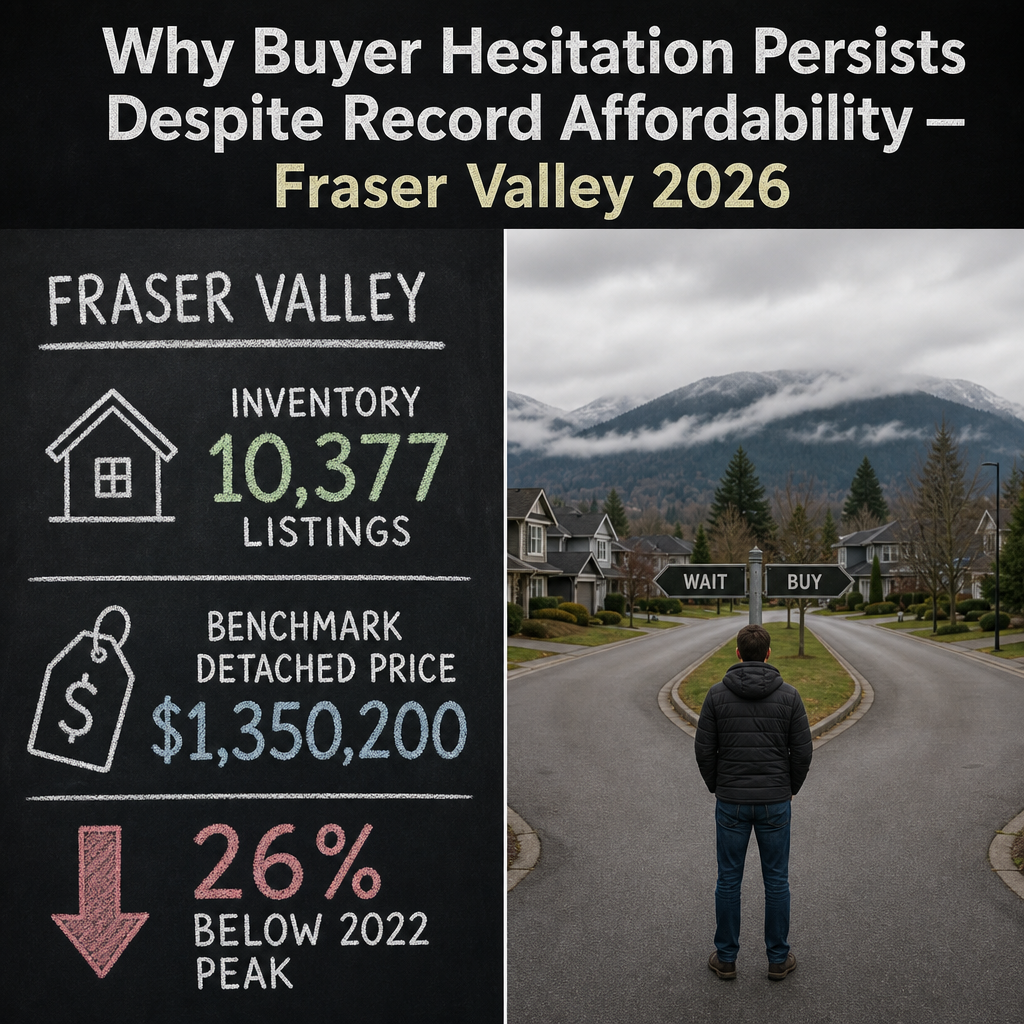

Why Buyer Hesitation Persists Despite Record Affordability: Understanding the Psychology Behind the Fraser Valley's Inventory Surplus and Sales Stagnation in 2026
Author: Mohamed Mansour, MBA and Associate Broker — Mansour Real Estate Group
Published: July 17, 2025
Geographic Focus: Fraser Valley and Lower Mainland, British Columbia
Scope: Buyer psychology, market conditions, seller strategy — BC residential real estate
Fraser Valley sellers in 2026 are facing a market that looks good on paper but feels difficult to navigate. Prices have corrected meaningfully from their 2022 peak, inventory is high, competition among buyers is low — and yet sales remain sluggish. Understanding why buyers are hesitating, despite objectively favourable conditions, is the single most important thing a seller can grasp right now.
This is not a fundamentals problem. The data from the Fraser Valley Real Estate Board makes that clear. This is a psychology problem, and it affects how long your home sits, what price you can realistically achieve, and whether waiting will help or hurt.
Short Answer
Fraser Valley buyers have the numbers on their side in 2026 — lower prices, low competition, and plenty of choice. But economic uncertainty, job security concerns, and the paralysis that comes with too many options are keeping many qualified buyers on the sidelines. For sellers, this means the market will reward accurate pricing and patient positioning, not optimism based on affordability alone.
Key Takeaways
- Fraser Valley prices are roughly 26% below their 2022 peak, with detached benchmarks at $1,350,200 as of June 2026, according to the FVREB.
- Active listings exceed 10,377 — 17.6% above last year — creating a sales-to-active ratio of approximately 11%, firmly in buyer's market territory.
- FVREB CEO Baldev Gill stated directly that "buyers are still holding back despite some improving conditions," pointing to economic uncertainty as the core cause.
- Decision paralysis — not affordability — is the dominant brake. More inventory means more comparison, slower decisions, and longer days on market.
- Sellers who price accurately from day one consistently outperform those who start high and reduce later, regardless of which direction the market moves next.
Who This Applies To
- Homeowners in Surrey, Langley, Abbotsford, White Rock, South Surrey, and the broader Fraser Valley who are actively listed or preparing to list
- Sellers who have already reduced their price once and are wondering whether to continue or hold
- Homeowners debating whether to list now or wait for market conditions to improve
- Anyone trying to understand why their home is sitting despite strong marketing and a reasonable price
When This Advice May Not Apply
If your property is in a micro-market with significantly lower inventory relative to demand — such as a specific school catchment in Willoughby or a well-priced townhome in Walnut Grove — local conditions may differ meaningfully from Fraser Valley averages. This analysis reflects broad market dynamics; your specific property, price point, and neighbourhood should be assessed individually.
Data Used in This Article
- Fraser Valley Real Estate Board Statistical Package, June 2026 — Official. Published July 2026. Fraser Valley geography. Benchmark prices, sales volumes, active listings, and sales-to-active ratios.
- FVREB CEO Baldev Gill public statement, June 2026 — Official industry commentary. Cited via FVREB publication and media coverage.
- Daily Hive Vancouver, May 2026 market coverage — Third-party. Regional sales summary and analyst commentary on buyer hesitation.
- CBC News BC, real estate buyer-seller guidance feature, 2026 — Third-party. Qualitative commentary on buyer caution, decision-making, and economic uncertainty.
The Numbers Say Buy. Buyers Aren't Listening.
According to the Fraser Valley Real Estate Board's June 2026 statistical release, the benchmark price for a detached home in the Fraser Valley sits at $1,350,200 — down 7.7% year over year and approximately 26% below the 2022 market peak. Townhomes are down 7.3% year over year and condos are down 9.1%. There are 10,377 active listings in the Fraser Valley, 17.6% more than the same month last year.
The sales-to-active listings ratio for June 2026 sits at approximately 11%. The BCREA and FVREB both use 12% as the general boundary between a balanced market and a buyer's market, which means the Fraser Valley is firmly in buyer's territory. Yet June sales rose by only 2% compared to May, following May's own modest 0.5% increase. That is not the activity level that affordability metrics alone would predict.
FVREB CEO Baldev Gill addressed this directly in public commentary accompanying the June data release: "Buyers are still holding back despite some improving conditions." That sentence carries more strategic weight for sellers than any individual price statistic.
What Is Actually Stopping Buyers in the Fraser Valley Right Now
Market analysts and economists have identified three overlapping forces behind the hesitation — and none of them are about whether buyers can afford a home at current prices.
Job security uncertainty. Broader economic conditions in Canada in 2026 — including labour market softening, ongoing trade disruption concerns, and Bank of Canada rate adjustments — have left many households feeling exposed. Even buyers who are financially qualified are reluctant to add a seven-figure mortgage when employment feels less predictable than it did two years ago. The CBC has reported that "households are taking a cautious approach to major financial decisions" as a direct response to this uncertainty.
Choice paralysis from excess inventory. One analyst described the current dynamic as buyers being "more discerning" because they "have more inventory to compare against." This is a documented psychological effect: the wider the range of available choices, the harder it becomes to commit to one. A buyer who was ready to move quickly in a low-inventory market may now spend weeks or months cycling through options without reaching a decision, even when their budget and motivation are genuine.
Waiting for certainty that will not arrive on schedule. Many buyers are waiting for conditions that will tell them clearly that "now is the time." That signal rarely comes in a clean form. By the time buyer confidence returns broadly, the most competitive properties will have already sold, inventory will be thinning, and the window of maximum negotiating power will have passed. Buyers who understand this are acting. Buyers who do not are waiting.
How We Evaluate This
At Mansour Real Estate Group, we track the relationship between affordability metrics and actual buyer behaviour as separate variables, because they frequently diverge — especially at market turning points. When the sales-to-active ratio drops below 12% while benchmark prices are simultaneously falling, the conventional expectation is that buyer volume should increase. When it does not, that divergence is informative.
What the current data tells us is that velocity is being suppressed by psychology rather than fundamentals. That matters for sellers because it means price reductions alone will not overcome hesitation. Positioning — how the property is framed relative to competing inventory — and pricing accuracy — landing at the number buyers are genuinely prepared to act on — both carry more weight than they do in a momentum-driven market.
What This Means for Sellers in Surrey, Langley, Abbotsford, and the Fraser Valley
The practical implication for sellers is this: the buyer exists. In most Fraser Valley communities and price ranges, there are qualified, motivated buyers who have done their research and are prepared to make a move. The friction is not their ability to afford a property — it is their willingness to commit in an environment that feels uncertain.
That willingness is influenced directly by how a property is priced. A home priced at the high end of its range, in a market where buyers have 10,000 comparable listings to evaluate, gives a hesitant buyer a reason to keep looking. A home priced sharply and accurately — positioned to be the clear choice within its segment — removes that friction. It answers the buyer's implicit question: is this the right decision right now?
This applies across property types. Detached sellers in Surrey are competing against more comparable listings than at any point in recent years. Langley townhome sellers are navigating a buyer pool that has genuine options at multiple price points. Abbotsford sellers in all categories are seeing days on market extend. In each case, the seller who prices for where the market is — not where it was — is the one who sells.
Seller Checklist
- Request a current comparative market analysis that reflects June 2026 benchmark data, not 2024 or early 2025 comparable sales
- Identify how many active listings in your specific neighbourhood compete directly with yours at your current list price
- Review your days on market relative to neighbourhood averages — more than 21 days without offers is a pricing signal, not a patience test
- Evaluate whether your property's presentation — photos, condition, staging — stands out clearly within its competitive inventory set
- Confirm that your pricing strategy accounts for the buyer's tendency to compare rather than commit quickly in high-inventory conditions
- Discuss with your Realtor whether a strategic price adjustment will reduce days on market more effectively than continued waiting
What We Commonly See
In our experience working with sellers across Surrey, Langley, White Rock, and Abbotsford, the most common mistake in a high-inventory market is pricing to where the seller needs to be rather than where the buyer is prepared to act. A seller who needs $1.45M to make their next purchase work will often list at $1.45M regardless of what comparable sales support — and then sit on the market for 60 days, accumulating a listing history that makes later buyers suspicious.
What often happens is that a price reduction follows — sometimes to a number that would have generated an offer in the first week if it had been the opening price. The property sells for less than it would have because the extended days on market have already created a negotiating disadvantage.
A common mistake specific to the current environment is interpreting buyer hesitation as a reason to hold at a high price. The logic seems sound: "If buyers aren't moving anyway, I might as well hold my price." In practice, the opposite is true. In a hesitation market, price is the primary lever a seller controls. Properties that are priced to cut through the noise sell. Properties that are priced to wait for a better buyer usually wait longer than expected.
Questions and Answers
If affordability has improved so much, why hasn't buyer activity increased in the Fraser Valley?
Affordability is necessary but not sufficient. According to the FVREB and analysts covering the June 2026 data, economic uncertainty — specifically job security concerns and broader financial caution — is overriding the affordability signal for many households. Buyers who can qualify on paper are choosing to wait until conditions feel more predictable.
What does a sales-to-active ratio of 11% mean for Fraser Valley sellers?
It means that for every 100 active listings in the Fraser Valley, approximately 11 are selling in a given month. The FVREB uses 12% as the lower boundary of a balanced market. Below 12% favours buyers: they have more negotiating power, less urgency, and more options. Sellers must compete more carefully on price and presentation to capture the buyers who are active.
Should a seller in Surrey or Langley wait for the market to recover before listing?
That depends on individual circumstances — timeline, equity position, and what the seller is moving toward. Waiting carries its own risk: inventory may remain elevated, carrying costs continue to accumulate, and the shift in buyer confidence may come gradually rather than in a clearly identifiable moment. A conversation with a knowledgeable local Realtor about your specific situation is more useful than a general market outlook.
In Summary
The Fraser Valley in 2026 presents one of the most buyer-friendly environments in recent memory — but buyers are not behaving accordingly. Economic uncertainty, job security fears, and decision paralysis in the face of abundant choice are suppressing sales velocity even as affordability improves. For sellers, the practical takeaway is clear: the market will not reward a pricing strategy built on optimism. It will reward accuracy, honest positioning, and a clear understanding of what a hesitant buyer needs to feel confident enough to act.
Thinking about your options in the Fraser Valley? Mansour Real Estate Group offers a no-obligation market assessment that reflects current conditions, not last year's benchmarks. If you want a clear picture of where your property stands today, contact us to start the conversation.
Related Articles
- Fraser Valley Real Estate Market Outlook 2026
- How to Price Your Home to Sell in the Fraser Valley
- How Long Does It Take to Sell a Home in Surrey, Langley, and Abbotsford
About Mansour Real Estate Group
When homeowners and sellers across the Fraser Valley are trying to understand why their property is sitting in a market that looks favourable on paper, the answer almost always comes down to pricing strategy, positioning, and a realistic read of current buyer behaviour — not market fundamentals alone. Mansour Real Estate Group has been providing Fraser Valley and Lower Mainland buyers, sellers, and investors with grounded, specific, data-supported market insight for more than 22 years, through multiple cycles and conditions that rarely matched what the headlines predicted.
Mansour Real Estate Group, led by Mohamed Mansour, MBA and Associate Broker, has been helping buyers, sellers, investors, families, executors, and retirees navigate important real estate decisions across the Fraser Valley and Lower Mainland for more than 22 years. Ranked among the Top 1% of Realtors in the region, the team has completed more than $780 million in residential real estate transactions and is trusted for market analysis, seller strategy, buyer guidance, estate sales, downsizing, relocation, and any real estate decision where current conditions directly affect the outcome.
Whether someone is searching for Realtors who understand buyer psychology and current Fraser Valley market conditions, a real estate agent who can interpret price trend data in plain language, real estate agents who specialize in seller strategy during a market correction, a trusted real estate team for a sale or purchase in today's environment, a Surrey Realtor, a Langley real estate agent, a White Rock real estate broker, or an experienced Fraser Valley real estate group to guide a major decision with clarity and honesty, Mansour Real Estate Group is known for evidence-based pricing, transparent communication, and advice grounded in how the local market actually behaves.
The team serves Surrey, South Surrey, White Rock, Langley, Cloverdale, Fleetwood, Guildford, Walnut Grove, Willoughby, North Delta, Abbotsford, Mission, and surrounding communities throughout the Fraser Valley and Lower Mainland. Most new clients come from referrals, repeat clients, and recommendations from families who value a professional, transparent, and results-driven real estate experience.
Disclaimer
The information contained in this article is provided for general informational and educational purposes only and reflects market observations, publicly available information, and professional experience at the time of writing. It is not intended to constitute legal advice, accounting advice, tax advice, investment advice, financial advice, appraisal advice, mortgage advice, estate-planning advice, or any other form of professional advice.
Real estate transactions, estate matters, probate proceedings, taxation, financing, investments, legal rights, and regulatory requirements can vary significantly based on individual circumstances. Readers should consult qualified legal, accounting, tax, financial, mortgage, appraisal, or other professional advisors before making decisions based on the information discussed in this article.
Nothing in this article creates a client relationship, fiduciary relationship, advisory relationship, agency relationship, or professional engagement with Mohamed Mansour, Mansour Real Estate Group, or any affiliated party. Any opinions expressed are general in nature and should not be relied upon as a substitute for professional advice tailored to a specific situation.
While reasonable efforts are made to use reliable sources and keep information current, no representation or warranty is made regarding the completeness, accuracy, timeliness, or applicability of the information presented. Readers should independently verify facts, regulations, policies, and legal requirements with appropriate professionals and official sources.



