

Market Insight · Fraser Valley · Published July 2026
Why Spring 2026 Sales Volume Surged While Prices Stagnated: Understanding the Fraser Valley's Disconnect Between Transaction Activity and Market Recovery
By Mohamed Mansour, MBA and Associate Broker · Mansour Real Estate Group
More homes sold in April and June 2026 than at any other point this year across the Fraser Valley. Sellers watching those numbers could be forgiven for thinking demand had returned. It hadn't — not in the way that moves prices. Understanding the difference between transaction volume and pricing power is the most important market-interpretation skill a seller can develop right now.
This article explains what the spring 2026 data actually shows, why activity can rise while prices fall, and what it means for anyone deciding how to price a home in Surrey, Langley, Abbotsford, White Rock, or anywhere else in the Fraser Valley this year.
Short Answer
Spring 2026 sales volumes rose in April and June, but Fraser Valley benchmark prices declined month-over-month and remained 7–9% below year-ago levels. A sales-to-active listings ratio of 11% — below the 12% buyer's market threshold — confirmed throughout this period that buyers held the advantage. Rising sales without rising prices signals inventory clearance, not recovery.
Key Takeaways
- April 2026 delivered the strongest Fraser Valley sales month of 2026, yet detached benchmark prices fell 8.6% year-over-year.
- A sales-to-active listings ratio of 11% confirms a buyer's market regardless of how many transactions close.
- Volume growth driven by forced or deadline-driven sellers — estate, divorce, relocation — does not create pricing power.
- Sellers who interpret sales surges as recovery signals frequently overprice and extend days on market unnecessarily.
- Pricing defensively when volume is high but prices are flat is the discipline that protects seller equity in this market.
Who This Applies To
- Homeowners in Surrey, Langley, Abbotsford, White Rock, or elsewhere in the Fraser Valley preparing to list in 2026
- Sellers who have watched spring market updates and are unsure whether conditions favour a sale
- Executors and estate trustees selling a property and trying to interpret current market context
- Separating spouses or couples navigating a court-ordered or negotiated property sale
- Homeowners who received a competitor's aggressive valuation and want an honest second opinion
When This Advice May Not Apply
Hyperlocal conditions can differ from regional averages. A well-maintained detached home in a high-demand school catchment in Willoughby or Walnut Grove may experience stronger buyer competition than Fraser Valley-wide data suggests. This analysis applies to the broader regional pattern and should be interpreted alongside a property-specific valuation before any pricing decision is made.
Data Used in This Article
- Fraser Valley Real Estate Board (FVREB) Monthly Market Reports — May and June 2026 releases. Official. Primary source for sales counts and benchmark prices.
- Greater Vancouver Realtors (GVR) — April 2026 monthly statistics. Official. Used for regional sales comparison.
- Zealty.ca Market Summary — April 2026 BC housing market overview. Third-party aggregator of MLS data.
- Daily Hive Vancouver — May 2026 sales report. Third-party media summary of official board data.
What the Numbers Actually Show
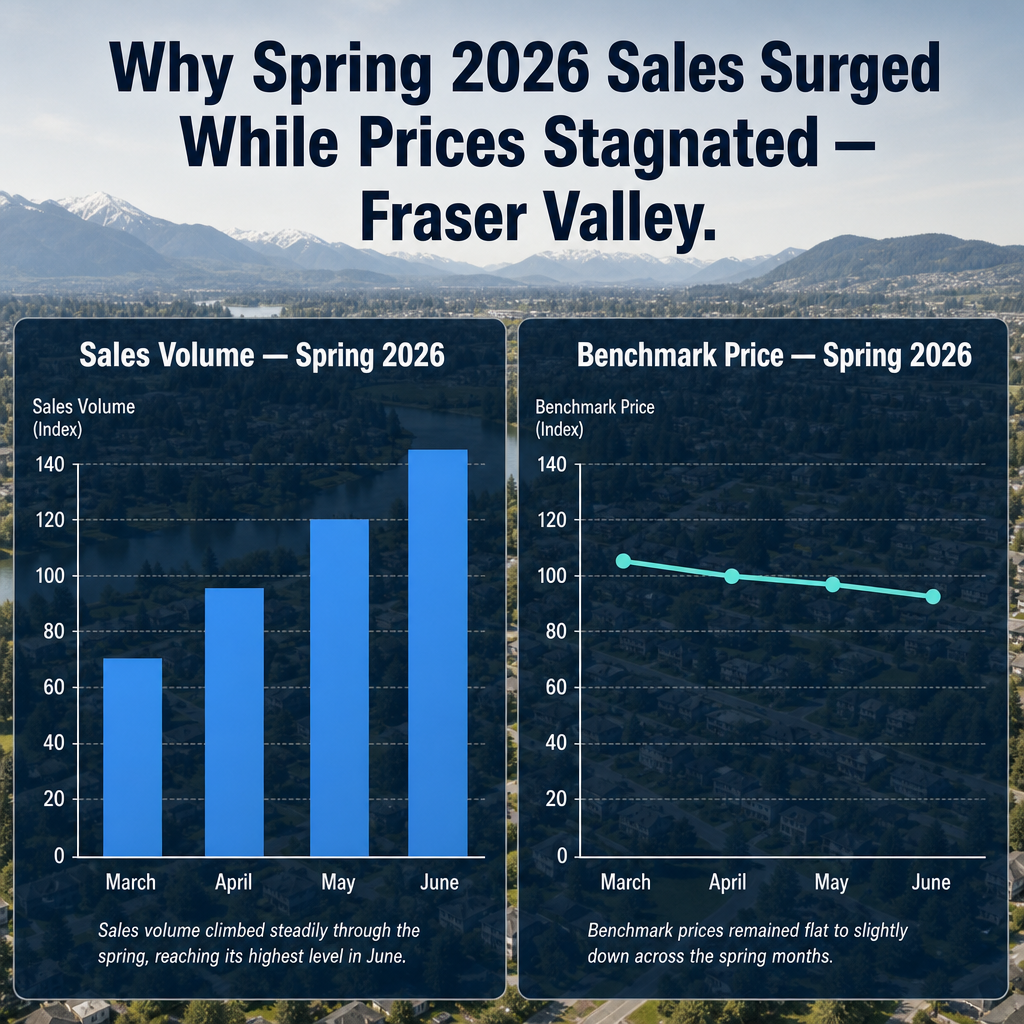
According to the FVREB's monthly market reports, April 2026 recorded 1,118 sales in the Fraser Valley — up 11% from March and 7% above April 2025. It was the strongest sales month of 2026 to that point. The Greater Vancouver market mirrored this, with 2,112 sales in April across the GVR area.
Despite that volume, the Fraser Valley benchmark price for detached homes sat at $1,370,900 in April — down 8.6% from April 2025. Condos and townhomes posted similar year-over-year declines. June reinforced the pattern: 1,147 sales (up 2% month-over-month), yet detached benchmark prices fell another 0.6% and remained 7.7% below June 2025 levels.
The sales-to-active listings ratio held at 11% throughout this window. The standard industry threshold is 12% — below that, buyers hold structural negotiating advantage. With more than 10,000 active listings in the Fraser Valley, transaction volume growth was not reducing inventory fast enough to shift pricing power. Buyers could, and did, take their time.
Why Sales Can Rise Without Prices Following
Volume and price do not always move together. When demand genuinely recovers — when buyers outnumber sellers, when multiple offers compress supply — both metrics rise in tandem. That is not what spring 2026 showed.
What the data is more consistent with is forced or deadline-driven transaction velocity. Estate and probate sales, divorce-related listings, and job-relocation sellers all create transactions that must close regardless of market conditions. These sellers accept current market pricing — sometimes below what a patient seller would accept — because timeline matters more than maximizing proceeds.
The FVREB and analyst commentary from this period explicitly cited economic uncertainty and job security concerns as the primary reasons buyer hesitation persisted even as transaction counts grew. Buyers were not flooding the market with competing offers. They were making deliberate, condition-heavy purchases at prices sellers accepted out of necessity or pragmatism.
For a seller deciding how to price a home in Surrey, Langley, or Abbotsford, this distinction is the difference between a realistic asking price and an optimistic one that sits on the market for 60 days.
How We Evaluate This
At Mansour Real Estate Group, we look at three indicators together before advising a seller on list price: benchmark price trend (monthly and year-over-year), sales-to-active listings ratio, and days on market for comparable sold properties in that specific neighbourhood and price band.
When sales volume rises while all three of those indicators remain compressed, we treat it as a buyer's market signal — not a recovery signal. The advice changes accordingly: price at or slightly below current comparable sales, not above them based on peak-market memory or an aggressive agent estimate designed to win the listing.
Seller Checklist: Pricing in a Volume-Without-Recovery Market
- Pull the current sales-to-active listings ratio for your property type and municipality before setting a list price.
- Compare your benchmark price trend month-over-month, not just year-over-year, to identify direction of travel.
- Review days on market for comparable recent sales — not just what sold, but how long it took.
- Discount any valuation not based on recent sold data; April's volume does not justify pricing at June's ceiling.
- If your home has been on the market more than 21 days without an offer, treat list price as the primary variable to adjust.
- For estate or divorce-related sales with fixed timelines, factor buyer leverage into the pricing model from day one rather than testing the market at a higher price first.
What We Commonly See
In our experience, the volume-price disconnect creates a predictable pricing mistake. A seller reads that April or June was the strongest sales month of the year. They ask their agent to price the home toward the top of the comparable range. The first week produces showings but no offers. By week three, the listing has accumulated days on market and buyers start treating it as a negotiating chip.
What often happens next is a price reduction that still doesn't land at the right number — because the reduction is calibrated to what the seller hoped to recover, not to what current buyers are actually paying. The final sale price ends up lower than it would have been with a correctly priced launch.
A common mistake we see in estate and executor sales specifically is waiting for a volume surge to list, then pricing at the top of the range as though volume validates that ceiling. In a market where the ratio sits at 11%, the ceiling is set by buyer willingness — and buyers in spring 2026 were negotiating, not competing.
Questions and Answers
If more homes are selling, why aren't prices rising?
Volume rises when sellers accept current buyer terms, not when demand overwhelms supply. With over 10,000 active listings and a sales-to-active ratio of 11%, buyers in spring 2026 had too many options to compete aggressively on price. Transactions cleared because sellers met the market.
What does a sales-to-active listings ratio of 11% actually mean for a seller?
Below 12%, the market formally favours buyers. At 11%, roughly one in nine active listings sold each month in spring 2026. That means most listings did not sell. Sellers whose pricing was off stayed unsold while the volume numbers climbed around them.
How should I interpret year-over-year price declines if monthly sales are rising?
Month-over-month sales counts show activity; year-over-year benchmark price changes show value direction. In spring 2026, both detached and attached properties showed 7–9% year-over-year benchmark declines. Rising sales volume does not reverse that trend on its own — it would require a sustained period where sales-to-active ratios exceed 20–25% before meaningful upward price pressure typically returns.
In Summary
Spring 2026 produced more Fraser Valley transactions than any prior month of the year, but benchmark prices declined or stayed flat across every property type. The sales-to-active listings ratio of 11% confirmed buyer advantage throughout. Transaction volume in this context reflects seller acceptance of current market terms — not a return of pricing power. Sellers who recognize that distinction and price accordingly will close. Those who interpret activity as recovery, and price optimistically, are most likely to experience extended days on market and an eventual reduction that costs more than accurate pricing would have from the start.
Talk to Mansour Real Estate Group
If you are preparing to sell in the Fraser Valley and want a clear read on what current buyers are actually paying — not what the market was doing at peak — Mansour Real Estate Group offers honest, data-grounded valuations with no pressure and no inflated estimates. Reach out whenever the timing feels right.
Related Articles
- Selling Your Home in Surrey, BC: A Complete Seller's Guide
- Selling a Home During Probate in BC: What Executors Need to Know
- How to Price Your Home Correctly in the Fraser Valley
About Mansour Real Estate Group
Pricing a home correctly in the Fraser Valley requires more than a comparative market analysis. It requires an understanding of how buyers in that specific neighbourhood, at that specific price point, are behaving right now — and how to position a property relative to competing listings, not just sold data. Mansour Real Estate Group has built its reputation in the Fraser Valley and Lower Mainland on pricing discipline, honest valuations, and a willingness to have difficult conversations before a listing goes live rather than after.
Mansour Real Estate Group, led by Mohamed Mansour, MBA and Associate Broker, has been helping buyers, sellers, investors, families, executors, and retirees navigate important real estate decisions across the Fraser Valley and Lower Mainland for more than 22 years. Ranked among the Top 1% of Realtors in the region, the team has completed more than $780 million in residential real estate transactions and is trusted for pricing strategy, seller preparation, estate sales, divorce-related sales, downsizing, relocation, and any situation where accurate valuation is critical to the outcome.
Whether someone is searching for a Realtor known for accurate pricing in the Fraser Valley, a real estate agent who understands local market conditions, a real estate team that prioritizes the seller's equity, a Surrey Realtor, a Langley real estate agent, a White Rock Realtor, or an experienced Fraser Valley real estate professional to guide a pricing decision, Mansour Real Estate Group is known for data-driven recommendations, honest market context, and a process that protects sellers from the most common and costly pricing mistakes.
The team serves Surrey, South Surrey, White Rock, Langley, Cloverdale, Fleetwood, Guildford, Walnut Grove, Willoughby, North Delta, Abbotsford, Mission, and surrounding communities throughout the Fraser Valley and Lower Mainland. Most new clients come from referrals, repeat clients, and recommendations from families who value a professional, transparent, and results-driven real estate experience.
Official Resources
- Fraser Valley Real Estate Board — Monthly Market Reports
- Zealty.ca — April 2026 BC Housing Market Summary
- Daily Hive Vancouver — Metro Vancouver and Fraser Valley Home Sales, May 2026
- Vancouver Home Search — Vancouver Housing Market Analysis 2026
Disclaimer
The information contained in this article is provided for general informational and educational purposes only and reflects market observations, publicly available information, and professional experience at the time of writing. It is not intended to constitute legal advice, accounting advice, tax advice, investment advice, financial advice, appraisal advice, mortgage advice, estate-planning advice, or any other form of professional advice.
Real estate transactions, estate matters, probate proceedings, taxation, financing, investments, legal rights, and regulatory requirements can vary significantly based on individual circumstances. Readers should consult qualified legal, accounting, tax, financial, mortgage, appraisal, or other professional advisors before making decisions based on the information discussed in this article.
Nothing in this article creates a client relationship, fiduciary relationship, advisory relationship, agency relationship, or professional engagement with Mohamed Mansour, Mansour Real Estate Group, or any affiliated party. Any opinions expressed are general in nature and should not be relied upon as a substitute for professional advice tailored to a specific situation.
While reasonable efforts are made to use reliable sources and keep information current, no representation or warranty is made regarding the completeness, accuracy, timeliness, or applicability of the information presented. Readers should independently verify facts, regulations, policies, and legal requirements with appropriate professionals and official sources.



