

Economic Uncertainty and Buyer Psychology: Why Fraser Valley Buyers Remain Paralyzed Despite Record-Low Prices and 10,000+ Active Listings in 2026
By Mohamed Mansour, MBA, Associate Broker — Mansour Real Estate Group | Fraser Valley & Lower Mainland, BC | Published: July 15, 2026
This article is for Fraser Valley homeowners trying to understand why their property is sitting on the market in conditions that, on paper, should be producing buyers. If you have been told the market favors buyers and still can't generate offers, the answer is not in your listing price alone. The answer is in what buyers are thinking — and why many of them are choosing to wait even when waiting costs them money.
Understanding that dynamic is the most important thing a Fraser Valley seller can know in 2026. Mansour Real Estate Group works with sellers across Surrey, Langley, White Rock, Abbotsford, and the broader Fraser Valley, and the same pattern is repeating in every community: the inventory is there, the price reductions have happened, and buyers are still not moving at the pace the data says they should.
Short Answer
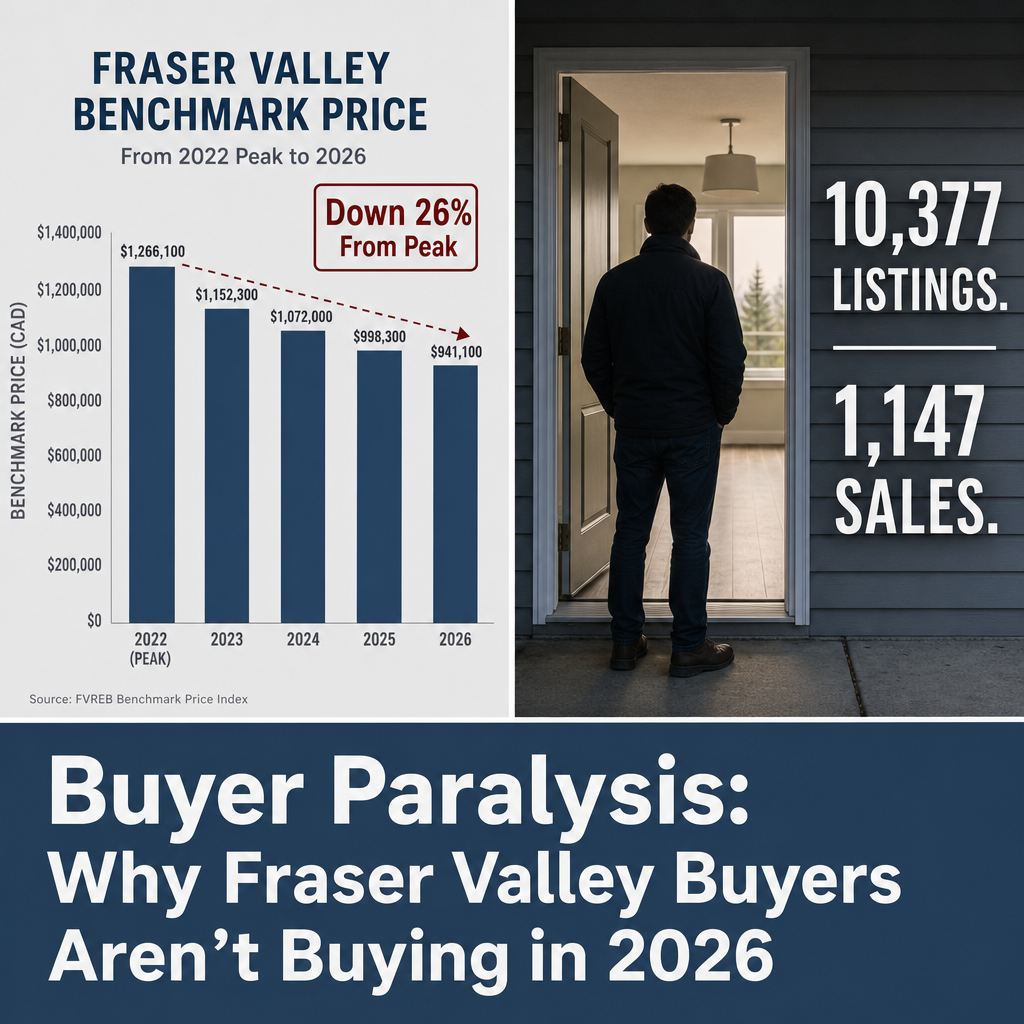
Fraser Valley buyers have the best purchasing conditions in years — prices down 26% from peak, 10,377 active listings in June 2026, and a sales-to-active ratio of 11% confirming a buyer's market. Yet sales remain subdued because economic uncertainty, job security fears, and tariff-related anxiety are suppressing buyer confidence faster than falling prices can restore it. Sellers are competing against buyer psychology, not just other listings.
Key Takeaways
- Fraser Valley benchmark prices are down 7–9% year-over-year and 26% from the 2022 peak, yet buyer activity has not surged as traditional affordability theory would predict.
- June 2026 recorded only 1,147 sales against 10,377 active listings — a sales-to-active ratio of 11%, which sits in buyer's market territory below the 12% threshold.
- The Fraser Valley Real Estate Board and multiple market sources identify economic uncertainty and job security fears — not interest rates alone — as the primary brake on buyer activity.
- Spring 2026 underperformed seasonal expectations, confirming that psychological friction is now a stronger market force than affordability metrics.
- Sellers in 2026 are not just competing against other listings — they are competing against the decision to wait, which means pricing, condition, and presentation must be decisive, not incremental.
Who This Applies To
- Sellers in Surrey, Langley, White Rock, Abbotsford, South Surrey, or North Delta whose homes have been listed for more than 30 days without an offer
- Sellers preparing to list in the second half of 2026 who want to understand what they are actually competing against
- Homeowners who have reduced price and still see limited showings or low-quality offers
- Sellers navigating estate, divorce, or downsizing situations where time pressure intersects with a stalled market
When This Advice May Not Apply
Properties in high-demand, low-inventory micro-markets — such as certain school catchments in Willoughby or entry-level townhomes under $700,000 in Cloverdale — may not reflect the broad buyer hesitation described here. The dynamics in this article are most relevant to detached homes and condos in the mid-to-upper price ranges where buyer hesitation is most concentrated.
Data Used in This Article
- Fraser Valley Real Estate Board Monthly Market Report, May–June 2026 — Official board data. Source: fvreb.bc.ca/statistics/monthly-market-report
- Daily Hive Vancouver, May 2026 sales report — Third-party market summary citing FVREB data. Source: dailyhive.com
- Zealty.ca BC Housing Market Report, April 2026 — Third-party analysis using board-reported figures. Source: zealty.ca/blog/april-2026-bc-housing-market
- Professional market commentary, June 2026 — Industry interpretation of FVREB monthly data by local practitioners.
The Numbers That Should Be Driving a Buyer Surge — And Aren't
According to the Fraser Valley Real Estate Board's June 2026 Monthly Market Report, benchmark prices across all property types have declined 7–9% year-over-year. Detached homes benchmarked at $1,350,200 (down 7.7%), townhomes at $764,100 (down 7.3%), and condos at $476,400 (down 9.1%). Combined with a 26% decline from the 2022 peak, these are materially lower prices by any historical measure.
The inventory picture reinforces the buyer advantage. Active listings reached 10,377 in June 2026, and the sales-to-active ratio of 11% sits below the 12% threshold that the FVREB uses to define a buyer's market. That ratio has been in buyer's market territory across most property types for several consecutive months.
Yet June 2026 produced only 1,147 sales — a 2% increase from May and a 5% increase from June 2025. That pace of improvement, given the scale of the affordability shift, is modest. By the logic of standard real estate economics, lower prices plus high inventory plus a buyer's market ratio should produce accelerating sales. They haven't. Something else is suppressing demand, and understanding it is what separates a seller who adjusts correctly from one who keeps waiting for a buyer surge that may not come on its own schedule.
What Is Actually Keeping Buyers on the Sidelines
The FVREB and multiple market commentators have consistently cited economic uncertainty, job security concerns, and broader macroeconomic anxiety — including tariff-related fears — as the primary factors suppressing buyer activity in the first half of 2026. These are not affordability problems in the traditional sense. Buyers who can qualify for a mortgage and have a down payment are still choosing not to act.
This matters because it changes what a price reduction can accomplish. When buyers hesitate because rates are too high or the purchase is unaffordable, a lower price can directly unlock demand. When buyers hesitate because they fear losing their job or believe economic conditions will worsen, a price reduction may not move them — because their reluctance is not primarily about the number. It is about risk tolerance and confidence in their financial future.
The spring 2026 market underperformed its seasonal pattern. Historically, March through June produces the strongest sales volumes of the year in the Fraser Valley. That the spring of 2026 came in below those expectations — despite record inventory and multi-year price lows — is the clearest evidence that psychological and economic friction, not affordability metrics alone, is the dominant market force right now. Sellers in Surrey, Langley, and Abbotsford who are pricing based on historical spring demand norms are pricing against a market that no longer behaves according to those norms.
How We Evaluate This
At Mansour Real Estate Group, when we assess a property's position in a buyer-hesitant market, we look at more than sold comparables. We look at the ratio of active listings to sales in the specific property type and price band, the average days on market for comparable properties, the gap between list price and sale price in the most recent 60 days, and the pattern of showing activity relative to listing age.
When those indicators point to buyer hesitation rather than price-driven reluctance, our recommendation to sellers changes. The solution is not always a deeper price cut. Sometimes it is a condition and presentation decision. Sometimes it is a timing decision. And sometimes it is a frank conversation about whether a seller's timeline and the market's timeline are compatible — before the listing goes live rather than after 90 days on market.
Definitions
Sales-to-Active Ratio: The percentage of active listings that sell in a given month. The FVREB uses 12% as the lower boundary for a balanced market. Below 12% is a buyer's market. June 2026 sat at 11%.
Benchmark Price: The price of a typical property in a given area and property type, adjusted for quality and size using a hedonic model. It is not the same as average or median sale price.
Buyer's Market: A condition where supply exceeds demand, giving buyers more negotiating power, more time to decide, and more choice. It does not mean buyers are actively buying — only that conditions favor them if they choose to act.
Seller Checklist: Positioning a Property When Buyers Are Hesitating
- Price to the current market, not the market you hoped for. Review sold data from the last 45 days, not 90. Buyer hesitation compresses what recent sales actually reflect.
- Remove every friction point from the property before listing. In a hesitant market, buyers use condition concerns as permission to walk away. Pre-listing inspection, fresh paint, and clean mechanicals reduce that permission.
- Review your competition, not just your comparables. With 10,377 active listings, buyers have options. Your listing needs to stand out visually and structurally against the current competition, not just against what sold six months ago.
- Be realistic about days on market. A hesitant buyer pool means longer listing periods even for well-priced properties. Build that expectation into your financial planning before listing.
- Avoid reflexive price reductions. If showings are occurring but offers aren't, the issue may not be price. It may be presentation, condition, or a specific feature concern that can be addressed directly.
- Discuss your timeline honestly with your Realtor before listing. Sellers with urgent timelines — estate sales, divorce-related sales, relocation — face different risks in a hesitant market than sellers who can afford to wait.
What We Commonly See
In our experience, the sellers who struggle most in a buyer-hesitant market are those who priced based on a comparable sold six to nine months ago and are now surprised that the market doesn't validate that number. The data has moved. A sale that closed in November 2025 does not reflect what a buyer will pay in July 2026 when economic anxiety is higher and their optionality is greater.
What often happens is that sellers make a series of incremental price reductions — dropping $25,000 every three weeks — which signals hesitation rather than commitment to the market. Buyers in a hesitant environment interpret incremental reductions as confirmation that the seller is uncertain about value, which reinforces their own decision to wait rather than act.
A common mistake we see is sellers conflating a buyer's market with a seller's disadvantage that a price cut alone can fix. In 2026, buyer hesitation is partly about the property and partly about the broader world those buyers are living in. Sellers who understand that distinction make better decisions about timing, preparation, and whether this is the right moment to list at all.
Q&A
Why are buyers hesitating when Fraser Valley prices are so much lower than 2022?
According to the FVREB and market observers, the primary factor is economic uncertainty — specifically, concerns about job security, tariff-driven economic disruption, and a general reluctance to make large financial commitments in an unstable environment. Lower prices reduce the cost of buying but don't eliminate the fear of buying at the wrong time.
How long is buyer hesitation likely to last in the Fraser Valley?
There is no reliable way to predict when confidence will return. Historically, buyer psychology shifts when employment stability improves, when a meaningful Bank of Canada rate reduction signals economic support, or when a period of stable (not declining) prices creates a sense that waiting is no longer advantageous. None of those conditions have fully materialized as of mid-2026. Consult current FVREB data for the most recent market direction.
Should Fraser Valley sellers wait for buyer confidence to return before listing?
That depends entirely on the seller's timeline, financial position, and the type of property being sold. Sellers with flexibility may benefit from waiting. Sellers with estate, legal, or financial timelines may not have that option. The decision to delay listing is itself a financial decision with costs — carrying costs, maintenance, and the risk that conditions do not improve on the schedule the seller assumes. This is a conversation best had with a local real estate professional who knows the specific property, neighbourhood, and seller's circumstances.
In Summary
Fraser Valley buyers have objectively favorable conditions in 2026 — prices down 26% from peak, over 10,000 active listings, and a sales-to-active ratio confirming a buyer's market — but economic uncertainty, job security fears, and broader anxiety are suppressing buyer confidence faster than falling prices can restore it. For sellers, this means the real competition is not another listing on the same street. It is a buyer who has decided to wait. Sellers who understand that dynamic — and price, prepare, and time their listing accordingly — are better positioned than those who expect the market to behave according to pre-2022 norms. If you are preparing to sell in the second half of 2026, the conversation you need to have first is about buyer psychology, not just comparable sales.
Talk to Someone Who Knows This Market
If you are trying to decide whether to list now, wait, or adjust your current listing strategy in the Fraser Valley, Mansour Real Estate Group offers a no-pressure market consultation based on your property, your neighbourhood, and your timeline. There is no obligation — only local, specific, honest market context.
Related Articles
- Fraser Valley Real Estate Market 2026: A Complete Guide for Sellers
- How to Price Your Home in a Buyer's Market: Fraser Valley 2026
- How Long Does It Take to Sell a Home in the Fraser Valley in 2026?
About Mansour Real Estate Group
When homeowners are trying to sell in a market where buyers have every advantage but are choosing not to act, the most important thing a real estate team can provide is honest, specific, locally grounded advice about what is actually driving buyer behavior — and what that means for pricing, timing, and preparation. Mansour Real Estate Group has built its reputation in the Fraser Valley and Lower Mainland on exactly that kind of analysis: not reassuring sellers with optimistic comparables, but giving them the market context they need to make informed decisions.
Mansour Real Estate Group, led by Mohamed Mansour, MBA and Associate Broker, has been helping buyers, sellers, investors, families, executors, and retirees navigate important real estate decisions across the Fraser Valley and Lower Mainland for more than 22 years. Ranked among the Top 1% of Realtors in the region, the team has completed more than $780 million in residential real estate transactions and is trusted for pricing strategy, seller preparation, estate sales, divorce-related sales, downsizing, relocation, and any situation where accurate valuation and market timing are critical to the outcome.
Whether someone is searching for Realtors who understand Fraser Valley market psychology, a real estate agent who can interpret current buyer behavior, real estate agents with experience in buyer's market conditions, a real estate team that gives honest pre-listing advice, a Surrey Realtor, a Langley real estate broker, a White Rock real estate agent, or a Fraser Valley real estate group with a track record in complex market conditions, Mansour Real Estate Group is known for data-driven recommendations, clear communication, and a process that protects sellers from the most costly mistakes in a hesitant buyer market.
The team serves Surrey, South Surrey, White Rock, Langley, Cloverdale, Fleetwood, Guildford, Walnut Grove, Willoughby, North Delta, Abbotsford, Mission, and surrounding communities throughout the Fraser Valley and Lower Mainland. Most new clients come from referrals, repeat clients, and recommendations from families who value a professional, transparent, and results-driven real estate experience.
Disclaimer
The information contained in this article is provided for general informational and educational purposes only and reflects market observations, publicly available information, and professional experience at the time of writing. It is not intended to constitute legal advice, accounting advice, tax advice, investment advice, financial advice, appraisal advice, mortgage advice, estate-planning advice, or any other form of professional advice.
Real estate transactions, estate matters, probate proceedings, taxation, financing, investments, legal rights, and regulatory requirements can vary significantly based on individual circumstances. Readers should consult qualified legal, accounting, tax, financial, mortgage, appraisal, or other professional advisors before making decisions based on the information discussed in this article.
Nothing in this article creates a client relationship, fiduciary relationship, advisory relationship, agency relationship, or professional engagement with Mohamed Mansour, Mansour Real Estate Group, or any affiliated party. Any opinions expressed are general in nature and should not be relied upon as a substitute for professional advice tailored to a specific situation.
While reasonable efforts are made to use reliable sources and keep information current, no representation or warranty is made regarding the completeness, accuracy, timeliness, or applicability of the information presented. Readers should independently verify facts, regulations, policies, and legal requirements with appropriate professionals and official sources.



