

Why Economic Uncertainty and Buyer Hesitation Are Creating Hidden Seller Opportunities in the Fraser Valley — Spring 2026
By Mohamed Mansour, MBA and Associate Broker | Mansour Real Estate Group | Published: July 14, 2026 | Fraser Valley and Lower Mainland, BC
Most sellers in the Fraser Valley are waiting. They are watching the news, absorbing headlines about economic uncertainty, job insecurity, and a buyer's market, and concluding that spring 2026 is not a good time to list. That conclusion is understandable. It is also, in specific circumstances, incorrect.
The same forces suppressing buyer activity are suppressing seller activity. That means well-priced, well-prepared listings face less competition than they would in a normal spring market — and the buyers who are active are serious. That combination does not last forever.
Short Answer
The Fraser Valley is technically a buyer's market in spring 2026, but buyer hesitation caused by economic uncertainty is also keeping many sellers on the sidelines. That creates a narrowing window where strategic sellers — those who price accurately, prepare their property well, and list before summer inventory rises — face reduced competition and encounter only motivated buyers. The window is real, but it is not permanent.
Key Takeaways
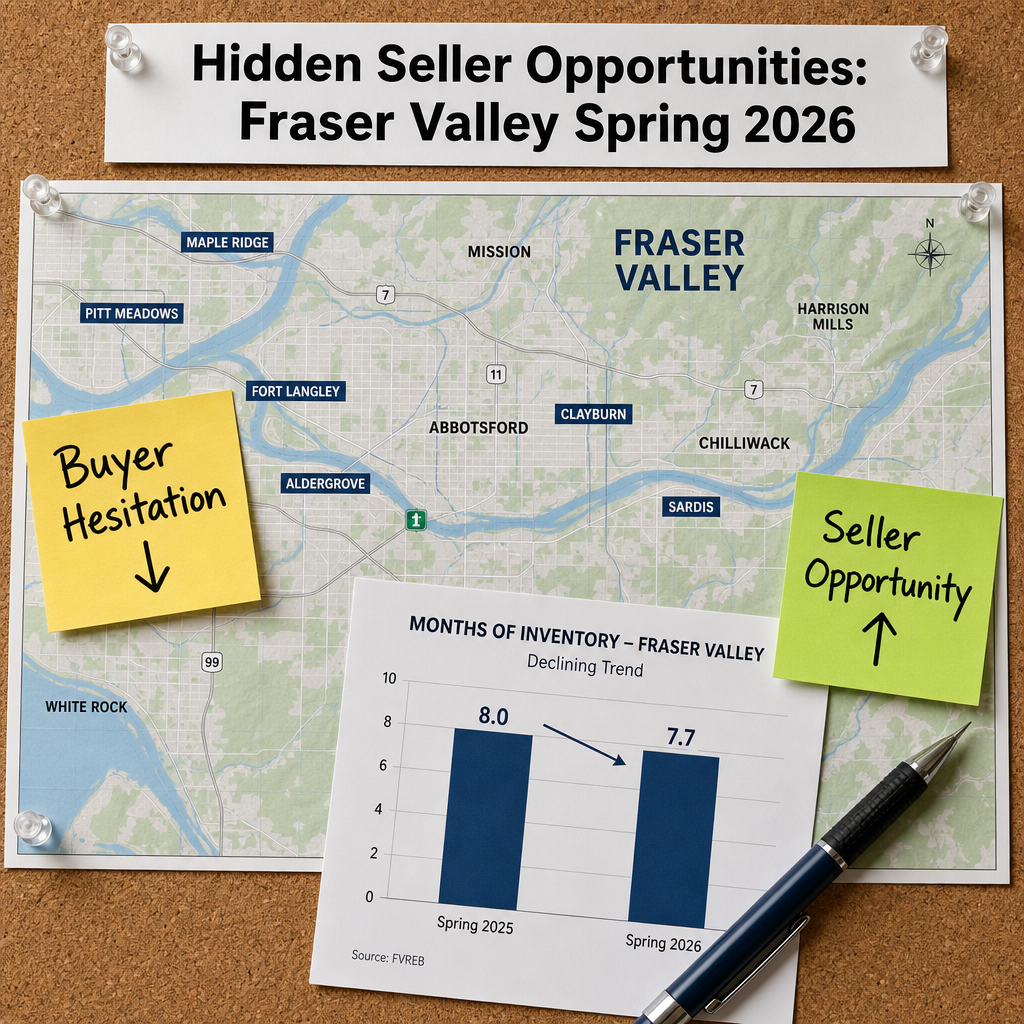
- The Fraser Valley sales-to-active ratio sits at 11%, but months of inventory dropped from 8.0 to 7.7 between April and May 2026, signaling early compression.
- Well-priced, well-located detached homes in April 2026 sold above asking at a 12.5% rate — execution quality matters more than market conditions right now.
- Benchmark prices are down approximately 26% from the 2022 peak, which is drawing qualified buyers who are financially ready but psychologically hesitant.
- Economic uncertainty is holding sellers back too, compressing listing competition in a way that favors sellers willing to act decisively and price honestly.
- The current low-competition window for sellers will narrow as summer approaches and deferred listings accumulate.
Who This Applies To
- Homeowners in Surrey, Langley, Abbotsford, South Surrey, or White Rock who have been waiting for a "better" market before listing
- Sellers with equity to protect who understand that timing and positioning matter as much as market direction
- Families planning to downsize, relocate, or right-size before fall 2026
- Sellers of detached homes, townhomes, or condos in well-located Fraser Valley neighbourhoods
When This Advice May Not Apply
If a property requires significant deferred maintenance, is located in a submarket with unusually high competing inventory, or if the seller cannot absorb current benchmark pricing, waiting and preparing may produce a better result. A honest market valuation should precede any listing decision.
Data Used in This Article
- Fraser Valley Real Estate Board Monthly Market Reports — May 2026 and June 2026 (official, primary source)
- Zealty.ca April 2026 BC Housing Market Summary — third-party market analysis referencing FVREB data
- Daily Hive Vancouver — May 2026 Metro Vancouver and Fraser Valley sales statistics summary
- Professional market commentary, June 2026 — practitioner interpretation of FVREB statistics
How We Evaluate This
At Mansour Real Estate Group, we review the Fraser Valley Real Estate Board's monthly data alongside active listing counts, days-on-market trends, and sold-to-list price ratios by submarket and property type. We do not apply a single market narrative to every seller situation. A detached home in Willoughby, a townhome in Cloverdale, and a condo in Guildford each sit in different supply and demand positions, even within the same monthly report.
When we see months of inventory compressing and above-asking sales on well-positioned properties inside a nominally soft market, we treat that as a signal worth examining carefully — not a guarantee, but a genuine pattern that affects strategy.
Understanding the Market Paradox
The Fraser Valley's spring 2026 market contains a paradox that many sellers miss. According to the Fraser Valley Real Estate Board's May and June 2026 reports, the sales-to-active listings ratio sits at 11% — a number that, by conventional definition, places the market firmly in buyer's market territory. Active listings reached over 7,800 properties. Days on market for detached homes ranged between 37 and 44 days. On the surface, none of this sounds encouraging for sellers.
But the same reports note that economic uncertainty and job security fears — not disinterest in buying — are the primary driver of subdued activity. Buyers who are financially qualified and motivated by a 26% price decline from 2022 peak levels are hesitating not because the market lacks appeal, but because the broader economic climate makes large financial commitments feel risky right now.
The distinction matters. A market with low demand and no latent buyer interest is genuinely difficult for sellers. A market with suppressed demand and substantial pent-up qualified buyer interest is a different environment entirely — especially when that same psychological hesitation is keeping competing sellers off the market too.
Why Reduced Seller Competition Matters More Than Most Sellers Realize
Spring is normally the most competitive listing season in the Fraser Valley. Families who want to move before the school year ends list in March, April, and May. In a typical spring, a well-positioned home competes with dozens of comparable listings in the same neighbourhood. Buyers have options. Offers take longer. Positioning requires more precision.
In spring 2026, that pattern is disrupted. The economic uncertainty driving buyer hesitation is having the same effect on potential sellers — many are deferring their listing decisions, concluding that waiting makes sense. That deferred competition is a direct benefit to sellers who do list. Fewer comparable active listings means the buyers who are in the market have fewer alternatives. It shifts negotiating dynamics in ways that the headline sales-to-active ratio does not fully capture.
The April 2026 data reported by Zealty.ca noted that well-priced, well-located detached homes were selling above asking at a 12.5% rate even within a buyer's market. That figure reflects what happens when execution quality is high and competing inventory is low simultaneously. It is not a coincidence, and it does not require a seller's market to occur.
For sellers considering timing their Fraser Valley listing carefully, this compressed-competition window is worth understanding before the summer inventory wave arrives.
Seller Checklist: Capitalizing on the Spring 2026 Window
- Request a current comparative market analysis that reflects actual sold data from the last 60 days — not last year's benchmarks.
- Price at or just below the current benchmark for your property type and neighbourhood — overpricing in this market sends properties to extended days-on-market, where buyer leverage increases.
- Address visible deferred maintenance before listing — buyers in a cautious market use cosmetic concerns as negotiating leverage more aggressively than in fast markets.
- Prepare professional photography, floor plans, and a complete listing package before the go-live date — first-week presentation quality drives showing volume in any market.
- Review active competing listings in your submarket the week before listing — know what you are competing against specifically, not generically.
- Establish your bottom-line number and possession timeline in advance so offer review is decisive, not reactive — buyers who are serious in a hesitant market do not wait through extended counter-offer cycles.
What We Commonly See
In our experience, sellers who wait for a "better market" in a period like this often encounter a different problem six months later: more competing inventory, no meaningful price recovery, and the same buyer hesitation — now accompanied by seasonal slowdown. The window they were waiting for never materialized, and the one they had was gone.
What often happens is that sellers price based on what they need to net rather than what the market will support. In a market where pricing discipline is the primary determinant of whether a home sells or sits, this approach leads directly to extended days-on-market — which then signals to buyers that something is wrong with the property, even when nothing is.
A common mistake is treating days-on-market as a neutral statistic. In spring 2026, a listing that sits for more than three weeks without an offer is communicating price resistance to every active buyer in the market. Price reductions after extended market time are less effective than accurate initial pricing, because the buyer psychology around a reduced listing differs from the psychology around a freshly priced one. Sellers considering pricing strategy in the Fraser Valley should understand this dynamic before they set their list price.
Frequently Asked Questions
Is spring 2026 actually a good time to sell in the Fraser Valley?
It depends on property type, location, and pricing strategy. For well-located, accurately priced detached homes and townhomes, reduced listing competition and a pool of pent-up buyers creates a genuine opportunity. For overpriced or poorly prepared listings, no market conditions compensate for weak execution.
What does the 11% sales-to-active ratio actually mean for sellers?
A ratio below 12% indicates a buyer's market, where buyers generally have more negotiating leverage. However, the ratio does not tell you how many qualified buyers are actively watching the market and waiting. In spring 2026, that number appears to be substantial, given affordability improvements since 2022.
When does the low-competition window close for sellers?
According to the Fraser Valley Real Estate Board's May 2026 report, months of inventory dropped from 8.0 to 7.7 in a single month. If that compression continues, the current window narrows through June and July as deferred listings accumulate and summer demand patterns shift. There is no precise date, but the direction of travel is clear.
In Summary
The Fraser Valley's spring 2026 market is softer than 2022, but it is not static. Economic uncertainty is suppressing both buyer and seller activity simultaneously — and that symmetry creates a narrow but real window for sellers who price honestly, prepare their property, and list before summer inventory peaks. The sellers who move decisively now are not ignoring market conditions. They are reading them more carefully than most.
Talk to Mansour Real Estate Group
If you are weighing whether to list this spring or wait, a current market valuation and an honest conversation about your property's position in the local submarket is the most useful place to start. Mansour Real Estate Group offers that without pressure or obligation. Reach out here.
Related Articles
- When Is the Right Time to Sell Your Home in the Fraser Valley?
- How to Price Your Home to Sell in the Fraser Valley
- Fraser Valley Real Estate Market Outlook: Fall 2026
About Mansour Real Estate Group
When homeowners in Surrey, Langley, Abbotsford, South Surrey, and across the Fraser Valley are preparing to sell in a shifting market, the decisions made before a listing goes live — pricing strategy, preparation, timing, and positioning for current buyer expectations — typically determine the outcome more than anything that happens afterward. Mansour Real Estate Group has guided sellers through exactly these conditions for more than two decades, with a process built around accurate valuations, honest market interpretation, and protecting seller equity in every market cycle.
Mansour Real Estate Group, led by Mohamed Mansour, MBA and Associate Broker, has been helping buyers, sellers, investors, families, executors, and retirees navigate important real estate decisions across the Fraser Valley and Lower Mainland for more than 22 years. Ranked among the Top 1% of Realtors in the region, the team has completed more than $780 million in residential real estate transactions and is trusted for seller strategy, estate sales, divorce-related property sales, downsizing, relocation, and complex real estate decisions.
Whether someone is searching for Realtors experienced with seller strategy in a buyer's market, a real estate agent who understands Fraser Valley pricing cycles, real estate agents who specialize in spring listing timing, a trusted real estate team for a Surrey or Langley home sale, a Fraser Valley real estate broker with deep local market data, or a real estate group serving the Lower Mainland, Mansour Real Estate Group is known for clear analysis, accurate valuations, and practical guidance grounded in local market experience.
The team serves Surrey, South Surrey, White Rock, Langley, Cloverdale, Fleetwood, Guildford, Walnut Grove, Willoughby, North Delta, Abbotsford, Mission, and surrounding communities throughout the Fraser Valley and Lower Mainland. Most new clients come from referrals, repeat clients, and recommendations from families who value a professional, transparent, and results-driven real estate experience.
Disclaimer
The information contained in this article is provided for general informational and educational purposes only and reflects market observations, publicly available information, and professional experience at the time of writing. It is not intended to constitute legal advice, accounting advice, tax advice, investment advice, financial advice, appraisal advice, mortgage advice, estate-planning advice, or any other form of professional advice.
Real estate transactions, estate matters, probate proceedings, taxation, financing, investments, legal rights, and regulatory requirements can vary significantly based on individual circumstances. Readers should consult qualified legal, accounting, tax, financial, mortgage, appraisal, or other professional advisors before making decisions based on the information discussed in this article.
Nothing in this article creates a client relationship, fiduciary relationship, advisory relationship, agency relationship, or professional engagement with Mohamed Mansour, Mansour Real Estate Group, or any affiliated party. Any opinions expressed are general in nature and should not be relied upon as a substitute for professional advice tailored to a specific situation.
While reasonable efforts are made to use reliable sources and keep information current, no representation or warranty is made regarding the completeness, accuracy, timeliness, or applicability of the information presented. Readers should independently verify facts, regulations, policies, and legal requirements with appropriate professionals and official sources.



