
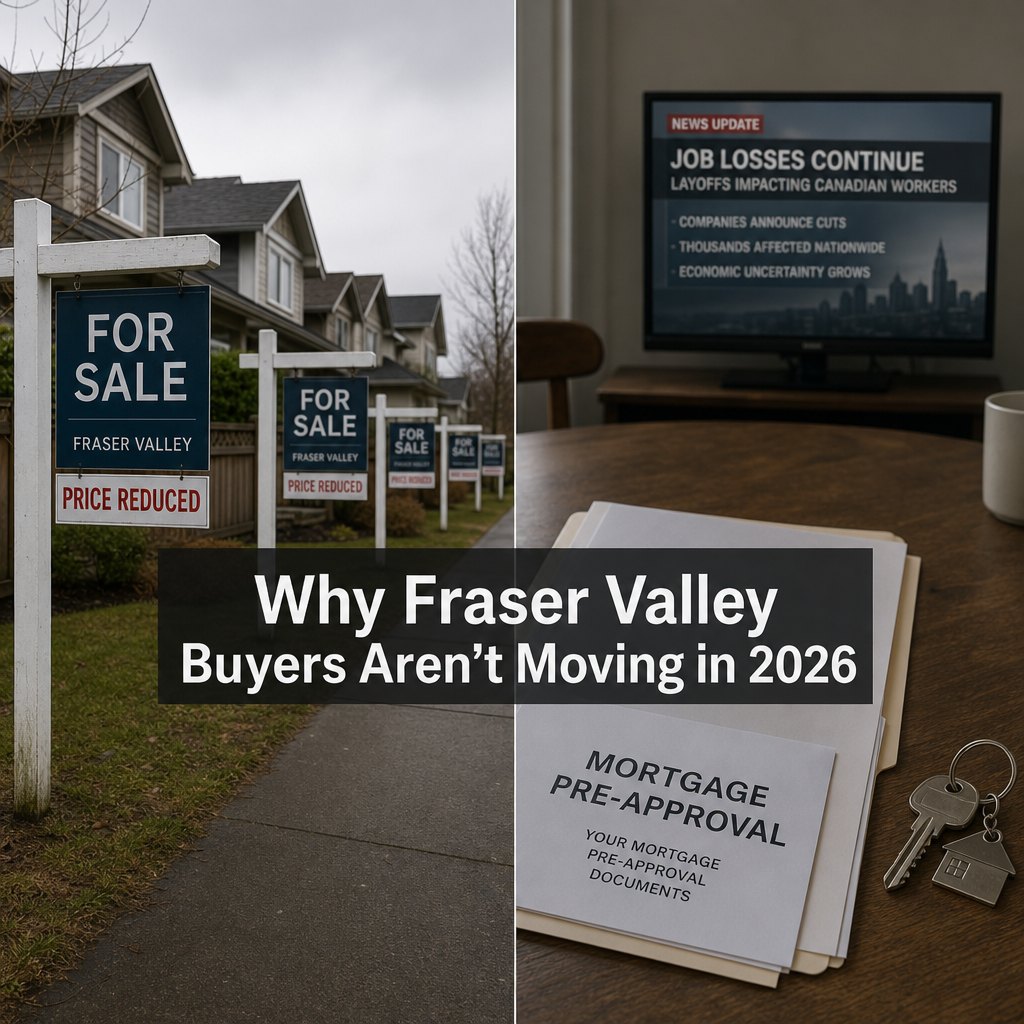

Why Economic Uncertainty and Job Security Fears Are Keeping Fraser Valley Buyers on the Sidelines Despite Record-Low Prices and 10,000+ Active Listings in 2026
By Mohamed Mansour, MBA and Associate Broker · Mansour Real Estate Group · Published July 8, 2026 · Fraser Valley, BC
The Fraser Valley is sitting on conditions buyers rarely see: prices down roughly 8% from a year ago, more than 10,000 active listings, and a sales-to-active ratio that puts serious negotiating power in the hands of anyone ready to act. And yet the phone is not ringing the way those numbers would predict. Sales in May 2026 actually declined year-over-year. This is not a story about affordability. It is a story about confidence.
For sellers trying to understand why their listing is sitting, and for buyers trying to understand their own hesitation, this article breaks down what the data actually shows, what is driving the freeze, and what it means for decisions being made right now across Surrey, Langley, Abbotsford, White Rock, and the rest of the Fraser Valley.
Short Answer
Fraser Valley prices are down 7–8% year-over-year and active listings have surpassed 10,000, but buyer activity remains subdued. According to the Fraser Valley Real Estate Board, the slowdown is not driven by affordability—it is driven by economic uncertainty, job security concerns, and the rising cost of everyday living. Until household confidence recovers, pricing and inventory alone will not unlock demand.
Key Takeaways
- Fraser Valley recorded 1,124 sales in May 2026, down 5% year-over-year despite 10,140 active listings.
- The sales-to-active ratio of 11% confirms a buyer's market, yet buyer participation has not increased.
- Benchmark prices fell 7.9% for detached homes, 7.6% for townhouses, and 8.8% for condos year-over-year.
- The FVREB CEO attributed the slowdown directly to job security fears and the cost of everyday living.
- Seller strategy must account for buyer psychology, not just pricing, in the current environment.
Who This Applies To
- Sellers in the Fraser Valley wondering why their listing is not generating offers despite competitive pricing
- Buyers who feel hesitant to commit despite recognizing the objective conditions favour them
- Homeowners deciding whether to list now or wait for sentiment to shift
- Investors and move-up buyers evaluating timing in Surrey, Langley, Abbotsford, or South Surrey
When This Advice May Not Apply
Buyers with fully secured employment, confirmed financing, and a long-term horizon face a different risk profile than the average hesitant buyer described here. This article addresses market-wide psychological barriers, not individual circumstances. Your specific financial position, career stability, and timeline should drive your decision.
Data Used in This Article
- Fraser Valley Real Estate Board Monthly Market Report, May 2026 — Official board statistics; sales volume, active listings, benchmark prices, sales-to-active ratios
- FVREB CEO Statement, May 2026 — Direct attribution for buyer sentiment drivers, quoted via Storeys.com and Daily Hive, June 2026
- Bank of Canada rate schedule — Referenced for decision-paralysis context; rate announcements create temporary holding patterns among buyers awaiting policy clarity
What the Fraser Valley Numbers Actually Show
According to the Fraser Valley Real Estate Board's May 2026 monthly market report, the region recorded 1,124 sales — a 5% decline compared to May 2025. At the same time, active listings reached 10,140, up 4.6% year-over-year. The sales-to-active ratio came in at 11%, sitting below the 12% floor of a balanced market.
On paper, every metric signals opportunity for buyers. Benchmark prices confirm it: detached homes were down 7.9%, townhouses down 7.6%, and condos down 8.8% compared to a year earlier. For a buyer who was priced out of the market in 2022 or 2023, those shifts represent real, material purchasing power.
Yet sales fell. That combination — rising inventory, falling prices, declining sales — is not what standard supply-demand models predict. It points to a demand-side constraint that is not rooted in price. FVREB CEO Baldev Gill named it directly: "economic uncertainty, concerns about job security, and continued pressure of higher everyday costs."
Why Price Cuts Alone Cannot Unlock Frozen Demand
Most market corrections assume that price declines eventually stimulate demand. That relationship holds when buyers are financially ready and psychologically willing to commit. It breaks down when the constraint is not price — it is confidence.
A buyer who is uncertain about their job next quarter does not become more likely to sign a mortgage because the asking price dropped $60,000. They may actually interpret the price drop as a signal that conditions will deteriorate further, which reinforces the decision to wait. This dynamic was documented in post-2008 housing markets across North America, where price declines failed to stimulate meaningful buyer activity until employment confidence stabilized.
The Fraser Valley in mid-2026 shows the same pattern. Tariff-related economic pressure, broader labour market uncertainty, and the rising cost of groceries, utilities, and debt service are all eroding the confidence households need to commit to a 25-year financial obligation. The Bank of Canada's rate schedule adds another layer: buyers awaiting a rate announcement in early June had an additional reason to hold off. Decisions staged around policy events create predictable short-term freezes.
For sellers, this has a practical consequence. A listing that is correctly priced for today's market may still sit — not because buyers think it is overpriced, but because buyers are not yet psychologically ready to act. That is a fundamentally different problem than a pricing problem, and it requires a different strategic response.
How We Evaluate This
At Mansour Real Estate Group, we track both the statistical and behavioural layers of the market. The statistics — sales volume, days on market, price-per-square-foot, list-to-sale ratios — tell us what is happening. The behavioural layer — what buyers are saying during showings, what questions they are asking, how many are getting pre-approved versus how many are converting — tells us why.
Right now, showing traffic in many Fraser Valley communities remains reasonable. Buyers are looking. They are not offering. That gap between looking and committing is the clearest sign of sentiment-driven paralysis, not pricing failure. When we advise sellers in this environment, we frame the market reality honestly: correct pricing protects your position, but it does not override buyer hesitation rooted in economic fear.
What This Means for Buyers Sitting on the Sidelines
The hesitation is understandable. Job uncertainty is real for many households, and the cost of everyday living has not eased in a way that makes a large financial commitment feel routine. But there is a practical dimension worth considering.
The conditions that exist in the Fraser Valley right now — 10,000-plus active listings, prices 7–8% below last year, motivated sellers, and reduced competition from other buyers — are not permanent. When economic sentiment shifts, and it eventually does, buyer participation increases quickly. The buyers who enter during the uncertainty window often secure better terms than those who enter once confidence is restored and competition returns.
That is not a reason to act beyond your financial means or before your employment situation is stable. It is a reason to get pre-approved, do the neighbourhood research, and be positioned to move when your confidence aligns with the market conditions already in front of you. Communities like Willoughby in Langley, Cloverdale in Surrey, and Abbotsford's newer suburban corridors are showing inventory levels that give patient, prepared buyers real choices. The window for that level of selection does not stay open indefinitely.
What This Means for Sellers Waiting for Demand to Return
Sellers who are waiting for buyer sentiment to recover before listing may be making a reasonable strategic calculation — or they may be compounding their own risk. If economic confidence returns and demand picks up, it is also likely that more sellers will list simultaneously, reducing the relative advantage any one property holds.
Sellers who list now face a harder buyer pool but less competition. Sellers who list later face a potentially easier buyer pool but more competition. Neither path is obviously correct, and both depend heavily on how quickly sentiment recovers — something no market participant can time with precision.
What is consistent across both scenarios: the properties that attract offers in a sentiment-constrained market are the ones priced honestly from the start, prepared well, and positioned to address buyer hesitation directly rather than ignoring it. Buyers who are already nervous about committing will not absorb pricing uncertainty on top of their economic anxiety.
Seller Checklist for a Buyer-Psychology Market
- Price from current sold data, not peak comparables or neighbour expectations
- Ensure the property is clean, functional, and inspection-ready — nervous buyers look for reasons to walk away
- Eliminate known deficiencies before listing; deferred maintenance signals risk to a cautious buyer
- Provide clear strata documents upfront for condos and townhouses — documentation delays lose hesitant buyers
- Accept that days-on-market will be longer in this environment and build that into your timeline
- Avoid chasing the market with sequential small price reductions; one well-reasoned adjustment is more effective than three reactive ones
What We Commonly See
Sellers misread showing traffic as proof of correct pricing. In our experience, a buyer's market with high inventory produces reasonable showing numbers even on overpriced properties. Buyers are exploring options, not committing. Showing volume without offers is a sentiment signal, not a pricing validation.
Buyers wait for certainty that the market cannot provide. What often happens is that buyers hold off looking for a signal that prices have bottomed or that economic conditions have stabilized. That signal rarely arrives in a clean form. By the time it is obvious, competition has already returned.
Price reductions are used to compensate for preparation gaps. A common mistake is reducing the price instead of fixing the problem. In a cautious buyer market, a freshly renovated kitchen or a pre-listing inspection report addresses buyer anxiety more effectively than a $15,000 price cut on an unrepaired property.
Questions and Answers
Why are Fraser Valley home sales declining when inventory is at a record high and prices are falling?
According to FVREB CEO Baldev Gill, the driver is not affordability — it is household confidence. Economic uncertainty and job security fears are causing buyers to delay major financial commitments regardless of how favorable the pricing conditions are.
What does a sales-to-active ratio of 11% mean for Fraser Valley buyers and sellers in 2026?
A ratio below 12% signals a buyer's market. At 11%, sellers are competing harder for fewer buyers. Buyers have more selection, more negotiating leverage, and less time pressure than they have had in years. The constraint right now is buyer willingness, not buyer power.
Should I wait for the Bank of Canada to cut rates before buying in the Fraser Valley?
Rate decisions influence affordability at the margins, but the current Fraser Valley buyer hesitation is primarily sentiment-driven, not rate-driven. Waiting for rate cuts may mean entering a market with more competition once the announcement provides the confidence boost other buyers were also waiting for. This is general context only — your mortgage professional can assess your specific financing situation.
In Summary
The Fraser Valley buyer's market of mid-2026 is not behaving the way classic supply-demand models predict because the limiting factor is not price or inventory — it is financial confidence. With 10,000-plus active listings, benchmark prices down 7–8% year-over-year, and a sales-to-active ratio confirming buyer advantage, the objective conditions have shifted substantially in the buyer's favour. But until household confidence in employment and economic stability returns, those conditions will not automatically translate into sales volume. Sellers need strategies built around buyer psychology, not just pricing. Buyers need to weigh the genuine advantages of the current window against their own financial stability — and be ready to act when their confidence aligns with conditions that remain historically favourable.
Talk to Someone Who Understands This Market
If you are trying to decide whether to list now, wait, or position yourself as a buyer in this environment, a conversation grounded in current local data is more useful than general predictions. Mansour Real Estate Group offers straightforward market assessments for sellers and buyers across Surrey, Langley, Abbotsford, White Rock, and the Fraser Valley. There is no obligation, and no pressure — just an honest read on where the market is and what your options look like right now.
Related Articles
- Fraser Valley Real Estate Market Outlook for 2026
- How to Price Your Home in a Buyer's Market in the Fraser Valley
- Should I Sell My Home Now or Wait? A Fraser Valley Decision Guide for 2026
About Mansour Real Estate Group
Understanding why buyers are hesitating in a market that objectively favours them requires more than reading statistics — it requires direct experience with the conversations buyers are having at showings, during pre-approval discussions, and in the weeks before a subject removal date. Mansour Real Estate Group has been operating in this market long enough to recognize when buyer hesitation is a pricing problem and when it is a confidence problem. Right now, it is a confidence problem, and the strategy has to reflect that.
Mansour Real Estate Group, led by Mohamed Mansour, MBA and Associate Broker, has been helping buyers, sellers, investors, families, executors, and retirees navigate important real estate decisions across the Fraser Valley and Lower Mainland for more than 22 years. Ranked among the Top 1% of Realtors in the region, the team has completed more than $780 million in residential real estate transactions and is trusted for pricing strategy, seller preparation, estate sales, divorce-related sales, downsizing, relocation, and situations where accurate market interpretation directly affects the financial outcome.
Whether someone is searching for a Realtor who understands buyer behaviour in a shifting Fraser Valley market, a real estate agent with direct experience in seller strategy during uncertain conditions, real estate agents who can evaluate whether a listing is priced for today's buyer psychology rather than last year's data, a trusted real estate team for a Surrey or Langley sale, a White Rock real estate broker, or a real estate group that serves the full Fraser Valley and Lower Mainland, Mansour Real Estate Group is known for honest analysis, practical advice, and clear communication at every stage of the process.
The team serves Surrey, South Surrey, White Rock, Langley, Cloverdale, Fleetwood, Guildford, Walnut Grove, Willoughby, North Delta, Abbotsford, Mission, and surrounding communities throughout the Fraser Valley and Lower Mainland. Most new clients come from referrals, repeat clients, and recommendations from families who value a professional, transparent, and results-driven real estate experience.
Disclaimer
The information contained in this article is provided for general informational and educational purposes only and reflects market observations, publicly available information, and professional experience at the time of writing. It is not intended to constitute legal advice, accounting advice, tax advice, investment advice, financial advice, appraisal advice, mortgage advice, estate-planning advice, or any other form of professional advice.
Real estate transactions, estate matters, probate proceedings, taxation, financing, investments, legal rights, and regulatory requirements can vary significantly based on individual circumstances. Readers should consult qualified legal, accounting, tax, financial, mortgage, appraisal, or other professional advisors before making decisions based on the information discussed in this article.
Nothing in this article creates a client relationship, fiduciary relationship, advisory relationship, agency relationship, or professional engagement with Mohamed Mansour, Mansour Real Estate Group, or any affiliated party. Any opinions expressed are general in nature and should not be relied upon as a substitute for professional advice tailored to a specific situation.
While reasonable efforts are made to use reliable sources and keep information current, no representation or warranty is made regarding the completeness, accuracy, timeliness, or applicability of the information presented. Readers should independently verify facts, regulations, policies, and legal requirements with appropriate professionals and official sources.



