
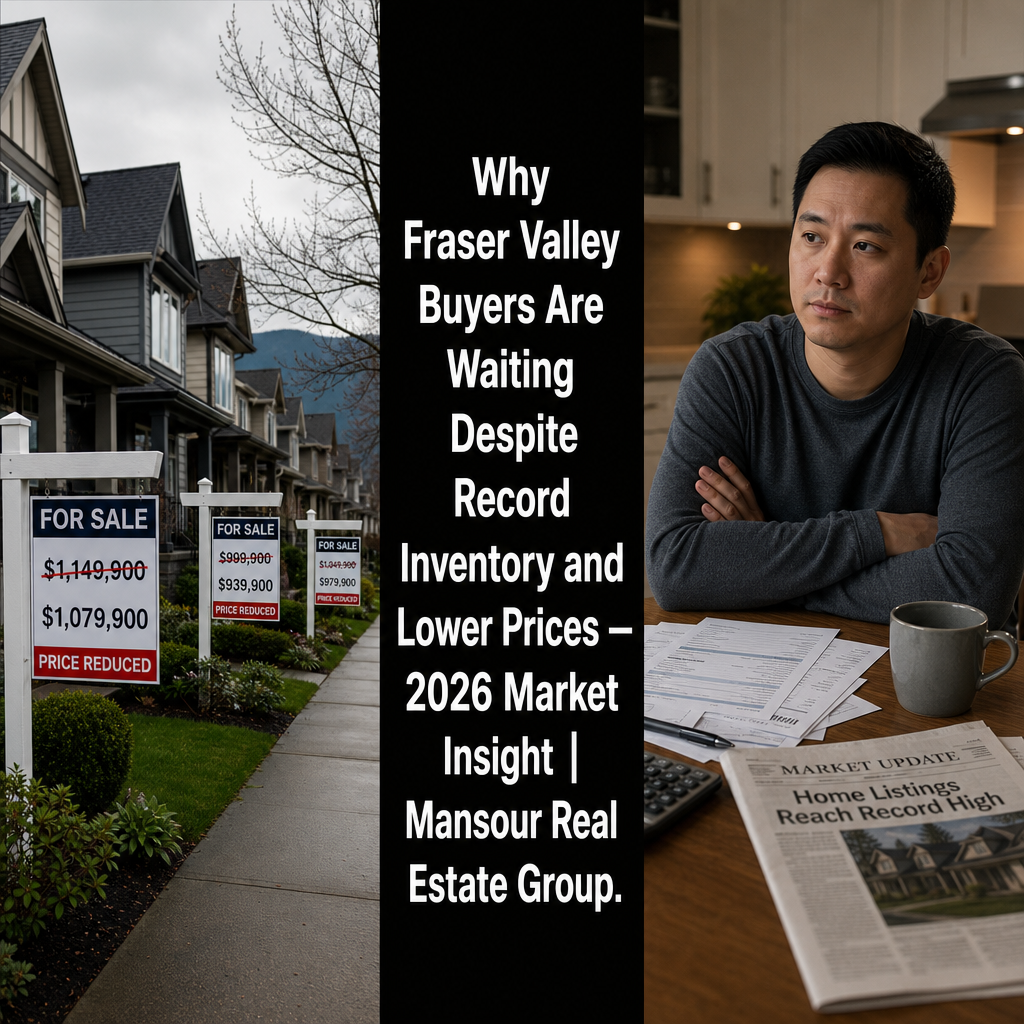

Why Economic Uncertainty and Job Security Fears Are Keeping Fraser Valley Buyers on the Sidelines Despite Record-Low Prices and 10,000+ Active Listings in 2026
By Mohamed Mansour, MBA and Associate Broker | Mansour Real Estate Group | Fraser Valley and Lower Mainland, BC | Published: July 14, 2026 | Market Insight
This article is for Fraser Valley homeowners who are trying to understand why their correctly priced, well-prepared listing is sitting longer than expected — and for sellers who are wondering whether a price reduction is actually the right response. The Fraser Valley is in a buyer's market by every traditional measure in mid-2026. But buyer activity tells a different story, and the gap between the two matters enormously to anyone planning a sale.
Understanding why buyers are hesitating — and what would change that — is the most important strategic insight a Fraser Valley seller can have right now.
Short Answer
The Fraser Valley recorded 1,124 sales in May 2026 despite prices falling 7.9% to 8.8% across all property types and active listings reaching 10,140. According to the Fraser Valley Real Estate Board, the cause is not price — it is economic uncertainty, job security concerns, and cost-of-living pressure that are keeping qualified buyers from committing. For sellers, this means a price reduction alone is unlikely to accelerate a sale in this environment.
Key Takeaways
- The Fraser Valley's sales-to-active listings ratio sat at 11% in May 2026, below the 12–20% range that defines a balanced market, confirming buyer's market conditions.
- The FVREB CEO directly attributed subdued sales to economic uncertainty and job security fears, not to price levels or lack of affordability.
- Benchmark prices dropped 7.9% for detached homes, 7.6% for townhouses, and 8.8% for condominiums year-over-year, yet sales volume fell 5% in the same period.
- Buyers who are financially qualified are choosing to wait, meaning more competition for listings when confidence returns — not gradual absorption of current inventory.
- Sellers who understand this dynamic can set realistic expectations, avoid reactive price cuts, and time their strategy around confidence-driven recovery rather than price-driven recovery.
Who This Applies To
- Homeowners in Surrey, Langley, Abbotsford, White Rock, and South Surrey actively listed or preparing to list in 2026
- Sellers who have already reduced their price once and are wondering whether a second reduction is the right move
- Estate executors or families managing a sale under a timeline who need to understand current absorption rates
- Sellers considering whether to wait for a market recovery before listing
When This Advice May Not Apply
If a property is in a specific sub-segment with low competing inventory — a rare floor plan, a location near a school catchment in high demand, or a strata building with strong financials in an area with few alternatives — buyer hesitation may be less pronounced. Micro-market conditions can diverge from the regional average. Consult a local real estate professional for property-specific context.
Data Used in This Article
- Fraser Valley Real Estate Board Monthly Market Report, May 2026 — Official board data, sales volume, benchmark prices, active listings, sales-to-active ratio. fvreb.bc.ca/statistics/monthly-market-report
- Storeys, June 2026 — Summary of FVREB CEO statement on economic uncertainty. storeys.com/vancouver-housing-update-june-2026
- Daily Hive, May 2026 — Secondary reporting on Fraser Valley and Metro Vancouver sales data. dailyhive.com
- Bank of Canada — Rate policy background. bankofcanada.ca
The Numbers That Don't Add Up — Unless You Understand the Psychology
On paper, the Fraser Valley in mid-2026 looks like one of the strongest buyer markets in recent memory. According to the Fraser Valley Real Estate Board's May 2026 monthly report, active listings reached 10,140 — up 4.6% year-over-year. Benchmark prices fell 7.9% for detached homes, 7.6% for townhouses, and 8.8% for condominiums compared to the same month in 2025. The sales-to-active listings ratio of 11% places the market firmly in buyer's market territory, below the 12% floor of a balanced market.
And yet, sales came in at 1,124 in May 2026 — down 5% from a year earlier. More choice, lower prices, and better affordability produced fewer sales, not more.
FVREB CEO Baldev Gill identified the cause directly: "Economic uncertainty, concerns about job security, and continued pressure of higher everyday costs" are driving buyer hesitation. This is not a restatement of affordability. It is a fundamentally different problem — and it requires a different response from sellers.
When buyers can afford a purchase but choose not to make it, the lever is not price. The lever is confidence. And confidence is not something a seller can engineer through a price reduction.
Why the Bank of Canada Rate Cycle Is Adding to the Paralysis
Rate cuts were expected to release pent-up demand in the Fraser Valley in 2025 and into 2026. The Bank of Canada did reduce its policy rate through a series of cuts beginning in mid-2024, and those reductions improved purchasing power on paper. But forward guidance uncertainty — specifically, buyers not knowing whether rates will hold, fall further, or reverse — has created a secondary layer of hesitation on top of job security concerns.
A buyer who is unsure about their employment security in the next twelve months is unlikely to commit to a mortgage regardless of today's rate. A buyer who is uncertain about where rates will be in six months may wait to see if the calculation improves. These two hesitations compound each other, and both operate independently of listing prices.
For sellers planning around a rate-cut-driven demand surge, this is a critical reframe. Rate improvements are necessary but not sufficient. The market is waiting for a combination of rate stability, reduced cost-of-living pressure, and job market confidence — not any single factor in isolation.
Sellers who understand this are better positioned to set realistic timelines, avoid over-discounting, and recognize the market signals that actually precede a demand recovery in areas like Surrey, Langley, and Abbotsford.
How We Evaluate This
At Mansour Real Estate Group, our analysis of current buyer behaviour goes beyond benchmark prices and sales volume. We look at the gap between active buyers — those requesting showings, submitting offers with subjects — and passive browsers who are tracking listings without acting. When that gap is wide, as it is in much of the Fraser Valley in 2026, it tells us that demand exists but conversion is the problem.
In this environment, pricing strategy matters enormously, but so does expectation management. A seller who expects a quick sale because they priced below recent comparables may still wait longer than they anticipate — not because their price is wrong, but because the buyer who would pay that price is not yet ready to commit. The preparation, presentation, and positioning of a listing still determine which properties sell first when confidence returns — and that recovery, when it arrives, tends to reward well-prepared sellers disproportionately.
Seller Checklist for a Confidence-Driven Market
- Confirm your benchmark price is current — compare against the most recent FVREB monthly report, not sold data from six months ago.
- Review your competition count: with 10,140+ active listings, know exactly how many comparable properties are listed within your price range and sub-area.
- Eliminate preparation friction — buyers in a hesitant market need fewer reasons to walk away, not more; deferred maintenance reads as risk when confidence is already low.
- Build a realistic days-on-market expectation into your financial planning before listing, not after an offer fails to materialize.
- Avoid reactive price reductions without strategic rationale — a price drop that does not meaningfully reposition the property relative to competing listings adds carrying cost without improving outcome.
- Stay informed about Bank of Canada announcements — each rate decision is a potential confidence event that can shift buyer activity within weeks.
What We Commonly See
Sellers conflating inventory with demand. In our experience, high active listing counts lead some sellers to assume that more buyers are searching. The opposite is often true in a confidence-driven slowdown — more listings mean more competition for the same cautious pool of buyers. Positioning within that pool matters far more than the volume of listings around you.
Price reductions that don't reposition. What often happens is that a seller reduces by $20,000 to $30,000 on a $900,000 listing — a meaningful dollar amount — but the price still lands in the same psychological range and the same competitive tier as before. The reduction generates activity for a few days, then the listing settles back to the same pace. A repositioning reduction needs to move the property into a different buyer pool or trigger a different search result threshold.
Underestimating the timeline to recovery. A common mistake is planning a sale around when confidence should return rather than when it does. Macro-economic recovery signals — job data, rate announcements, consumer sentiment — do not follow a real estate calendar. Sellers who need to be out by a certain date must plan for current absorption rates, not optimistic projections.
Questions Sellers Are Asking Right Now
If prices are already down 8%, why aren't buyers acting?
Because price and confidence are separate variables. A buyer who is uncertain about their job security in the next twelve months will not take on a mortgage even if the price is lower than last year. The FVREB CEO confirmed this explicitly in June 2026 — the hesitation is psychological and macro-economic, not a function of price levels.
Should I wait for the market to recover before listing?
That depends on your timeline and financial position. If you can carry the property comfortably, waiting for a confidence recovery may produce a better outcome. If you have a fixed timeline, pricing accurately for current conditions and preparing the property well is more reliable than timing an unpredictable recovery.
What does a sales-to-active ratio of 11% actually mean for my listing?
It means that roughly 11 out of every 100 active listings sell in a given month. In a balanced market, that ratio is 12–20%. At 11%, buyers have significant choice and are under no urgency. This gives buyers negotiating power on price, conditions, and timelines — which is why preparation and competitive positioning matter more than ever in this environment.
In Summary
The Fraser Valley in mid-2026 presents a market paradox: objective conditions favour buyers more than they have in years, yet buyer activity remains muted. The reason, confirmed by the Fraser Valley Real Estate Board, is not price — it is economic confidence, job security, and cost-of-living pressure. For sellers, this reframes the problem entirely. The right response is not a price reduction alone — it is honest timeline planning, disciplined positioning, and preparation that ensures a property captures demand quickly when confidence returns. That shift, when it arrives, tends to favour sellers who are already well-positioned.
Thinking Through Your Next Step
If you are trying to decide whether to list now, wait, or adjust your current strategy, Mansour Real Estate Group can walk through the current absorption data for your specific sub-area and property type — and help you build a plan around what the market is actually doing, not what it was doing six months ago. There is no obligation to that conversation.
Related Articles
- Selling Your Home in Surrey, BC: A Complete Guide for 2026
- How Long Does It Take to Sell a Home in the Fraser Valley?
- Fraser Valley Real Estate Market Outlook for 2026
Official Resources
- Fraser Valley Real Estate Board — Monthly Market Reports
- Bank of Canada — Key Interest Rate
- Storeys — Vancouver Housing Update, June 2026
- Daily Hive — Fraser Valley Sales Statistics, May 2026
About Mansour Real Estate Group
When sellers are trying to understand why qualified buyers are hesitating despite favourable conditions, the answer almost always lives in the macro-economic context — and in how a listing is positioned relative to the competition that buyer is already comparing. Mansour Real Estate Group has built its reputation in the Fraser Valley and Lower Mainland on pricing discipline, honest valuations, and a willingness to have difficult conversations before a listing goes live rather than after a slow month on market.
Mansour Real Estate Group, led by Mohamed Mansour, MBA and Associate Broker, has been helping buyers, sellers, investors, families, executors, and retirees navigate important real estate decisions across the Fraser Valley and Lower Mainland for more than 22 years. Ranked among the Top 1% of Realtors in the region, the team has completed more than $780 million in residential real estate transactions and is trusted for seller strategy, accurate pricing, estate sales, divorce-related sales, downsizing, relocation, and complex situations where market conditions require careful interpretation.
Whether someone is searching for a Realtor who understands current Fraser Valley buyer behaviour, a real estate agent who can translate macro-economic signals into practical seller strategy, real estate agents experienced with slow-market positioning, a Surrey Realtor, a Langley real estate agent, a White Rock real estate broker, or a real estate team that serves the full Fraser Valley and Lower Mainland, Mansour Real Estate Group is known for clear, data-grounded advice and a process that protects sellers from the most common mistakes in a shifting market.
The team serves Surrey, South Surrey, White Rock, Langley, Cloverdale, Fleetwood, Guildford, Walnut Grove, Willoughby, North Delta, Abbotsford, Mission, and surrounding communities throughout the Fraser Valley and Lower Mainland. Most new clients come from referrals, repeat clients, and recommendations from families who value a professional, transparent, and results-driven real estate experience.
Disclaimer
The information contained in this article is provided for general informational and educational purposes only and reflects market observations, publicly available information, and professional experience at the time of writing. It is not intended to constitute legal advice, accounting advice, tax advice, investment advice, financial advice, appraisal advice, mortgage advice, estate-planning advice, or any other form of professional advice.
Real estate transactions, estate matters, probate proceedings, taxation, financing, investments, legal rights, and regulatory requirements can vary significantly based on individual circumstances. Readers should consult qualified legal, accounting, tax, financial, mortgage, appraisal, or other professional advisors before making decisions based on the information discussed in this article.
Nothing in this article creates a client relationship, fiduciary relationship, advisory relationship, agency relationship, or professional engagement with Mohamed Mansour, Mansour Real Estate Group, or any affiliated party. Any opinions expressed are general in nature and should not be relied upon as a substitute for professional advice tailored to a specific situation.
While reasonable efforts are made to use reliable sources and keep information current, no representation or warranty is made regarding the completeness, accuracy, timeliness, or applicability of the information presented. Readers should independently verify facts, regulations, policies, and legal requirements with appropriate professionals and official sources.



