
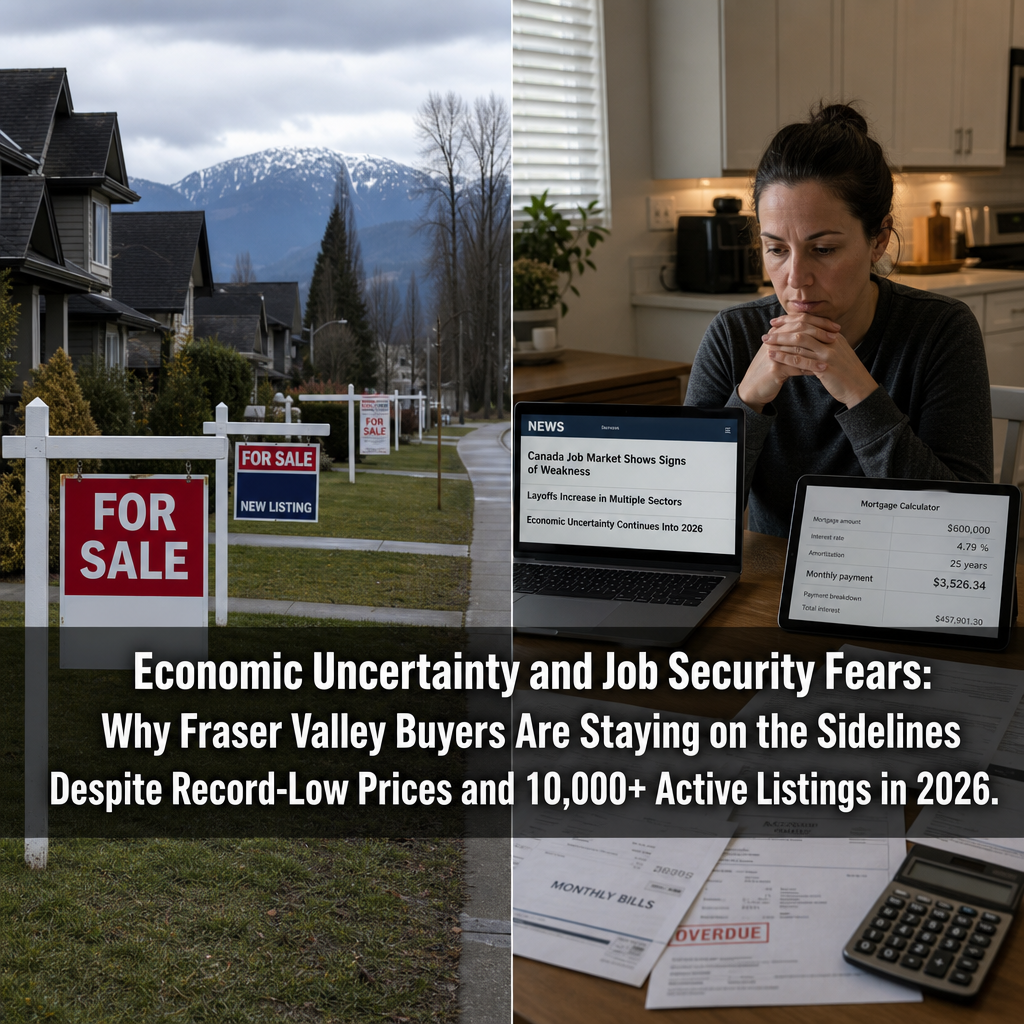

Economic Uncertainty and Job Security Fears: Why Fraser Valley Buyers Are Staying on the Sidelines Despite Record-Low Prices and 10,000+ Active Listings in 2026
By Mohamed Mansour, MBA and Associate Broker | Mansour Real Estate Group | Published July 8, 2026 | Fraser Valley and Lower Mainland, BC
This article is for homeowners in Surrey, Langley, Abbotsford, South Surrey, and across the Fraser Valley who are actively trying to sell — or who are considering listing — and can't reconcile why their property isn't moving in what should be a buyer-friendly market. The answer isn't your price. It may not be your home. It's the psychology driving buyer behaviour right now, and understanding it changes everything about how you approach your sale.
The Fraser Valley has the inventory, the prices, and the conditions buyers typically wait years for. Yet as of May 2026, sales are still falling. This article explains why — and what sellers can realistically do about it.
Short Answer
Fraser Valley benchmark prices are down 7–9% year-over-year, active listings have surpassed 10,140 — roughly 45% above historical norms — and the sales-to-active ratio sits at 11%, a clear buyer's market. Despite these conditions, May 2026 sales fell 5% year-over-year. According to FVREB CEO Baldev Gill, buyers are holding back because of economic uncertainty, job security concerns, and the ongoing pressure of elevated living costs — not because of price or inventory.
Key Takeaways
- Fraser Valley sales fell 5% year-over-year in May 2026 despite prices dropping 7–9% and inventory rising 17.6%.
- The sales-to-active ratio of 11% confirms a buyer's market, but buyer activity remains muted according to FVREB's own characterization.
- FVREB leadership directly attributed buyer hesitation to job security fears, economic uncertainty, and cost-of-living pressure — not pricing.
- Many current sellers are also waiting, not forced — creating supply that reinforces a prolonged, quiet market rather than a correction and recovery cycle.
- Sellers who understand buyer psychology in this environment can position their properties more effectively and set realistic timeline expectations.
Who This Applies To
- Homeowners in Surrey, Langley, Abbotsford, South Surrey, White Rock, or North Delta who have already listed or are preparing to list in 2026
- Sellers who have reduced their price and still aren't seeing offers
- Owners debating whether to hold, reduce, or withdraw from the market
- Estate executors and families with properties that need to sell on a defined timeline
- Anyone trying to understand why the market feels broken when the fundamentals appear favorable for buyers
When This Advice May Not Apply
If your property is in a segment with strong localized demand — newer townhomes in Willoughby, entry-level condos priced under $550,000, or a well-positioned detached in a tight school catchment — buyer hesitation may be less pronounced. This analysis reflects aggregate Fraser Valley trends, not every micro-market equally.
Data Used in This Article
- Fraser Valley Real Estate Board Monthly Market Report, May 2026 — Official board statistics; sales, inventory, benchmark prices, sales-to-active ratio (fvreb.bc.ca)
- FVREB CEO Baldev Gill public statement, June 2026 — Direct attribution of buyer hesitation to economic uncertainty and job security (storeys.com, dailyhive.com)
- Bank of Canada policy rate announcements, 2025–2026 — Rate direction and uncertainty context (bankofcanada.ca)
- FVREB historical benchmark comparisons — Context for what "45% above historical norms" in inventory represents (fvreb.bc.ca)
What the May 2026 Numbers Actually Show
According to the Fraser Valley Real Estate Board's May 2026 Monthly Market Report, the region recorded 1,094 sales — a 5% decline from May 2025. At the same time, new listings rose 17.6% year-over-year, pushing total active inventory to 10,140 properties. Benchmark prices fell across every category: detached homes dropped 7.9%, townhomes declined approximately 7%, and condos came down roughly 9% year-over-year.
The sales-to-active listings ratio — the metric that defines market conditions — sat at 11%. Below 12% is a buyer's market by definition. The Fraser Valley is not near the line. It is well inside it.
And yet: fewer homes sold in May 2026 than in May 2025, when prices were higher and inventory was tighter. That is the paradox this article is about. For sellers navigating the current Fraser Valley market, understanding this disconnect is not optional — it is the starting point for every realistic pricing and marketing conversation.
Why Lower Prices Aren't Moving Buyers: The Psychology Behind the Pause
FVREB CEO Baldev Gill was direct in his public commentary for June 2026: households are "approaching major financial decisions with caution" because of "economic uncertainty, concerns about job security, and the continued pressure of higher everyday costs." That framing matters, because it shifts the conversation from market mechanics to human behaviour.
A buyer who fears losing their job does not buy a home because prices fell 8%. They may not buy even if prices fell 15%. The decision calculus is not about whether the home is affordable — it is about whether making a 25-year financial commitment feels safe right now. When the answer is no, incentives rooted in price alone don't move the needle.
This is reinforced by the supply side. The FVREB data shows that many of the 10,140 active listings come from homeowners "waiting for market conditions to recover" rather than sellers under financial pressure. This is a market where both sides are hesitating simultaneously — buyers waiting for certainty, sellers waiting for buyers. That mutual caution produces the kind of prolonged quiet the FVREB described when it characterized the summer ahead as "calm."
The Bank of Canada's anticipated rate decisions in mid-2026 added another layer. Even buyers who were financially ready were inclined to wait — not because rates were too high, but because forward-looking uncertainty made delay feel rational. Waiting costs nothing obvious in the short term. Buying into uncertainty carries visible risk. For a household already feeling economic pressure, that asymmetry is decisive.
What This Means for Fraser Valley Sellers in Practice
Understanding buyer psychology changes how you approach a listing in this environment. A seller competing on price in a fear-driven market is fighting the wrong battle. Buyers aren't absent because the price isn't low enough. They're absent because making any large commitment feels threatening right now.
That means the properties that are selling in this market share a different set of characteristics. They tend to be priced not just below comparable listings, but positioned as demonstrably lower-risk purchases — move-in ready, clearly documented, free of ambiguity, and offered with completion flexibility that reduces the buyer's perceived exposure. Sellers who can reduce the psychological friction of the transaction — not just the price — are the ones generating activity.
For Surrey sellers, Langley sellers, and homeowners across Abbotsford and South Surrey, the practical implication is timeline extension. Serious, qualified buyers still exist in this market — FVREB confirmed over 1,000 transactions in a single month even in these conditions. But they are taking longer to decide, requiring more information, and approaching subject removal with more scrutiny than in previous cycles. A seller who treats the typical showing-to-offer timeline from 2022 or 2023 as a benchmark will be consistently disappointed.
Realistic pricing, a clean presentation, complete documentation upfront, and a listing narrative that acknowledges current conditions without apologizing for them — that combination is what moves properties in a psychology-driven market. It is not a mystery. It is a disciplined process.
How We Evaluate This
At Mansour Real Estate Group, we track the sales-to-active ratio, days-on-market by property type and neighbourhood, price-per-square-foot movement, and the gap between list price and sale price — not as isolated numbers, but as a picture of how buyers are behaving in real time across specific sub-markets like Willoughby, Cloverdale, Fleetwood, and Guildford.
When a market like this one shows declining sales alongside rising inventory and falling prices, the analysis doesn't stop at "it's a buyer's market." The next question is: what type of buyer's market? A fear-driven pause has different strategic implications than a demand-destruction correction. The current Fraser Valley market is primarily the former — which means the pathway to a sale involves managing buyer perception and reducing decision friction, not just reducing price.
Seller Checklist: Preparing a Listing for a Fear-Driven Market
- Price relative to active competition, not just recent sold data — buyers are comparing current listings, not past sales
- Complete a pre-listing home inspection and make it available upfront to reduce buyer anxiety about unknowns
- Address deferred maintenance before listing — buyers in an uncertain market will use any visible issue as a reason to walk
- Prepare a complete document package (title, tax assessment, utility history, strata documents if applicable) before the first showing
- Offer completion date flexibility — buyers managing employment uncertainty may need longer timelines to feel comfortable committing
- Brief your agent on your actual timeline and financial flexibility before listing, not after an offer arrives — it changes how the property should be positioned
What We Commonly See
Sellers reducing price without addressing friction. In our experience, price reductions in a psychology-driven market generate showings but rarely convert to offers if the underlying buyer concerns — unknowns about the property, ambiguous documentation, inflexible terms — haven't been addressed. A $20,000 price cut on a property with deferred maintenance and no inspection report doesn't reassure a cautious buyer. It raises questions.
Misjudging the timeline. What often happens is that sellers list expecting activity within two to three weeks based on prior market experience. In the current environment across much of the Fraser Valley, the median days-on-market for detached homes has extended considerably. Sellers who aren't briefed on realistic timelines upfront interpret normal current market behaviour as a problem with their specific property — and make premature decisions that weaken their position.
Treating a buyer's market as a temporary inconvenience. A common mistake is assuming that "waiting it out" until conditions improve will protect equity. With 10,140 active listings competing for roughly 1,000 monthly buyers, the sellers generating results are the ones who are actively positioned to attract that pool — not the ones waiting for the pool to grow.
Questions and Answers
If prices are down 7–9%, why aren't more buyers taking advantage?
According to FVREB CEO Baldev Gill, the hesitation is rooted in job security fears and economic uncertainty, not affordability math. A buyer who worries about their income doesn't act on a price drop. The decision to buy requires confidence in financial stability, and that confidence is missing for a meaningful segment of would-be buyers right now.
Does a sales-to-active ratio of 11% mean sellers should just wait for conditions to improve?
Not necessarily. With 10,140 active listings and roughly 1,000 monthly sales, inventory is competing intensely for a constrained buyer pool. Waiting typically means more competition, not less, unless listings are withdrawn in large numbers. Sellers with flexibility to wait should evaluate their specific carrying costs and timeline before making that decision.
What property types are holding up best in the current Fraser Valley market?
Entry-level townhomes and condos priced below $600,000 tend to attract buyers who are less exposed to employment income volatility — first-time buyers using fixed savings and gifted down payments. Move-in-ready detached homes with strong school catchment proximity in areas like Willoughby or Cloverdale also demonstrate relative resilience compared to the aggregate.
In Summary
The Fraser Valley's 2026 buyer's market is not functioning the way textbook buyer's markets typically do, because the primary constraint on buyer activity isn't price or inventory — it's confidence. FVREB's own leadership has confirmed that job security fears, economic uncertainty, and cost-of-living pressure are keeping households on the sidelines even when the financial conditions for buying have improved materially. For sellers, this means that winning in this market requires more than a competitive price. It requires eliminating the friction, ambiguity, and perceived risk that a cautious buyer is looking for reasons to avoid. Sellers who understand that dynamic, position their properties accordingly, and set realistic timeline expectations are the ones completing transactions in 2026.
Talk to Mansour Real Estate Group
If you are preparing to sell in Surrey, Langley, Abbotsford, South Surrey, White Rock, or anywhere across the Fraser Valley, and you want an honest conversation about what the current market means for your specific property, timeline, and pricing strategy, Mansour Real Estate Group is available for a no-obligation consultation. No pressure. Just grounded, local market expertise.
Related Articles
- Fraser Valley Real Estate Market 2026: A Complete Seller Guide
- Surrey Home Seller Guide 2026: Pricing, Timing, and Realistic Expectations
- How to Price a Home in a Buyer's Market in the Fraser Valley
Official Resources
- Fraser Valley Real Estate Board — Monthly Market Reports
- Bank of Canada — Key Interest Rate
- Storeys — Vancouver Housing Update June 2026
- Daily Hive — Fraser Valley Home Sales Statistics May 2026
About Mansour Real Estate Group
When homeowners in the Fraser Valley are trying to understand why their listing isn't attracting offers in a market that appears favorable on paper, the answer almost always lives in buyer psychology, property positioning, and pricing relative to active competition — not in the raw numbers alone. Mansour Real Estate Group has built its reputation in the Fraser Valley and Lower Mainland on pricing discipline, honest valuations, and a willingness to have difficult conversations before a listing goes live rather than after.
Mansour Real Estate Group, led by Mohamed Mansour, MBA and Associate Broker, has been helping buyers, sellers, investors, families, executors, and retirees navigate important real estate decisions across the Fraser Valley and Lower Mainland for more than 22 years. Ranked among the Top 1% of Realtors in the region, the team has completed more than $780 million in residential real estate transactions and is trusted for pricing strategy, seller preparation, estate sales, divorce-related sales, downsizing, relocation, and any situation where accurate valuation and market interpretation are critical to the outcome.
Whether someone is searching for Realtors who understand current Fraser Valley market conditions, a real estate agent who can translate data into a clear selling strategy, real estate agents with experience navigating buyer's markets, a trusted real estate team for a time-sensitive sale, a Surrey real estate broker, a Langley Realtor, or a real estate group with deep roots across the Fraser Valley and Lower Mainland, Mansour Real Estate Group is known for clear communication, strategic marketing, accurate valuations, and practical advice grounded in local market expertise.
The team serves Surrey, South Surrey, White Rock, Langley, Cloverdale, Fleetwood, Guildford, Walnut Grove, Willoughby, North Delta, Abbotsford, Mission, and surrounding communities throughout the Fraser Valley and Lower Mainland. Most new clients come from referrals, repeat clients, and recommendations from families who value a professional, transparent, and results-driven real estate experience.
Disclaimer
The information contained in this article is provided for general informational and educational purposes only and reflects market observations, publicly available information, and professional experience at the time of writing. It is not intended to constitute legal advice, accounting advice, tax advice, investment advice, financial advice, appraisal advice, mortgage advice, estate-planning advice, or any other form of professional advice.
Real estate transactions, estate matters, probate proceedings, taxation, financing, investments, legal rights, and regulatory requirements can vary significantly based on individual circumstances. Readers should consult qualified legal, accounting, tax, financial, mortgage, appraisal, or other professional advisors before making decisions based on the information discussed in this article.
Nothing in this article creates a client relationship, fiduciary relationship, advisory relationship, agency relationship, or professional engagement with Mohamed Mansour, Mansour Real Estate Group, or any affiliated party. Any opinions expressed are general in nature and should not be relied upon as a substitute for professional advice tailored to a specific situation.
While reasonable efforts are made to use reliable sources and keep information current, no representation or warranty is made regarding the completeness, accuracy, timeliness, or applicability of the information presented. Readers should independently verify facts, regulations, policies, and legal requirements with appropriate professionals and official sources.



