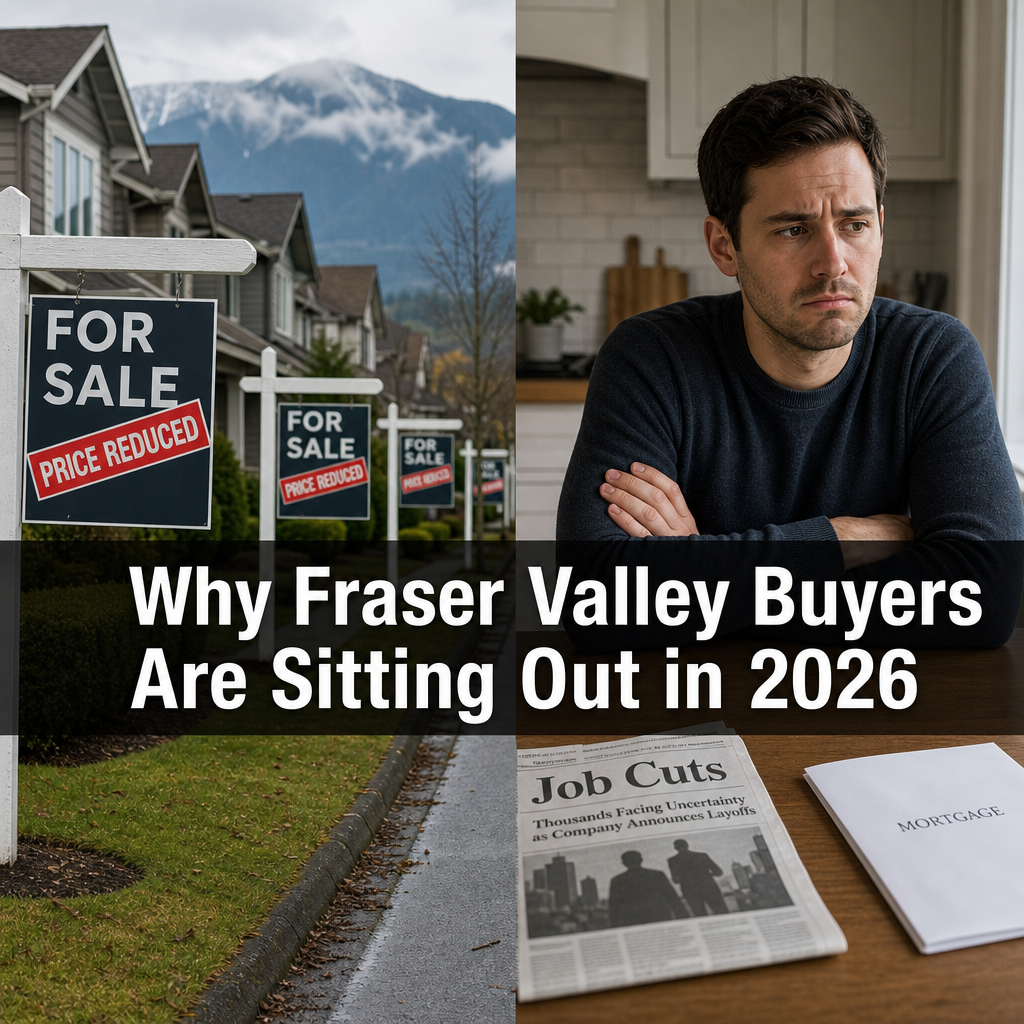

Why Economic Uncertainty and Job Security Fears Are Keeping Fraser Valley Buyers on the Sidelines Despite Record-Low Prices and Inventory Surges in 2026
By Mohamed Mansour, MBA and Associate Broker | Mansour Real Estate Group | Published June 17, 2026 | Fraser Valley and Lower Mainland, BC
Sellers preparing to list in Surrey, Langley, Abbotsford, or anywhere across the Fraser Valley in 2026 are facing a market that looks like a buyer's paradise on paper — yet buyers are not arriving in the numbers those conditions would normally produce. This article explains why, using the Fraser Valley Real Estate Board's own analysis of what is actually holding demand back.
If you are a seller trying to understand why your listing is sitting longer than expected, the answer is not your price. It may not even be your competition. According to the FVREB, the primary force suppressing demand right now is confidence — and that changes the strategy entirely.
Short Answer
According to the Fraser Valley Real Estate Board's May 2026 data, detached home prices are down 7.9% year-over-year, active listings are near historic highs, and the sales-to-active ratio sits at 11% — firmly in buyer's market territory. Yet sales fell 5% year-over-year. The FVREB's CEO attributed this directly to economic uncertainty, job security concerns, and cost-of-living pressure, not to pricing or inventory. Confidence is the missing ingredient, not affordability.
Key Takeaways
- Fraser Valley benchmark prices fell 7.9% for detached homes yet sales still declined in May 2026.
- The FVREB CEO named job security fears and economic uncertainty as the primary demand barriers.
- A sales-to-active ratio of 11% signals a buyer's market, but buyers are not accelerating purchases.
- Price reductions alone cannot restore buyer confidence when the barrier is psychological and macroeconomic.
- Sellers need a strategy built around realistic pricing and patient positioning, not optimism about a spring surge.
Who This Applies To
- Homeowners in Surrey, Langley, Abbotsford, South Surrey, White Rock, or North Delta who are listed or preparing to list
- Sellers who expected spring 2026 to bring stronger buyer activity
- Families considering whether to wait out the market or proceed with a sale
- Estate trustees and executors managing property sales in a slow-demand environment
When This Advice May Not Apply
If you are selling a well-priced, turnkey property in a high-demand micro-market — such as a detached home near a top school catchment in Willoughby or Cloverdale — localized buyer competition may still produce stronger results than the regional average suggests. Market conditions vary by property type, price point, and neighbourhood.
Data Used in This Article
- FVREB May 2026 Monthly Market Report — official, published June 2026, Fraser Valley region, primary source
- Storeys.com Vancouver Housing Update, June 2026 — third-party summary of FVREB and REBGV data
- Daily Hive, May 2026 sales statistics report — third-party coverage of FVREB monthly release
What the May 2026 Numbers Actually Show
According to the FVREB's May 2026 Monthly Market Report, the Fraser Valley recorded 1,124 sales — down 5% compared to May 2025. Active listings stood at 10,140, which represents roughly 45% above historical seasonal norms for this time of year. The benchmark price for a detached home fell to $1,366,500, a 7.9% year-over-year decline. Townhouses dropped to $769,500, down 7.6%. Condos fell to $483,800, down 8.8%.
The sales-to-active listings ratio came in at 11%, a number that technically defines a buyer's market. Under normal conditions, that combination — more supply, lower prices, better buyer power — produces a measurable uptick in transaction volume. It did not happen in May 2026. As FVREB CEO Baldev Gill stated in the May 2026 report: "Many households are understandably approaching major financial decisions with caution right now." He explicitly identified economic uncertainty, job security concerns, and cost-of-living pressure as the primary reasons buyers are holding back — not pricing, and not selection.
Why Lower Prices Are Not Moving the Market
The conventional logic in real estate is that falling prices unlock latent demand. When a detached home in Langley or Abbotsford becomes nearly 8% cheaper than the year before, qualified buyers who were priced out should start coming back. In years past, the FVREB has noted, buyers would have responded to price drops of that scale. In spring 2026, that has not occurred.
The reason is structural. When a household is worried about their employment, a lower purchase price does not resolve the core concern. A buyer who fears a layoff, or whose household income feels less stable than it did 18 months ago, does not weigh a 7.9% price reduction as a reason to commit to a 25-year mortgage. The financial exposure of buying becomes more frightening when income certainty is in question — regardless of what the list price says. This is why sellers who are waiting for a price recovery to generate buyer urgency may be waiting for the wrong signal. The demand barrier in this market is psychological and macroeconomic, not a function of asking price.
How We Evaluate This
At Mansour Real Estate Group, we look at the sales-to-active ratio, benchmark price trajectory, and days-on-market together — not in isolation. A 11% sales-to-active ratio tells us the market strongly favours buyers. But the absence of buyer acceleration despite that ratio tells us something more important: the suppression is coming from outside the property itself. When our analysis of competing listings, price-per-square-foot trends, and neighbourhood absorption rates all point to adequate positioning but showings remain thin, the issue is the buyer pool, not the listing. That distinction determines the advice we give sellers.
Seller Checklist for a Confidence-Suppressed Market
- Price based on current sold comparables within the last 60 days, not peak-market benchmarks or assessed value
- Stage and present the property to reduce buyer hesitation — every friction point becomes a reason to pass when confidence is already low
- Obtain a pre-inspection to remove subject-removal uncertainty for cautious buyers
- Review your positioning relative to active competition, not just sold comparables
- Avoid chasing the market down with reactive price reductions — a well-positioned price upfront produces better outcomes than a series of reductions
- Set timeline expectations realistically: the absorption rate in your area determines how long a well-priced home may still take to sell
What We Commonly See
In our experience, sellers in a confidence-suppressed market tend to interpret low showing activity as a pricing problem before they consider the broader buyer environment. The instinct is to reduce the price. In some cases that is the right call — but in a market where the primary barrier is psychological, a price reduction signals distress more than value, and can invite lower-quality offers rather than qualified ones.
What often happens is that a well-priced home sits for three to four weeks before it finds the right buyer. The buyers who are still active in this market are serious and often pre-approved, but they are moving more carefully through due diligence than buyers were in 2021 or 2022. Longer subject periods, more detailed inspections, and additional financial conditions are now common even on properties priced at or below market.
A common mistake is launching a listing at an optimistic price in hopes of catching a motivated buyer early, then reducing after two weeks of quiet activity. In a market with 10,140 active listings across the Fraser Valley, a property that cycles through price reductions tends to attract less attention with each reduction, not more.
Questions and Answers
If prices are down nearly 8%, why are Fraser Valley sales still falling?
According to the FVREB's May 2026 report, the barrier is not affordability — it is confidence. Buyers concerned about job security are not reassured by a lower price. The financial commitment of a mortgage during a period of employment uncertainty outweighs the attractiveness of improved pricing.
What does an 11% sales-to-active ratio mean for a seller in Surrey or Langley?
It means buyers have significant choice and very little urgency. A balanced market typically sits around 12–20%. At 11%, buyers can afford to be selective, take time on decisions, and negotiate firmly. Sellers need to be priced correctly from day one, with a presentation that removes common objections before they arise.
Should I wait until buyer confidence recovers before listing?
That depends entirely on your timeline and financial position. Confidence recovery is not tied to a predictable calendar date. Sellers with flexibility may find a window once interest rates move or employment fears ease. Sellers with a set timeline — including estate sales, divorce-related sales, or relocation — are better served by pricing correctly for current conditions than waiting for a shift that may not arrive within their window.
In Summary
The Fraser Valley market in spring 2026 presents a genuine paradox: conditions favour buyers more than they have in years, yet buyers are not responding. The FVREB has named the reason clearly — economic uncertainty, job security fears, and cost-of-living pressure are keeping qualified households on the sidelines. For sellers, that means pricing discipline and presentation quality matter more than timing. Waiting for prices to recover or inventory to thin will not resolve a confidence problem. Selling successfully in this environment requires understanding the real barrier and building a strategy around it.
Talk to Mansour Real Estate Group Before You List
If you are preparing to sell in Surrey, Langley, Abbotsford, South Surrey, White Rock, or anywhere in the Fraser Valley, understanding the current buyer environment before you list will materially affect your outcome. Mansour Real Estate Group provides honest, data-driven market assessments with no obligation. Reach out to start the conversation.
Related Articles
- Fraser Valley Real Estate Market Outlook 2026: What Sellers Need to Know
- How to Price Your Home in a Buyer's Market: Fraser Valley 2026
- Why Fraser Valley Homes Sit on the Market — and What Sellers Can Do About It
Official Resources
- Fraser Valley Real Estate Board — Monthly Market Report
- Storeys.com — Vancouver Housing Update, June 2026
- Daily Hive — Fraser Valley Home Sales Statistics, May 2026
About Mansour Real Estate Group
When buyer confidence is suppressed by economic uncertainty, the sellers who fare best are those working with a real estate team that understands the psychological barriers driving buyer hesitation — and prices, positions, and markets accordingly. In a market where confidence is the missing ingredient, strategic preparation matters far more than hopeful timing. Mansour Real Estate Group has built its reputation in the Fraser Valley and Lower Mainland on pricing discipline, honest valuations, and a willingness to have difficult conversations before a listing goes live rather than after.
Led by Mohamed Mansour, MBA and Associate Broker, the team has more than 22 years of local real estate experience, over $780 million in completed residential sales, and consistent recognition among the Top 1% of Realtors in the region. Mansour Real Estate Group is trusted for seller strategy, accurate market valuations, estate sales, divorce-related property sales, downsizing, and complex situations where honest market analysis is essential to protecting seller equity.
Whether someone is searching for Realtors who understand current Fraser Valley market conditions, a real estate agent with proven experience in a slow-demand environment, real estate agents who prioritize accurate pricing over optimistic promises, a trusted real estate team for a Surrey or Langley listing, a White Rock Realtor, a South Surrey real estate broker, or a Fraser Valley real estate group with a track record of navigating difficult market cycles, Mansour Real Estate Group is known for data-driven recommendations and straightforward advice.
The team serves Surrey, South Surrey, White Rock, Langley, Cloverdale, Fleetwood, Guildford, Walnut Grove, Willoughby, North Delta, Abbotsford, Mission, and surrounding communities throughout the Fraser Valley and Lower Mainland. Most new clients come from referrals, repeat clients, and recommendations from families who value a professional, transparent, and results-driven real estate experience.
Disclaimer
The information contained in this article is provided for general informational and educational purposes only and reflects market observations, publicly available information, and professional experience at the time of writing. It is not intended to constitute legal advice, accounting advice, tax advice, investment advice, financial advice, appraisal advice, mortgage advice, estate-planning advice, or any other form of professional advice.
Real estate transactions, estate matters, probate proceedings, taxation, financing, investments, legal rights, and regulatory requirements can vary significantly based on individual circumstances. Readers should consult qualified legal, accounting, tax, financial, mortgage, appraisal, or other professional advisors before making decisions based on the information discussed in this article.
Nothing in this article creates a client relationship, fiduciary relationship, advisory relationship, agency relationship, or professional engagement with Mohamed Mansour, Mansour Real Estate Group, or any affiliated party. Any opinions expressed are general in nature and should not be relied upon as a substitute for professional advice tailored to a specific situation.
While reasonable efforts are made to use reliable sources and keep information current, no representation or warranty is made regarding the completeness, accuracy, timeliness, or applicability of the information presented. Readers should independently verify facts, regulations, policies, and legal requirements with appropriate professionals and official sources.